
In this answer
Short answer
No. A generator must never be plugged into a normal household wall socket to feed power back into the wiring of a home. The rule is stated in the same terms by equipment makers and by the standards that govern UK plugs: do not connect a generator or power station to a normal wall socket to feed power back into household wiring1, and never attempt to feed a home's electrical system by plugging a generator into a normal household socket2.
The reason is not a matter of preference. BS 1363, the standard for the familiar three-pin plug, does not permit plugs and sockets to be used to connect electricity-generating equipment3. The Plugs and Sockets etc. (Safety) Regulations 1994 carry the same constraint: BS 1363 prohibits the use of plugs for connecting electricity-generating devices to socket-outlets4. A plug of that type therefore does not conform to BS 1363, because the standard contains a provision that prohibits or restricts its use for connecting a generating device to a socket-outlet5.
What follows is that the socket is the wrong interface entirely. Power from a generator has to reach the circuits through a fixed, electrician-installed connection that breaks the link to the network before the generator is energised. Everything below sets out why the socket route fails, what a safe connection involves, and how a household can stay powered during an outage without it.
Why back-feeding household wiring is dangerous
Back-feeding means energising the fixed wiring of a home from a socket, so current runs backwards through circuits that were designed to carry it one way. The consequences fall into three groups: shock risk inside the home, shock risk to people working on the network, and mechanical risk to the installation itself.
Inside the home, the Institute of Engineering and Technology has warned that some older homes may have wiring or protection devices not designed for electricity flowing back into a circuit, and that older consumer units may contain residual current devices that may not trip properly, meaning they do not offer shock protection when a fault occurs9. A circuit that is live at the socket but not protected at the board is a shock hazard for anyone who touches it.
On the network side, the danger is that the installation stays live while staff believe it is dead. Network operators restore supplies partly by using their own generators for temporarily restoring customers whilst permanent repairs are completed10, and a back-feed on a shared low voltage network puts those staff and neighbours at risk. The legal framework reflects how seriously continuity of the neutral and earthing conductors is treated: a generator or distributor shall not introduce or retain any protective device in any supply neutral conductor or any earthing connection of a low voltage network which they own or operate11.
There is also a straightforward loading problem. Guidance on socket use is to not overload plug sockets as this can lead to overheating12, and a socket circuit pressed into service as a generator inlet is being asked to carry current in a direction and at a level it was never specified for. Where a fault develops, the results are the familiar ones: a recalled ground source heat pump was found to pose a risk of fire and electric shock because two cables are electrically overloaded and because of badly connected wires13.
"BS 1363 does not permit plugs and sockets to be used to connect electricity-generating equipment"
The safe alternatives: transfer switches and changeover panels
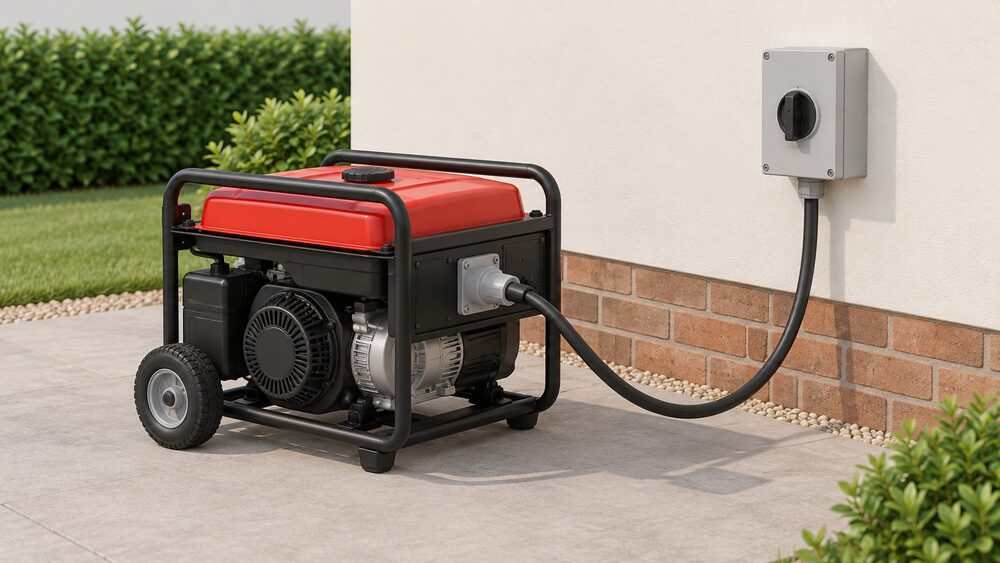
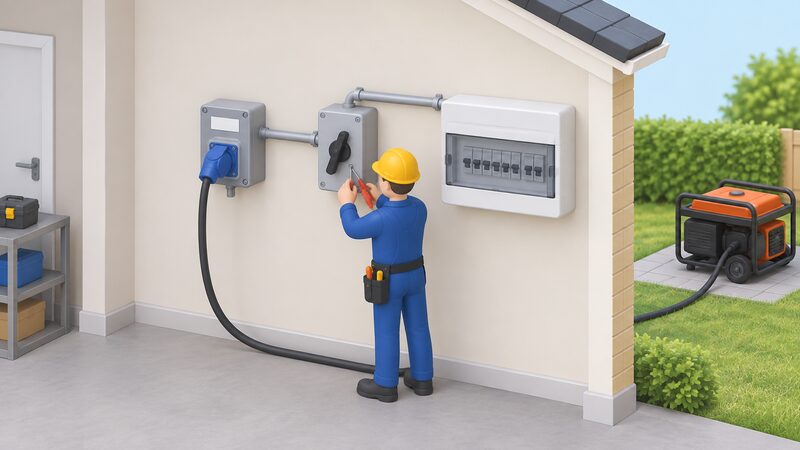
The safe route is a fixed connection with a changeover device. If a generator is to supply selected household circuits, a properly installed transfer or changeover arrangement can provide a safer and more convenient solution2. The device sits between the generator inlet and the circuits it will serve, and its job is to make it impossible for the generator and the network to be connected at the same time.
The principle is the same one that applies to any generating equipment connected to a home. Solar installations include a converter to convert the direct current electricity from the panel to alternating current so it can be connected to the building's main electricity distribution board14, and domestic distributed generation uses a device called an inverter to connect solar panels or wind turbines to the main wiring in the house15. In each case the connection is made at the distribution board, not at a socket, and it is made once, by an electrician.
For a generator, the changeover arrangement is what allows selected circuits to run while the rest of the installation stays isolated. The choice between a manual changeover switch and an automatic transfer switch turns on how the household wants to operate it: without an automatic transfer switch, a generator must be started manually when a power cut occurs16. A manual switch is operated by hand at the point of use; an automatic one senses the loss of supply and transfers the load itself.
Two conditions matter for any such installation. First, the generator must be sited outdoors, because a fuel generator must never be operated indoors, in a garage, shed or other enclosed area connected to the home1. Second, the connection itself is not a householder task: it is absolutely not a DIY job17.
What a qualified electrician does and what it costs
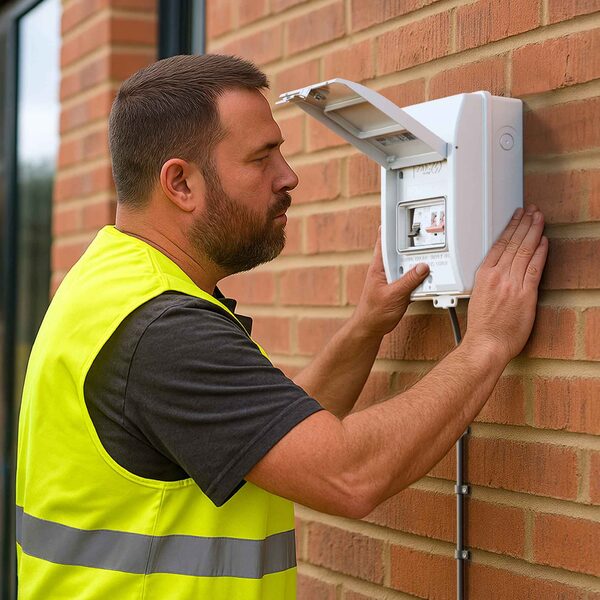
The work is electrical installation work on the fixed wiring of a home, and it is treated as such by the bodies that regulate and register it. If electrical work is being done, a properly qualified or registered electrician should be used18. For electrical installation work in homes and gardens, it is recommended to hire an installer who is registered with a competent person scheme, a registered competent person, who can self-certify that the work meets the required standards19.
Self-certification is the practical benefit of using a registered installer. Electricians registered on a competent person scheme such as NICEIC's are deemed competent to self-certify their own work, saving householders time and money20. That removes the need for a separate building control notification for the notifiable parts of the work.
There is a boundary to what an electrician can do. Moving the electricity cable coming in from the road has to be done by the network operator's qualified engineers, because electricians are not trained to work on the electricity supply or the electricity meter21. A generator connection stops at the consumer unit and does not touch the supply cable or the meter.
On cost, no published figure applies. Transfer switch and changeover installations are quoted by the installer after seeing the property, the circuits to be backed up and the route for the generator inlet, so prices are installer-quoted. The same pattern holds across domestic electrical work: a dry underfloor heating system is an option for a skilled DIY-er, which would help keep costs down, but a qualified electrician would need to connect it to the mains electricity22. The connection to the fixed wiring is the part that carries the labour.
Power stations and portable generators: the same rule applies
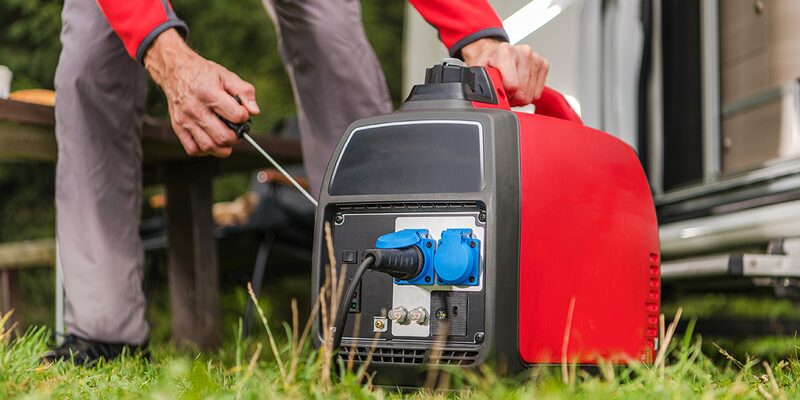
The prohibition is written around generating equipment, not around fuel. Battery power stations are covered by the same instruction as petrol generators: do not connect a generator or power station to a normal wall socket to feed power back into household wiring1. The plug standard makes no distinction either, since it restricts the use of the plug for connection of an electricity-generating device to a socket-outlet5.
Where battery units differ is in the risks they do not carry. Battery power stations avoid the carbon monoxide risk of combustion generators, and petrol, diesel and LPG generators must stay outdoors and never be run in a garage or shed1. That makes a battery unit suitable for use inside a home in a way a fuel generator is not, but it does not change how it may be connected to the fixed wiring.
Whole-home battery storage follows the fixed-wiring route. Battery storage systems must be hard-wired into the home's circuit by a qualified electrician8. A standalone battery without solar can charge from a normal 230V socket, with no rewiring or electrician needed unless it is wired into the consumer unit for whole-home cover23. The distinction is between charging the unit from a socket, which is what the socket is for, and discharging it back through one, which is not.
The same logic applies to plug-in solar, the one product category where a socket connection has been contemplated. Even there, the interim product specification restricts the connection: a plug-in solar device shall only be connected to socket circuits and not to circuits supplying lighting or other fixed equipment24, and safety guidance is to always connect the system directly to a suitable outdoor wall socket, never into an extension lead25. A socket connection for a small generating device is a narrow, specified exception under active regulatory work, not a general permission.
| Equipment | Socket connection permitted? | Connection route |
|---|---|---|
| Petrol or diesel generator | No1 | Fixed connection via transfer or changeover arrangement2 |
| Battery power station | No1 | Appliance use only, or hard-wired for whole-home cover8 |
| Standalone home battery | Charging only23 | Hard-wired into the consumer unit for whole-home backup8 |
| Plug-in solar device | Socket circuits only, under interim specification24 | Direct to a suitable outdoor wall socket, never an extension lead25 |
Staying powered during outages without back-feeding
A household can keep selected appliances running through a cut without touching the fixed wiring at all. The simplest route is to run appliances directly from the generator or power station by lead, keeping the installation isolated from both the generator and the network. Extension leads are a normal part of that, with limits: an extension lead is not recommended as an alternative to properly wiring a shed17, and Electrical Safety First urges households to plug their tumble dryers directly into a wall socket rather than an extension lead, which can be overloaded and overheat26.
For a battery unit, the changeover can be automatic. A home battery backup unit takes over in about 20 milliseconds when the grid drops out23, which is fast enough that most equipment does not notice the interruption. That speed is a property of a hard-wired installation, not of a lead run from a socket.
It is worth knowing what the network itself does during a long outage. Generators will sometimes be used for temporarily restoring customers whilst permanent repairs are completed10, and if a supply has been restored through generators, the customer remains on that arrangement until the repair is complete, with a short outage possible while the network connects them back10. A household running its own generator on a changeover switch is unaffected by that sequence, because its installation is isolated from the network throughout.
The wider point for energy independence is that a generator or battery gives a household control over its own supply during a cut, but only through a connection that keeps it separate from the grid. Independence here is not a matter of how much power the equipment can make; it is a matter of whether the installation can be disconnected from the network cleanly. A socket back-feed does the opposite, tying the household's supply to the network at the one moment when the network most needs to be isolated.
Sources26 cited
- Best generator for home backup power UK, BLUETTI, 2026-08-31
- Home backup guide, Champion Power Equipment, 2026-09-20
- Plug-in solar consultation document, UK Government, 2026-06-16
- Plug-in solar consultation, UK Government, 2026-06-16
- The Plug-in Microgeneration etc. (Amendment) Regulations 2026, regulation 2, legislation.gov.uk, 2026
- Emergency power cuts, Electricity North West, 2026-09-19
- Planned work, NIE Networks, 2026-09-19
- Plug-in solar advice, Centre for Sustainable Energy, 2026-09
- Plug-in solar panels vs rooftop systems, Which?, 2026-04-27
- Restoration following a power cut, Electricity North West, 2026-09-19
- Looped services, NIE Networks, 2026-09-19
- Demand flexibility: running appliances at cheaper times, Electrical Safety First, 2026-09-19
- Product recall: ground source heat pump, Electrical Safety First, 2026-09-17
- Generating your own energy: solar electricity, Welsh Government, 2026-09-17
- What is domestic distributed generation, UK Power Networks, 2026-09-17
- Powerwall 3 or generator, Tesla, 2026-09-17
- Wiring a shed: a guide for homeowners, NICEIC, 2026-09-17
- Before you get building work done, Citizens Advice, 2026-09-20
- Do I need building regulations approval for electrical work?, Planning Portal, 2026
- Electric vehicle charger installation and maintenance, NICEIC, 2025-08
- Moving your electricity supply: cost and time, UK Power Networks, 2026-09-17
- Underfloor heating, Centre for Sustainable Energy, 2025-11
- Home battery storage UK without solar, BLUETTI, 2026-08-03
- Plug-in solar interim product specification (withdrawn), UK Government, 2026-06
- Plug-in solar panels: five top tips to save money and stay safe, REA, 2026-08-04
- Dire dryers: easy cleaning hack that could avoid a deadly fire, Electrical Safety First, 2026-09-19
 Generator Transfer SwitchesA generator can only be wired into your home's circuits through a proper changeover switch, never by plugging it into a socket.
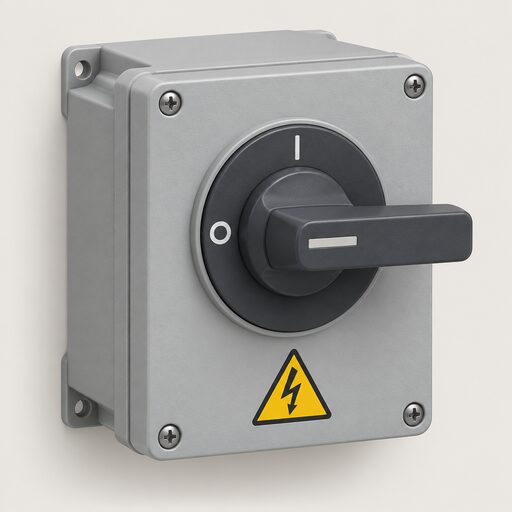 Backup Power Safety RulesWho signs off a battery or backup circuit, and can you legally plug in a power station or a plug-in solar panel in the UK?
 Plug-In Battery StoragePlug-in batteries are not legal in a grid-connected British home, even though plug-in solar panels are.
 Plug-In Solar KitsCan you really plug solar panels into a normal wall socket in the UK, and is it legal now?
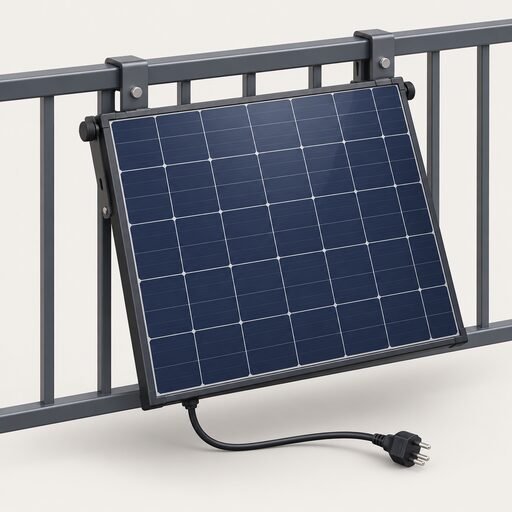 Balcony Solar SystemsCan you really plug solar panels into a normal socket, and what will it save you?
 Generator SafetyCovers the main hazards of running a generator at a home: exhaust fumes and carbon monoxide, hot surfaces and refuelling fires, electric shock and earthing.