
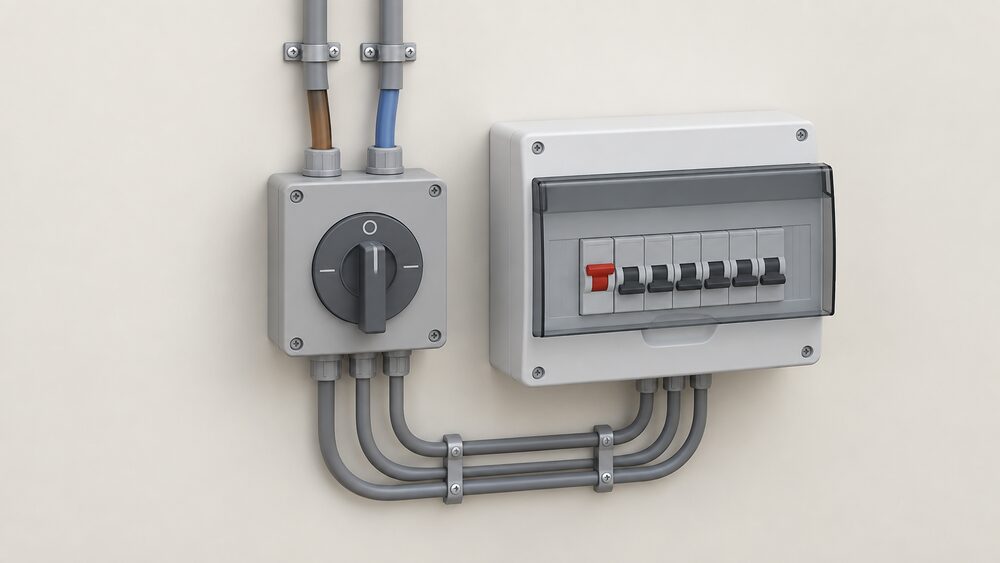
In this comparison
A transfer switch is the device that decides where a home's electricity comes from when the mains fails. A manual changeover switch requires someone to be present to move the supply from the home circuit to the generator, so it does not provide uninterrupted power1. An automatic transfer switch detects a power outage and transfers power from the generator to the home electrical circuit without manual intervention1. That single difference in operation drives everything else: the speed of switchover, the cost, the wiring, and how much of the household's independence depends on a person being in the right place at the right time.
The choice matters because a home backup supply is only as good as the point at which it joins the house wiring. Both types sit between the incoming supply and the circuits they serve, and both exist to stop the two supplies meeting. What separates them is who throws the switch, and how quickly.
Neither device generates anything. A transfer switch is a routing component: the generator, battery or inverter behind it does the work. So the decision is not about how much power a household gets, but about how reliably and how automatically that power reaches the circuits when the grid goes down.
Manual changeover switch vs automatic transfer switch: the core difference
The core difference is presence. A manual transfer switch requires the user to manually switch the power source from the home circuit to the generator, so someone must be present and it does not provide uninterrupted power1. An automatic transfer switch detects a power outage and transfers power from the generator to the home electrical circuit without manual intervention1. Everything downstream of that distinction, from the wiring to the price, follows from it.
It helps to separate the transfer switch from the other switches in a home. The main switch on a consumer unit allows you to turn off the electricity supply to your home4, and the consumer unit's main switch is the master control for all electricity entering the unit, allowing the electrical system to be safely isolated during emergencies or maintenance work2. A transfer switch is a different component with a different job: it selects between two sources rather than simply isolating one.
The two types are not variants of one product. A manual changeover switch is a mechanical device operated by hand. An automatic transfer switch contains sensing and control circuitry that watches the incoming supply and acts on what it finds. That is why the automatic version can start a standby generator and move the load while the household is asleep, and why the manual version cannot.
There is a third behaviour worth knowing, because it is often confused with transfer switching. A grid-tied generation inverter, such as a solar inverter, is connected to the house's main wiring, and to protect itself it switches itself off until after the mains supply has been restored3. That is anti-islanding protection, not a transfer function. It keeps the inverter safe and keeps the network safe; it does not route power to the house during an outage.
How a manual changeover switch works in a home backup setup
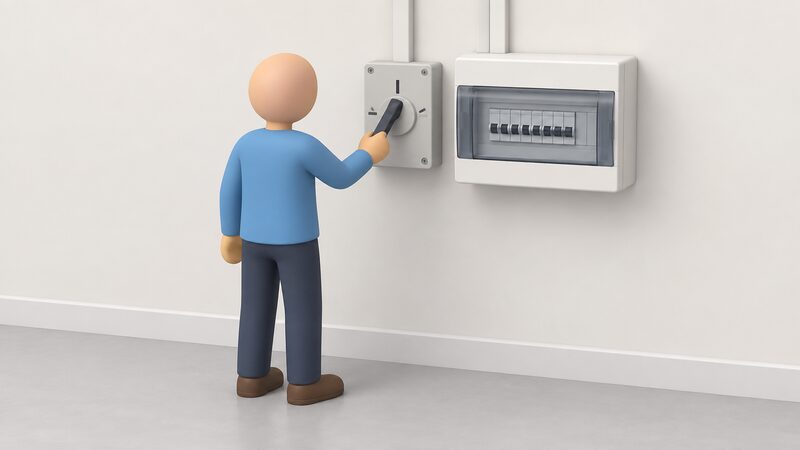
A manual changeover switch is operated by hand at the point of changeover. The householder, or whoever is present, moves the switch from the mains position to the generator position, then starts the generator. The sequence is deliberate: the switch isolates one source before it connects the other, so the two can never be live together.
The practical consequence is that the household must be there. A manual transfer switch does not provide uninterrupted access to power1, which means anything running at the moment of the outage stops, and stays stopped until someone acts. For a freezer, a broadband router or a heating pump, that gap is usually tolerable. For medical equipment or a home office mid-transaction, it is not.
Manual changeover devices are made for domestic and light commercial use. A panel-mounted AC changeover switch, for example, is a two position on with centre-off 2-pole unit5. That is a changeover contact for a circuit rather than a whole-house generator switch, but it shows the shape of the category: a compact, rated device that moves a circuit between two states. The manual version of the same idea requires the user to switch the power source from the home circuit to the generator, so someone must be present and it does not provide uninterrupted power6.
The rating is the constraint that matters most. A changeover contact rated for a small circuit suits that circuit alone. A whole-house arrangement needs a device rated for the full supply, and the choice of rating is set by the backed-up load and the supply fuse, not by the size of the building. No single figure for a typical UK dwelling is published, so the rating is a matter for the electrician designing the installation. What the device must do is prevent the inverter from back-feeding the grid, which is both dangerous for DNO engineers and illegal under UK G98/G99 regulations7.
How an automatic transfer switch detects loss of mains and switches over
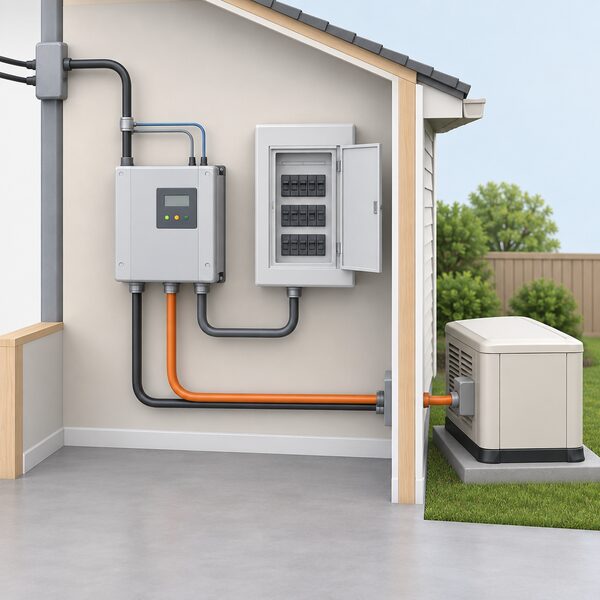
An automatic transfer switch watches the incoming supply and acts when it disappears. It detects a power outage and transfers power from the generator to the home electrical circuit without manual intervention1. In a standby generator installation, the same signal that confirms the outage typically starts the generator, and the switch moves the load once the generator is producing usable power.
The sensing is the whole point. Because the switch is monitoring continuously, it does not depend on anyone noticing that the lights have gone out. That makes it the natural partner for a permanently installed standby generator, and for battery systems that can supply a backup circuit without a fuel engine.
It also changes what the household has to think about. With an automatic switch, the sequence of outage, start and transfer happens as one event. With a manual switch, it is three separate actions, and the middle one requires a person. The automatic version therefore removes the human step entirely, at the cost of a more complex device and a more involved installation.
There is a limit worth stating plainly. An automatic transfer switch routes power; it does not create it. If the standby source is a generator, the generator must start and run reliably. If it is a battery inverter, the battery must hold enough charge. The switch is the most reliable part of the chain precisely because it has no fuel and no state of charge.
Speed of switchover: what each type delivers
Speed is where the two types diverge most sharply, and it is measured in different units for each. A manual changeover switch delivers power when someone operates it. An automatic transfer switch delivers power when its sensing circuit confirms the outage and the standby source is ready.
The manual case has no fixed figure, because it depends on who is home. The automatic case has no published figure in the material here either, but its defining property is that it does not wait for a person. That is the difference between a supply that returns in seconds and one that returns when the household gets to it.
For context on how long switching can take in a comparable domestic process, the timescales quoted elsewhere in the energy sector are measured in days and weeks rather than seconds. A supplier switch usually takes place within five working days8, and the switch process typically takes anywhere between four and six weeks6. Those figures describe changing energy supplier, not changing over to a backup supply, and the contrast is the point: a transfer switch operates on a completely different timescale from anything involving a supplier.
Cost, installation and wiring differences
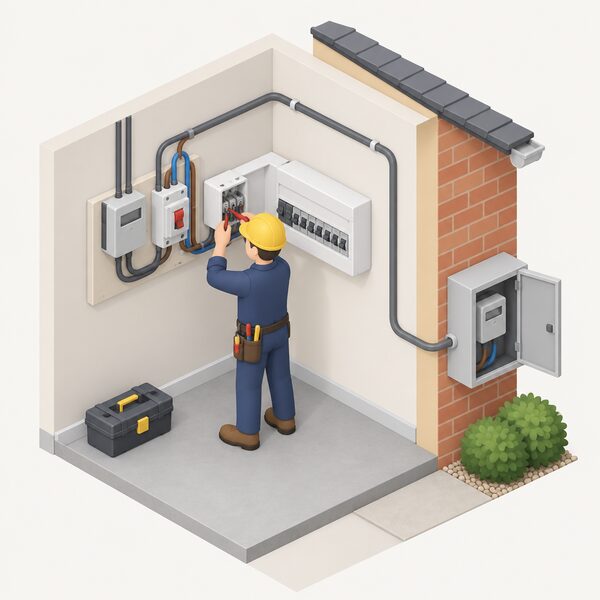
On cost, the two types sit at opposite ends of the same category. Manual transfer switches are typically the least expensive of the transfer switch types1. Automatic transfer switches are more expensive than manual switches but offer the convenience of automatic operation1. Transfer switch installation costs around £150 to £1000, while automatic transfer switch installation runs from £600 to £25002. The figure depends on the rating, the number of backed-up circuits and the wiring route.
The installation work is the larger variable. Fitting a transfer switch means working on the supply side of the consumer unit, and that is regulated work. It is essential to hire a registered electrician to carry out any work relating to the installation, replacement or repair of a consumer unit2. The same principle applies to the meter tails and main switch that a changeover device sits alongside.
Where the meter sits affects the job. In most modern homes, electricity meters are located in an outdoor meter cubicle and are the property of the home owner7. A transfer switch installed indoors therefore has to be fed from that point, and the cable route between the two is part of the cost.
| Manual changeover switch | Automatic transfer switch | |
|---|---|---|
| Operation | Operated by hand; someone must be present1 | Detects an outage and transfers without manual intervention1 |
| Continuity | Does not provide uninterrupted power1 | Transfers automatically once the standby source is ready1 |
| Cost position | Typically the least expensive of the transfer switch types1 | More expensive, with the convenience of automatic operation1 |
| Typical use | Essential-loads circuits, occasional outages | Standby generators and battery backup circuits |
| Installation | Registered electrician required for consumer unit work2 | Registered electrician required for consumer unit work2 |
Safety: isolation, interlocking and why the two supplies must never meet
The safety rule is absolute: the mains supply and the backup supply must never be connected to each other. A changeover device exists to enforce that, by isolating one source before it connects the other. Where that isolation is missing or defeated, the generator back-feeds the network, energising wiring that the network operator and anyone working on it believe to be dead.
The interlock is the mechanism that makes the rule physical rather than procedural. A manual changeover switch with a mechanical interlock cannot be in both positions at once. An automatic transfer switch enforces the same separation electrically. In both cases the protection is built into the device, which is why the device matters more than the intention of whoever operates it.
There is a second safety layer on the generation side. A grid-tied inverter is connected to the house's main wiring and, to protect itself, switches itself off until after the mains supply has been restored3. That behaviour protects the network as well as the equipment, and it is why a solar inverter alone cannot be relied on to keep a home supplied during an outage.
Network operators plan for the same principle at scale. Mutual aid arrangements provide for the voluntary and temporary transfer of staff and equipment from one company to another during emergencies9. That is a different kind of transfer, but it illustrates the same discipline: moving capacity between systems is a controlled operation, not an improvised one.
Which suits which household: choosing between manual and automatic
The choice turns on three things: whether anyone is usually home, what the backed-up circuits need, and how much the household wants to spend. A manual changeover switch suits a household that is often present, backs up a small set of essential circuits, and accepts a gap in supply. An automatic transfer switch suits a household that wants the supply to return without anyone acting, and is prepared to pay for the more expensive device1.
Behavioural evidence from flexibility trials points the same way. In the CrowdFlex research, those who used automation such as smart plugs or delay settings on appliances shifted significantly more electricity during events10. Automation does not just add convenience; it changes what actually happens, because it removes the moment where a person has to remember to act.
There is also a route that avoids a transfer switch altogether for some loads. A household can agree for its energy supplier or another company to manage when certain appliances switch on and off11. That is demand-side flexibility rather than backup, and it does not keep the lights on during an outage, but it shows that automatic control of domestic loads is an established arrangement rather than an exotic one.
Whatever is installed, the work should be documented and the guarantee should survive a move. Workmanship guarantees must be valid for a minimum of 2 years and be transferable to the new owner in the event that the consumer moves home12. A transfer switch installation is part of the home's electrical infrastructure, and that transferability matters when the property changes hands.
Documentation and manuals: what to check before specifying either device
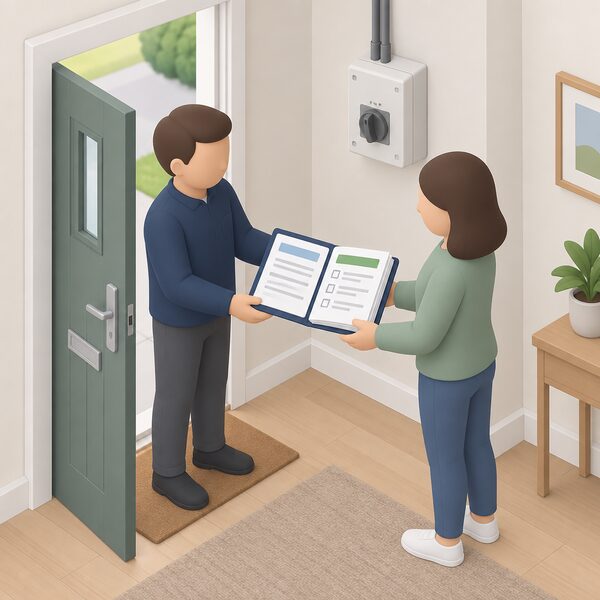
A transfer switch installation should end with a documented handover. The handover pack for a domestic energy installation includes operation and maintenance instructions13, and for micro CHP it includes a list of the system's key parts, health and safety guidance, a recommended servicing and maintenance schedule, the manufacturer's instruction manual(s), and all relevant guarantees and warranties14. A changeover switch installation should leave the household with the equivalent: what was fitted, how to operate it, and what is guaranteed.
Commissioning is part of that record. Approved Document L Volume 1 requires setting up and testing the associated automatic control systems15. An automatic transfer switch is exactly such a control system, so its setup and test should be evidenced rather than assumed.
Where a formal certification route applies, the documentation burden is heavier. That standard governs retrofit work rather than every transfer switch job, but it shows the level of paperwork that a certified installation carries. For a hybrid inverter, the term should be checked against the current datasheet and installation manual, not only a product overview16.
For heating-related work, the installer must hand over the manufacturer's instructions, including the Benchmark Checklist, to the customer on completion of an installation16. The principle generalises: the household should hold the operating instructions and the guarantee, not just the installer.
"Hand over the manufacturer's instructions, including the Benchmark Checklist, to the customer on completion of an installation"
For comparison on maintenance expectations, a solar PV owner reports that while there is no annual maintenance or service required, the inverter is likely to need replacing at some point17. A changeover switch is a simpler device than an inverter, but the same logic applies: it is a component with a working life, and the household should know what it is and where the paperwork is.
Sources17 cited
- Connect backup power generator to home, EcoFlow, 2025-06-16
- Consumer units and fuse boxes, NICEIC, 2025-09
- What is domestic distributed generation, UK Power Networks, 2026-09-17
- Electricity made easy, Electrical Safety First, 2026-09-19
- MicroRex time switch 230V AC 16A changeover contact, Legrand, 2026-09-17
- Independent gas transporters, Uswitch, 2025-06-05
- How do I get my outdoor meter cubicle replaced, NIE Networks, 2026-09-19
- Energy switching, Confused.com, 2026
- Ensuring our energy networks are resilient in bad weather, Energy Networks Association, 2021-11-27
- CrowdFlex research into consumer experiences of flexibility, Centre for Sustainable Energy, 2026-04-29
- Flexibility services, UK Power Networks, 2026-09-20
- Consumer Code, RECC, 2026-07-01
- Pre and post installation checklists, Flexi-Orb, 2024-06-24
- Micro CHP, MCS Certified, 2026-08-17
- Approved Document L Volume 1, HM Government, 2026-09-17
- HHIC installation guidance, HHIC, 2026-09-17
- Installing solar panels to help reduce your carbon footprint, Energy Saving Trust, 2025-09-24
 Switch Energy SupplierThe practical sequence of a domestic energy switch: the details and readings needed, the five working day transfer, cooling-off periods, exit fees and the final bill.
 New Boiler Cost in the UKWhat a replacement boiler costs in the UK by type and fuel, and what drives the installation element: conversions, relocations, flue work and system upgrades.
 Types of Air ConditioningPortable, wall-mounted, multi-room or ducted: which air conditioning suits your home?
 The Full Tariffs GuideWhich energy tariff suits how you live, and will switching really save you money?
 Energy Smart AppliancesCan your washing machine or car charger be told when to use power, and who gets to decide?
 Electric BoilersHow electric flow boilers heat a conventional wet system, what they cost to buy and run, where they suit UK homes, and why point-of-use efficiency near 99% does not translate into cheap heating at the meter.