
In this guide
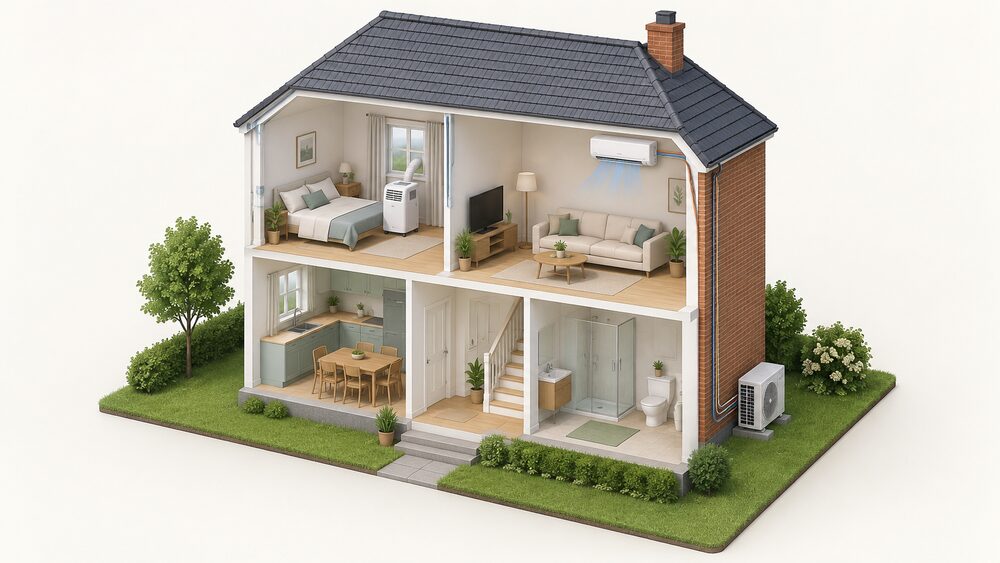
Domestic air conditioning in the UK comes in two broad families. Portable units sit inside the room and vent heat through a hose. Fixed systems move heat through refrigerant pipework to an outdoor unit, or out through a wall. The fixed family includes the wall-mounted single split, the multi-split serving several rooms from one outdoor unit, ducted systems, ceiling cassettes, floor consoles and through-wall monobloc units. All of them move heat rather than create cold, and all run on electricity.
The types differ most in how much electricity they draw for the cooling they deliver. A typical portable unit is rated at 0.75 to 1.5 kW, a single split at 0.8 to 2.5 kW and a multi-split or ducted system at 1 to 5 kW. At the July 2026 price cap, a portable unit costs £0.20 to £0.39 an hour to run. Portable units use 30 to 50% more electricity than fixed systems. Fixed systems need an F-Gas registered engineer to install or commission them, and they may need planning permission.
Air conditioning is still uncommon in UK homes. It is estimated that 3% of UK homes have it1. London is the outlier: approximately 32 per cent of London households report owning air conditioning, around three times the rate in several other regions2. In the government's winter 2025 attitudes tracker, 5% of households said they used air conditioning3.
The range at a glance: seven types for UK homes
The table sets out the categories sold for UK homes, where each is fitted, and what installation involves. Power ratings come from Uswitch4. The F-Gas rule for split systems comes from the maker Cooleasy5.
| Type | Where the parts go | Installation | Power rating |
|---|---|---|---|
| Portable (monobloc) | Whole unit in the room; hose to a window | Plug in; no engineer | 0.75 to 1.5 kW |
| Through-wall monobloc | Single unit on an inside wall, venting through it | Wall openings; no outdoor unit | Not stated |
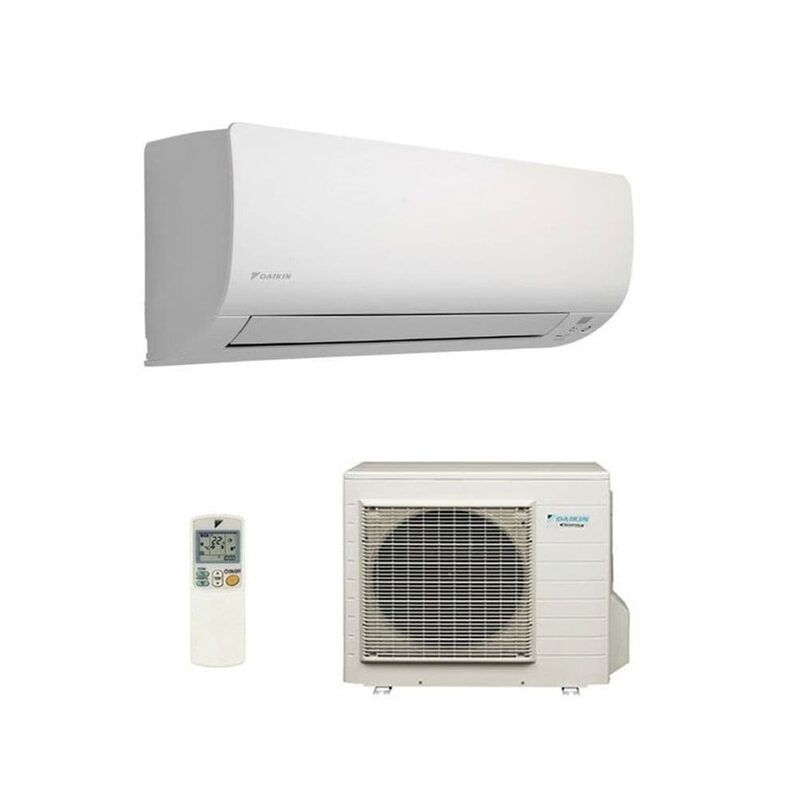
| Single split (wall mounted) | One indoor unit high on a wall; one outdoor unit | F-Gas engineer by law | 0.8 to 2.5 kW |
| Multi-split | Several indoor units; one outdoor unit | F-Gas engineer by law | 1 to 5 kW |
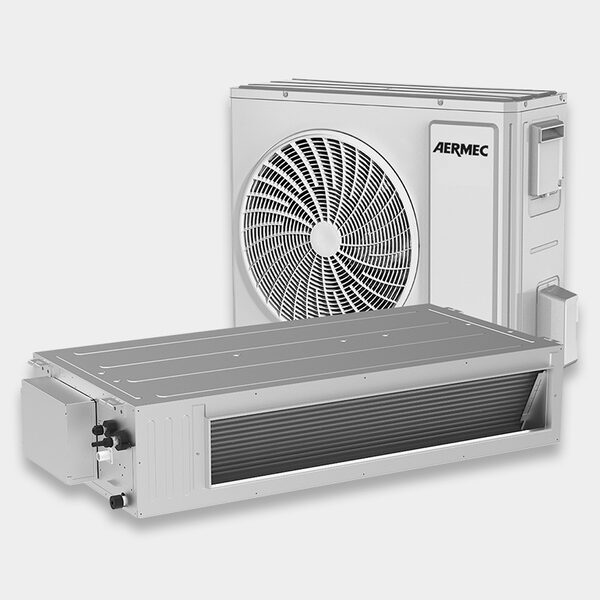
| Ducted | Hidden unit feeding grilles through ducts | F-Gas engineer; space for ducts | 1 to 5 kW |
| Ceiling cassette | Indoor unit recessed into a ceiling | F-Gas engineer; ceiling void | Not stated |
| Floor console | Indoor unit low on a wall | F-Gas engineer | Not stated |
The wall-mounted single split is the reference type. Ducted units, ceiling cassettes and floor consoles are split systems with differently shaped indoor units. The choice between them turns on where an indoor unit can sit, and on whether there is a ceiling void or space for ducting. Each has its own page: split air conditioning, multi-split air conditioning, ducted and ceiling cassette air conditioning, portable air conditioners and through-wall monobloc units. The wider context is in the home cooling guide.
For energy independence, no type makes a household self-sufficient. Every type runs on grid or self-generated electricity. Fixed systems also tie the household to a qualified engineer for installation, commissioning and servicing. The link with rooftop generation is covered in running air conditioning on solar panels.
A refrigerator without the insulated box
Air conditioning works like a fridge turned inside out. A refrigerant circulates in a closed loop, driven by an electric compressor. It absorbs heat as it evaporates in the indoor coil, and gives heat up as it condenses in the outdoor coil or exhaust. The room gets cooler because heat is carried out of it, not because cold is made. This is why efficiency is measured as heat moved per unit of electricity, and why a modern fixed system can move several kilowatts of heat for each kilowatt it draws.
The maker Cooleasy puts the plumbing point plainly5:
"Air conditioning is a sealed system running refrigerant, so no plumbing for a water supply is required."
The exception is the rare water-cooled system, which the same maker notes. The fact that the refrigerant loop is sealed has a practical consequence. Opening it, charging it or connecting split pipework is regulated work (see the section on installation below).
The same principle underlies the air source heat pump. Heat pumps are classed as air-to-air or air-to-water, depending on whether the building distributes heat by air or by water. An air-to-air heat pump is, in hardware, a split air conditioner that can run in either direction, moving heat through fan coil units or "blowers"9. A heat pump run in reverse removes heat in the same way as an air conditioner (see the section on reversible units below).
What air conditioning does not do is supply hot water. An air-to-air system heats and cools room air only. Hot water still needs a cylinder with an immersion heater, point-of-use heaters, a hot water heat pump cylinder, a heat battery or solar water heating. That leaves a separate dependency in place for any household using air-to-air units as its main heating.
Portable air conditioners: plug-in cooling with the compressor in the room
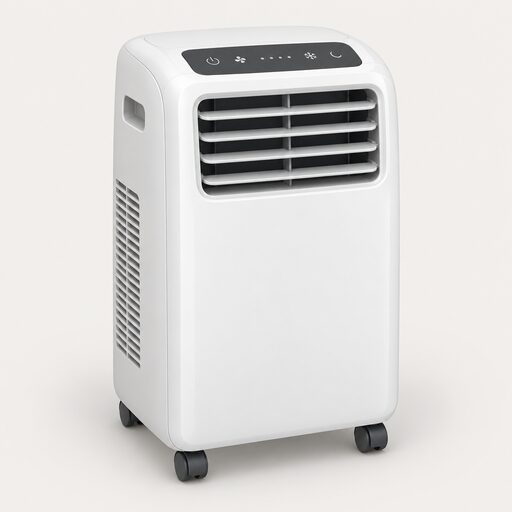
A portable air conditioner is a self-contained monobloc unit. The compressor, both coils and the fan share one casing on wheels, and warm air is exhausted through a flexible hose led to a window. There is no refrigerant pipework to connect, so no engineer is needed. The maker Cooleasy notes that DIY-category monobloc products are the exception to the F-Gas installation rule for split systems5. Portable units also need no water connection.
Electrically, a portable air conditioner is a heavy appliance. Electrical Safety First lists it at typically 900 to 2000W, with higher-BTU models drawing more power. It gives a maximum of up to 2000 W and up to 9.3 A10. National Energy Action gives a typical rating of 1,000 to 1,500W6. Uswitch lists 0.75 to 1.5 kW4. The figures differ because each body describes a different spread of models, but all place a portable unit in the same band as a kettle-class appliance running for hours.
The compromise is efficiency. The Centre for Sustainable Energy finds that portable units use 30 to 50% more electricity than fixed systems7. The reasons are structural. The hot parts of the machine sit inside the room being cooled. The exhaust hose passes through a window opening that lets warm air back in. And a single unit has limited capacity. Noise follows the same logic: the maker Cooleasy states that most portable units produce approximately 56dB of sound pressure while running5, because the compressor is in the room.
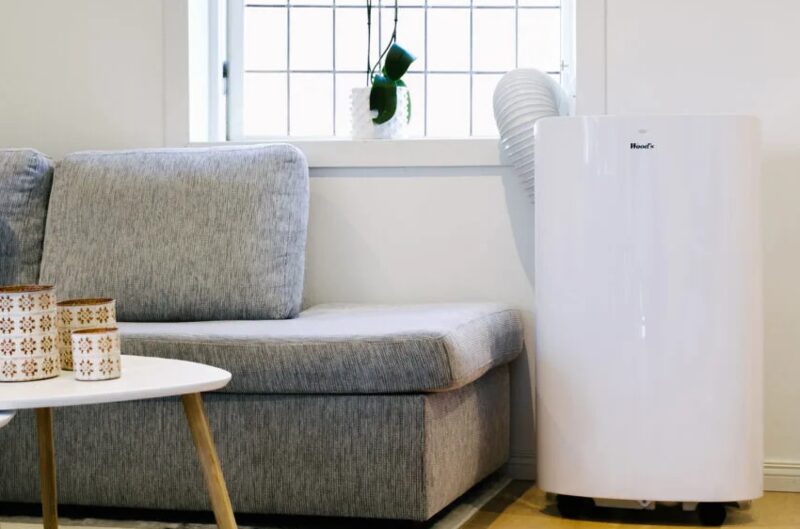
For a household, a portable unit is the only type that needs no fixed installation, no planning check and no engineer. That makes it the usual option for tenants (see portable air conditioners in a rental). The comparison with a fixed system is set out in split vs portable air conditioning, and questions of hose and drainage in does a portable air conditioner need a drain hose?
Split and multi-split systems: roughly 4 kW out per kW in
A split system divides the machine in two. The compressor and one coil sit in an outdoor unit. The other coil and a quiet fan sit in the indoor unit. Refrigerant pipework links the two through the wall. Because the noisy, hot parts are outside, the indoor unit only has to move air. The maker Cooleasy states that most modern systems have a coefficient of performance of roughly 4, producing roughly 4kW of output for every kilowatt of electricity used5. That is the maker's general figure, not a measured result for any one model.
Uswitch gives the power ratings4:
| Configuration | Power rating |
|---|---|
| Portable unit | 0.75 to 1.5 kW |
| Single-split system | 0.8 to 2.5 kW |
| Multi-split or ducted system | 1 to 5 kW |
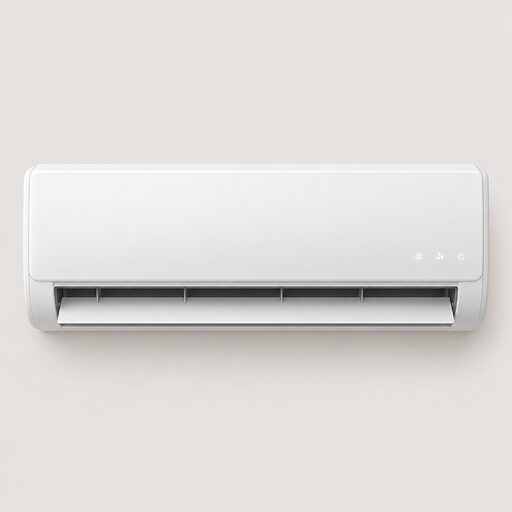
A single split pairs one outdoor unit with one indoor unit, most often a wall-mounted "high wall" unit. A multi-split connects several indoor units, which can be different styles (wall, cassette, floor console), to one outdoor unit. Maker figures for the outdoor capacity of multi-split systems disagree: one range is given as 4kW to 12 kW and another as 2.6kW to 15.2 kW. The documents do not settle this, and each reflects a different manufacturer's range. How many rooms one outdoor unit can serve is covered in multi-split: how many indoor units, and the trade-offs in single split vs multi-split.
Ducted systems hide the indoor unit in a loft, ceiling void or bulkhead and supply rooms through grilles. Ceiling cassettes are recessed into the ceiling and blow in several directions. Floor consoles sit low on a wall where high-wall mounting is impractical, for example under a sloping ceiling. All three are split systems and share the same installation rules (see ducted vs multi-split).
The gain in efficiency comes with more dependence on outside parties. A split system is a fixed installation. By law it needs an F-Gas registered engineer, at least for commissioning5. It may also need planning permission, and it counts as building work (see below).
Reversible air conditioning: cooling in summer, heating in winter

Many fixed air conditioners are reversible. Which? describes air-to-air heat pumps as able to both heat and cool air, depending on need9. It also notes that they offer the added benefit of air conditioning in summer11. CIBSE describes the same machine from the other side: a heat pump operated in reverse removes heat in the same way as an air conditioner12. MCS likewise notes that air-to-air systems can also offer cooling13. The distinction between "air conditioner" and "air-to-air heat pump" is therefore largely one of labelling and of which season the unit is sold for.
Reversibility matters in three ways.
- Planning in England. Permitted development rights apply only where the system has a heating function. A cooling-only unit needs a planning application (see below).
- Winter operation. Uswitch reports that an air-to-air heat pump can absorb heat from air as cold as minus 15°C14. The Energy Saving Trust states that most current heat pumps work to about minus 25°C, and that some advanced cold-climate models work as low as minus 35°C15. These are limits for heating; the figures vary by model.
- Hot water. A reversible unit heats rooms, not water. The Energy Saving Trust lists the options: a cylinder with an immersion heater, an electric shower or point-of-use heaters, an air-to-air model that supplies a cylinder, or solar water heating16. Nesta adds hot water heat pump cylinders and heat batteries17.
For independence, a reversible unit can move a room's heating from gas to electricity. That swaps one supplier dependency for another, rather than removing it. The full picture is in air conditioning that heats and air conditioning vs electric heater efficiency.
Running costs: 26 to 39p an hour for a typical portable
National Energy Action puts a typical portable air conditioner of 1,000 to 1,500W at around 26 to 39p an hour. That is roughly 14 to 20 times the cost of a fan6. Uswitch, using the July 2026 Ofgem price cap of 26.11p per kWh, gives £0.20 to £0.39 an hour for a portable unit rated at 0.75 to 1.5 kW4. The two sources agree at the top of the range. They differ at the bottom because Uswitch includes smaller units.
Weekly figures depend on hours of use. Uswitch modelled a 1kW portable unit run for an average of 9.1 hours a day for seven days18:
| Tariff basis | Weekly cost, 1kW portable |
|---|---|
| Cheapest fixed tariff rates | £13.37 |
| Predicted July rates | £16.70 |
The difference between the two is £16.70 minus £13.37, which is £3.33 a week. These are modelled figures for one size of unit, not measured bills.
Fixed systems cost less to run for the same cooling. The Centre for Sustainable Energy finds that portable units use 30 to 50% more electricity than fixed systems7. The Centre for Alternative Technology warns that bolt-on cooling in general tends to use a lot of electricity, leading to higher bills19. Which? notes that some air conditioners can use as much energy in one hour as a fridge uses in a day20.
Purchase and installation prices for fixed systems are installer-quoted, and no published range is given here. Detail is in air conditioning cost, running costs and portable running cost per hour. Where a household generates its own electricity, daytime cooling demand overlaps with solar output. The unit still draws from the grid whenever generation falls short.
Efficiency and energy ratings: SEER 4.0 and 4.6 minimums
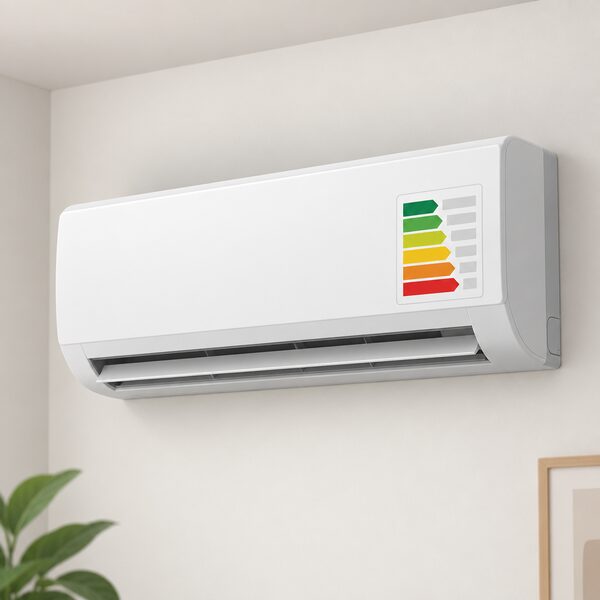
The binding figures are in Approved Document L, the conservation of fuel and power guidance for dwellings. For an air conditioner working in cooling mode, it sets a minimum seasonal energy efficiency ratio (SEER) of 4.0 in existing dwellings and 4.6 in new dwellings8. The Welsh Government's consultation version of its Approved Document L carries the same two minimums21. On labels, the maker Cooleasy states that the majority of modern systems are rated a minimum of A, with many at A+ or higher5. That is a maker's description of the market, not a regulatory threshold.
SEER measures cooling delivered across a season against the electricity used, so it reflects part-load running as well as peak output. The 4.0 minimum for existing homes is consistent with the maker's "roughly 4 kW out per kW in" figure for modern split systems. A portable unit, with its compressor in the room and its hose through a window, is not the type these minimums are written around.
Two further points bear on efficiency in practice:
- Air conditioning is not assumed in new homes. The notional dwelling used in the 2021 Approved Document L (with 2023 amendments) lists air conditioning as "None"22. New homes are expected to control overheating by design, which is the subject of Part O.
- Larger systems face inspections. Regulations covering air-conditioning systems apply to those with an effective rated output of more than 12kW23. Few single-home systems reach that size. In Scotland, Regulation 17 guidance sets inspection intervals of three years for poorly maintained, inefficient systems, up to five years for well-maintained ones24.
Label classes and SEER, SCOP and EER are explained in air conditioning efficiency ratings.
Planning permission: cooling-only units are not permitted development
In England, fitting air conditioning may be permitted development, provided every limit and condition in the legislation is met. Those limits cover function, size, placement and number of units25. The condition that most often catches households is function:
"The rights only apply if the system provides a heating function (including if it can provide both heating and cooling)."
A cooling-only system therefore needs a planning application. Permission is also required in a protected area such as a Conservation Area, and listed building consent is required for a listed building26.
The underlying rights sit in Class G of the General Permitted Development Order, which covers air source heat pumps on domestic premises. The main conditions are:
- Outdoor unit size. The outdoor compressor unit, including any housing, must not exceed 1.5 cubic metres on a dwellinghouse, or 0.6 cubic metres on a block of flats27.
- Listed buildings. There are no rights if the building or its curtilage is a listed dwellinghouse or block of flats28.
- Wind turbines. There are no rights if a wind turbine is installed on the same building or within the curtilage28.
- MCS Planning Standards. The unit must comply with the MCS Planning Standards or equivalent standards29.
- Local restrictions. Rights may be removed by a planning condition, an Article 4 Direction or another restriction30.
Separately, putting in a fixed air-conditioning system is work that falls under building regulations approval31. The Planning Portal states that the installation must comply with building regulations26.
The rules differ across the nations. Details for each are on the pages for England, Scotland, Wales and Northern Ireland. Flats raise lease and consent questions too (see air conditioning in flats).
Installation and servicing: F-Gas engineers and a minimum 6-year life
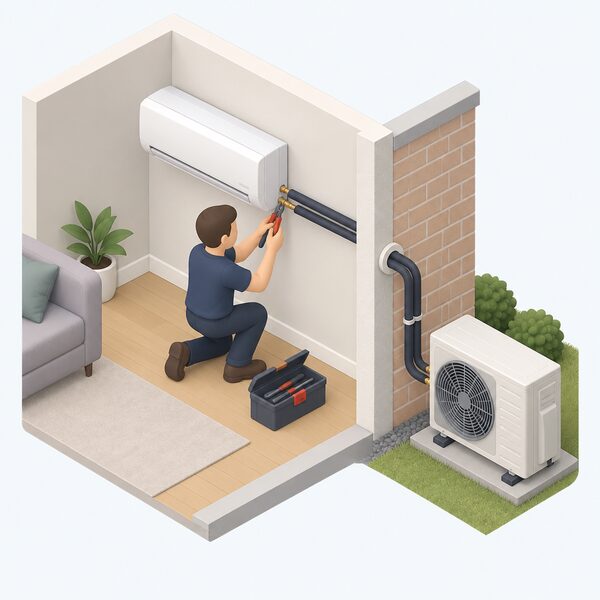
Only portable and DIY-category monobloc units escape the engineer requirement. The maker Cooleasy states that by law all split-type systems need an F-GAS registered engineer to carry out the installation, or at a minimum to commission the system5. HHIC reports the same for air-to-air heat pumps: installations must be carried out by F-gas-qualified engineers32. The rules and refrigerants are covered in F-Gas rules for air conditioning, and pre-charged "easy-fit" kits in DIY air conditioning installation.
A fixed installation usually follows this sequence (see air conditioning installation):
- Survey of the room, wall and outdoor position, including planning and building regulation checks.
- Mounting of the indoor and outdoor units.
- Running of refrigerant pipework, cabling and condensate drain through the wall.
- Commissioning of the refrigerant circuit by an F-Gas registered engineer.
On servicing, the maker Cooleasy advises an annual service by an F-Gas registered engineer. It also advises cleaning the indoor unit every 1 to 3 months and the outdoor unit every 6 to 12 months, depending on use5. For air source heat pumps, Agility Eco states that they generally need only a simple yearly service33.
Lifespan figures vary by source and by type. The maker Cooleasy states a minimum of 6 years of reliable life for a system used an average of 8 hours a day for cooling and heating and maintained correctly5. MCS gives an average life of up to 20 years for air source heat pumps13. The two figures measure different things: a maker's floor for a heavily used cooling unit, and an independent average for heat pumps as a class. Maintenance detail is in air conditioning maintenance.
Warranty: a minimum of 5 years on most systems, the maker states
The maker Cooleasy states that most systems carry a minimum 5 year warranty5. Terms, registration conditions and any extensions vary by manufacturer and model. The manufacturer's own documents are the reference for a given unit (see air conditioning with a 5 year warranty).
Installer workmanship is a separate matter from the product warranty. Under MCS rules for certified installers, workmanship must be guaranteed for a minimum of two years following installation34. In the new-build market, the IAA New Build Guarantee offers material and workmanship guarantees of 25, 10, 6 or 2 years35.
The brands and their ranges are described, without ranking, in air conditioning brands sold in the UK. The wider question of what cooling does for a household's resilience is covered in home cooling and energy independence.
Sources35 cited
- Can the grid keep up?, CIPHE, 2025-10-22
- Are London's homes ready for a heatwave? Collated call for evidence, Greater London Authority, 2026-06
- DESNZ Public Attitudes Tracker: heat and energy use in the home, winter 2025, Department for Energy Security and Net Zero, 2025
- Is air conditioning worth it in the UK?, Uswitch, 2026-07-14
- FAQs, Cooleasy, 2026-09-23
- Summer energy tips, National Energy Action, 2026-08-13
- How to keep your home cool in hot weather, Centre for Sustainable Energy, 2026-07
- Approved Document L Volume 1: Dwellings, GOV.UK, 2026
- Heating your home with renewable energy, Which?, 2025-09-22
- Ratings of electrical appliances, Electrical Safety First, 2026-09-19
- What it's really like to have a heat pump, Which?, 2025-09-22
- Heat pumps campaign, CIBSE, 2026-09-17
- Air source heat pump, MCS, 2026-07-24
- Air source heat pumps, Uswitch, 2026-01-06
- Heat pump fact check, Energy Saving Trust, 2026-07-01
- Air-to-air heat pumps, Energy Saving Trust, 2026-09-11
- Air-to-air heat pumps, Nesta, 2026-09-17
- The cost of keeping cool: four million homes now use air conditioning, Uswitch, 2026-04-30
- Home cooling, Centre for Alternative Technology, 2025-06-27
- How to beat the soaring price cap, Which?, 2026-05-28
- Approved Document L Volume 1, consultation version, Welsh Government, 2026-09-17
- Approved Document L Volume 1: Dwellings, 2021 edition incorporating 2023 amendments, GOV.UK, 2026-09-17
- Energy Performance of Buildings Regulations 2012, Part 4, legislation.gov.uk, 2026-09-17
- Building Standards Technical Handbook: Domestic, April 2026, Scottish Government, 2026-03
- Planning Portal FAQ on air conditioning, Planning Portal, 2026
- Planning Portal FAQ on air conditioning and building regulations, Planning Portal, 2026-09-17
- GPDO Schedule 2 Part 14 Class G, legislation.gov.uk, 2026-09-17
- GPDO Class G, paragraph G.2, legislation.gov.uk, 2026-09-17
- GPDO Class G as made, legislation.gov.uk, 2026-09-17
- Air source heat pumps planning guidance, Cornwall Council, 2026-09-17
- Building regulations approval, GOV.UK, 2026-09-17
- Air-to-air heat pumps added to Boiler Upgrade Scheme, HHIC, 2026-01-20
- Heating systems we install, Agility Eco, 2026-09-20
- Insurance-backed guarantee products, MCS, 2026-05-13
- New build guarantees, IAA, 2026-09-20
 The Full Cooling and Air Conditioning GuideDo you really need air conditioning in a British summer, or would a fan and better shading do the job?
 Air Conditioning CostPublished UK equipment prices and the parts of an installed price for portable, single split, multi-split and whole-house air conditioning.
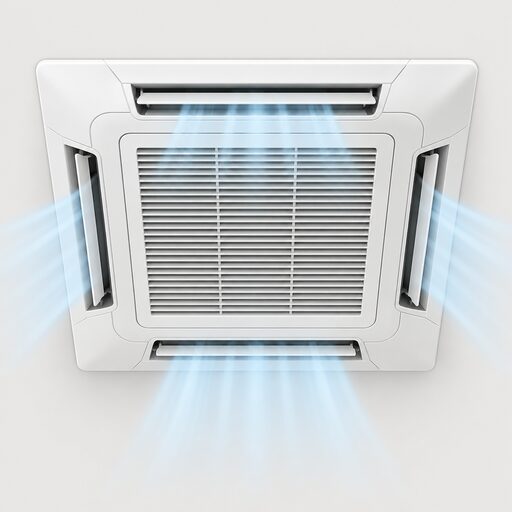 Ducted and Cassette ACDucted air conditioning hides the unit in a loft or ceiling, while a ceiling cassette sits in the ceiling with only vents on show.
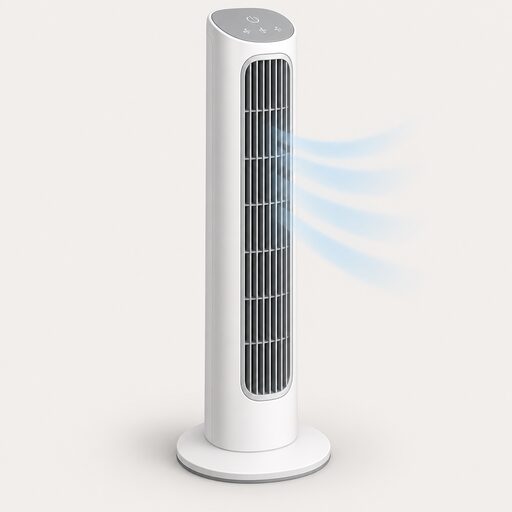 Electric FansHow electric fans cool people rather than rooms, what the main UK fan types (desk, pedestal, tower, ceiling and bladeless) draw in watts and cost per hour, where they fall short in a heatwave, how to use them safely, and how they fit alongside night ventilation and shading.
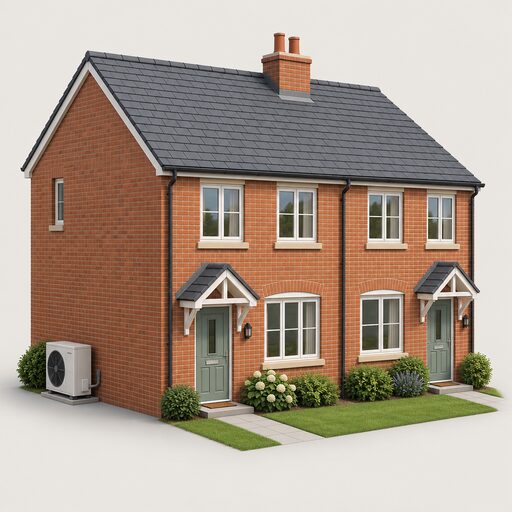 Which Homes Suit a Heat PumpMost UK homes can have a heat pump fitted, so the real question is whether yours makes it easy or expensive.
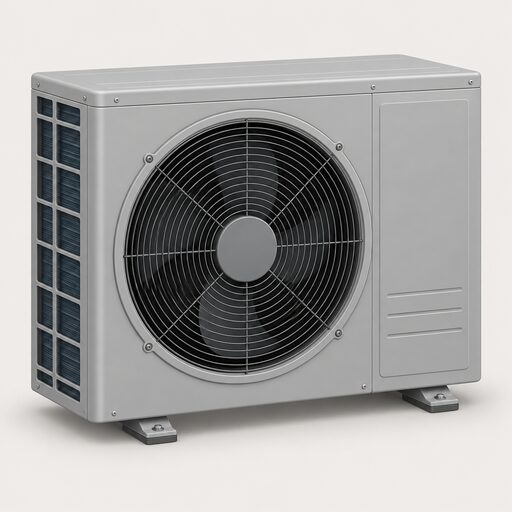 Cooling and Heat PumpsCan an air conditioner heat your home as well as cool it?