
In this answer
Short answer
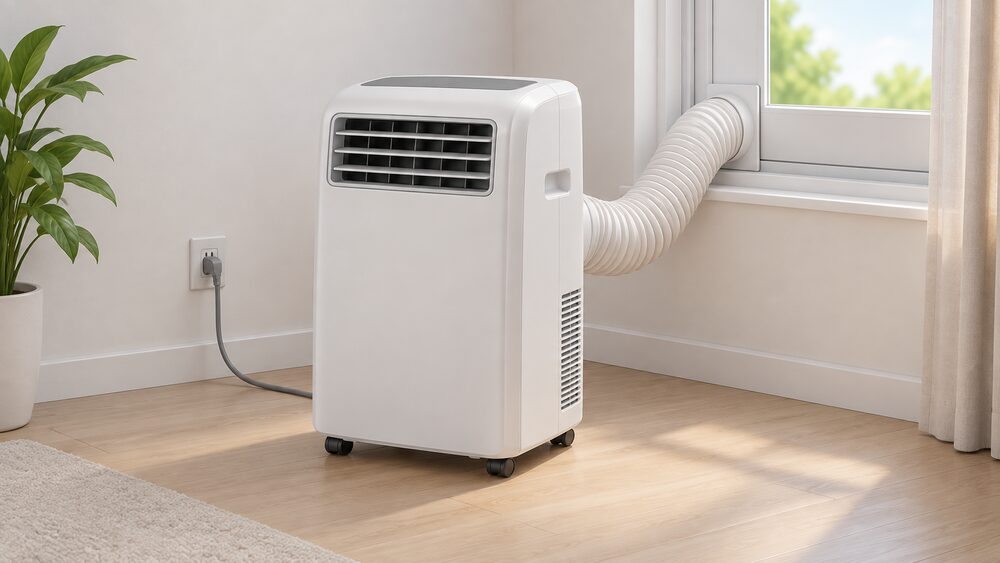
A typical portable air conditioner costs around 20p to 40p an hour to run. The National Energy Action figure for a portable unit rated 1,000 to 1,500W is around 26p to 39p an hour, which it describes as roughly 14 to 20 times more than a fan1. Uswitch puts a 0.75 to 1.5kW portable unit at £0.20 to £0.39 an hour, based on the July 2026 Ofgem price cap unit rate of 26.11p per kWh2.
The spread comes from two things: the power the unit draws, and the electricity price used to work it out. Portable air conditioners are typically rated 900 to 2,000W, and the higher the BTU rating the higher the power3. Makers quote their own hourly figures on their own tariff assumptions, which is why a smaller unit in one maker's range can be listed at 25p an hour and a larger one at 40p an hour.
What matters for a household is that the running cost is a direct function of the unit rate on the bill. A portable air conditioner is a plug-in appliance drawing from the grid through a standard socket, so it adds to electricity consumption and to summer bills, with no cylinder, no gas connection and no fixed installation to justify the outlay4.
Hourly running cost: roughly 20p to 40p for a typical unit
The headline range for a portable air conditioner is around 20p to 40p an hour. National Energy Action gives 26p to 39p for a unit rated 1,000 to 1,500W1. Uswitch gives £0.20 to £0.39 for a 0.75 to 1.5kW unit, calculated on the July 2026 Ofgem price cap unit rate of 26.11p per kWh2. The two ranges overlap heavily and differ mainly because the lower bound of the Uswitch figure covers a smaller 0.75kW unit.
The driver is straightforward: a portable air conditioner is a resistive-plus-compressor appliance whose consumption tracks its rated input. Electrical Safety First notes that portable air conditioners typically run at 900 to 2,000W, and that the higher the BTU rating the higher the power3. A 2,000W unit at the price cap rate would cost roughly twice what a 1,000W unit costs for the same hour of running, though in practice a unit that reaches its set temperature and cycles down draws less than its rated input over a long session.
For context on where that sits among household appliances, a 1,000W microwave costs 26p an hour of use, a 500W dehumidifier 13p an hour, a 300W fridge-freezer 8p an hour and a 2,500W electric heater 65p an hour7. A portable air conditioner is therefore in the same band as a microwave or a small heater, and well above the always-on background appliances.
The independence picture is limited. A portable unit needs no installer, no F-gas engineer and no landlord consent in most cases, which makes it the lowest-friction way to cool a single room. What it does not do is reduce dependence on the grid or on a supplier: it is a plug-in load, and every hour of cooling is bought at the retail unit rate. Running it from a solar array or battery would change that arithmetic, but the unit itself offers no generation or storage.
Real examples: quoted running costs from 25p to 46p an hour
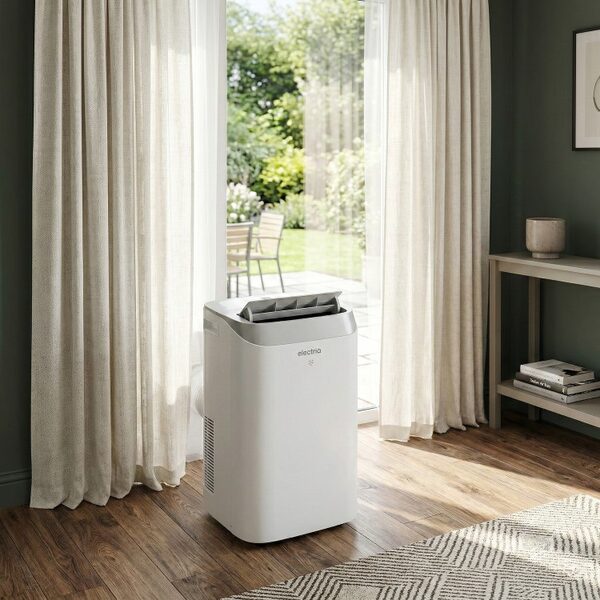
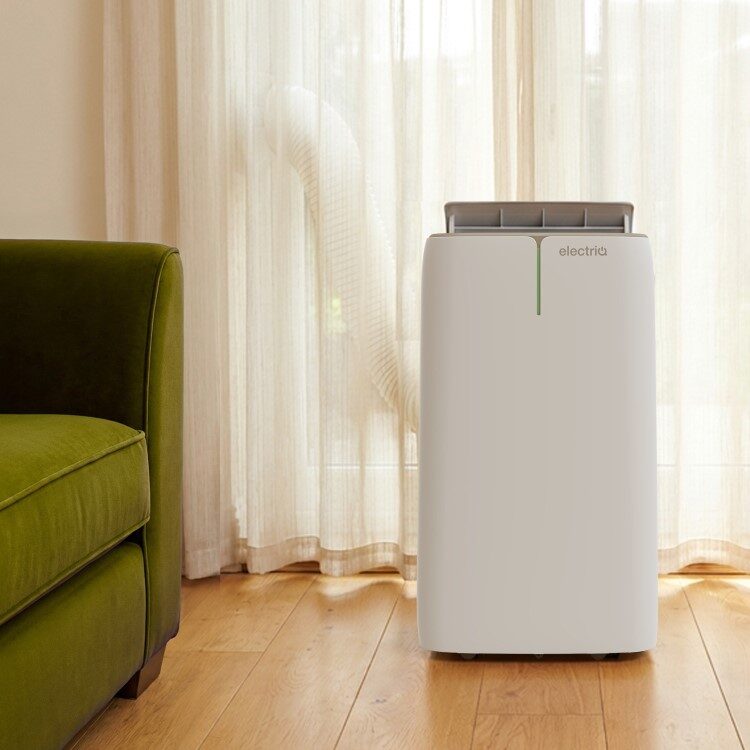
Maker-quoted running costs for named models give a clearer picture than a generic range, because each figure comes with the tariff assumption behind it.
| Model | Capacity | Quoted running cost | Tariff basis |
|---|---|---|---|
| MeacoCool MC Series Pro | Smaller model | 25p / hour | 24.67p / kWh5 |
| Meaco Cirro | Mid-sized model | 35p / hour | Not stated9 |
| Meaco Cirro+ (inverter) | Larger model | 40p / hour | Not stated10 |
| electriQ EcoPlus10HPW | Not stated | 25p to 40p / hour in cooling mode | 25 to 35p / kWh11 |
The pattern is that quoted cost rises with capacity, from 25p for the smaller MeacoCool unit to 40p for the larger Cirro+, but the tariff assumption moves too, so the figures are not directly comparable across rows. The MeacoCool figure is calculated on 24.67p per kWh, below the July 2026 price cap rate of 26.11p per kWh, so on the cap rate the same unit would cost slightly more than 25p an hour5.
The electriQ figure is the widest single range, 25p to 40p an hour in cooling mode, and the same retailer quotes 20p to 40p an hour in heating mode for the same unit11. That is a useful reminder that a maker's hourly figure is an estimate on a stated tariff, not a metered reading: in cooling mode the top of the range is 15p above the bottom (40p less 25p).
For a household comparing a smaller unit against a larger one, the honest answer is that the larger unit will usually cost more per hour when both are running flat out, but may run for shorter periods to reach the same temperature in a larger room. Sizing is covered in more detail in what size air conditioner you need, and the wider cost picture in air conditioning running costs.
Cost per night and per month: what a 1kW unit adds to the bill
A 1kW portable air conditioner draws 1kWh for every hour it runs at full output. Uswitch reports that the 2.2 million homes with portable air conditioning units use 1kW of power, and gives a weekly cost of £13.37 on the cheapest fix rates for an average of 9.1 hours of daily use over seven days, rising to £16.70 a week on predicted July rates12. That works out at roughly £1.47 to £1.84 a day on those assumptions.
Scaling from the unit rate is the more portable method. At the July 2026 price cap unit rate of 26.11p per kWh, the cost of a session is the unit's power in kW, multiplied by the hours it runs, multiplied by that rate2. A 1.5kW unit on the same rate would cost roughly half as much again as a 1kW unit over the same hours. Any such result is arithmetic on a stated unit rate and stated power, not measured consumption.
For comparison, a 1kW radiator costs 25p an hour to run at full power on a 25p per kWh tariff13, and a 1,500W portable heater costs around £0.42 an hour at a UK average rate of 28p per kWh14. A portable air conditioner of similar input sits in the same band, which is the point: cooling with a plug-in compressor unit costs roughly what heating with a plug-in resistive unit costs, because both are drawing similar power from the same socket.
Cooling vs heating mode: how the running cost differs
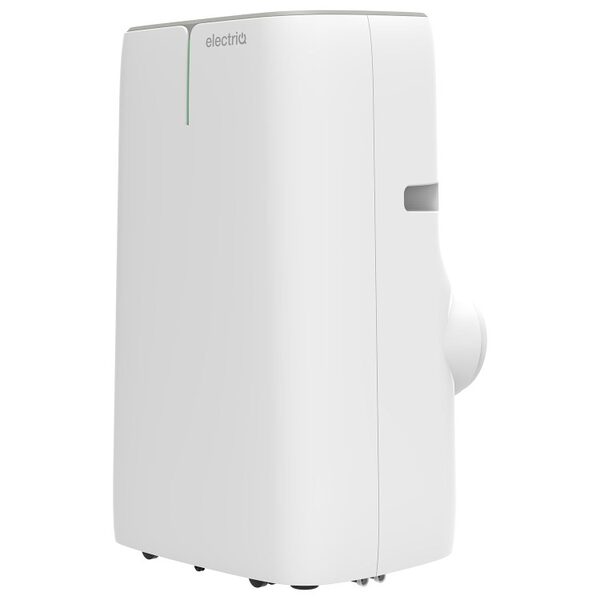
Many portable units are reversible and can run in heating mode as well as cooling. The retailer's own figures for one model put cooling at around 25p to 40p an hour and heating at 20p to 40p an hour11. The overlap is wide enough that the two modes are not reliably distinguishable on quoted cost alone.
The physics is more useful than the quoted range. A reversible air conditioner operating in heating mode produces only 2 to 3 kWh of heat per kilowatt-hour of electricity, according to one maker's guidance15. That is still better than a resistive heater, which converts one kilowatt-hour of electricity into at most one kilowatt-hour of heat, and it is why Which? reports that an air-to-air heat pump gives lower running costs than other types of electric heating and plug-in air conditioning16.
The comparison with resistive heating is where the numbers get concrete. Which? found most of the electric heaters it tested cost around 48p an hour to run17, with oil-filled radiators at 33p an hour on average, fan heaters at 60p and convector heaters at 48p18. A top-scoring electric heater heats a room quickly for around 50p an hour19. A reversible portable unit in heating mode, drawing similar power but delivering two to three times the heat per unit of electricity, should therefore cost less per unit of warmth, though the maker's 2 to 3 kWh figure is a claim rather than a tested result.
For a household, the practical point is that a reversible portable unit used in heating mode is a plug-in electric heater with a modest efficiency advantage, not a substitute for a gas boiler or a heat pump on running cost. It remains dependent on the grid and the tariff in exactly the way a fan heater is. The wider comparison is set out in air conditioning that heats.
Do higher BTU models always cost more per hour to run?
Not automatically, and the reason is that running cost follows power drawn rather than the BTU label. Electrical Safety First notes that portable air conditioners typically run at 900 to 2,000W and that the higher the BTU rating the higher the power3, so there is a real correlation. But three things break the direct link.
First, a unit that reaches its set temperature and modulates down draws less than its rated input over a long session. One maker notes that a heater's running cost is determined by its duty cycle, how long it needs to draw electricity per hour to maintain temperature, rather than its wattage rating alone20. The same logic applies to a cooling unit: a well-sized larger unit that cycles may use less over an evening than an undersized smaller unit running flat out and never reaching its set point.
Second, inverter compressors modulate continuously rather than switching on and off at full power. The Meaco Cirro+ is an inverter model quoted at 40p an hour10, while the smaller non-inverter Cirro is quoted at 35p an hour9. The larger inverter unit is quoted higher, so the maker's own figures do not show an inverter saving at the headline level, and the comparison is covered in inverter vs non-inverter portable air conditioner savings.
Third, the tariff assumption behind each quoted figure varies. The MeacoCool MC Series Pro quoted at 25p an hour on 24.67p per kWh5 and the Meaco Cirro+ quoted at 40p an hour on an unstated tariff10 are not measured on the same basis. The honest reading is that capacity raises the likely hourly cost, but the quoted figure is the better guide than the BTU number alone.
How to work out the hourly cost for your own unit
The standard formula is set out by the Northern Ireland Energy Advice service: appliance running cost in pence per hour equals the power rating in watts multiplied by the electricity unit rate in pence per kWh, divided by 1,00021. A 1,000W unit on a 26.11p per kWh tariff gives 1,000 × 26.11 ÷ 1,000, which is 26.11p an hour2.
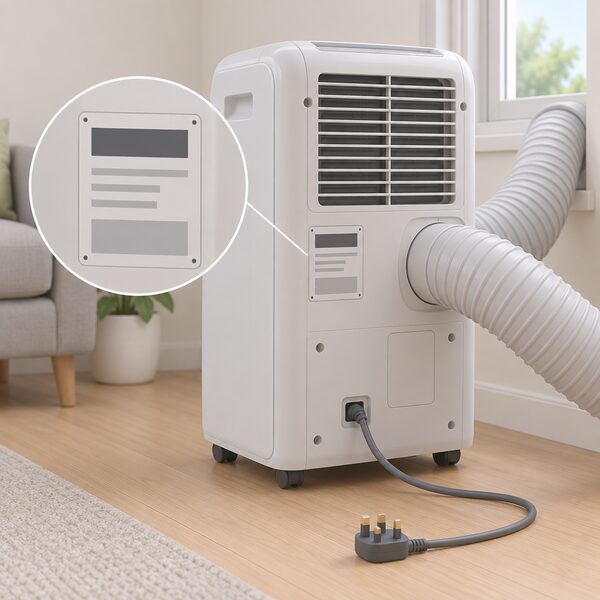
The two inputs are on the appliance and on the bill. The power rating is on the rating plate or in the manual, in watts or kilowatts. The unit rate is on the electricity bill or tariff statement, in pence per kWh, and it is the unit rate rather than the standing charge that drives the hourly figure. A worked example from Which? uses a 2kW fan heater at 27.69p per kWh to give 55p an hour22, which is the same formula applied to a different appliance.
The Consumer Council offers a single appliance checker that shows how much appliances cost to run on a per-minute, per-hour and per-day basis23, which removes the arithmetic for anyone who would rather not do it by hand. For a household on a time-of-use tariff, the unit rate varies by hour, so the same unit costs different amounts depending on when it runs.
Is a portable air conditioner expensive to run compared with a fan?
Yes, by a wide margin, and the gap is the single most useful comparison for a household deciding what to buy. The average fan costs around 3p an hour to run4. A typical portable air conditioner at 1,000 to 1,500W costs around 26p to 39p an hour, which National Energy Action describes as roughly 14 to 20 times more than a fan1. One maker states that a standard fan uses about 20 times less electricity than a portable air conditioner24.
The Centre for Sustainable Energy notes that fans are far cheaper to run than air conditioning, and that air conditioning increases electricity use and can add significantly to summer energy bills25. It also notes that portable units use 30 to 50% more electricity than fixed systems4, which is a second gap worth knowing: a fixed split system of the same cooling capacity will generally draw less than a portable unit doing the same job, because the portable unit has to exhaust hot air through a hose and pull replacement air in from outside.
For a household, the choice is between a low-cost appliance that moves air and a higher-cost appliance that genuinely lowers room temperature. Fans do not cool the air; they increase air movement over the skin. Portable air conditioners remove warm air from the room and vent it outside via an exhaust hose while circulating cooled air indoors8. The trade-off is set out in air conditioning vs fans and electric fans for cooling a home.
Purchase price vs running cost: £170 to £700 for a portable unit
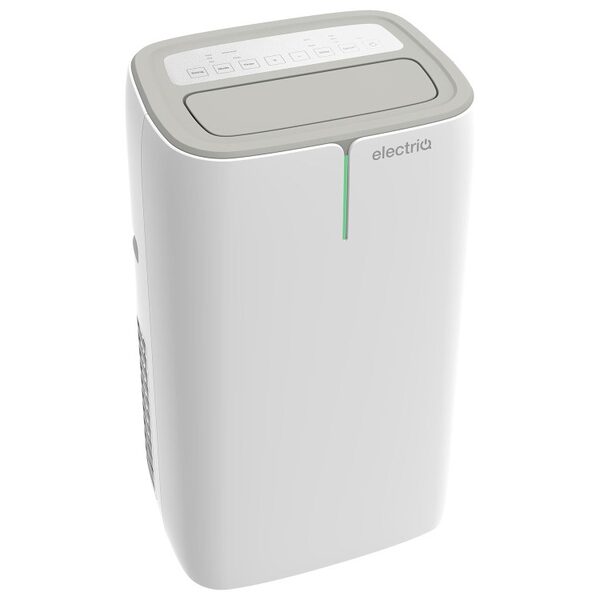
Portable packaged air conditioners cost between £170 and £700 depending on capacity and features6. That is the maker's own range for the category, and it sits below the cost of a fixed installation: one maker cites Checkatrade figures of £500 to £720 per day for air conditioning installation26, which is a labour cost on top of the equipment.
The purchase price and the running cost pull in opposite directions. A cheaper, smaller unit costs less to buy and less per hour to run, but may not cool the intended room adequately and so runs longer. A larger unit costs more to buy and more per hour at full output, but reaches the set temperature sooner. The £170 to £700 range spans units with very different capacities, and the running cost figures in this article span 25p to 46p an hour for the same reason.
There is also a wider price range in the market. One maker puts portable air conditioning systems at around £250 for entry-level models up to more than £3,500 for more comprehensive systems such as portable split air conditioning27. That upper figure is well outside the £170 to £700 packaged range and reflects a different class of equipment.
For a household, the purchase price is a one-off and the running cost is recurring, so the two should be weighed over a season rather than in isolation. A unit bought for £250 and run for two hours a day through a hot fortnight will cost far less in electricity than the same unit run for nine hours a day all summer. The buying decision is covered in how much does air conditioning cost to buy and install and the category itself in portable air conditioners.
Sources27 cited
- Summer energy tips, National Energy Action, 2026-08-13
- Is air conditioning worth it in the UK?, Uswitch, 2026
- Ratings of electrical appliances, Electrical Safety First, 2026-09-19
- How to keep your home cool in hot weather, Centre for Sustainable Energy, 2026-07
- MeacoCool MC Series Pro 9000 BTU Portable Air Conditioner, Meaco, 2026-09-23
- Packaged air conditioning, Netatmo, 2026-09-20
- How much electricity am I using?, Centre for Sustainable Energy, 2026-07
- Domestic portable air conditioners, Cool Easy, 2026-09-23
- Meaco Cirro 12000 BTU Super Quiet Smart Portable Air Conditioner, Meaco, 2026-09-23
- Meaco Cirro+ 14000 BTU Super Quiet Inverter Smart Portable Air Conditioner, Meaco, 2026-09-23
- electriQ EcoPlus10HPW air conditioner, electriQ, 2026-05-22
- The cost of keeping cool: four million homes now use air conditioning, Uswitch, 2026-04-30
- Are electric radiators expensive to run?, Electrorad, 2026-09-20
- Best portable electric heater, EcoFlow, 2025-08-21
- Does it make sense to use photovoltaics for heating?, LONGi, 2026-09-17
- How a heat pump can cool your home, Which?, 2026-07-17
- Cheap ways to stay warm this winter, Which?, 2026-01-29
- Best oil filled radiators, Which?, 2026-06-29
- Common heating mistakes and how to avoid them, Which?, 2026-01-16
- Why electric panel heaters spike bills despite 100% efficiency, Fischer Future Heat, 2026-06-05
- NI electrical items cost, National Energy Action, 2025-04
- Are electric heaters eco friendly?, Which?, 2026-01-15
- Save energy and money, Consumer Council, 2026-09-20
- Do fans work in hot weather? 5 ways to keep your home cool this summer, Ecotricity, 2025-07-15
- Make your home more comfortable in warmer weather, Plymouth Energy Community, 2026-09-20
- Air source heat pumps vs air conditioning, Hive, 2025-10-17
- Packaged air conditioning, Netatmo, 2026-09-20
 Running CostsA portable air conditioner costs roughly twenty to forty pence for every hour it runs, while a fixed unit uses far less electricity for the same cooling.
 Air Conditioning CostPublished UK equipment prices and the parts of an installed price for portable, single split, multi-split and whole-house air conditioning.
 Portable Power Station CostHow much does a portable power station cost in the UK, and what does the money actually buy?
 Domestic Wind Turbine CostA home wind turbine usually costs between nine thousand and nineteen thousand pounds, but the real price depends on its size and how it is mounted.
 Portable Power Station SizeHow big a portable power station does a home actually need, and how long will it keep things running in a power cut?
 Appliance Running CostsWorking out what your appliances cost to run comes down to two things: how much power they use and what you pay per unit of electricity.