
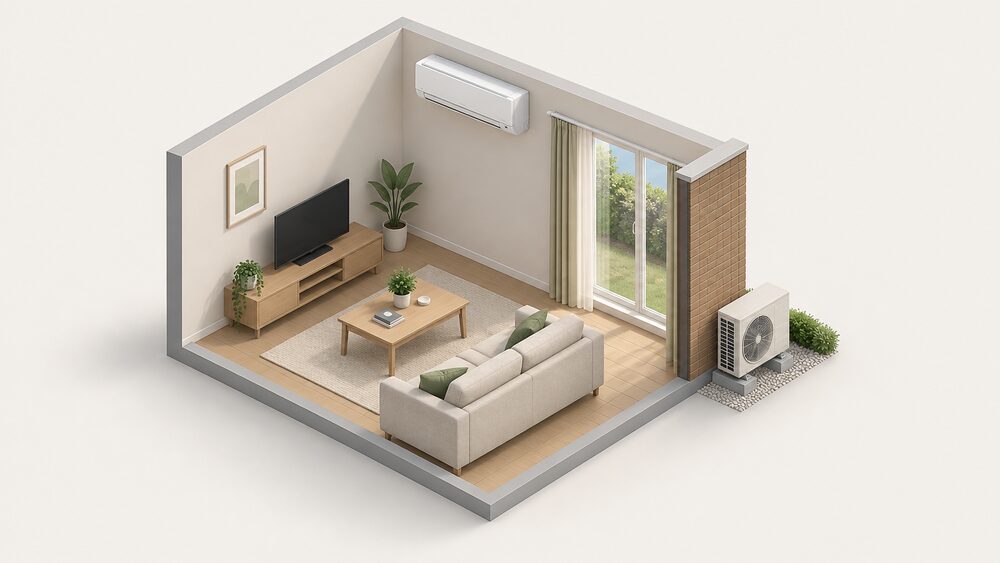
Short answer
A high wall mounted air conditioning system is a fixed indoor unit installed high on the wall of the room being cooled, paired with an outdoor unit1. The cost of one splits into three parts: the hardware, the installation, and the electricity to run it. On hardware, a Daikin Comfora high wall system is listed at £974.99 including VAT, and a Daikin Sensira at £569.99 including VAT2. On installation, the Energy Saving Trust figure reported by Which? is around £1,900 for a single-unit system serving a single room3.
That £1,900 is the number most households want, because it is the whole job rather than the box. It covers the indoor unit, the outdoor unit, the refrigerant pipework, the condensate drain and commissioning. It is also the figure that moves most, because pipe runs, wall construction, access and the electrical supply all vary from one property to the next.
What drives the price: capacity, number of units and brand
Capacity is the first driver. A unit sized for a bedroom costs less than one sized for an open-plan living area, because the compressor, coil and fan are all larger. The second driver is how many indoor units the system serves. A single split has one indoor unit on one outdoor unit; a multi-split puts several indoor heads on one outdoor unit, which raises the hardware cost but avoids a second outdoor position. The multi-split page sets out how that arithmetic works.
Brand is the third driver, and it is the one households notice most because it is visible on the price list. The spread across the ranges sold in the UK is wide. A Samsung WindFree AVANT S2 high wall system is listed at £190.00, with a high street price of £1,489.997. A Daikin Sensira is listed at £569.99 including VAT, or £474.99 excluding VAT2. A Daikin Comfora is listed at £974.99 including VAT, or £812.49 excluding VAT2. One further model is listed at £474.99 including VAT and £474.99 excluding VAT in one place and at £474.99 in another, and its high street price appears as £619.99 and £516.664. Where a maker's own pages give two figures, both are shown here rather than one chosen.
For comparison, a centralised forced air heating system generally starts from £1,700 and rises according to the surface area to be heated8. That is a different product doing a different job, but it shows that a single high wall split sits at the lower end of installed building services work.
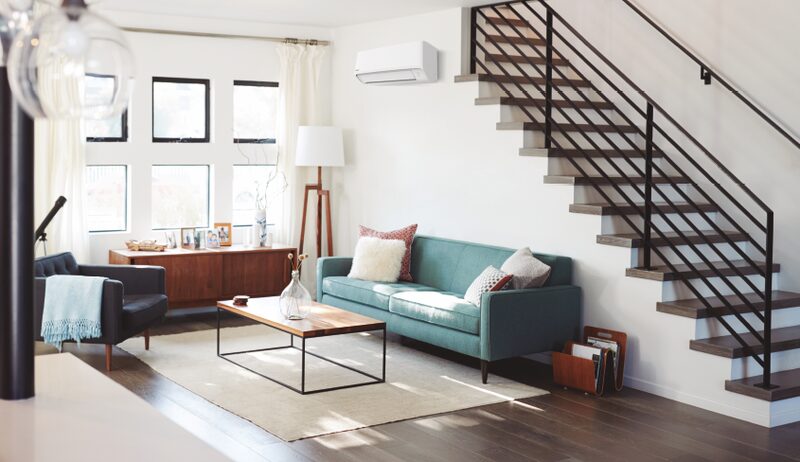
Installation costs and why they vary
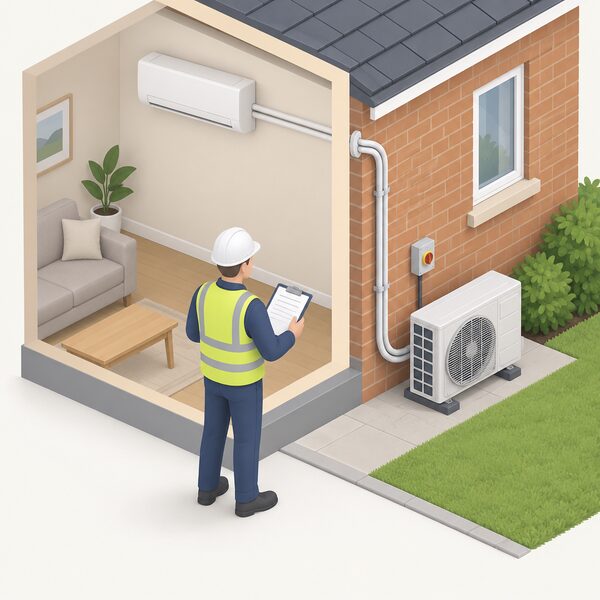
The installed cost of a single-room system is around £1,9003. What sits behind that figure is labour, materials and the physical difficulty of the specific property. External solid wall insulation is a useful benchmark for how much installation labour can vary: it is likely to be more expensive than internal wall insulation because the cost of material and labour are higher9, and a wet underfloor heating system costs between £90 and £110 per square metre with possible extra labour costs on top because it is more complicated to install10. Air conditioning installation follows the same logic. A short pipe run through a cavity wall is a different job from a long run through solid stone.
The range across whole-property work is instructive. External solid wall insulation on a mid-terrace house starts at £7,200 including VAT and can rise to more than £36,000 for a large detached house11. Official statistics put external solid wall insulation for a typical three-bedroom semi-detached house at over £12,00012. Those are insulation figures, not air conditioning figures, but they show how far a single headline number can travel once property type is taken into account.
For a household, the practical point is that the £1,900 figure is a starting expectation for one room, not a quote. A survey establishes pipe route, outdoor unit position, electrical supply and drainage before any price is fixed. The installation page covers what that survey involves.
Running costs and efficiency ratings
Running cost is where a wall unit's energy independence story is weakest. Independent guidance puts a typical portable air conditioner of 1,000 to 1,500W at around 26 to 39p per hour, roughly 14 to 20 times more than a fan5. A fixed high wall inverter unit is generally more efficient than a portable of the same capacity, but the same relationship holds: cooling with a compressor costs far more per hour than moving air with a fan. The air conditioning vs fans page works through that comparison.
Consumption also depends on how long the unit runs. One set of independent figures puts air conditioning at 492 kWh a month on the basis of eight hours a day14. That is a heavy pattern of use, and it shows how quickly a summer of cooling adds up. For context on how electricity is priced, domestic energy bills carry VAT at 5%6, and the unit rate a household pays is set by its tariff rather than by the appliance.
"they are far cheaper to run than air conditioning"
Efficiency ratings matter here. A unit with a better seasonal efficiency figure delivers more cooling per kilowatt hour, which lowers the running cost for the same comfort. The efficiency ratings page explains how SEER and EER are read. What a household should expect in practice is that a well-sized, inverter-driven high wall unit running for a few hours on the hottest days costs a fraction of what the same unit costs if it is left on all day as background cooling.
Grants, VAT and other ways the bill changes

No grant pays for domestic air conditioning. The grant money that exists is aimed at insulation and low carbon heating. Warm Homes: Social Housing Fund Wave 3 offers an additional cost cap uplift of £7,500 grant funding for grant recipients installing low carbon heating measures in homes off the gas grid16. Home Energy Scotland's grant and loan terms set maximum combined funding per improvement, including solid wall at £10,000, flat roof or roof-in-roof insulation at £4,000, loft insulation at £2,000, floor insulation at £2,000, cavity wall insulation at £2,000, high heat retention electric storage heaters at £8,000, a cylinder thermostat at £500, draught proofing at £500, a wastewater heat recovery system at £500, a hot water tank jacket at £500 and heating controls at £60017. None of those lines is air conditioning.
VAT is the one lever that does touch the bill. Domestic energy bills carry VAT at 5%6, and the reduced rate for the installation of energy-saving materials rests on Schedule 7A, Group 3 of the VAT Act 1994, as amended by the Value Added Tax (Installation of Energy-Saving Materials) Order 202418. The changes were introduced by affirmative Statutory Instrument19. Whether a particular air conditioning installation qualifies for the reduced rate depends on the measure and the circumstances, and it is a question for the installer and their accountant rather than something a household can assume.
The grants page covers what is and is not available in each nation.
Owning a wall unit: servicing, lifespan and what it means for energy independence
A wall unit is a long-lived appliance if it is maintained. The pattern used for air source heat pumps, which share the same refrigeration circuit and outdoor unit, is an annual check by the householder and a service every few years by a professional, with maintenance costs described as low20. Wind turbine maintenance checks are necessary every few years and generally cost around £100 to £200 per year depending on the turbine21. Those are different technologies, but they show the order of magnitude for periodic professional attention on a domestic energy appliance.
Warranty is the clearest published figure. The iPAC Wall Mounted Air Conditioning Inverter System carries a 5 year warranty4. For comparison, most system designers can provide a warranty of, or in excess of, 25 years on external wall insulation22. The gap is not a criticism of air conditioning; it reflects that a refrigeration circuit with moving parts and a refrigerant charge is a different proposition from a static insulated wall. The maintenance page covers filter cleaning and servicing in detail.
On energy independence, the honest position is mixed. A high wall unit gives a household direct control over the temperature of one room without relying on a central system, and a reverse-cycle unit can heat as well as cool. But it depends on the electricity grid and on a supplier, it draws a large load when running, and its refrigerant circuit depends on a certified engineer for any work. It does not reduce a household's exposure to electricity prices; it adds to it. Insulation does the opposite, and the figures show why: external wall insulation installed correctly can cut heating bills by as much as 35% or even more23, cavity wall insulation saves a detached house £410 a year24, and solid wall insulation brings benefits including being cheaper to run, feeling warmer in winter and cooler in summer, better air quality and less chance of condensation25. Solid wall insulation can cost thousands of pounds depending on size and wall condition26, and the headline figures differ: around £15,000 for external wall insulation on a whole property27 against around £12,00028. Both figures are given here because the two sources disagree.
The energy independence page sets out how cooling fits into that wider picture. For a household weighing a wall unit, the cost question has three answers: a few hundred pounds for the hardware, around £1,900 for a single-room installation, and an ongoing electricity cost that is real and recurring.
Sources28 cited
- How does air conditioning work?, Netatmo, 2026-09-20
- High wall mounted single split air conditioning systems, Cool Easy, 2026-09-23
- How a heat pump can cool your home, Which?, 2026-07-17
- High wall mounted air conditioning systems, Cool Easy, 2026-09-23
- Summer energy tips, National Energy Action, 2026-08-13
- Understand your electricity and gas bills, Ofgem, 2026
- Kitchen cooling and heating systems, Cool Easy, 2026-09-23
- Forced air heating, Netatmo, 2026-09-20
- Solid wall insulation: external, Centre for Sustainable Energy, 2025-07
- Underfloor heating, Centre for Sustainable Energy, 2025-11
- Wall insulation types, Uswitch, 2026-09-04
- Energy innovation needs assessment: heat and buildings, Department for Energy Security and Net Zero, 2025-06
- Hydropower for the home, Uswitch, 2026-01-06
- Appliances: how much do yours cost to run?, Confused.com, 2025-12-18
- Make your home more comfortable in warmer weather, Plymouth Energy Community, 2026-09-20
- Warm Homes: Social Housing Fund Wave 3 scheme guidance addendum, Department for Energy Security and Net Zero, 2026-06
- Home Energy Scotland Grant and Loan: terms and conditions, Home Energy Scotland, 2024-06-05
- VAT energy-saving materials and grant-funded heating supplies, HM Revenue and Customs, 2026-09-17
- Draft VAT guidance on changes to energy-saving materials, HM Revenue and Customs, 2026-09-17
- Everything you need to know about air source heat pumps, Plymouth Energy Community, 2026-09-20
- Wind turbines, Home Energy Scotland, 2026-09-20
- External wall insulation, Plymouth Energy Community, 2026-09-20
- Benefits of EWI, SWIGA, 2026-09-20
- Cavity wall insulation costs and savings, Which?, 2026-05-05
- Insulating solid walled homes can save on energy bills, SWIGA, 2026-09-20
- 7 tips to keep your home cool during a heatwave, Elmhurst Energy, 2025-08-13
- Insulation, Uswitch, 2026-09-16
- Insulation grants, Which?, 2026-02-26
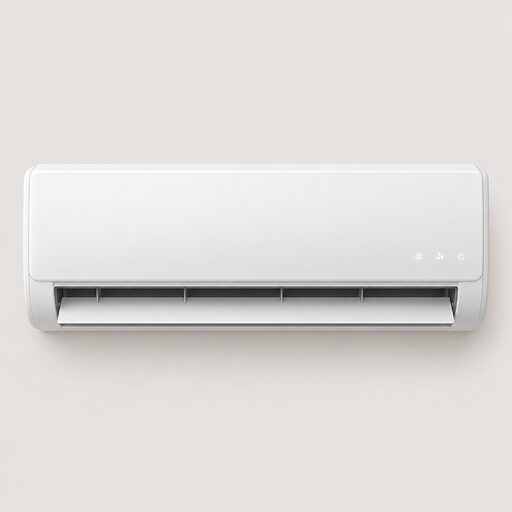 Air Conditioning CostPublished UK equipment prices and the parts of an installed price for portable, single split, multi-split and whole-house air conditioning.
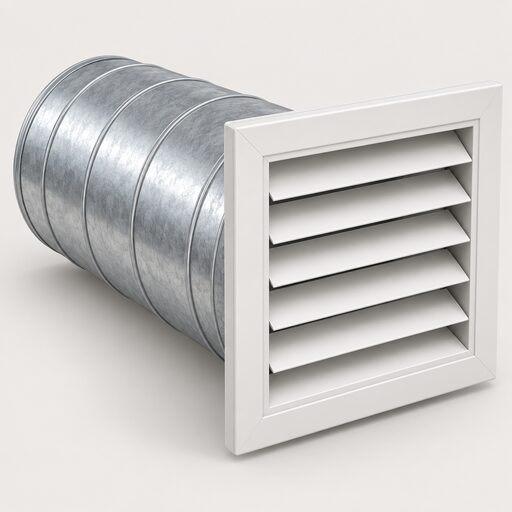 Types of Air ConditioningPortable, wall-mounted, multi-room or ducted: which air conditioning suits your home?
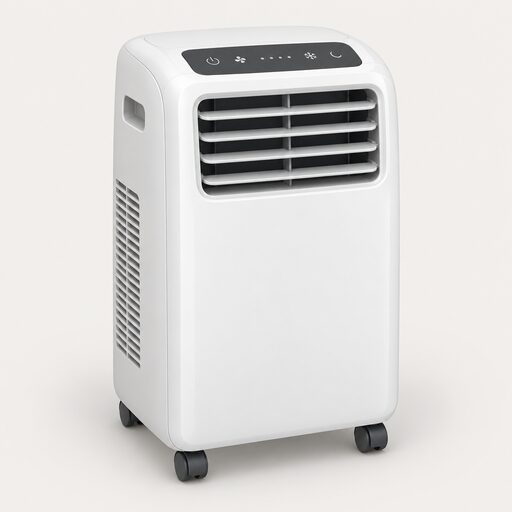 The Full Cooling and Air Conditioning GuideDo you really need air conditioning in a British summer, or would a fan and better shading do the job?
 Insulation and Glazing CostsTypical installed costs for cavity wall, solid wall, loft and roof insulation, draught-proofing and replacement glazing, by measure and home size, with the savings, VAT position and funding schemes that shape the final bill.
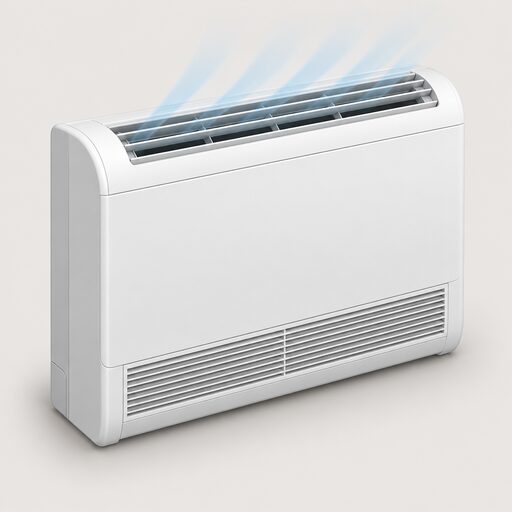 Split Air ConditioningA split air conditioning system cools or heats one room using an indoor unit and an outdoor unit linked by pipes.
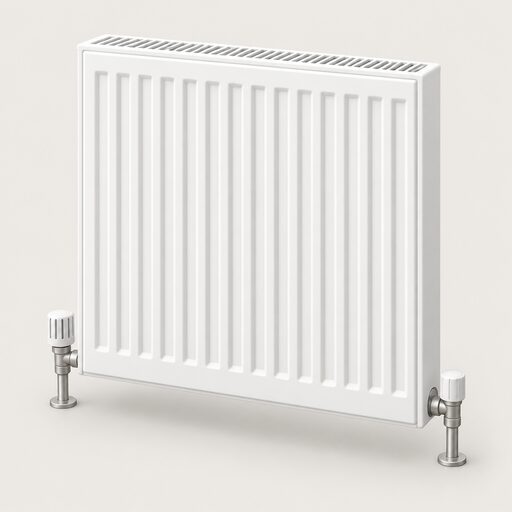 How Much Does a Heat Pump CostA heat pump usually costs around eleven thousand pounds installed, though quotes vary a lot depending on your home.