
In this answer
Short answer
Yes, a fixed air conditioning system can be installed in an existing conservatory, and it is a common way to make a glazed room usable in hot weather. The work is not simply a cooling purchase: it changes how the conservatory is treated under the building regulations, because a conservatory's exempt status depends on it being thermally separated from the house and on no fixed heating being installed in it1.
The practical consequences are straightforward. A fixed air conditioning system is covered by building regulations approval2, and if the heating system is altered or extended into the conservatory it must comply with the Building Regulations, including independent temperature and on/off controls3. A portable unit avoids that entirely, but can only cool small spaces and costs around 26 to 39p per hour to run at 1,000 to 1,500W4.
Costs for a built-in packaged air conditioner usually run from £850 to £2,500, and may cost a bit more in some cases5. For a household, the gain is a room that works in summer without opening the house up to the heat; the dependence that remains is the electricity supply, the outdoor unit's siting, and the fact that a conservatory is still a poorly insulated space that cooling has to fight.
Can you install air conditioning in an existing conservatory?
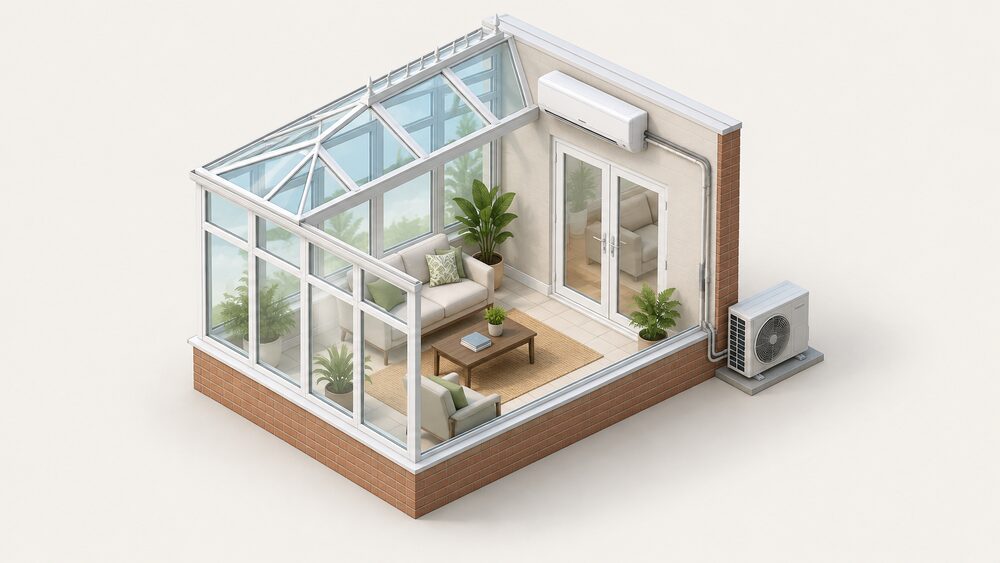
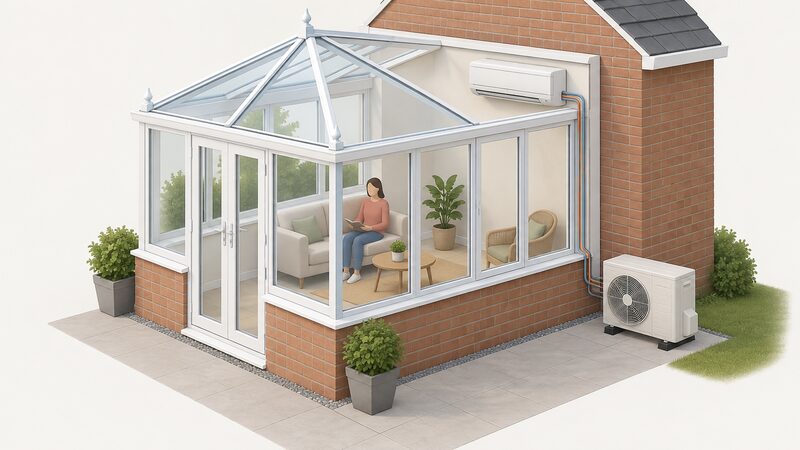
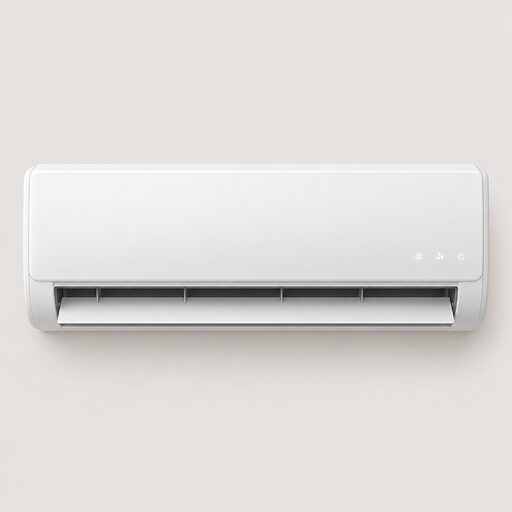
The physical answer is yes. A split system needs an indoor unit on a wall or floor, an outdoor unit for the condenser and compressor, and a route between them for refrigerant pipework, drainage and power. The condenser sits in the outdoor unit with its own fan blowing air across the coil to transfer heat, and the compressor, also housed outdoors, circulates refrigerant between the two parts9. Air-to-air systems need only small refrigerant pipes, typically 6 to 12mm in diameter, for the connection between outdoor and indoor units7.
The regulatory answer is more conditional. A conservatory keeps its exemption from full building regulations compliance only while it is thermally separated from the house by external quality walls, doors or windows, has no fixed heating appliance, and does not have the dwelling's heating system extended into it1. Adding a fixed air conditioning system is itself work covered by building regulations approval2. In Northern Ireland the same principle is expressed as a thermal break that must remain between the dwelling and the extension, with no heating extended into or installed in the conservatory without an application being made10.
That does not make installation impossible. It means the conservatory stops being a simple exempt add-on and starts being treated more like part of the dwelling, with the thermal and ventilation consequences that follow. Where a conservatory is not separated from the house by external quality walls, doors or windows, it loses its exempt status and must adhere to thermal efficiency and ventilation rules, and the new opening needs building regulations approval11.
What the installation involves
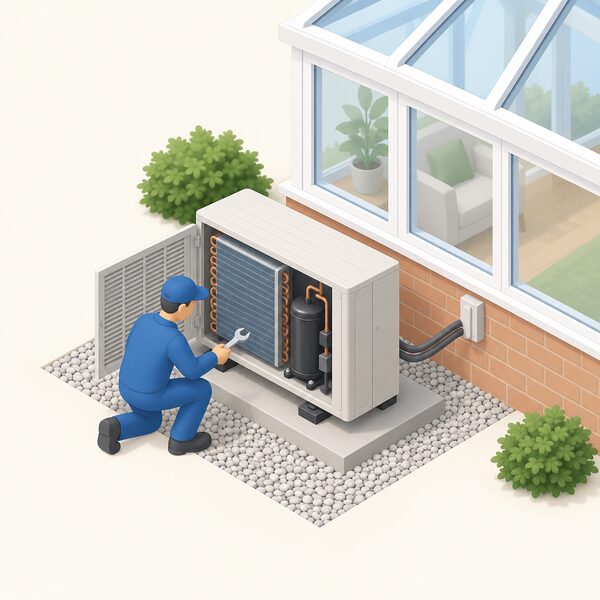
A conservatory installation has three parts: the indoor unit, the outdoor unit and the connection between them. The outdoor unit carries the condenser and the compressor, and needs a position with airflow and reasonable access for servicing9. The compressor's job is to raise the low pressure of the low-temperature refrigerant from the evaporator to a pressure high enough to match the desired condensing temperature, increasing both pressure and temperature12.
Not every conservatory needs an outdoor unit. Internal-installation air conditioners are made for installation without an outdoor unit13, which suits conservatories where there is no practical external position or where the appearance of a wall-mounted condenser is unwanted. These are a different product class from a conventional split, and the trade-offs belong to that category rather than to conservatories specifically.
Where a conservatory roof is being replaced or upgraded at the same time, the guidance for replacement conservatory roofs sets out what may be required: upgrading the thermal qualities of the floor, walls or windows, SAP calculations to justify compliance with the Equivalent Carbon Approach, suitable safety glazing to doors and windows, and safe steps or landings3. The same guidance requires adequate ventilation where necessary to avoid condensation within the roof structure, and states that if the existing conservatory is not already separated from the house by double glazed draught sealed doors, these should be fitted unless previous Building Regulation approval was obtained3.
Planning permission and building regulations
Planning permission and building regulations are separate questions, and conservatories sit differently in each. Conservatories and orangeries do not require planning permission provided they meet certain criteria explained on the Government's Planning Portal website14. Conservatory insulation work generally does not need planning permission either15.
Air conditioning is a separate matter. Adding air conditioning to a home may be considered permitted development provided all the limits and conditions set in legislation are met, and those limits cover the function, size, placement and quantity of units16. Where the property is in a protected area such as a Conservation Area, permission will be required, and listed buildings need listed building consent16. Planning permission is likely to be required for changes to buildings in the ordinary sense17, and householder planning consent covers conservatories as a project type18.
On the building regulations side, putting in a fixed air-conditioning system is listed work requiring approval2. The efficiency requirement for the equipment itself is set in Approved Document L: for existing dwellings, a minimum seasonal energy efficiency ratio of 4.0 in cooling mode6. In Wales, Approved Document L Volume 1 sets out the equivalent framework for dwellings19, and conservatories and porches are included in dwelling primary energy rate, emission rate and energy use intensity calculations only if constructed at the same time as the dwelling and either there is no thermal element between dwelling and conservatory, or the conservatory will be heated via fixed heating19.
The position differs across the four nations. England and Wales share the Approved Document L structure but publish separately, with the Welsh volume issued in 202619. Northern Ireland applies its own building control guidance, including the thermal break rule10 and the replacement conservatory roof requirements3. Scotland is not covered by the documents here, so a household there should treat the position as governed by separate Scottish building standards.
Costs to expect

The published price for a built-in packaged air conditioner is usually £850 to £2,500, and may cost a bit more in some cases5. That is the equipment figure for a built-in model, which the same guidance describes as trickier to install than a portable unit5. Installation labour, electrical work and any making good are quoted by installers rather than published, so no total installed price can be given here.
For comparison within the same room, underfloor heating in a conservatory is quoted at £50 to £75 per m²20. That is a heating measure rather than a cooling one, but it shows the order of magnitude of a conservatory-specific installation. The Forte Grid System, for example, connects floor heating pipes to the reinforced steel gridwork within a conservatory's concrete screed subfloor21, which is a different kind of intervention from an air conditioning install and carries its own disruption.
| Item | Published figure | Source |
|---|---|---|
| Built-in packaged air conditioner | £850 to £2,500, sometimes more | 5 |
| Portable air conditioner running cost | around 26 to 39p per hour at 1,000 to 1,500W | 4 |
| Portable unit, predicted July rates | £16.70 per week at 9.1 hours daily use | 22 |
| Underfloor heating in a conservatory | £50 to £75 per m² | 20 |
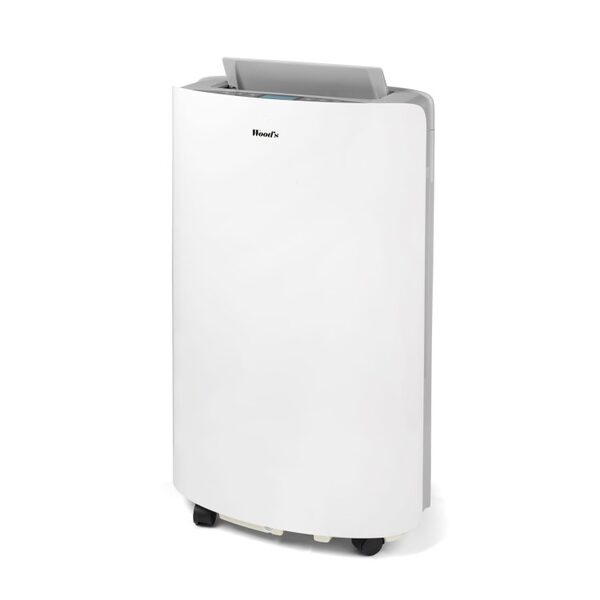
The portable figures matter because they are the alternative a household is most likely to weigh against a fixed system. A portable air conditioner is on castors so it can be wheeled from one room to another, but it can only cool small spaces5. A conservatory is often not a small space, and it is usually the most heat-gain-heavy room in the house.
Running costs and efficiency
Cooling a conservatory is expensive relative to cooling an ordinary room, because the glazing and roof let heat in. Fans are far cheaper to run than air conditioning, and air conditioning increases electricity use and can add significantly to summer energy bills23. A typical portable air conditioner of 1,000 to 1,500W costs around 26 to 39p per hour, roughly 14 to 20 times more than a fan4. At predicted July rates and an average of 9.1 hours of daily use over seven days, a 1kW portable unit comes to £16.70 per week22.
The efficiency of the equipment is regulated rather than left to the market. For existing dwellings, the minimum seasonal energy efficiency ratio in cooling mode is 4.06. That is a floor, not a target, and it applies to the appliance rather than to the room: a conservatory with a large glazed area and a poorly insulated roof will still demand more running hours than the same unit in a bedroom.
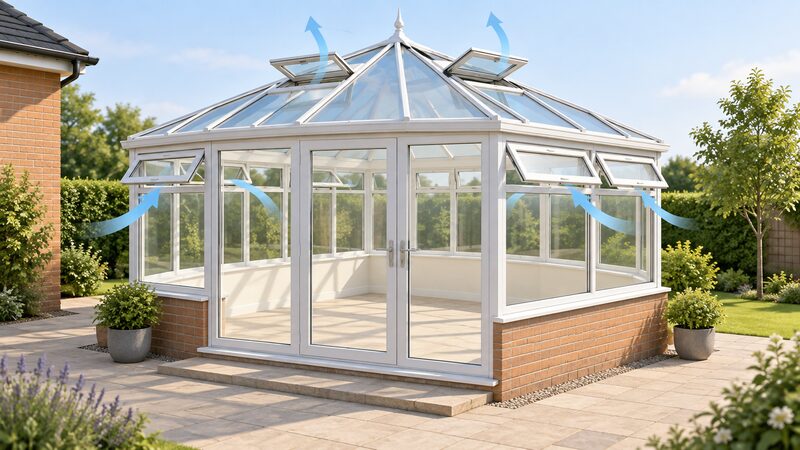
The cheapest cooling measure for a conservatory is not mechanical at all. Designing in natural ventilation such as trickle ventilators, top opening windows or roof vents is far more economical and environmentally friendly than air conditioning24. The same point is made in guidance on conservatory energy efficiency24. Where a conservatory has been built without adequate opening vents, that is a design limitation that no amount of cooling capacity fully corrects.
Alternatives to a dedicated air conditioning unit
The first alternative is ventilation. Natural ventilation through trickle ventilators, top opening windows or roof vents is far more economical and environmentally friendly than air conditioning24. Where the conservatory is separated from the house and can be closed off at night and on cold days25, opening it up in the evening and closing it during peak sun is a zero-running-cost approach.
The second is thermal separation and insulation. Keeping the door shut between the conservatory and the rest of the house reduces heat loss15, and draught excluders for doors, cushions and windows, heavy lined curtains or blinds, and a large rug or carpet are all listed as basic measures15. Low-emissivity coatings on the inside face of double glazed windows can reduce heat loss from radiators inside the structure, and are strongly recommended for north-facing conservatories14. Insulation measures are described as making a conservatory cool in summer, warm in winter, quieter and cheaper to heat15.
The third is a portable unit, which avoids building regulations approval for a fixed system but can only cool small spaces5. A portable air conditioner still needs somewhere for the warm air to go, and its running cost is the figure above.
The fourth is a different appliance entirely. A dehumidifier or heated clothes horse is suggested as an alternative to a tumble dryer26, and an air fryer or microwave instead of an oven27, which shows the general principle that the cheapest way to manage a difficult room is often to change what the room is used for rather than to condition its air. Mechanical ventilation with heat recovery is the Passivhaus approach to air quality and heat28, and a ventilated cavity system forms the basis of at least one official energy efficiency innovation measure29, though neither is a conservatory cooling product.
Where a conservatory air conditioner falls short
A fixed system does not change the fabric of the room. The conservatory remains a glazed structure with high heat gain, and the cooling has to remove that heat continuously while the sun is on it. The efficiency floor of a seasonal energy efficiency ratio of 4.0 applies to the appliance, not to the building6.
It also does not remove the regulatory consequences. Once a fixed system is installed, the conservatory is no longer in the simple exempt category, and the thermal separation conditions that keep it exempt are the same conditions that make it a comfortable room1. In Northern Ireland, no heating can be extended into or installed in the conservatory without an application being made10.
For a household's energy independence, a conservatory air conditioner is a mixed proposition. It gives control over one room without opening the rest of the house, and it can run from a home's own electricity supply, including solar generation. But it adds a summer electrical load, it depends on the grid or on a supplier for that electricity, and it depends on a manufacturer for parts, refrigerant handling and warranty service. The passive alternatives, ventilation, shading and separation, reduce that dependence rather than adding to it.
Sources29 cited
- Building regulations: conservatories, Welsh Government, 2026-09-17
- Building regulations approval, GOV.UK, 2026-09-17
- Replacement conservatory roofs guidance, Building Control Northern Ireland, 2026-04
- Summer energy tips, National Energy Action, 2026-08-13
- Packaged air conditioning, Netatmo, 2026-09-20
- Approved Document L Volume 1: Dwellings, HM Government, 2026
- Air-to-air heat pumps: a low carbon solution for UK homes, Nesta, 2026-02-17
- F-gas regulation, part 4, legislation.gov.uk, 2026-09-17
- How does air conditioning work, Hitachi Air Conditioning, 2026-09-17
- Building control FAQs, Building Control Northern Ireland, 2026
- Do I need building regulations approval to add underfloor heating, Planning Portal, 2026
- Heat pump work, Heat Pumping Technologies, 2025-09-26
- COMPACT, Aermec, 2026-08-13
- Conservatories, Glass and Glazing Federation, 2026-09-20
- Conservatory insulation: make it a room you use all year round, EDF Energy, 2026-09-17
- Is permission needed for installing new roof tiles, Planning Portal, 2026
- Find out if you need planning permission, Buckinghamshire Council, 2026-09-17
- Householder planning consent, Planning Portal, 2026-09-17
- Approved Document L Volume 1 2026, Welsh Government, 2026-04
- How much does underfloor heating cost, Jackery UK, 2026-04-29
- Best floor system for conservatory or extension, Warmup, 2025-02-17
- The cost of keeping cool, Uswitch, 2026-04-30
- Make your home more comfortable in warmer weather, Plymouth Energy Community, 2026-09-20
- Conservatories and energy efficiency, Glass and Glazing Federation, 2023-12-22
- Planning permission: greener homes and conservatories, Welsh Government, 2026-09-17
- Energy efficient laundry, Uswitch, 2026-01-06
- Cold weather energy saving: your top tips, Energy Saving Trust, 2025-09-22
- Passivhaus: what you need to know, Energy Saving Trust, 2026-02-16
- ECO4 Innovation Approved Innovation Measures, Ofgem, 2023-07
 Air Conditioning CostPublished UK equipment prices and the parts of an installed price for portable, single split, multi-split and whole-house air conditioning.
 Running CostsA portable air conditioner costs roughly twenty to forty pence for every hour it runs, while a fixed unit uses far less electricity for the same cooling.
 Split Air ConditioningA split air conditioning system cools or heats one room using an indoor unit and an outdoor unit linked by pipes.
 The Full Cooling and Air Conditioning GuideDo you really need air conditioning in a British summer, or would a fan and better shading do the job?
 DIY Air ConditioningExplains which air conditioning can be fitted without a refrigerant engineer, including portable, through-wall and pre-charged quick-connect split kits, and where the limits lie.
 Types of Air ConditioningPortable, wall-mounted, multi-room or ducted: which air conditioning suits your home?