
In this answer
Short answer
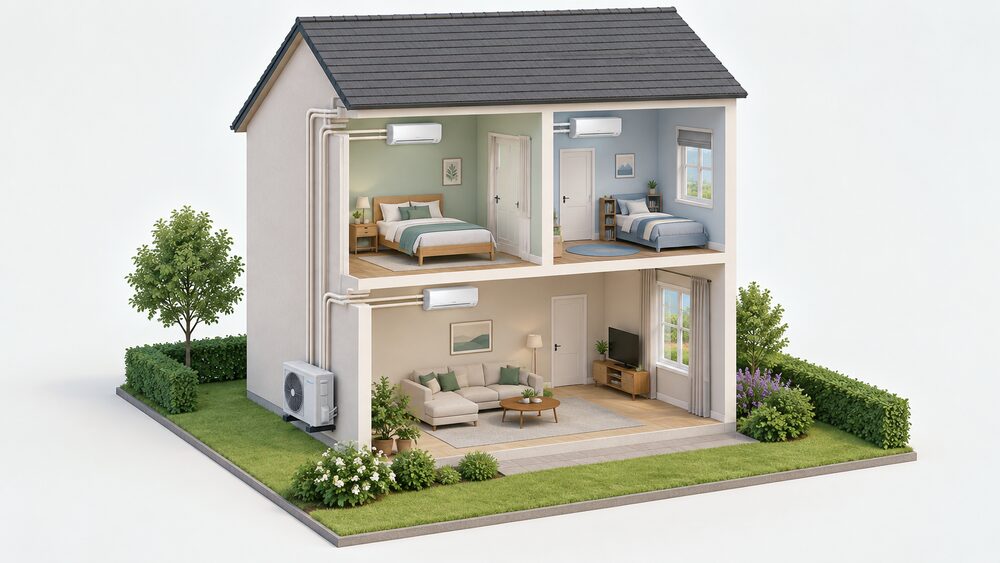
One air conditioning unit can cool more than one room, but only if it is the right kind of unit. A multi-split system runs several indoor units from a single outdoor unit, and Daikin guidance describes one outdoor heat pump connected to up to five indoor units, each adjustable separately1. Nesta puts the typical figure at two to five indoor units per outdoor unit2. A ducted or concealed ceiling system goes further: one unit can heat and cool multiple rooms, with the air handling unit roughly the size of a boiler3.
What does not work is expecting a single-room unit to serve several spaces. A wall-mounted monobloc heats and cools one room only and is not a whole-house solution5. A portable air conditioner is the same story: Pro Breeze states that a single unit cannot cool multiple rooms at once, though models on castors can be wheeled from room to room6. A pair system, one outdoor unit to one indoor unit, is described by Daikin as heating and cooling for one room7.
So the answer turns on system type rather than on the number of rooms a household wants to cool. The sections below set out what each type can and cannot do, what it costs to run, and what maintenance it needs.
The short answer: it depends on the type of unit
The distinction that matters is between a system with one indoor unit and a system with several. An air conditioning system with multiple units can heat several rooms inside the home10. A single split, by contrast, is designed to provide climate control to one room within the house11. Daikin's pair system is described in the same terms: heating and cooling for one room by connecting one outdoor unit with one indoor unit7.
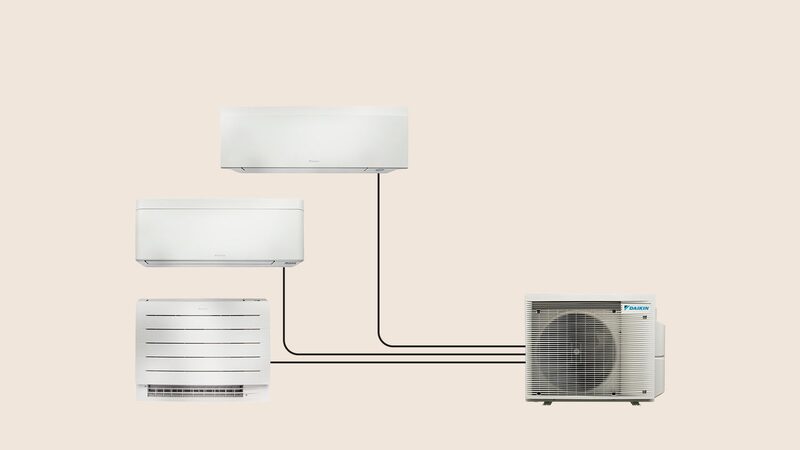
Multi-split systems are the middle path. They allow multiple indoor units to be connected to a single outdoor unit12, and Ferroli describes several rooms being climatised from one outdoor unit13. Netatmo's guidance is that this makes it possible to cool several rooms in the house, unlike with a mono-split system14. Panasonic's Free Multi Split range is described as powerful heating of two or three rooms with one outdoor unit, even at -35°C low outdoor temperatures15.
There is a constraint that catches people out. On a multi-split system, all indoor units must be operating in cooling or heating mode simultaneously8. A household cannot heat one bedroom while cooling another from the same outdoor unit. Each room's temperature can be set individually, but the mode is shared.
Ducted and concealed ceiling systems take the same principle further, serving the whole house from one plant location. The trade-off is that they are fixed, hidden in ceiling voids, and installed as part of a build or refurbishment rather than added room by room.
Portable air conditioners: one unit, one room
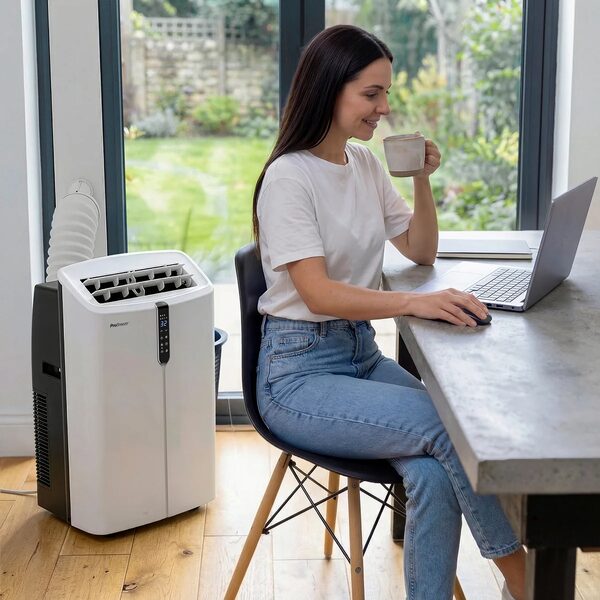
A portable air conditioner actively cools the air in the room it stands in16. It removes warm air from the room and vents it outside via an exhaust hose, while circulating cooled air indoors17. That is a single-room process by design, and Pro Breeze states that a single unit cannot cool multiple rooms at once6.
Portability is the compensation. Portable units sit on castors so they can be wheeled from one room to another18, and they are described as ideal for bedrooms, lounges, home offices and rental properties where fixed systems may not be possible17. They are also suitable for commercial spaces and anywhere flexible, on-demand climate control is wanted19. What they are not is a way to cool two rooms at the same time.
Two practical points follow. Air conditioning works best in a completely sealed environment, so all windows and doors should be kept closed while in operation8. And because the main unit sits inside the room and vents through a hose, portable units may not feel as quiet or efficient as a fixed system20. Most portable units have a sound pressure of approximately 56 dB during operation8.
Multi-split systems: several rooms from one outdoor unit
A multi-split system connects multiple indoor units to a single outdoor unit12. Daikin guidance describes one outdoor heat pump unit connected to up to five indoor units, with per-room temperature adjustment1. Nesta's figure is typically two to five indoor units per outdoor unit2. A specific Daikin Multi+ Class 90 model is listed as connecting up to four indoor units21.
The appeal is partly practical. A single compact outdoor unit enables air conditioning in multiple rooms, which solves the problem of narrow or limited installation space22. For a flat or a terraced house with nowhere to put several condensers, that matters as much as the cooling itself.
Control is per room. Each unit can be adjusted individually using its own remote control or an app, so different rooms can run at different temperatures23. Fujitsu's AIRSTAGE Mobile app allows multiple air conditioners to be combined into a single group for centralised operation, with several groups organised at once24. Panasonic's Comfort Cloud app notes that for a multi-split air conditioner, electricity bill and energy consumption will be the same for all indoor units25.
The efficiency case is made by Mitsubishi Electric: a multi-split is more energy-efficient than using several separate units, as it uses one outdoor unit for multiple indoor units, reducing overall energy consumption and maintenance costs compared with multiple single-split systems23. That is a maker's claim about its own category, and it rests on the shared outdoor unit rather than on any particular indoor unit.
Concealed ceiling and ducted options: one unit for the whole house
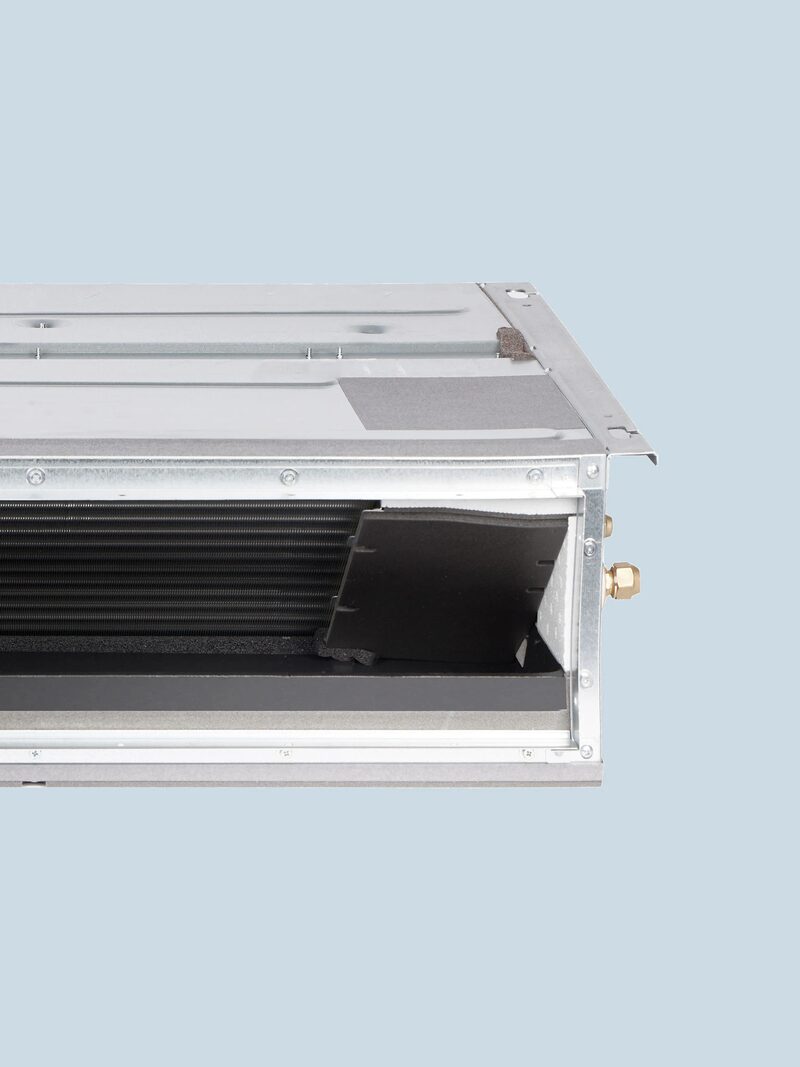
Ducted systems move air through slim pipes hidden in ceiling voids, with the air warmed or cooled in an air handling unit roughly the size of a boiler, normally in a loft or utility room4. Daikin states that one unit can heat and cool multiple rooms3. Mitsubishi Electric describes its ceiling concealed ducted systems as usable for heating and cooling, and as versatile all year round26.
This is the closest thing to whole-house cooling from a single unit. It is also the least flexible to install. Ducting has to be routed through voids, which suits a new build, a major refurbishment, or a loft conversion where the ceiling is already open. Retrofitting ducts into a finished house is a different proposition from hanging a high wall unit.
There is an energy point that applies to ducted systems and to any room-sealed appliance. Official Welsh building guidance states that installation of room-sealed appliances, or those with a directly connected ducted external air supply, will minimise ventilation energy losses from the room and the risk of cold draughts27. A ducted system that draws and returns air within the building fabric avoids the open-window losses a portable unit creates.
The trade-off against a multi-split is control. A ducted system serves zones rather than individual rooms, and zoning depends on how the ductwork and dampers are designed. A multi-split gives each room its own indoor unit and its own setpoint. A household wanting one bedroom cool and the rest of the house untouched may find the multi-split more precise; a household wanting even temperatures throughout may prefer the ducted approach.
Cost and efficiency: what each option involves
The cost picture follows the hardware. A single packaged air conditioner costs less than installing a system with multiple units28. That is the straightforward comparison: one indoor unit and one outdoor unit against several of each.
Running costs are where the picture shifts. Portable units use 30 to 50% more electricity than fixed systems9. The reason is structural rather than a matter of build quality: the compressor and the evaporator sit in the room being cooled, and the exhaust hose radiates heat back into that room as it carries warm air out. A fixed split puts the noisy, heat-producing half outdoors.
Multi-split efficiency rests on sharing. Mitsubishi Electric states that a multi-split is more energy-efficient than using several separate units, reducing overall energy consumption and maintenance costs compared with multiple single-split systems23. Panasonic's app guidance notes that on a multi-split, electricity bill and energy consumption will be the same for all indoor units25, which is a metering statement rather than an efficiency one: the household sees one combined figure.
| System | Rooms served | Installation | Notes |
|---|---|---|---|
| Portable | One at a time | None, plug and play8 | 30 to 50% more electricity than fixed systems9 |
| Pair (single split) | One room7 | Fixed, by installer | Efficient cooling and heating for individual rooms29 |
| Multi-split | Two to five rooms2 | Fixed, by installer | One outdoor unit for multiple indoor units23 |
| Ducted or concealed ceiling | Multiple rooms3 | Fixed, during build or refurbishment | Air handling unit roughly the size of a boiler4 |
For a household weighing independence, the split matters. A portable unit depends on a window being available and on the household moving it; a fixed system depends on an installer, on pipework, and on an outdoor position that may need consent. Neither removes the dependence on grid electricity, and a multi-split concentrates more of that dependence into a single outdoor unit that must run for any room to be cooled.
Running and maintaining whichever system you choose
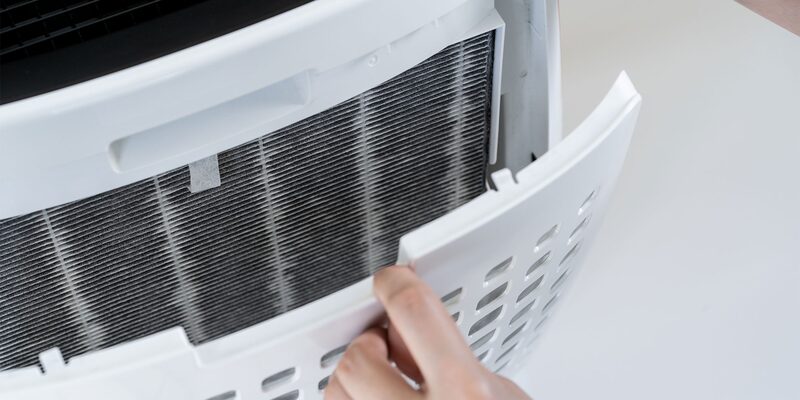
Maintenance tasks for homeowners are listed as washing the filter, removing dust, and checking for mould and other build-ups11. On a portable unit that is a household job, done more often because the filter sits in the room and collects dust from the space being cooled. On a fixed system the same tasks apply to each indoor unit, and a multi-split with five indoor units means five filters.
Air-to-air systems can also offer cooling30, and many models function as both heaters and air conditioners31. Reversible units can provide both heating and cooling, but not all units do this5. A household buying for summer cooling alone may find the heating function unused; a household buying a reversible unit gets a second function from the same hardware.
There is a limit at the cold end. In very cold winters and at particularly low temperatures, reversible air conditioning will not be powerful enough to heat the room well28. That is a heating limitation rather than a cooling one, but it matters for anyone treating an air conditioner as a year-round heat source.
On the cooling side, most air conditioning products will only go as low as 18°C, a limit attributed to legislation8. That applies to the setpoint, not to the temperature of the air leaving the unit.
"Air conditioning works best in a completely sealed environment, so to achieve the optimum results all windows and doors should be kept closed while in operation."
For a household, the maintenance burden scales with the number of indoor units, and so does the number of things that can go wrong. A single portable unit is one filter and one hose. A five-room multi-split is five filters, five drain routes and one outdoor unit that every room depends on. That concentration is the price of cooling several rooms from one system, and it is worth weighing against the convenience before committing to a whole-house installation.
Sources31 cited
- How many rooms can I cool or heat with an air to air heat pump?, Daikin, 2026-09-17
- Air-to-air heat pumps: a low-carbon solution for UK homes, Nesta, 2026-02-17
- Concealed ceiling, Daikin, 2026-09-17
- Air to air heat pumps, Energy Saving Trust, 2026-09-11
- How a heat pump can cool your home, Which?, 2026-07-17
- Air conditioners, Pro Breeze, 2026-09-23
- Pair system, Daikin, 2026-09-17
- FAQs, Cool Easy, 2026-09-23
- How to keep your home cool in hot weather, Centre for Sustainable Energy, 2026-07
- How does air conditioning work, Netatmo, 2026-09-20
- Air conditioner buying guide: which one is right for your home, Hitachi, 2026-09-17
- Multi split air conditioning, Cool Easy, 2026-09-23
- Air conditioners, Ferroli, 2026-09-17
- Home air conditioning, Netatmo, 2026-09-20
- Free multi split, Panasonic, 2026-09-17
- Cooling, Dimplex, 2026-09-17
- Domestic portable air conditioners, Cool Easy, 2026-09-23
- Packaged air conditioning, Netatmo, 2026-09-20
- Cooling and heating portable air conditioners, Cool Easy, 2026-09-23
- Air conditioning size guide, Cool Easy, 2026-09-23
- Daikin 5 port Class 90 multi air conditioner, Quiet Mark, 2026-09-17
- Outdoor units features, Panasonic, 2026-09-17
- How to choose the right home air conditioning, Mitsubishi Electric, 2026-09-17
- AIRSTAGE Mobile, Fujitsu General, 2026-09-17
- Panasonic Comfort Cloud app, Panasonic, 2026-09-20
- Ceiling concealed ducted system, Mitsubishi Electric, 2026-09-20
- Building regulations guidance Part J: heat producing appliances, Welsh Government, 2026-09-17
- How does air conditioning work, Netatmo, 2026-09-20
- Domestic ranges, Panasonic, 2026-09-17
- Air source heat pump, MCS Certified, 2026-07-24
- Air to air fitted heating units, Cool Easy, 2026-09-23
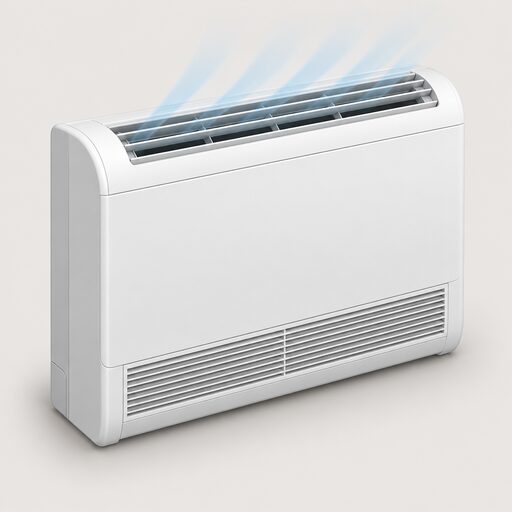 Split Air ConditioningA split air conditioning system cools or heats one room using an indoor unit and an outdoor unit linked by pipes.
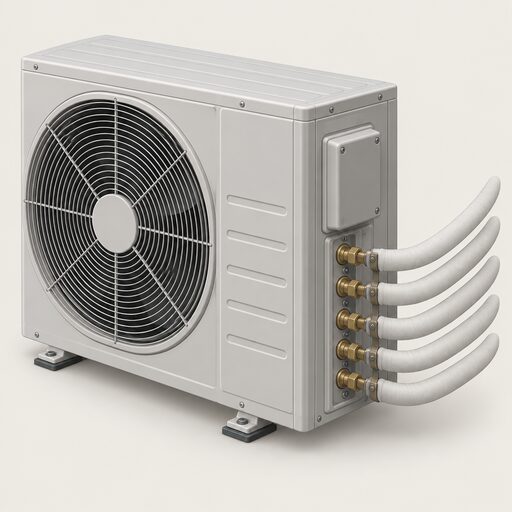 Multi-Split ACHow multi-split air conditioning works when one outdoor unit serves several indoor units: how many rooms one system can serve, independent room control, efficiency, outdoor unit size and sound, planning rules in England and Scotland, servicing and lifespan, the 0% VAT position and how it compares with separate single splits.
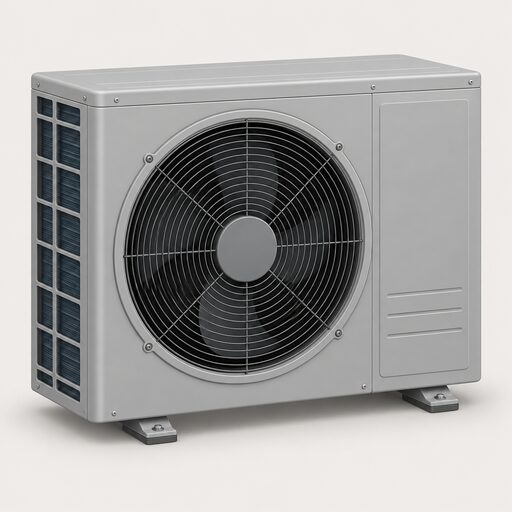 Cooling and Heat PumpsCan an air conditioner heat your home as well as cool it?
 Using a Heat Pump for CoolingCan a heat pump cool your home in summer as well as heat it in winter?
 Air Conditioning SizingHow big an air conditioner does a room need?
 Types of Air ConditioningPortable, wall-mounted, multi-room or ducted: which air conditioning suits your home?