
In this answer
Short answer
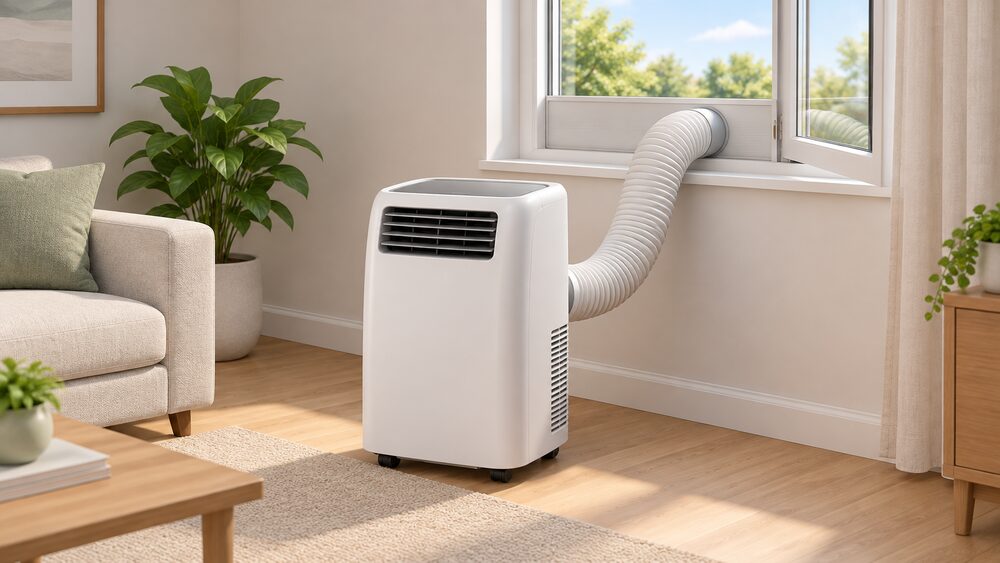
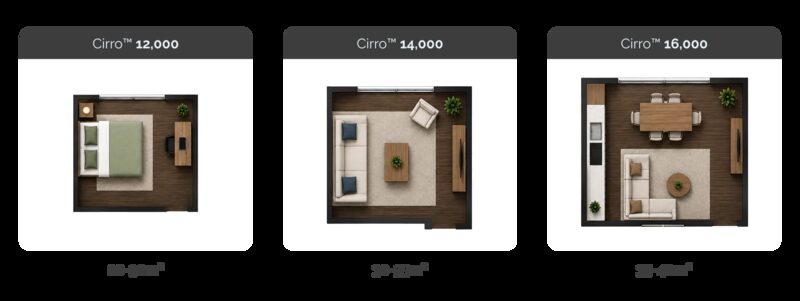
A 16,000 BTU portable air conditioner is rated for a room of roughly 35 to 40 m². That is the figure the maker of the Meaco Cirro+ 16000 BTU gives for its own unit, described as an estimate based on a typical UK living space1. It sits just above the 15,000 BTU row in the CoolEasy sizing table, which puts 4.5 kW at up to 40 m²2. For scale, the same maker rates its 12,000 BTU Cirro at 20 to 30 m² and its 14,000 BTU Cirro+ at 25 to 35 m²3.
The number is a starting point, not a promise. Portable units are single-duct or twin-duct appliances that sit inside the room and exhaust heat through a window kit, so the room they can hold at temperature depends as much on the building as on the badge. Meaco states plainly that room sizes are approximate and that ceiling height, insulation, glazing and sun exposure can affect cooling performance5.
This page sets out what 16,000 BTU covers, how the figure maps across the portable range, and where real-world coverage falls short of the label.
Room size: 35 to 40 m² for a 16,000 BTU unit
The headline figure comes from the maker's own product page. The Meaco Cirro+ 16000 BTU is listed with a room size of 35 to 40 m², marked as an estimate for a typical UK living space1. The same rating appears on the heater version of the unit7. That places a 16,000 BTU portable in the top tier of what is commonly sold as a plug-in, window-vented appliance.
Cross-checking against a general sizing table gives a consistent answer. CoolEasy's guide puts 4.5 kW, which is 15,000 BTU, at up to 40 m², and 5.0 kW, or 18,000 BTU, at up to 45 m²2. A 16,000 BTU unit therefore sits between those two rows, closer to the 40 m² mark. The table is built on standard room heights up to approximately 2.7 metres, and the same guidance notes that sizing also depends on insulation, glazing, sunlight, ceiling height, room use and occupancy2.
Other makers in the same tier quote similar coverage. The electriQ AirFlex 14000 BTU, including its refurbished and heating versions, is rated for rooms in the same mid-thirties band as the Meaco 14,000 BTU unit8. The Lux Air 14,000 BTU portable heat pump is rated for spaces up to 35 m², with conservatories up to 22 m²11. Those are 14,000 BTU machines, so a 16,000 BTU unit sits a little above them, which is what the 35 to 40 m² rating reflects.
How BTU output maps to room size across the portable range
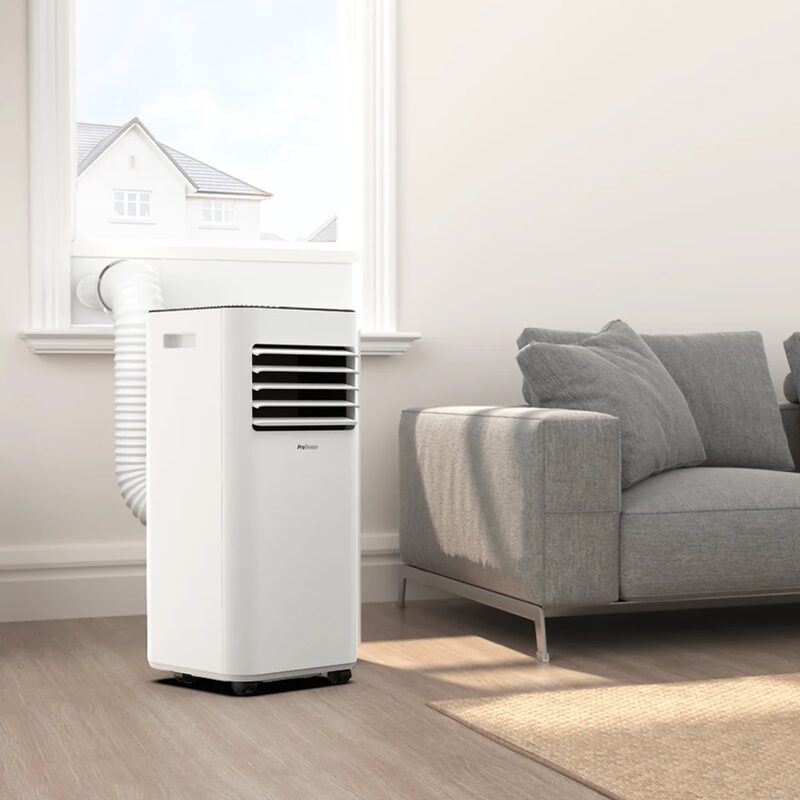
BTU output and floor area rise together, but not in a straight line. The CoolEasy table runs from 1.5 kW, or 5,000 BTU, at up to 12 m², through 9,000 BTU at up to 20 m² and 12,000 BTU at up to 30 m², to 4.5 kW, or 15,000 BTU, at up to 40 m²2. Above that, 5.0 kW, or 18,000 BTU, covers up to 45 m², 6.2 kW, or 21,000 BTU, up to 50 m², and the table continues to 14.0 kW, or 48,000 BTU, at up to 110 m²2.
| Output | Rated room area | Example |
|---|---|---|
| 9,000 BTU | 16 to 26 m² | MeacoCool MC Series Pro 9000 BTU12 |
| 12,000 BTU | 20 to 30 m² | Meaco Cirro 12000 BTU3 |
| 14,000 BTU | 25 to 35 m² | Meaco Cirro+ 14000 BTU4 |
| 14,000 BTU | up to 35 m² | Lux Air portable heat pump11 |
| 16,000 BTU | 35 to 40 m² | Meaco Cirro+ 16000 BTU1 |
The maker ratings and the general table do not always agree. CoolEasy's own product pages carry a 12,000 BTU row at up to 30 m² and a 9,000 BTU row at up to 20 m², while the Meaco figures for the same nominal outputs are 20 to 30 m² and 16 to 26 m² respectively2.
Higher output also means more electricity. The National Energy Action guidance gives a typical portable air conditioner a power rating of 1,000 to 1,500 W6, and Electrical Safety First puts the general portable range at 900 to 2,000 W, noting that the higher the BTUs the higher the power13. A 16,000 BTU unit sits at the upper end of that band, which matters for running cost and for what a domestic circuit can carry.
What limits real-world coverage: layout, insulation and heat gain
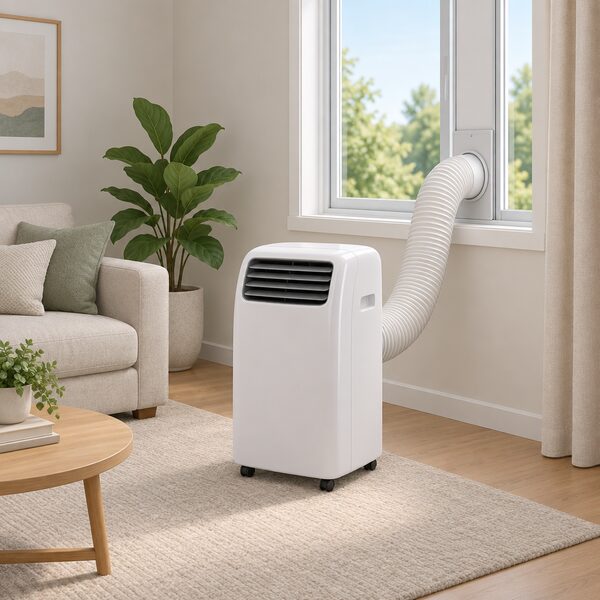
The rated area assumes a room the appliance can actually reach. Meaco states that room sizes are approximate and that ceiling height, insulation, glazing and sun exposure can affect cooling performance5. CoolEasy's table is based on standard room heights up to approximately 2.7 metres, and the same guidance lists insulation, glazing, sunlight, ceiling height, room use and occupancy as factors that change the answer2. A south-facing room with large glazing and a high ceiling will not behave like the table row.
Ceiling height matters because a taller room holds more air. The sizing rule quoted by Hitachi Air Conditioning, attributed to the US Department of Energy, is 20 BTU per square foot at an average ceiling height14. That rule is a floor-area calculation, so it assumes a normal ceiling; raise the ceiling and the same floor area needs more output. The CoolEasy table makes the same assumption explicit at 2.7 metres2.
Layout and heat gain do the rest. An open-plan space shares its air with a kitchen, stairs and hallway, so a unit rated for 35 to 40 m² of enclosed room may only hold part of a larger connected volume. Independent guidance suggests aiming for 18,000 BTUs for the best results in that situation15, and the CoolEasy table puts 18,000 BTU at up to 45 m²2. Conservatories are a separate case again: the Lux Air 14,000 BTU unit is rated for spaces up to 35 m² but for conservatories up to 22 m², a much smaller figure for the same machine11.
Is a 16,000 BTU unit too big for a bedroom?
For a single bedroom, yes, in most cases. The MeacoCool MC Series Pro 9000 BTU is rated at 16 to 26 m² and the Meaco Cirro 12000 BTU at 20 to 30 m²12, both well under the 35 to 40 m² of the 16,000 BTU Cirro+1. A typical UK bedroom falls inside those smaller bands.
Oversizing is not just wasted capacity. CoolEasy notes that an oversized system can create stronger airflow than needed and may not provide the steady, gentle temperature control wanted, especially in bedrooms or small offices2. A larger unit cycling on and off in a small room gives a harsher result than a smaller one running steadily.
There is a counter-example in the guidance. Hitachi Air Conditioning, quoting the US Department of Energy recommendation, gives a 16,000 BTU air conditioner as the example for a two-room apartment of 800 sq ft, a living room and bedroom together14. That is a multi-room figure, not a single bedroom, and it shows how the same output can be right for one layout and wrong for another.
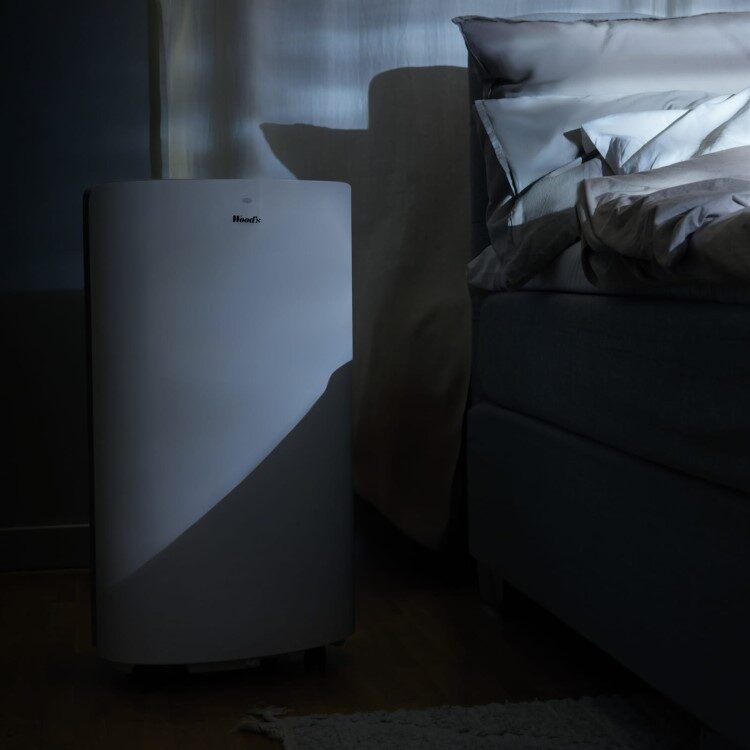
What happens if the air conditioner is undersized for the room?
An undersized unit shows itself in behaviour rather than a number. CoolEasy lists slow cooling, constant running, uneven comfort and poor performance during heatwaves as signs that a system may be too small2. Hitachi Air Conditioning adds that the unit will run at its maximum power continuously and still not reach the desired comfort level, which increases energy consumption and lowers the air conditioner's lifespan14.
That second point is the one that costs money. A machine that never reaches its setpoint runs at full draw for as long as it is switched on, so the electricity bill reflects continuous operation rather than the shorter, steadier cycles of a correctly sized unit. The same logic applies in reverse to an oversized unit, which cools quickly and then cycles, giving less even comfort2.
The practical test is whether the unit holds the room at the temperature set on a hot afternoon. If it runs without pause and the room still drifts warm, the output is short for the space, the glazing or the heat gain. If it reaches temperature quickly and then keeps stopping and starting, it is larger than the room needs.
Does ceiling height affect the room size a portable AC can cool?
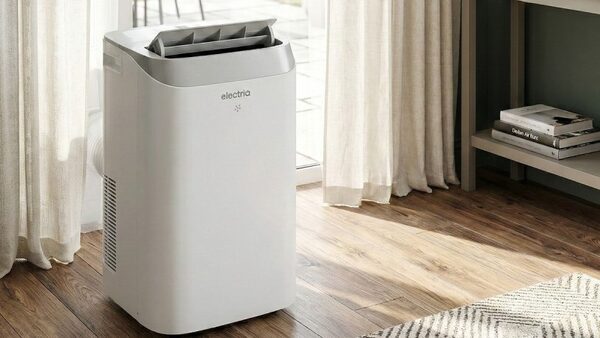
It does, and the sizing tables say so. CoolEasy's table is based on standard room heights up to approximately 2.7 metres, and the same guidance names ceiling height among the factors that change the result2. The 20 BTU per square foot rule quoted by Hitachi Air Conditioning is likewise tied to an average ceiling height14.
The reason is volume rather than floor area. Room size tables of this kind are based on standard room heights up to approximately 2.7 metres, and a room with a higher ceiling holds more air over the same footprint, all of which has to be cooled. A 16,000 BTU unit rated at 35 to 40 m² on a standard ceiling will cover less floor area in a taller room, and the shortfall grows with the height.
For a household in a period property, a converted loft or a room with a vaulted ceiling, the rated figure should be treated as optimistic. The same applies to rooms with large unshaded glazing, which adds heat gain through the day. Meaco's own note that room sizes are approximate and depend on ceiling height, insulation, glazing and sun exposure covers both cases5.
Can a 16,000 BTU portable air conditioner cool an open-plan space?
Partly, and usually not the whole of it. Independent guidance suggests aiming for 18,000 BTUs for the best results in a larger or open space15, and the CoolEasy table puts 18,000 BTU at up to 45 m² against 15,000 BTU at up to 40 m²2. A 16,000 BTU unit sits between those rows, so it is close to the recommended figure but below it.
The bigger problem is that open-plan space is not one room. Air moves between the kitchen, dining and living zones, and a single portable unit placed in one corner will not hold the whole volume at temperature. The rated 35 to 40 m² assumes an enclosed room of standard height1; an open-plan layout of the same floor area behaves like a larger space because the unit is cooling air that circulates away from it.
Where a portable unit does fit, the guidance is narrow. Daikin states that portable air conditioning units still have a place, particularly for temporary set-ups or rooms under 10 m², but for longer-term use a fixed system is the better route16. Netatmo describes a single-packaged air conditioner as ideal for small areas of up to 30 m²17. For a large open-plan room, a fixed split system sized to the space is the option the sources point to, and the air conditioning sizing guide sets out how that calculation works.
Where a 16,000 BTU portable falls short
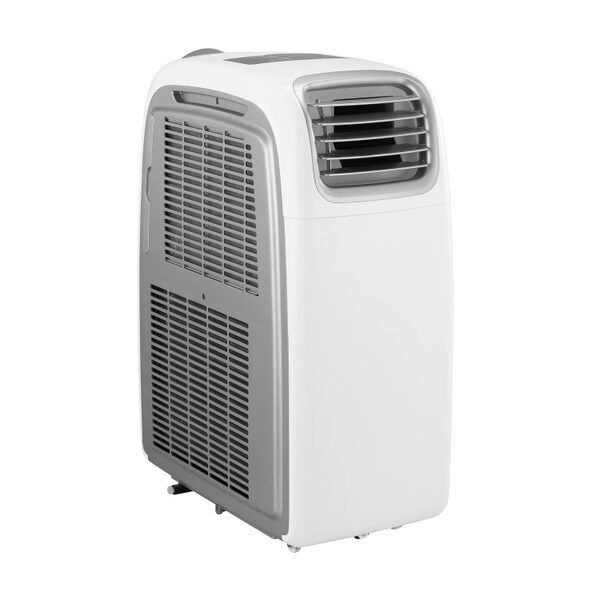
The appliance is a compromise by design. It sits inside the room it cools, so it adds its own heat and noise to the space, and it needs a window or wall opening for the exhaust. The Meaco Cirro 12000 BTU's window kit reaches up to 39 cm wide and up to 4 m long3, which is a constraint on where the unit can stand relative to a suitable opening.
It also draws a substantial load. Electrical Safety First gives portable air conditioners a typical range of 900 to 2,000 W, with higher BTUs meaning higher power13, and National Energy Action puts a typical portable unit at 1,000 to 1,500 W6. A 16,000 BTU machine sits at the top of that band, so the circuit it plugs into and the cost of running it both matter.
For a household weighing independence, the portable unit is the least fixed option: no installer, no refrigerant work, no planning question in most cases, and it can move between rooms or go into storage out of season. What it does not do is remove the dependence on the electricity supply, and it cannot match a fixed system for even coverage of a large space. The portable air conditioners guide covers how these units work and where their limits lie, and the home cooling pillar puts them alongside the alternatives.
"Room sizes are approximate. Ceiling height, insulation, glazing and sun exposure can affect cooling performance."
Sources17 cited
- Meaco Cirro+ 16000 BTU Portable Air Conditioner, Meaco, 2026-09-23
- Air Conditioning Size Guide, CoolEasy, 2026-09-23
- Meaco Cirro 12000 BTU Portable Air Conditioner, Meaco, 2026-09-23
- Meaco Cirro+ 14000 BTU Portable Air Conditioner, Meaco, 2026-09-23
- Meaco Air Conditioners Collection, Meaco, 2026-09-23
- Summer Energy Tips, National Energy Action, 2026-08-13
- Meaco Cirro+ 16000 BTU Portable Air Conditioner and Heater, Meaco, 2026-09-23
- electriQ AirFlex 14000 BTU Portable Air Conditioner, electriQ, 2026-09-23
- electriQ BUN/AIRFLEX15 Portable Air Conditioner, electriQ, 2026-09-23
- electriQ AirFlex 14000 BTU Portable Air Conditioner with Heating, electriQ, 2026-09-23
- Lux Air 4.0kW (14000 Btu) Portable Air Conditioning Heat Pump, CoolEasy, 2026-09-23
- MeacoCool MC Series Pro 9000 BTU Portable Air Conditioner, Meaco, 2026-09-23
- Ratings of Electrical Appliances, Electrical Safety First, 2026-09-19
- What Size of Air Conditioner Do I Need?, Hitachi Air Conditioning, 2026-09-17
- Is Air Conditioning Worth It in the UK?, Uswitch, 2026-07-14
- Air-to-Air Heat Pumps for Small Rooms, Daikin, 2026-09-17
- How Does Air Conditioning Work?, Netatmo, 2026-09-20
 Air Conditioning SizingHow big an air conditioner does a room need?
 Running CostsA portable air conditioner costs roughly twenty to forty pence for every hour it runs, while a fixed unit uses far less electricity for the same cooling.
 Types of Air ConditioningPortable, wall-mounted, multi-room or ducted: which air conditioning suits your home?
 Air Conditioning NoiseHow loud will an air conditioner be inside your home, and how much noise will the outdoor unit make for you and your neighbours?
 Thermostat and Room TemperaturesWhat temperature should a thermostat be set to, and does it differ from room to room?
 Portable Power Station SizeHow big a portable power station does a home actually need, and how long will it keep things running in a power cut?