In this guide
The Lux Air 3.5kW (12000 Btu) portable air conditioning heat pump is a floor-standing unit that both cools and heats, with no permanent installation. It is sold with 3.5kW (12000 Btu) of cooling capacity and 3.7kW (12700 Btu) of heating capacity, and Lux Air lists it as suitable for rooms up to 30m²1.
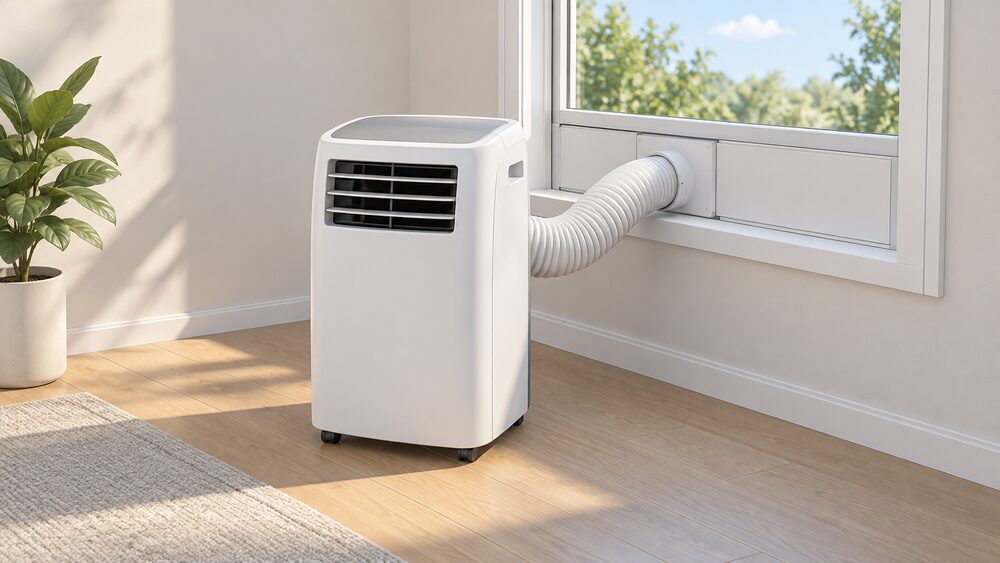
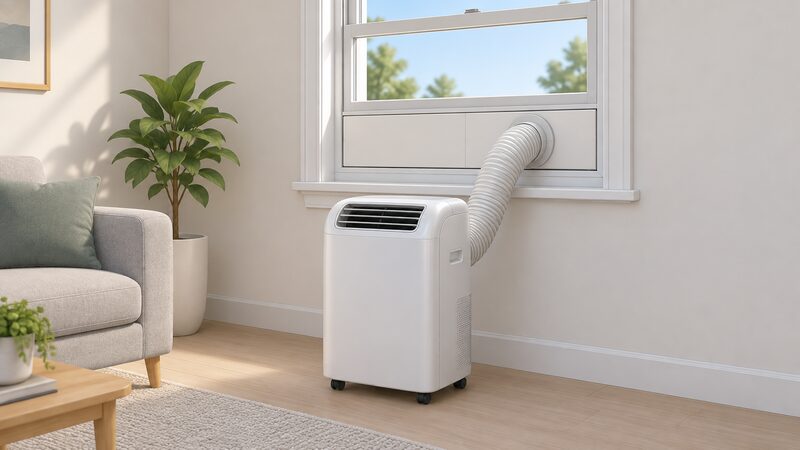
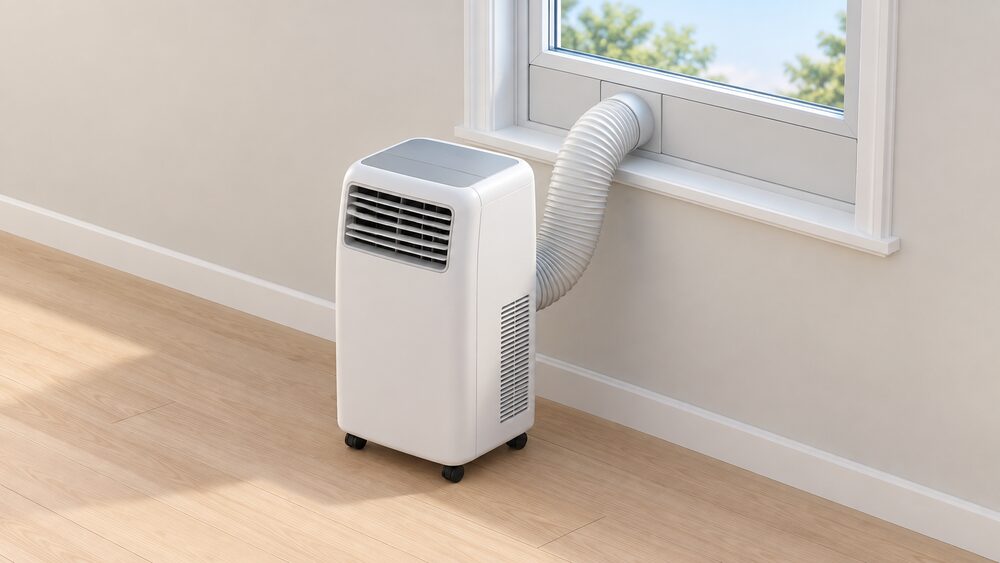
It is a monobloc portable: everything sits in one cabinet, and the warm air produced while cooling is pushed outside through a ducted exhaust hose rather than through an external condenser. Lux Air states that portable air conditioners require no permanent installation, and that the unit is positioned near a suitable window with the exhaust hose connected to vent warm air outside2. A ducted exhaust hose and an adjustable window mounting panel are included1.
For a household, that means cooling and heating without a fixed installation, without an F-gas engineer visit and without landlord or freeholder consent for building work. What remains is a dependence on electricity, on a window or opening for the hose, and on the unit's own controls and app for anything beyond the remote. This page sets out the specifications, the room coverage, the efficiency figures and the limits, using the maker's published data.
What the Lux Air 3.5kW (12000 Btu) heat pump is
Lux Air describes this model as a high quality portable unit with both cooling and heating functions1. It is a single self-contained appliance: the compressor, the heat exchanger and the fan all sit in the cabinet, and the only connection to the outside is the exhaust hose. That is the defining feature of a monobloc portable, and it is what separates it from a split system, where an outdoor unit is fixed to a wall and refrigerant pipework runs through the building.
The compressor is a Toshiba unit, according to the maker's specification1. Lux Air positions the 3.5kW model within a range that runs from 9,000 Btu to 14,000 Btu, and its own sizing guidance describes 12,000 Btu as suitable for medium-sized rooms and living spaces2. The unit is also listed among Lux Air's portable air conditioners that cool, heat and sterilise, a family description that covers several models rather than this one alone2.
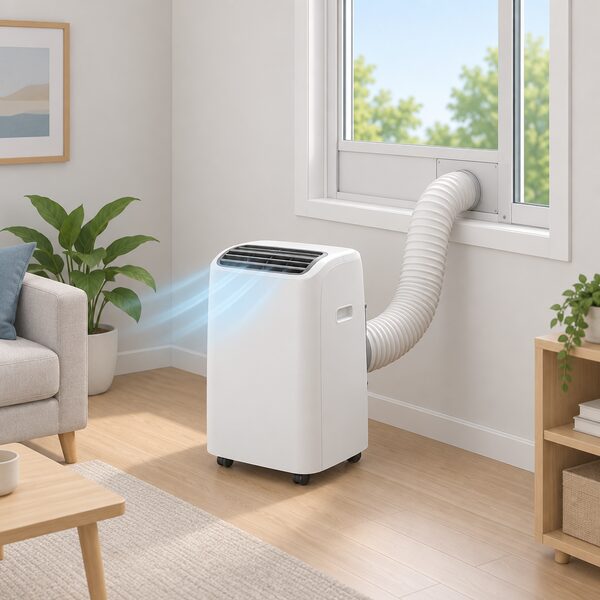
Because it is portable, it can be moved between rooms, which matters for households that need cooling in a bedroom at night and in a living room during the day. The trade-off is that the hose has to reach a window or opening wherever the unit is placed, and the unit has to be carried or rolled there. Lux Air's larger 4.0kW model lists easy-roll casters among its features3; the 3.5kW model's specification does not state casters.
For a household weighing up how much of its cooling it controls itself, a portable unit sits at the low-dependence end of the market: no installer, no fixed pipework, no outdoor unit, and no permission needed. The dependence that remains is on the electricity supply and on the manufacturer for parts and support. More on where portables fit is at portable air conditioners.
Specifications at a glance
The table below sets out the maker's published figures for the 3.5kW model. Every figure comes from the Lux Air product page for this unit1.
| Specification | Figure |
|---|---|
| Cooling capacity | 12000 Btu / 3.5kW1 |
| Heating capacity | 12700 Btu / 3.7kW1 |
| Power input, cooling / heating | 1350W / 1391W1 |
| Current input, cooling / heating | 5.5A / 6.0A1 |
| Power rating | 1 / 220-240 / 50 (phase / volts / hertz)1 |
| Energy efficiency rating, cooling | A1 |
| EER | 2.61 |
| COP | 2.31 |
| Dehumidification | 1.2 litres per hour1 |
| Airflow | 380 m³/hr1 |
| Exhaust hose length | 1.5m1 |
| Exhaust hose diameter | 150mm1 |
| Maximum conservatory size | 20m²1 |
| Dimensions | 440 x 335 x 715mm (W x D x H)1 |
| Compressor brand | Toshiba1 |
| WiFi control | Yes1 |
The 150mm hose diameter is consistent with other portables: electriQ lists a 150mm (6-inch) hose on its P12C 12000 BTU model4, and a 150mm hose on its P16HPW 16,000 BTU unit5. Hose diameter matters because a narrow hose restricts airflow and reduces the heat the unit can expel.
Cooling and heating: 3.5kW cooling, 3.7kW heating
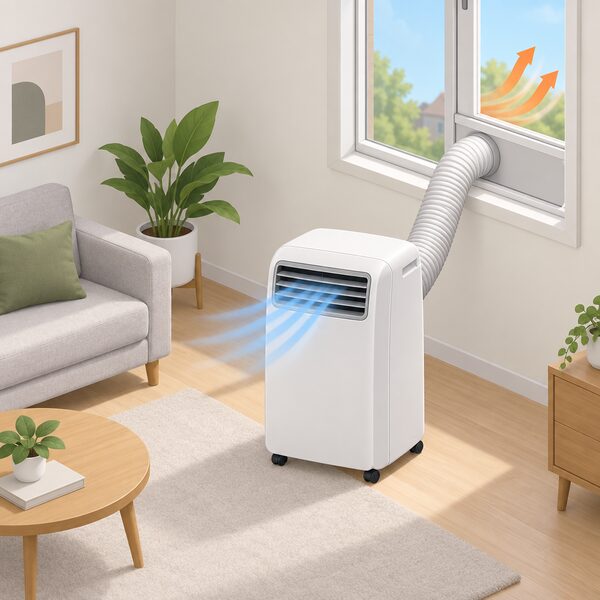
The unit's cooling capacity is 12000 Btu, which is 3.5kW, and its heating capacity is 12700 Btu, which is 3.7kW1. Heating output is therefore slightly higher than cooling output, which is normal for a reverse-cycle machine: the compressor and refrigerant circuit are optimised differently in each direction, and the indoor coil that evaporates refrigerant in cooling mode becomes the condenser in heating mode.
The power figures tell the householder what the unit draws from the mains. Cooling draws 1350W and heating draws 1391W1. Those are the inputs, not the outputs: the unit moves more heat than it consumes in electricity, which is what the efficiency ratios below describe. For comparison, an electriQ AirFlex 14000 BTU unit with heating is listed at 1.5kW running power in both cooling and heating6, and the same maker states that unit requires only 1.5kW of power to produce 4kW of cooling and 3.2kW of heating7.
The heating function is what makes this a heat pump rather than an air conditioner alone. It is a reverse-cycle air-to-air machine: it moves heat from the outside air into the room rather than generating heat from a resistive element. That is the same principle as a fixed air-to-air heat pump, which Daikin describes for small rooms8. The practical consequence is that the unit can take the chill off a room in spring and autumn, and can heat a room that has no other source, but it is a single-room appliance with a hose that must vent outside in both modes.
Room coverage: up to 30m², and where it falls short
Lux Air lists the 3.5kW model as suitable for rooms up to 30m², and the product description gives a maximum recommended room size of 28m²1. The maker's own sizing table pairs 3.5kW and 12,000 Btu with 30m² and 300 ft²1, and its size guide states that a 3.5kW system can provide around 3.5kW of cooling output9.
That 30m² figure is a headline, not a guarantee. Lux Air states plainly that rooms with large windows, strong sunlight or poor insulation may require a higher cooling capacity2. A south-facing room with a large glazed area will gain more heat than a shaded room of the same floor area, so the same unit will hold one comfortable and struggle in the other. The maker also lists a maximum conservatory size of 20m² for this model1, smaller than the general room figure, which reflects how much solar gain a conservatory takes through its roof and walls.
The wider market uses similar numbers. Netatmo states that a single-packaged air conditioner is ideal for small areas of up to 30m²10. electriQ lists its A2/EcoSilent12W as suitable for areas up to 30m²11, and its P12C 12000 BTU model for rooms up to 30m²4. Daikin's guidance is that portable units still have a place, particularly for temporary set-ups or rooms under 10m², but that for longer-term use other options may suit better8.
For a household, the honest reading is that 30m² is the top of the range in good conditions. A bedroom, a home office or a small living room is well within it. A large open-plan space, a loft conversion with roof glazing, or a conservatory above 20m² is not. Sizing is covered in more depth at what size air conditioner do you need.
Efficiency: EER 2.6, COP 2.3 and an A cooling rating
The 3.5kW model carries an A energy efficiency rating for cooling, an EER of 2.6 and a COP of 2.31. The EER is the cooling ratio: cooling output divided by electrical input. The COP is the heating ratio: heating output divided by electrical input. Both are single-point figures taken under standard test conditions, not seasonal averages, so they describe the machine at a defined operating point rather than across a whole summer.
Those figures sit in the normal band for a portable. Lux Air's 4.0kW model lists an EER of 2.3 and a COP of 3.0, also A rated for cooling3. The two models are not directly comparable on efficiency because they are different machines with different compressors and outputs, and the 4.0kW model's heating ratio is higher while its cooling ratio is lower. What the numbers mean in practice is that for every unit of electricity the 3.5kW unit consumes in cooling, it moves about 2.6 units of heat out of the room.
Portable units as a class are less efficient than fixed split systems, because the whole compressor sits inside the room being cooled and the hose radiates some heat back into the space. That is a design limit, not a fault of this model. The efficiency ratings explained, including how EER and COP differ from seasonal ratings, are at air conditioning efficiency ratings.
Running cost follows directly from the power input. At 1350W in cooling and 1391W in heating1, the unit draws roughly the same as a small kettle or a fan heater on low, and it draws that continuously while the compressor runs. The cost per hour depends on the household's electricity tariff, which is not published here. A worked method for estimating it is at air conditioning running costs.
Controls, WiFi and smart features
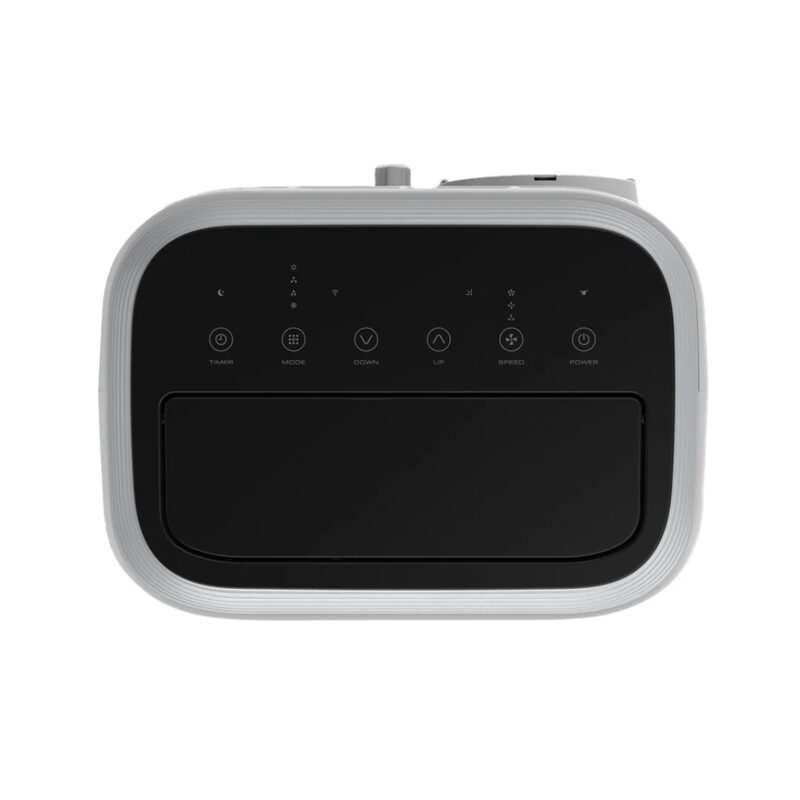
The 3.5kW model is listed with WiFi control1. Lux Air states that selected models offer WiFi connectivity and compatibility with Alexa and Google, and advises checking the individual product specification before ordering2. That caveat matters: smart features are not uniform across the Lux Air range. The 4.0kW model is listed with WiFi control and as controllable by Alexa, Google and mobile phone app, with voice control for Amazon Alexa or Google Home3.
The wider market treats voice control as a premium feature rather than a baseline. electriQ lists its AirFlex Smart 14000 BTU unit as Alexa and Google assistant compatible, controllable by voice7, and Meaco lists voice control through Amazon Alexa and Google Assistant on its Cirro 12000 BTU portable12. Simpler units rely on a remote and a panel: Lux Air's 2.5kW (9000 Btu) model is listed with adjustable fan speeds, a programmable timer and a remote control6.
The dependence this creates is worth stating plainly. A remote control and the unit's own panel work without any network. WiFi control, scheduling from another room and voice commands depend on the household's broadband, the manufacturer's app and its servers, and a smart speaker. If the broadband drops, the unit still runs from its panel and remote, but the app functions do not. That is a small but real addition to the household's reliance on external services, and it is the same pattern across the portable market. Controls and app dependence generally are covered at air conditioning controls and wifi.
Setup: no permanent installation, but the exhaust hose matters
Lux Air states that its portable air conditioners require no permanent installation, and that the unit is positioned near a suitable window, the exhaust hose connected, and the warm air vented outside2. The 3.5kW model ships with a ducted exhaust hose and an adjustable window mounting panel1. The hose is 1.5m long and 150mm in diameter1.
That 1.5m length is the constraint that shapes where the unit can go. It has to sit within reach of a window, a door or another opening, and the panel has to fit the opening. Other makers publish the same hose length: electriQ lists a 1.5m hose on its AirFlex 14000 BTU units13, and a 15cm (150mm) hose diameter on the same models13. Pro Breeze states that its portable air conditioners come with a window kit for quick setup and need no permanent installation14.
Water is the other setup question. Lux Air states that the 3.5kW unit has an automatic inbuilt water wheel and can condense the water out with the exhaust air, so there is generally no need to empty the water tank except in extremely humid conditions1. The 4.0kW model is described as having an automatic inbuilt condensate pump in heat mode, evaporating water through the exhaust hose in cool mode, with manual emptying only in extremely humid conditions3. The 3.5kW model's dehumidification rate is 1.2 litres per hour1.
The Lux Air range: 9,000, 12,000 and 14,000 BTU compared
Lux Air's own sizing guidance splits the range three ways: 9,000 Btu is described as ideal for smaller bedrooms and home offices, 12,000 Btu as suitable for medium-sized rooms and living spaces, and 14,000 Btu as a stronger option for larger rooms2. The 3.5kW model sits in the middle of that ladder.
The 9,000 Btu model is listed as a 2.5kW portable air conditioning unit, described as perfect for domestic use5. Lux Air lists that model as covering up to 35m², with conservatories up to 22m²3. The maker's collection pages repeat the 35m² figure for the 4.0kW model15.
| Model | Cooling | Heating | Room coverage | Efficiency |
|---|---|---|---|---|
| Lux Air 2.5kW (9000 Btu) | 2.5kW (9000 Btu)5 | Not stated | Not stated | Not stated |
| Lux Air 3.5kW (12000 Btu) | 3.5kW (12000 Btu)1 | 3.7kW (12700 Btu)1 | Up to 30m², max recommended 28m²1 | EER 2.6, COP 2.3, A cooling1 |
| Lux Air 4.0kW (14000 Btu) | 4.1kW (14000 Btu)3 | Not stated on the specification table | Up to 35m², conservatories up to 22m²3 | EER 2.3, COP 3.0, A cooling3 |
Two cautions on the range. First, Lux Air states that selected models offer both cooling and heating, and that the individual product specification should be checked before ordering2, so heating is not universal across the range. Second, the maker's own sizing caveat applies to all three: rooms with large windows, strong sunlight or poor insulation may require a higher cooling capacity2. A comparison with another portable brand is at Lux Air vs Meaco air conditioners, and the wider brand picture is at air conditioning brands.
Delivery and what owning one means for household independence
Lux Air states that the 3.5kW unit is delivered on a pallet, and that once the order is ready to be dispatched the customer is contacted to confirm a delivery date1. A pallet delivery means the unit arrives on a wooden base rather than by ordinary parcel carrier, so someone needs to be present to receive it and to move it indoors.
On independence, the position is straightforward and worth stating without decoration. A portable air conditioning heat pump of this kind gives a household cooling and heating in a single room without any fixed installation, without an outdoor unit, without refrigerant pipework and without a certified engineer. It can be moved between rooms and taken to another property. Nothing about it requires the freeholder's consent, a planning application or a building notice, which is why portables are common in rented homes and flats. The wider case for cooling without fixed plant is at air conditioning without an outdoor unit.
What remains is dependence. The unit runs on grid electricity from a supplier, so it does nothing to reduce reliance on the electricity network; it adds load to it. It needs a window or opening for the hose, so it cannot cool a sealed internal room. Its smart features depend on broadband and the manufacturer's app. Parts, servicing and any warranty support come from the maker and its retail channel. And it is a single-room appliance: it will not cool a whole house, and it will not replace a central heating system in winter, because the hose must vent outside and the output is sized for one room.
For a household that wants some cooling and some heating without committing to fixed plant, that is the trade: low installation dependence, higher running dependence. The wider relationship between cooling choices and household energy independence is set out at home cooling and energy independence.
Sources15 cited
- Lux Air 3.5kW (12000 Btu) Portable Air Conditioning Heat Pump, Cooleasy, 2026-09-23
- Lux Air Portable AC That Cools, Heats and Sterilises, Cooleasy, 2026-09-23
- Lux Air 4.0kW (14000 Btu) Portable Air Conditioning Heat Pump, Cooleasy, 2026-09-23
- electriQ P12C 12000 BTU Portable Air Conditioner, electriQ, 2026-09-23
- electriQ P16HPW Air Conditioner, electriQ, 2026-09-23
- Lux Air Portable Air Conditioning Unit 2.5kW (9000 Btu), Cooleasy, 2026-09-23
- electriQ AirFlex Smart 14000 BTU Portable Air Conditioner with Heating Function, electriQ, 2026-09-23
- Air-to-Air Heat Pumps for Small Rooms, Daikin UK, 2026-09-17
- Air Conditioning Size Guide, Cooleasy, 2026-09-23
- How Does Air Conditioning Work, Netatmo, 2026-09-20
- Portable Air Conditioners, electriQ, 2026-09-23
- Meaco Cirro 12000 BTU Super Quiet Smart Portable Air Conditioner, Meaco, 2026-09-23
- electriQ AirFlex 14000 BTU 4kW Portable Air Conditioner with Heat Pump, electriQ, 2026-09-23
- Pro Breeze Air Conditioners, Pro Breeze, 2026-09-23
- Lux Air Portable Air Conditioning Heat Pump 4.0kW (14000 Btu), Cooleasy, 2026-09-23
 Lux Air air conditioningWhich Lux Air portable air conditioner suits your room size, and do you need heating or WiFi as well?