
In this answer
Short answer
A portable air conditioner is worth it for one job: cooling a single small room for a limited period, where a fixed system cannot be installed. It is not worth it as a substitute for whole-home cooling, and it is not a cheap way to run cooling over a long summer. The evidence points the same way from several directions.
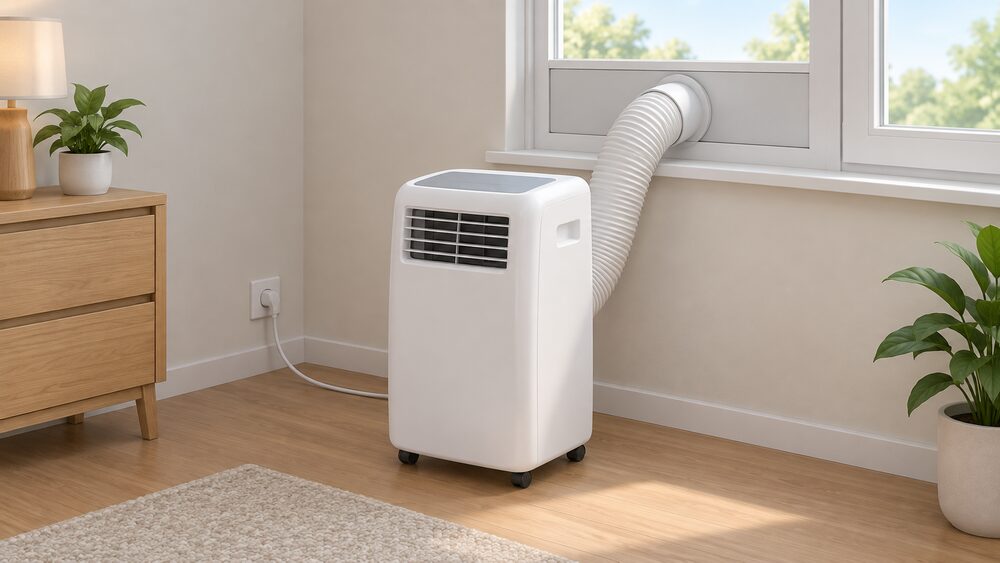
The case for is real but narrow. A portable unit sits on castors so it can be wheeled from one room to another, can be stored away when not in use, and needs no fitting work1. Maker guidance states that portable air conditioning units still have a place, particularly for temporary set-ups or rooms under 10 m²2. For a rented flat, a listed building or a room where a wall unit is not possible, that is the whole argument.
The case against is about running cost and capacity. Independent guidance puts a typical portable air conditioner of 1,000 to 1,500W at around 26 to 39p per hour, roughly 14 to 20 times more than a fan, and states that portable units use 30 to 50% more electricity than fixed systems3. Packaged units generally have less cooling capacity than split systems and are not powerful enough to cool a large room1. A portable unit also needs proper venting through a window fitting, or the heat it removes comes straight back in3.
What a portable air conditioner actually does
A portable air conditioner actively cools the air in the room6. That distinguishes it from a fan, which moves air without lowering its temperature, and from a dehumidifier, which does not lower the air temperature but can take out existing moisture in the air7. The three appliances are often sold side by side and do different jobs.
The mechanism is the same as any air conditioner: a refrigerant circuit moves heat from inside the room to outside it. In a portable unit, the whole circuit sits in one cabinet on the floor, which is why it needs a hose to a window. In a fixed split system, the noisy part sits outdoors. That single design difference explains most of the practical drawbacks: a portable unit is described by maker guidance as an auxiliary device with limited cooling capacity, and noisier than a fixed unit8.
Some units do more than cool. The Aermec PST is described by its maker as a portable air conditioner for heating, cooling, dehumidification or ventilation, for use both at home and at the office9. Midea's PortaSplit is marketed with 6x more cooling power compared with conventional portable AC units10. Those are maker claims for those specific products, not a general rule about the category.
Room size: why the m² rating decides whether it works

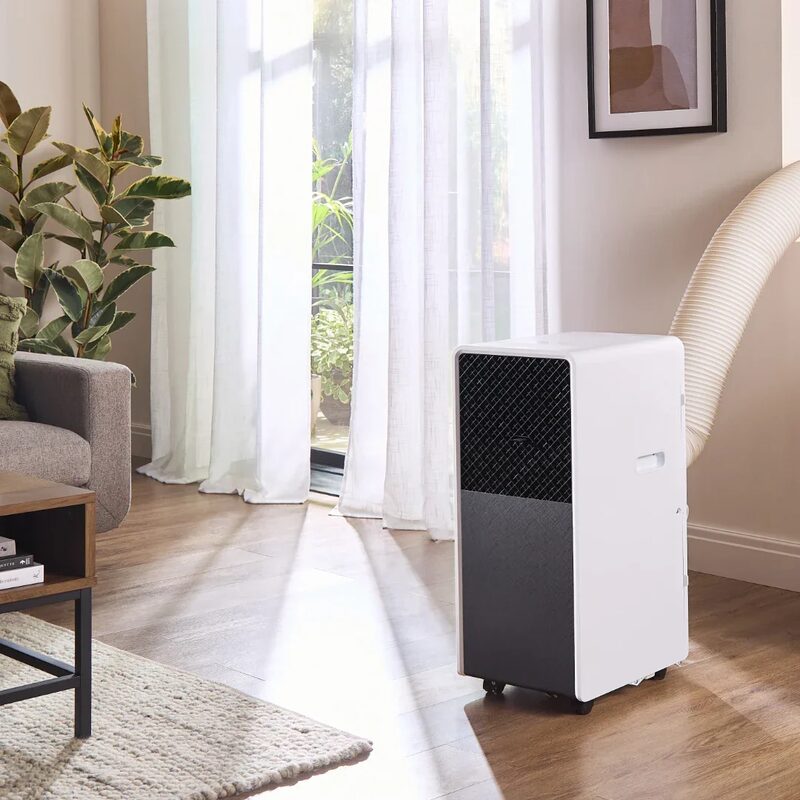
The stated room size is the figure that decides whether a portable unit performs or disappoints. Maker guidance describes a single-packaged air conditioner as ideal for small areas of up to 30 m²4. One independent guide suggests aiming for 18,000 BTUs for the best results11. Those two figures are not directly comparable, because one is a floor area and the other is a cooling capacity. Both point the same way: a portable unit is a small-room appliance. Sizing guidance for air conditioning also weighs humidity and temperature, the thermal insulation of the home, the size of windows or balconies and glass quality, the orientation of the house, and the number of electronic devices connected in the room11. An undersized unit runs at its maximum power continuously and still will not reach the desired comfort level, which increases energy consumption and lowers the air conditioner's lifespan12.
Floor area alone is a poor guide. Maker guidance on sizing lists humidity and temperature, the thermal insulation of the home, the size of windows or balconies and glass quality, the orientation of the house, and the number of electronic devices connected in the room13. A south-facing glazed living room and a shaded north-facing bedroom of the same size do not need the same capacity.
Getting this wrong has a cost beyond comfort. Maker guidance states that an undersized air conditioner will run at its maximum power continuously and still will not reach the desired comfort level, increasing energy consumption and lowering the air conditioner's lifespan12. Oversizing is not a safe answer either, since it cycles inefficiently and costs more to buy.
Efficiency ratings matter alongside size. Maker guidance advises buying a unit with a class A rating, or A+, A++ or A+++, and avoiding the lowest letters of the classification8. For existing dwellings, official guidance in Wales sets a minimum seasonal energy efficiency ratio of 4.0 for an air conditioner working in cooling mode14. That is a regulatory benchmark for fixed installations rather than a label on a portable box, but it shows the direction of travel.
Where a portable unit falls short
The limits are structural, not a matter of picking a better model. Maker guidance lists the disadvantages plainly: an auxiliary device with limited cooling capacity, and noisier than a fixed unit8. The same source lists the advantages as convenience, storability and no fitting work8. A household is choosing between those two sets of properties, not between good and bad products.
Venting is the most common practical failure. Independent guidance states that portable air-conditioning units need to be properly vented to the outside using a special fitting for the window, and that if the vent is just put through an open window, heat comes back in3. A hose hung out of a casement window without a seal is the classic version of this mistake.
Energy use compounds over a long hot spell. Maker guidance notes that portable air conditioning units tend to use more energy, especially when left running all day15. The same pattern appears with portable electric heating: portable convector heaters will consume more energy than an installed heating appliance, though this can be offset by infrequent use as a supplementary space heater16. The parallel is instructive, because the same logic applies to cooling.
There is also a ventilation rule that applies to the room itself, not the appliance. Official guidance for private rented housing fitness checks states that all habitable rooms should be ventilated directly to the open air by opening a window17. A sealed window with a vent kit fitted is a compromise between cooling and air change, and it is worth understanding which one is being traded.
Costs to weigh before buying
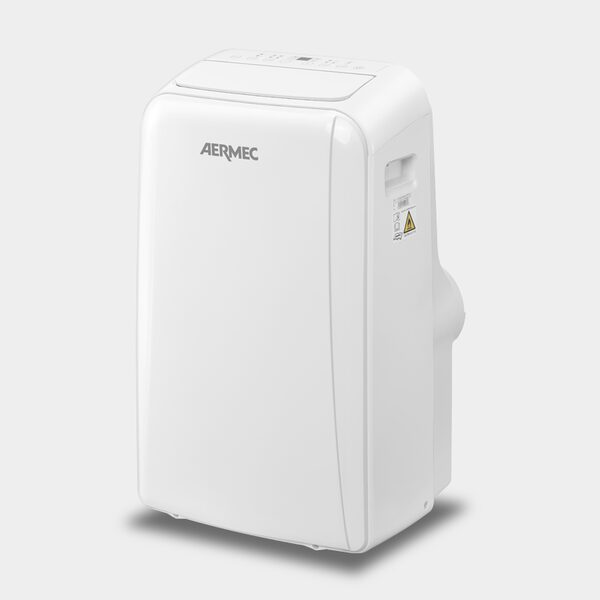
The purchase price is the smaller number over a unit's life. Maker guidance puts portable packaged air conditioners at £170 to £700, depending on their capacity and features1. For comparison, portable generators start at around £160 but can go up to £2,000 or more18, and the priciest portable electric heaters will set you back around £150 or more19. Portable cooling sits in the middle of that range.
Running cost is where the money goes. Independent guidance puts a typical portable air conditioner of 1,000 to 1,500W at around 26 to 39p per hour, roughly 14 to 20 times more than a fan7. At the top of that range, a unit run for eight hours a day is a significant addition to a summer bill. The same guidance states that portable units use 30 to 50% more electricity than fixed systems3.
| Item | Figure | Source |
|---|---|---|
| Portable packaged unit, purchase | £170 to £700 | 1 |
| Running cost, 1,000 to 1,500W unit | around 26 to 39p per hour | 7 |
| Electricity use vs fixed systems | 30 to 50% more | 3 |
| Power draw | up to 2,000W, up to 9.3A | 5 |
| Portable generator, for comparison | £160 to £2,000 or more | 18 |
Two further costs are easy to miss. A portable unit takes up floor space and needs somewhere to live in winter, which is a real constraint in a small flat. And a unit that is undersized for the room will run continuously, raising consumption and shortening its working life12. Buying the right capacity first time is cheaper than replacing a unit that never coped.
Portable, fixed or fan: which suits which room
Air conditioners can be fixed or mobile, wall-mounted, or ceiling-mounted as a cassette20. That is the full menu, and a portable unit is one option on it rather than the default.
A fixed wall-mounted air conditioner costs more than a portable model but is generally more efficient at cooling the home1. Maker guidance lists its advantages as quiet operation and better performance than portable units8. For a room used every summer for years, and where installation is possible, the fixed unit is the more efficient appliance. For a single room, maker guidance describes single split wall mounted air conditioners as ideal, while multi-split units can be used in various rooms throughout the house12.
A fan is the low-cost option and should not be dismissed. A tower fan is easy to place in bedrooms, living rooms and offices, and a pedestal fan offers flexible airflow for larger rooms6. Fan heaters are mostly entirely portable, needing no installation in any particular space21, and the same logic of zero installation applies to cooling fans. The running cost gap is the point: a fan costs a fraction of an air conditioner to run7.
| Option | Best suited to | Key trade-off |
|---|---|---|
| Portable air conditioner | One small room, temporary or rented set-ups, rooms under 10 m²2 | Noisier, limited capacity, 30 to 50% more electricity than fixed3 |
| Fixed wall-mounted system | A room cooled regularly, where installation is possible12 | Higher purchase cost, more efficient in use1 |
| Fan | Any room needing air movement rather than temperature drop6 | Does not lower air temperature7 |
For a household weighing independence, the honest position is that a portable air conditioner increases dependence rather than reducing it. It adds a mains load, it does not work without electricity, and it cools one room while the rest of the home stays as it was. It is a comfort appliance for a specific problem, not a step towards a self-sustaining home. Where the aim is a cooler home rather than a cooler room, the measures that matter are shading, ventilation and reducing internal heat gains, and those are covered in overheating and hot weather in UK homes. Where the choice is between a portable unit and a fixed one, air-to-air heat pump vs portable air conditioner sets out the comparison, and fan vs portable air conditioner running costs deals with the cheaper end of the market.
Sources21 cited
- Packaged air conditioning, Netatmo, 2026-09-20
- Air-to-air heat pumps for small rooms, Daikin UK, 2026-09-17
- How to keep your home cool in hot weather, Centre for Sustainable Energy, 2026-07
- How does air conditioning work, Netatmo, 2026-09-20
- Ratings of electrical appliances, Electrical Safety First, 2026-09-19
- Air treatment: cooling, Dimplex, 2026-09-20
- Summer energy tips, National Energy Action, 2026-08-13
- Home air conditioning, Netatmo, 2026-09-20
- PST portable air conditioner, Aermec UK, 2026-09-17
- Midea PortaSplit, tado, 2026
- Is air conditioning worth it in the UK?, Uswitch, 2026-07-14
- What size of air conditioner do I need, Hitachi Air Conditioning, 2026-09-17
- How to calculate the air conditioning power for a given surface area, Hitachi Air Conditioning, 2026-09-17
- Approved Document L Volume 1, consultation version, Welsh Government, 2025-08
- Guide to air conditioning units, EDF Energy, 2024-05-22
- Dehumidifier buying guide, Dimplex, 2026-09-20
- Checking your home is fit to live in, nidirect, 2026-09-17
- How to buy the best generator, Which?, 2026-01-20
- Cheap electric heaters, Which?, 2025-12-22
- Cooling down a room: what is the best way, Netatmo, 2026-09-20
- Fan heating, Netatmo, 2026-09-20
 Running CostsA portable air conditioner costs roughly twenty to forty pence for every hour it runs, while a fixed unit uses far less electricity for the same cooling.
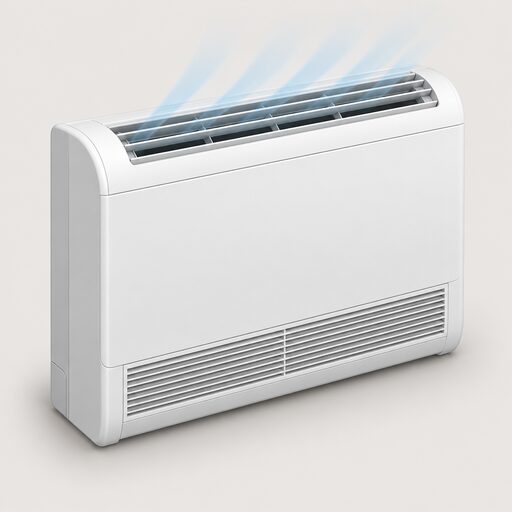 Split Air ConditioningA split air conditioning system cools or heats one room using an indoor unit and an outdoor unit linked by pipes.
 Types of Air ConditioningPortable, wall-mounted, multi-room or ducted: which air conditioning suits your home?
 The Full Cooling and Air Conditioning GuideDo you really need air conditioning in a British summer, or would a fan and better shading do the job?
 Passive Cooling at HomeKeeping a home cool without air conditioning comes down to blocking heat before it gets in, then letting trapped heat out.
 Air Conditioning CostPublished UK equipment prices and the parts of an installed price for portable, single split, multi-split and whole-house air conditioning.