In this guide
Home Energy by Home Type and Household: The Full UK Guide
Home energy differs by home type because of three things: the fabric of the building, the rules attached to it, and who has the right to change it. The common starting point is the Energy Performance Certificate (EPC). It gives an assessment of a home's energy efficiency1 and is valid for a maximum of ten years2. After that the routes diverge. Flats and maisonettes are the most energy efficient property type in England and Wales, with a median EPC score of 743. Older homes, converted flats and bungalows have the lowest average ratings4. In Scotland, 14% of off-gas-grid dwellings and 10% of rural dwellings sit in bands F and G5.
The two largest physical upgrades covered here are an air source heat pump and solid wall insulation. Each carries its own planning conditions. In England the heat pump's outdoor unit must not exceed 1.5 cubic metres on a house or 0.6 cubic metres on a block of flats6. Council guidance sets a noise limit of 42 decibels at a metre from any habitable room7. Tenure adds a further layer. Domestic private rented property in England and Wales must reach EPC band E or above8, and the UK government has consulted on a new standard with a single compliance date of 1 October 20309.
This page sets out those rules and the evidence behind them for each kind of home and household, across England, Scotland, Wales and Northern Ireland. It links to the detailed pages on renting, flats, off-gas-grid and rural homes, new builds and support for low-income households.
Start with your EPC: what it tells you about your home
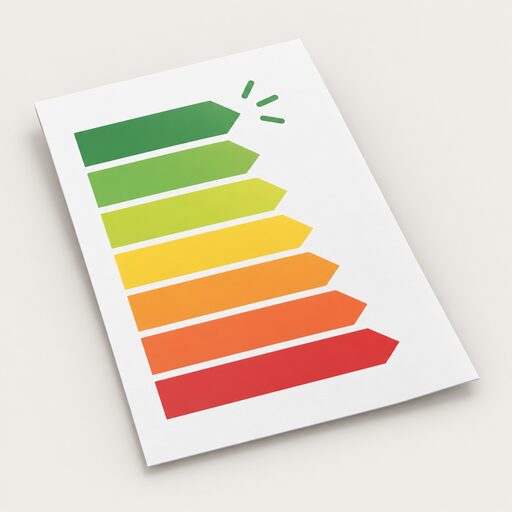
An EPC is the one document that almost every other rule on this page refers back to. The assessment records the dwelling type, floor area, construction type, insulation, heating, ventilation and lighting10. From that record it rates the property from A to G, with G the least energy efficient11. A home rated EPC C or above is generally regarded as having an adequate level of energy efficiency12. That is why band C appears so often as a policy target.
Because construction type is recorded, the certificate is also the quickest way to see what kind of home you are dealing with in energy terms. It shows solid or cavity walls, the main heating fuel and whether the loft is insulated. Those entries decide which of the later sections of this page apply to you.
Ratings vary sharply by tenure and built form:
- Around two-thirds of council or housing association houses in England and Wales have EPC ratings A to C, compared with around 40% of houses in other tenures13.
- Around a third of EPC-rated bungalows reach A to C, compared with almost half of all other types of houses13.
- Northern Ireland publishes Census 2021 estimates that classify households by EPC band and by household characteristics, so the same comparison can be made there14.
Each certificate is valid for 10 years and can be used multiple times in that period. It should be made available to buyers or prospective tenants at no cost, and a buyer receives a copy from the seller that can be reused while it remains valid15. For what an EPC means at the point of sale, see the page on selling or buying a home with energy equipment.
For energy independence, the EPC is a map and not a measure. It shows where a home loses heat and what it depends on for fuel. It does not show how much of your own energy you generate or store.
What an EPC covers, and what it leaves out
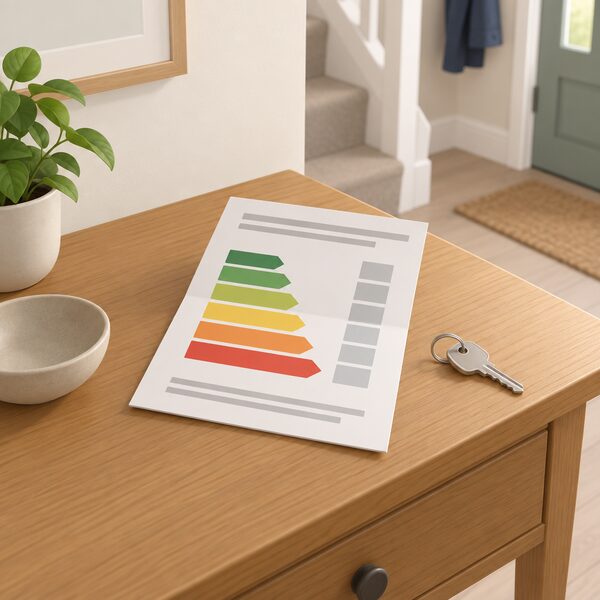
An EPC is a document recording the estimated energy performance of a building and its main heating system or systems. It is a legal requirement whenever a home or non-domestic building is advertised for sale or let16. That trigger is also its main limitation as a picture of the housing stock. The register in England and Wales does not hold records for all dwellings, because EPCs are only required when a dwelling is constructed, sold or let17. Around a third of domestic properties in England and Wales do not have an EPC rating at all13. A household that has lived in the same owned home for decades may never have needed one.
Which buildings need one
An EPC is required for each self-contained dwelling. Scottish guidance states that this includes HMO-licensed properties let under a joint tenancy agreement, and bedsits or similar units let as a whole18. The page on HMOs and shared houses covers shared accommodation in more detail.
EPCs are not required for2:
- protected buildings and places of worship
- temporary buildings with a planned use of two years or less
- low energy demand industrial and agricultural buildings
- seasonal residential buildings
- stand-alone buildings (other than dwellings) with a useful floor area of less than 50 m²
- buildings suitable for, or sold for the purpose of, demolition
What the rating does not measure
The headline rating is a cost measure. A House of Commons committee report put it plainly:
"EPC ratings are based on the costs of home heating, rather than its carbon footprint"
The consequence is that a cheaper fuel can score better than a cleaner one, and the rating says little about carbon emissions or comfort. Non-domestic EPCs work differently. They show an asset rating alongside an indication of energy performance based on primary energy use21. An EPC is also an estimate made from recorded features and not a reading of your meter. The gap between the two is explored on the page about the new build performance gap.
Reading the ratings: Band A to G and what drives the score
Assessments are banded from A to G, where A is the most efficient, with an A+ band for non-domestic properties only22. The Standard Assessment Procedure (SAP) assigns one of seven bands to a dwelling, from A (most energy efficient) to G (least energy efficient)23. The bands sit on a numerical scale. Both the energy efficiency rating and the environmental impact rating are scored from 1 to 100 and then split into bands A to G24. In Scotland the Energy Efficiency Rating gives an A to G band and a 1 to 100 number based on the cost to run the dwelling, normalised to the floor area25.
| Element | What it shows | Source |
|---|---|---|
| Band | A (most efficient) to G (least efficient); A+ for non-domestic only | 22 |
| Numerical score | 1 to 100, split into the bands | 24 |
| Energy efficiency rating | Running cost, normalised to floor area (Scotland's EER) | 25 |
| Environmental impact rating | Scored separately on the same 1 to 100 scale | 24 |
What pushes a home into the lowest bands
The Scottish House Condition Survey 2024 shows which dwellings fall into bands F and G: 9% of pre-1919 dwellings, 12% of electrically heated homes, 9% of oil-heated homes, 11% of homes on other fuels, 5% of detached homes, 14% of off-gas-grid homes and 10% of homes in rural areas5. Age, fuel and location overlap. An old, detached, rural home off the gas grid carries every one of those risk factors at once. The pages on off-gas-grid homes and rural homes deal with that combination.
The direction of travel is upward. In England, the proportion of homes in the lowest bands of E to G fell from 23% to 9% over the last decade, according to the English Housing Survey's 2024 figures26.
The same A to G lettering appears on appliance energy labels, which rate products from A to G in terms of energy use27. The two scales are unrelated. An A-rated appliance does nothing to a building's EPC band.
A single score under reform
The Climate Change Committee has recommended that domestic EPCs carry four primary metrics in real-world units28:
- total energy use intensity
- space heating demand intensity
- heating system type, ranked from 1 to 6
- energy cost intensity
The Scottish Government's response to its EPC reform consultation sets out a Heat Retention Rating, a Heating System Type Rating and an Energy Cost Rating29. Separating fabric from fuel cost would make the certificate more useful for judging independence. A well-insulated home needs less of any fuel, from any supplier.
Air source heat pumps: how they work and what they suit
Air source heat pumps extract heat from the outside air to heat your home and water30. Northern Ireland's official guidance lists them as suitable for residential homes, apartments and small commercial buildings31. Two forms exist, and the difference matters for grants:
- An air-to-water system transfers heat drawn from the surrounding air to water in a wet central heating system.
- An air-to-air system is not considered a renewable system under ECO432.
The page comparing an air-to-air heat pump with a portable air conditioner covers the second type.
Ground source heat pumps do the same job from a different source. They transfer energy from the natural heat stored in the earth to heat the home and domestic hot water33. Welsh Government guidance names three types of domestic heat pump where permitted development rights apply: air source, ground source and water source34.
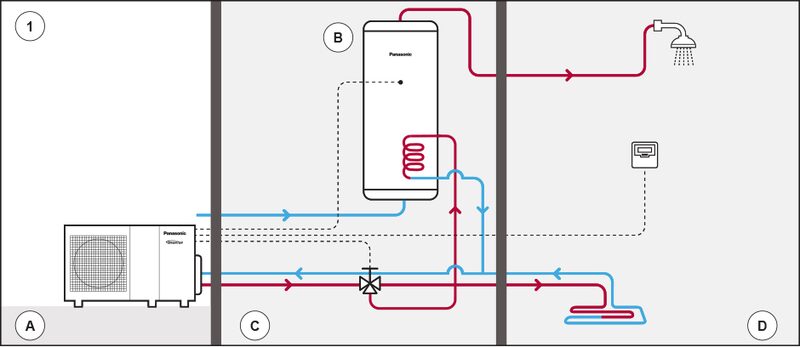
Modelling for the Scottish Government on new-build energy standards found that the air source heat pump consistently gave the lowest delivered energy result across the home archetypes modelled35. In the same modelling it had the lowest capital cost for houses, but not for the block of flats, where it was the highest for the business-as-usual specification35. That split between houses and flats recurs throughout this page. For the alternatives in flats, see electric boiler vs heat pump.
A heat pump removes a household's dependence on gas, oil or LPG deliveries and replaces it with dependence on the electricity grid and a supplier. It does not make a home self-sufficient on its own. The page on whether solar panels can power a heat pump addresses how far on-site generation can narrow that gap. The page on heat pump cooling in summer covers the other season.
Heat pump planning rules: size, siting and noise limits

In England, permitted development rights cover the installation, alteration or replacement of an air source heat pump on a house or block of flats. They also cover the curtilage of either, including a building within that curtilage6. The conditions are specific, and an installation that misses any of them needs a planning application.
The size limit, and why documents disagree
The legislation made on 6 May 2025 sets the limit for an air source heat pump on, or within the curtilage of, a dwellinghouse at 1.5 cubic metres36. The Planning Portal gives the same figure: 1.5 cubic metres on a house and 0.6 cubic metres for a block of flats, in each case including housing6. Some council guidance still states 0.5 cubic metres for a house37. Central Bedfordshire's guidance confirms 0.6 cubic metres on a block of flats38. 5 cubic metre figure.
Conditions for permitted development in England
The conditions below are from the Planning Portal6, except where marked.
| Condition | Rule |
|---|---|
| Standard | Must comply with the MCS Planning Standards (MCS 020a)7 |
| Number | First installation only on a non-detached house or block of flats; first two on a detached house |
| Wind turbine | No existing wind turbine on the building or within its curtilage |
| Pitched roof | Not permitted development |
| Flat roof | All parts at least one metre from the external edge of the roof |
| Highway-facing wall | Not above ground floor storey level on a wall fronting a highway |
| Use | Not used solely for cooling |
| Removal | Removed as soon as reasonably practicable when no longer needed |
| Siting | Sited, so far as is practicable, to minimise its effect on the external appearance of the building and the amenity of the area |
Bedford's guidance also states that all parts of the unit must be at least one metre from the property boundary, and that only the first installation is permitted development7. The unit must also be sited, so far as practicable, to minimise its effect on the building's appearance and on the amenity of the area6.
New Forest's guidance states the conservation area rule in the same terms. It adds that a ground source heat pump within the curtilage of a house or block of flats does not require planning permission, though listed building consent may be required if the property is listed39. The rules for each built form are gathered on the page about permitted development by home type. Flat owners will also need leasehold consent.
Heat pump costs and running costs: what to expect
Heat pump prices are installer-quoted and depend on the home's heat load, its radiators and its hot water arrangements. No single published price applies to every home. What official evidence does establish is where the money goes over the life of the system. A government evidence review cites an estimate by Nesta made under current policy and market conditions, published in June 202540:
| Cost component | Share of lifetime cost |
|---|---|
| Upfront cost | approximately 15 to 20% |
| Running cost | approximately 55 to 65% |
| Installation cost | approximately 20% |
Running cost is therefore the larger question. A household comparing quotes on installation price alone is looking at the smaller part of the total.
Performance in use is what drives that running cost. A May 2026 government-published report on the heat pump transition describes a gap between expected and achieved performance. It states that this gap is equivalent to several hundred pounds a year in running costs for a typical fuel poor home41. The figure is an estimate, not a tariff. It shows that design, sizing and commissioning decide whether a heat pump lowers a bill or raises it. The Warm Homes: Local Grant rules reflect the same concern. For retrofit and packaged hybrid systems, the heat pump must be sized to provide a minimum of 55% of the calculated heat load42.
For households already heating with electricity, the comparison is different. It is covered on the page about heat pump bills in an electrically heated flat. Grant contributions are covered under how much you pay yourself under the Boiler Upgrade Scheme. Where grants require a certified installer is covered under the certified installer grant rule.
Running cost is the part of a heat pump's lifetime cost that stays exposed to electricity prices. That part is the majority. Better fabric reduces that exposure, which is why insulation comes next.
Solid wall insulation: the main option for pre-1930 homes
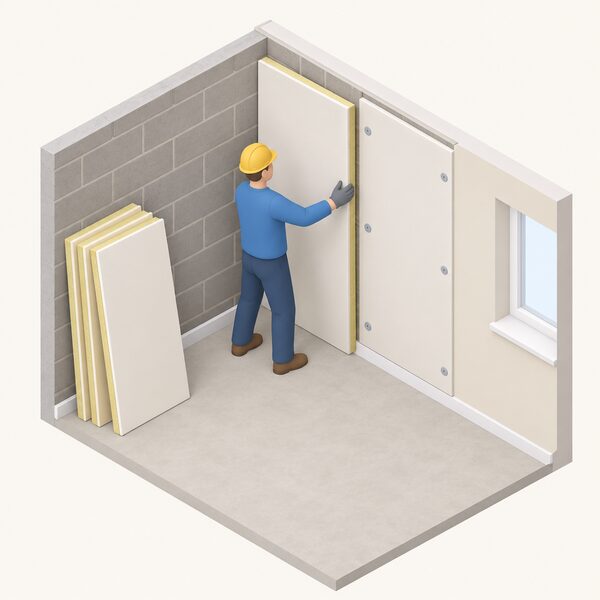
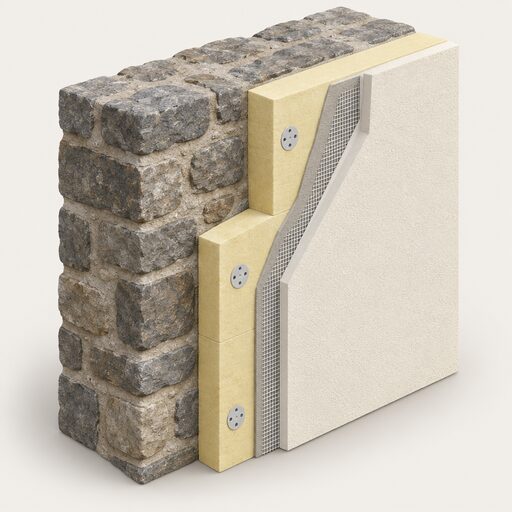
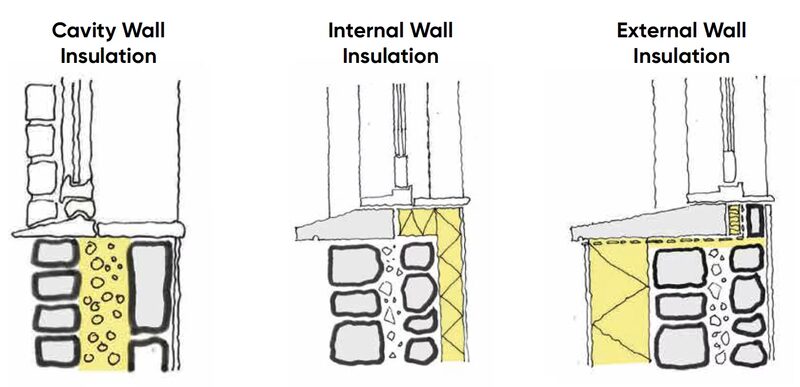
Solid walls lose even more heat than cavity walls, according to Planning Portal guidance43. They have no gap to fill, so the insulation has to be added to one face of the wall. Northern Ireland's official guidance describes the two routes. One is a decorative, weatherproof insulating treatment on the outside of the walls. The other is ready-made insulation boards fitted internally44.
| Approach | Typical build-up | Source |
|---|---|---|
| External | Insulation between 50 and 100mm thick, with a weatherproof finish | 43 |
| Internal laminate | Plasterboard backed with insulation, typically to a total of up to 90mm | 43 |
| Other internal types | Wooden battens in-filled with insulation, or flexible linings | 43 |
External insulation is usually installed where there are severe heating problems. It is also used where the exterior of the building needs some other repair work, which gives the opportunity to add insulation43.
Public schemes treat solid wall insulation as a core measure for older stock. In Northern Ireland, the Whole House Warmer Homes NI scheme in the 2026 to 2027 list lists the following45:
- solid wall insulation, with cavity wall insulation where required
- loft insulation
- a natural gas central heating system where the home is on the gas network
- an oil central heating system where gas is not available, or high heat retention electric storage heaters
Northern Ireland's current Decent Homes Standard takes a narrower view of what counts as effective insulation in a dwelling with gas or oil programmable heating. It requires cavity wall insulation where cavity walls can be insulated effectively, or loft insulation that meets current NI Building Regulations standards where there is loft space46. Solid walls do not feature in that test, which is one reason solid-walled homes can meet a standard and still be hard to heat.
Related pages cover whether you can replace a boiler with a heat pump if your walls are unusual, and how to retrofit a 1930s bungalow.
Solid wall insulation costs, savings and guarantees
Official guidance does not give a price, and published estimates of both cost and annual savings differ widely between sources. Prices are installer-quoted and turn on wall area, access, the finish chosen and whether the work is internal or external. What official guidance does say is direct:
"Solid wall insulation can be expensive so the ideal time to do it is when your walls need some other corrective work."
That timing point is the main cost lever available to a household. Re-rendering, repointing, replastering or a new kitchen or bathroom on an outside wall all involve work that insulation would otherwise duplicate.
The benefits described in official guidance go beyond the heating bill. The Planning Portal states that solid wall insulation will help create a more even temperature in the home. It will help prevent condensation on the walls and ceilings. It can also reduce the amount of heat building up inside during summer hot spells43. The pages on overheating and hot weather and cold homes and health explain why both ends of that range matter.
On guarantees, no official source gives a standard term, so none is given here. The scheme rules on the certified installer grant rule page are the relevant starting point for work that is grant funded.
Wall insulation is the measure that cuts demand for any fuel. It carries no dependence on an app, a supplier or a manufacturer staying in business once it is installed.
Insulation inside or outside: which approach fits which wall
Welsh Government building regulations guidance describes solid walls as generally insulated by placing some form of thermal element on the inside, the outside, or both47. The choice is rarely free. It is set by the building's appearance, its ownership and how the wall handles moisture.
When internal insulation fits
Scottish Government guidance on converting traditional buildings sets out the advantage plainly: insulation can be installed in one property, or even one room only, where needed48. That matters in a flat, a terrace or a tenement, where the outside face is shared or protected. It also matters for listed and older buildings, whose external appearance cannot be changed. The same guidance is specific about materials:
"The preferred technique to insulate internally in most cases is to install vapour permeable, capillary active and hygroscopic insulation direct against a wall which has been prepared and has no residual impermeable finishes."
In plain terms, a traditional solid wall manages moisture by absorbing and releasing it. Guidance for those buildings favours insulation that lets that process continue. Ventilation has to be considered alongside. See ventilation in flats and apartments and the pages on condensation damp.
When external insulation fits
External insulation suits a wall that already needs repair43. It changes the building's appearance, which is why planning and leasehold questions come first. In Scotland, the Energy Efficient Scotland: Area Based Scheme lists the following measures49:
- external wall insulation
- internal wall insulation
- cavity wall insulation
- loft insulation
- underfloor insulation
- room-in-roof insulation
- park home insulation
What works best by home type: houses, flats and rural homes
Flats
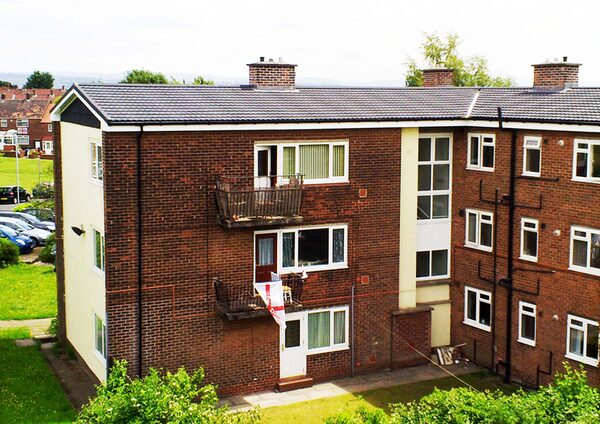
Flats and maisonettes were the most energy efficient property type in England and Wales in the year to March 2025, with a median score of 743. Converted flats, by contrast, are among the types with the lowest average ratings4. In Scotland, flats have a mean environmental impact rating of 69.4, against 62.4 for houses5. Electricity is the main heating fuel in 14% of Scottish flats, a higher share than for any of the three house types50. A flat has fewer exposed surfaces but less control. Walls, roofs and outside space usually belong to someone else. See energy improvements in flats, EPC improvements in a flat, high-rise flats and building safety and energy independence for renters and flats.
Older, traditional and rural homes
Responses to Scotland's Heat in Buildings Bill consultation frequently noted that traditional buildings, flats and rural properties are less suitable for both energy efficiency improvements and clean heating systems51. The F and G figures for pre-1919, off-gas-grid and rural dwellings bear that out5. The pages on oil vs LPG heating, park homes and solar panels on a Georgian home cover these cases.
New builds
In England, a new dwelling's primary energy rate, emission rate and fabric energy efficiency rate must not exceed their respective target rates, both as designed and as built52. Official statistics break down the energy efficiency characteristics of new dwellings by property type and heating system53. ONS reports on efficiency, emissions and main fuel for new and existing homes by property type, tenure and age54. The Home Energy Model is the calculation methodology designed to assess the energy performance of homes55. Scottish Government material identifies it as the domestic counterpart to the Simplified Building Energy Model used for non-domestic buildings56. See new build homes and energy and living in a low-energy home.
| Home type | Key evidence | Main constraint |
|---|---|---|
| Purpose-built flat | Median EPC score 743 | Consent, shared fabric, 0.6 cubic metre heat pump limit6 |
| Converted flat, older home, bungalow | Lowest average ratings4 | Solid walls, heritage controls |
| Rural or off-gas-grid home | 14% and 10% in bands F and G in Scotland5 | Fuel choice, suitability concerns51 |
| New build | Must meet three target rates52 | Performance in use against the design |
Brands and product ranges sold in the UK
This page covers rules and home types, not products, and the maker information relevant to it is limited. Heat pump manufacturer Hitachi states that most high-temperature heat pumps on the market use refrigerants such as R290 or R32. It also states that incentives and government grants may be available in the UK for installing energy-efficient systems such as high-temperature heat pumps57. Those are a maker's statements about its own product category. Grant eligibility is set by the scheme rules described below, not by manufacturers. Any heat pump also ties a household to its maker for parts and, often, to an app or cloud service for controls. For ventilation products, see the page on Vent-Axia.
Funding routes: grants, loans and support schemes
Support is organised by nation, and within England largely by local authority.
| Nation | Route | What it covers |
|---|---|---|
| England | Warm Homes: Local Grant | Insulation, heating, solar PV, batteries and more, for homes rated EPC D to G42 |
| Scotland | Area Based Schemes | External, internal and cavity wall insulation, loft, underfloor and room-in-roof insulation49 |
| Northern Ireland | NISEP schemes, NI Energy Advice | Whole-house insulation and heating; free advice and grant referrals45 |
| Great Britain | Energy supplier schemes | Energy costs, energy debt, energy-saving improvements60 |
England: Warm Homes: Local Grant
The supported home types are58:
- houses
- flats
- park homes
- houses in multiple occupation with separate kitchens
- some other property types may also apply
The home must have an EPC of D to G, or the equivalent for a park home58. The grant is open to homes using any fuel type: gas, electric, oil, LPG, coal or solid fuel61. The July 2026 policy guidance confirms that all primary heating fuel types are eligible. It lists the following measures42:
- insulation types
- heating controls
- hot water cylinder measures
- low energy lighting
- solar PV and solar thermal
- digital and smart controls
- draughtproofing
- double or triple glazing
- energy efficiency doors
- domestic batteries
Council descriptions summarise the offer as insulation, energy-efficient heating systems and renewable energy installations62. Some councils run a support service alongside it. East Herts offers grant eligibility checking, benefits support, supplier switching advice, debt advice and referral to other organisations or contractors62. More detail is on the pages for help for low-income households in England and ECO4 Flex referrals.
Across Great Britain: supplier schemes
Ofgem describes energy supplier schemes and grants as help with energy costs, paying off energy debt, and making energy-saving improvements to your home60.
Scotland and Wales
Scotland's Area Based Schemes are delivered through councils49. See Warmer Homes Scotland and Nest in Wales.
Northern Ireland
NI Energy Advice offers referrals to energy grants and other sources of help59. Its advice topics are63:
- energy grants and support
- heating and energy use
- energy bills and fuel poverty support
- damp, condensation and ventilation
- insulation and home improvements
- renewable energy
- changing electricity or gas supplier
- heating-oil savings
Belfast City Council describes the same service as free advice on saving energy at home, energy efficiency grants and oil buying clubs64. See help for low-income households in Northern Ireland.
Related support for particular households is covered under fuel poverty, vulnerable and medically dependent households, older people, the Disabled Facilities Grant and home improvement agencies.

How the rules are changing for owners and landlords
The current minimum
In England and Wales, the minimum standard of energy efficiency for certain domestic rented property is a rating of E or above8. The regulations cover private, local authority and other public body landlords. They also cover a tenant who sub-lets a property within scope8. A landlord currently letting a property with a rating of F or G must improve it to a minimum of E, or register an exemption where one applies. The Welsh council guidance that states this describes the rule as the 2018 "Minimum Level of Energy Efficiency" standard65. The rule dates from April 201866.
Tenants have a related right in England. From April 2016, landlords of residential properties have not been able to unreasonably refuse a tenant's request for consent to make energy efficiency improvements where financial support is available66. See asking a landlord for energy improvements and renting and home energy.
What is proposed
The consultation on improving the energy performance of privately rented homes was last updated on 21 January 2026. Its proposals are9:
- a single compliance date of 1 October 2030 for the new standard
- an increase in the number of exemptions available, with amendments to the current ones
- more engagement on short-term lets before any further consideration
For landlords, the detail is on landlord energy and safety duties, funding energy upgrades as a landlord, the Renters' Rights Act and energy and the overview of the UK private rented sector. Standards in other tenures and nations are covered under social housing energy, the Decent Homes Standard, the Repairing Standard in Scotland and fitness for human habitation in Wales.
EPC reform and rental standards interact. If the certificate moves from a single cost-based score to separate fabric, heating and cost metrics, as the Climate Change Committee has recommended and Scotland has set out, the measure used to judge a rented home will change too28. An owner planning work for a future band is planning against a measure that is itself under review.
Sources66 cited
- Solar PV panels and energy assessment advice, London Borough of Bromley
- Energy performance certificates: trading standards guidance, Isle of Anglesey County Council, September 2025
- Energy efficiency of housing in England and Wales: 2025, Office for National Statistics, 2025
- Research briefing CBP-9889 on home energy efficiency, House of Commons Library
- Scottish House Condition Survey 2024: key findings, full report, Scottish Government, 2026
- Planning permission: air source heat pump, Planning Portal
- Building regulations and renewables guidance, Bedford Borough Council
- Minimum energy efficiency standard for domestic rented property, Isle of Anglesey County Council, May 2026
- Improving the energy performance of privately rented homes: 2025 update, UK Government, updated 21 January 2026
- Domestic EPC reform consultation, Scottish Government, 23 July 2021
- Energy Company Obligation ECO4 scheme, Derbyshire County Council
- Bristol Warm Homes Plan, Bristol City Council, April 2025
- National Energy Efficiency Data Framework: summary of analysis 2026, UK Government, 11 June 2026
- CT0062: EPC band by household characteristics, Northern Ireland, NISRA, 13 December 2024
- Energy Performance Certificates, nidirect, 26 February 2026
- Delivering net zero for Scotland's buildings: Heat in Buildings Bill consultation, Scottish Government, November 2023
- EPC statistical release, January to March 2023, England and Wales, UK Government, 27 April 2023
- Energy Performance Certificates guide: buildings for let, Scottish Government, 29 November 2023
- Energy Performance Certificates: introduction, Scottish Government, December 2015
- Energy Security and Net Zero Committee report, UK Parliament, 9 May 2025
- Energy Performance Certificates guide, Scottish Government, 24 August 2026
- EPC statistical release, January to March 2026, England and Wales, UK Government, 19 May 2026
- Debate pack CDP-2022-0129, House of Commons Library
- Research briefing CBP-8830, House of Commons Library
- EPC reform consultation, Scottish Government, 25 July 2023
- English Housing Survey 2024 to 2025: headline findings on housing quality and energy efficiency, UK Government
- Choosing energy efficient products, nidirect, 9 April 2025
- Letter: reform of domestic EPC rating metrics, Climate Change Committee
- EPC reform consultation: government response, Scottish Government, 21 January 2025
- DESNZ Public Attitudes Tracker: heat and energy use in the home, summer 2025, UK Government, 28 October 2025
- Heat pumps, nidirect, 24 February 2025
- ECO4 New Measures and Products Guidance v3.0, Ofgem, 26 March 2026
- VAT energy-saving materials manual: ground source heat pumps, HMRC
- Planning permission: heat pumps, Welsh Government
- Improvements to the energy standard for new domestic buildings within Scottish building regulations, Scottish Government, 24 July 2026
- Statutory instrument 2025 No. 560, legislation.gov.uk, 6 May 2025
- Air source heat pumps: planning advice, Cornwall Council
- Air source heat pumps: householder planning advice, Central Bedfordshire Council
- Heat pumps, New Forest District Council
- Evidence and innovation needs assessment 2025: heat and buildings, UK Government, June 2025
- Report on the heat pump transition, UK Government, May 2026
- Warm Homes: Local Grant policy guidance, UK Government, July 2026
- Solid wall insulation, Planning Portal, 2026
- Insulation guidance including solid walls, nidirect, 2 September 2026
- NISEP list of schemes 2026-27, Utility Regulator, April 2026
- Current Decent Homes Standard: summary table, Department for Communities, 5 August 2025
- Building regulations, external walls: thermal resistance, Welsh Government
- Guide to the conversion of traditional buildings, Scottish Government, 10 August 2026
- Home energy efficiency, Argyll and Bute Council
- Scottish House Condition Survey 2024: key attributes of the Scottish housing stock, Scottish Government, 2026
- Heat in Buildings Bill consultation analysis, Scottish Government, 29 January 2026
- Approved Document L, Volume 1: Dwellings, UK Government, 2021 edition with 2023 amendments
- Energy efficiency characteristics of new dwellings, UK Government, 4 February 2026
- Energy efficiency of housing in England and Wales 2025: release, Office for National Statistics, 28 October 2025
- Home Energy Model: heat pump methodology, UK Government, January 2026
- Energy Performance of Buildings (Scotland) Regulations 2025 update, Scottish Government, 10 October 2025
- High temperature heat pumps, Hitachi
- Warmer Homes, Greater London Authority
- Energy saving grants in your area, nidirect
- Get help with your energy bills, Ofgem
- Warm Homes Local Grant 2025 to 2028, Birmingham City Council
- Home and business grants, schemes and advice, East Herts District Council
- Energy advice, Northern Ireland Housing Executive
- Cost of living support, Belfast City Council
- Minimum Energy Efficiency Standards, Carmarthenshire County Council
- Written evidence to the Energy and Climate Change Committee, UK Parliament