
In this guide
An Energy Performance Certificate rates how energy efficient a building is, on a scale running from band A, very efficient, to band G, inefficient1. The underlying score runs from 1 to 100 and is divided into those letter bands: 92 to 100 points is band A, 81 to 91 is band B and 39 to 54 is band E, with 1 to 20 points at the bottom of band G2. Domestic certificates show both an energy efficiency rating and an environmental impact rating, each on that same 1 to 100 scale4.
Reading the certificate means reading four things in sequence: the current rating, the potential rating the building could reach, the estimated energy costs and emissions, and the list of improvement measures that connects the first figure to the second. Alongside those, the certificate records the address, a reference number and issue date, and the building's total useful floor area5. The rating reflects the energy performance of the building itself, not the way it is used by its occupants6, so it is a statement about fabric and plant rather than a prediction of any particular household's bills.
A certificate is required when a dwelling is constructed, converted, sold or let2, and is valid for 10 years or until a newer one is lodged for the same property2. It is a modelled document, not a metered one, which is why the assumptions behind it matter as much as the headline letter.
What an EPC is and what it records
An EPC is a document recording the estimated energy performance of a building and its main heating systems12. Official guidance describes its purpose plainly: it explains how energy efficient a building is and how it could be improved6. It gives information about the energy efficiency of a property, its heating source, estimated carbon emissions and estimated energy cost6.
The figures come from an inspection rather than from meter data. The assessor visits the property and uses information such as the type of construction, heating system and lighting13. The assessment records specific items: dwelling type, floor area, construction type, insulation, heating, ventilation and lighting14. Certificates are produced using standard information about buildings, which is what allows buyers and tenants to compare energy efficiency and likely heating and lighting costs before entering a contract8. That standardisation is the point, and also the limitation: two households in identical houses will not spend the same amount.
Most domestic assessments take about an hour3, and the report itself runs to four pages11. A certificate cannot be obtained purely online, because an assessor has to visit the property to make their judgment3. Once complete, a copy is lodged on a national register and can be found through the register's public search facility8.
The A to G bands and what a score means
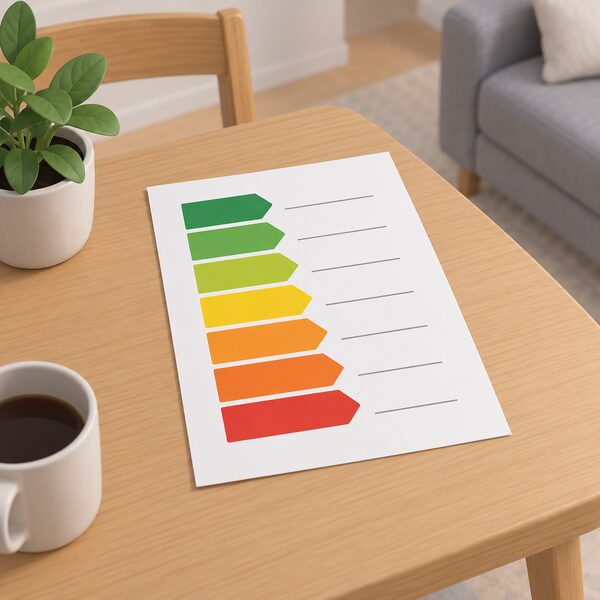
Both ratings on a domestic certificate use a scale of 1 to 100, split into bands A to G4. Non-domestic certificates add an A+ band above A2. The bands are set out below.
A home rated EPC C or above is generally regarded as having an adequate level of energy efficiency16. That threshold has become the working definition of a warm, efficient home in local and national policy, and it is the line several grant schemes work around: the Welsh Nest scheme, for example, requires an EPC rating of 54 (E) or less for eligibility17.
What the score actually measures is worth understanding before acting on it. EPC ratings are based on the costs of home heating rather than on carbon footprint, which affects how different heating systems score18. The underlying metric is expressed in pounds per square metre per year, so the relative price of gas and electricity can have a significant effect on the rating10. A household that electrifies its heating may therefore not see the band move as far as the carbon saving would suggest. The Climate Change Committee has argued that reforms to EPC rating metrics should be applied alongside wider improvements to the system, to improve the quality of assessments and the use of data19.
Scotland is changing this. A new domestic rating system will give clearer information on the fabric energy efficiency of a property, the emissions, efficiency and running costs of its heating system, and the cost of energy to run the home to standardised conditions20. In England and Wales, reform proposals would keep results grouped into bands identified by the letters A to G or A+ to G, with a rating on a scale of 1 (Very Poor) to 5 (Very Good) for each individual feature21.
The four parts of a certificate
Guidance sets a minimum content list. A certificate should contain the building asset rating against a benchmark, a recommendation report, a reference number and date of issuance, the building address, and the building's total useful floor area5. In Scotland the statutory content is set by section 6 of the Energy Performance of Buildings (Scotland) Regulations 2008, which requires the asset rating, a reference value, cost effective recommendations, the address, the approved organisation's name and the issue date22.
Scotland also describes the process itself in four parts: assessment by an accredited person, calculation using an approved methodology, lodgement on a national register, and production of a certificate to an agreed Scottish format22. For non-domestic buildings the certificate shows an asset rating alongside an indication of energy performance based on primary energy6. For new-build homes, a SAP certificate scores efficiency and gives an indication of projected energy costs after construction7.
Format differs across the UK. Certificates in England, Wales and Northern Ireland are fully displayed online, while Scottish certificates are distributed as PDFs and are typically printed and provided to the householder7. The content and design of the certificate in England and Wales also differs from the Scottish version23. In Scotland there is a further legal duty: the certificate must be affixed to the building, and building standards guidance suggests the boiler or meter cupboard24.
The recommendation report: how improvements are listed
The certificate is accompanied by a recommendations report which provides more detailed information about improvement measures6. Each certificate comes with a report setting out cost effective measures a homeowner or business can take to improve efficiency and the rating, such as low energy bulbs or upgrading insulation8.
The ordering is not arbitrary. The recommendations are cumulative, meaning they should be installed in the order they appear on the certificate in order to reach the potential energy efficiency rating shown7. Installing the fourth measure and skipping the first will not deliver the modelled potential rating, because each measure's saving is calculated on the assumption that the ones above it are already in place.
How much notice households take of this section is measurable. In the DESNZ Public Attitudes Tracker for winter 2025, 32% of those aware of certificates recalled seeing the section in their home's certificate that recommends ways to improve energy efficiency, and of those who had seen it, 65% said they had made changes, small or large, based on the recommendations25.
Both the name and the scope of the section are under review. Scotland has decided to rename recommendations on domestic certificates as "Potential Improvement Options"26. Which? has recommended that government consider improvements to the training and auditing of assessors that would improve the accuracy of assessments, together with a simple consumer feedback mechanism to support targeted auditing23. The Climate Change Committee has suggested certificates could also be expanded to provide information on risks posed by climate change and ways to reduce these19.
If a measure or an assumption on the certificate does not match the house as built, there is a route to challenge an EPC error through the assessor's certification body.
Estimated energy costs and emissions
The certificate carries information on potential energy costs and carbon dioxide emissions, with a coloured chart showing how energy efficient the building is or could be8. In England and Wales it gives an estimation of the annual energy costs for the property10.
These are modelled figures produced to standardised occupancy and heating patterns, not a forecast of a bill. Because the assessment reflects the energy performance of the building itself and not the way occupants use it6, a household that heats fewer rooms, or one that runs the heating harder than the standard assumption, will diverge from the printed estimate. The comparison value is between properties, not between a certificate and a supplier statement. For actual consumption, meter readings are the only reliable record.
The stakes attached to those modelled numbers are high. Government research describes certificates as the basis of many energy efficiency policies in the domestic built environment27, and the same research programme is working to develop insights to improve modelling algorithms and enable dynamic updates to certificates when building changes occur27. A certificate is currently valid for 10 years regardless of any changes that have been made to the property10, which is the central criticism of the cost estimates: a house insulated in year two still displays the year-one figures until a new assessment is lodged.
U-values: the fabric measure behind the rating
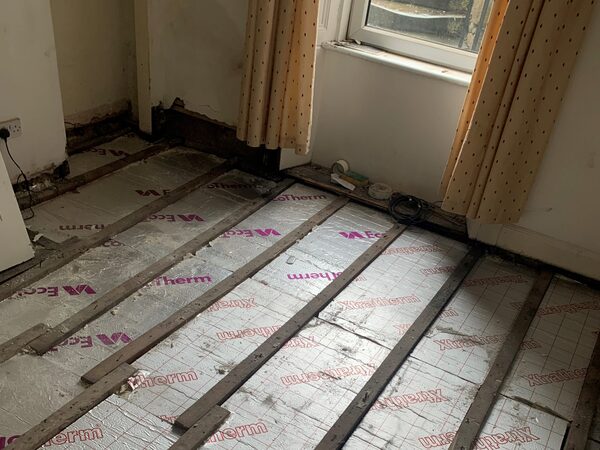
A U-value measures the rate at which heat passes through a building element, in watts per square metre per kelvin. A lower number means less heat lost. The assessor does not measure U-values on site; they are inferred from construction type, age and observed insulation, which is why a house with unrecorded insulation can score worse than it deserves.
The figures below show the U-values used in UK schemes and building regulations guidance, and give a sense of what counts as good.
| Element and context | U-value | Source |
|---|---|---|
| Floor, maximum for new dwellings (Welsh consultation guidance, 2026) | 0.15 W/(m2.K) | 28 |
| Suspended underfloor insulation, ECO4 target | at least 0.25 W/m2K | 29 |
| Cavity wall insulation, ECO4 target | 0.55 W/m2K | 30 |
The gap between 0.15 and 0.55 is the gap between new-build fabric and a retrofit measure in an older wall, and it explains why a solid-walled Victorian house rarely climbs to band A or B on insulation alone. Because the certificate's score is driven by modelled heating cost per square metre per year10, fabric improvements that cut heat demand feed straight into the rating, while a change of heating fuel can move it in either direction depending on relative fuel prices.
Where the rules come from
Legislation covering certificates was introduced across the UK in 2008, transposing the EU Energy Performance of Buildings Directive, and was retained in UK law following EU Exit26. The directive itself was first adopted in 200231. In England and Wales the regime is currently governed by the Energy Performance of Buildings Regulations 2012, derived from EU law32; those regulations define the certificate and set out duties including the EPC construction duty33. In Scotland the directive was transposed by the Energy Performance of Buildings (Scotland) Regulations 200822.
The EU directive has since moved on. A recast directive was adopted in April 2024, aiming to reduce greenhouse gas emissions by at least 60% in the building sector by 2030 compared with 2015, with a long-term objective of a highly energy efficient, zero-emission building stock by 205031. Those targets do not bind the UK, but they shape the reform debate here.
Reform is live in Scotland. The Scottish Government is reforming certificates by introducing new ratings, redesigning the certificates and improving the operational infrastructure35. A redesigned certificate has been developed on a first phase of user testing, with a second phase planned before the regulations come into force, and its introduction will coincide with the regulations bringing the new rating system into force26. Scotland has also decided to reduce the validity period from 10 years to five36. A further change follows: after 30 April 2028, anyone selling or letting a building in Scotland must provide a valid EPC and property report both when advertising it and once it is sold or let37.
When a certificate is needed, and for how long

Certificates are needed whenever a property is built or marketed for sale or rent8, and are required when a dwelling is constructed, converted, sold or let2. The owner or landlord is responsible for having one, for making it available to potential buyers or tenants, and for giving a copy to the new owner when selling8. In Scotland, a certificate is required as part of the Home Report, and it must be provided to the purchaser free of charge, which guidance states is a legal requirement38. Estate and letting agents must legally show the certificate to anyone who makes an enquiry about a property, when they first ask about it13.
| Point | Position |
|---|---|
| Current validity | 10 years, usable multiple times in that period8 |
| Ends early if | a newer certificate is produced and registered for the same building39 |
| Scotland | validity being reduced from 10 years to five36 |
| Grant use | Boiler Upgrade Scheme requires an EPC no more than 10 years old40 |
The 10 year life is the weak point most often criticised, because the certificate stays valid regardless of any changes made to the property10. Which? has suggested reducing validity from ten to five years, applying only where the certificate was required for a property sale, a new rental agreement or a grant application10.
Cost of an assessment, and the published figures differ
There is no set fee for an assessment. Boiler Upgrade Scheme guidance specifically removed an earlier recommendation that an assessment may cost £60 upwards and replaced it with a statement that there is no set fee41. Cost varies from one company to another depending on the size, location and age of the building39.
Published ranges do not agree, and each is dated differently:
- £50 to £150, Welsh government guidance, March 20269
- £60 to £120 to get a property on the register, Uswitch, July 20263
- £35 to £100, Which? consumer research, April 202410
- over £100 in the domestic sector, Scottish Government consultation, November 202312
All are quoted as consumer prices; none of these documents states a VAT position. Since there is no set fee, the sensible reading is that these are observed ranges rather than a tariff. Guidance on where to start is covered in the page on getting an EPC or finding an existing one.
How the rating affects selling, letting and improving

When a building is advertised for sale in Scotland, the rating must be included in the property advertisement38. For rented property in England and Wales, a certificate rating of E or better is required to let11, which is why band E, at 39 to 54 points2, is the threshold landlords watch. Buyers pay attention too: in Which? research, 39% of prospective homebuyers stated that a property's rating was a "very important" factor10.
For an owner planning work, official guidance frames the certificate as a starting point rather than an endpoint: "Looking at your Energy Performance Certificate (EPC) is a good starting point to help improve the energy efficiency of your property."
"Looking at your Energy Performance Certificate (EPC) is a good starting point to help improve the energy efficiency of your property."
The rating also acts as a gate to funding. The Welsh Nest scheme sets an eligibility threshold of 54 (E) or less17, and the Boiler Upgrade Scheme requires a certificate no more than 10 years old40. That makes the age and accuracy of the document a practical matter, not a paperwork one. Which schemes a household can reach is set out under checking which grants you qualify for.
What the certificate does and does not tell you about independence
For a household working towards less dependence on bought-in energy, the certificate is a useful map of the fabric and a poor map of everything else. It records construction type, insulation, heating, ventilation and lighting14, so it identifies where heat is being lost, which is the first and most durable step away from supplier dependence. The directive that created the regime explicitly contemplates low or zero carbon technologies including photovoltaics, micro-wind turbines, combined heat and power, community heating and heat pumps43.
The limits are real and should be read as firmly as the benefits:
- The score is modelled from standard assumptions, not measured, and reflects the building, not the occupants6.
- It is driven by heating cost per square metre per year rather than carbon10, so a low-carbon electric system may not lift the band as far as the emissions cut implies.
- It stays valid for 10 years whatever is done to the house10, so a well-improved home can carry a stale letter.
- It is a snapshot from an hour-long visit3, dependent on what the assessor could see and what evidence was available.
- Dependence on the register, the accreditation scheme and the assessor remains: a wrong certificate has to be corrected through the certification body, found via the register's scheme details15.
Nothing on the certificate measures self-generation, storage or actual consumption. Those have to come from meters and from the household's own records, which is why the certificate sits alongside, rather than instead of, meter data in any plan set out under taking more control of your home's energy. The broader route through switching, readings, grants and complaints is covered in the home energy how-to guide.
Sources43 cited
- Energy Performance Certificates research briefing, House of Commons Library, 2026-09-20
- Energy efficiency of housing in England and Wales 2025, ONS, 2025-10-28
- Energy performance certificates guide, Uswitch, 2026-07-27
- Energy Performance Certificates briefing, House of Commons Library, 2026-09-17
- What does an EPC contain, Planning Portal, 2026
- Energy performance certificates: a guide, Scottish Government, 2026-08-24
- EPCs explained, Elmhurst Energy, 2026-09-20
- Energy performance certificates, nidirect, 2026-02-26
- Five top tips from Which? to cut your energy bills, Welsh Government, 2026-03-18
- Reforming EPCs to support households in the energy transition, Which?, 2024-04-29
- Energy performance certificates and ratings explained, Confused.com, 2025-12-08
- Delivering net zero for Scotland's buildings consultation, Scottish Government, 2023-11
- Energy Performance Certificates leaflet, Building Control Northern Ireland, 2014
- Delivering net zero for Scotland's buildings consultation, Scottish Government, 2021-07-23
- Domestic RHI: who to contact, Ofgem, 2026-09-17
- Bristol Warm Homes Plan, Bristol City Council, 2025-04
- Nest scheme eligibility, Welsh Government, 2026-09-17
- Heating our homes select committee report, UK Parliament, 2025-05-09
- Letter on reform of domestic EPC rating metrics, Climate Change Committee, 2026-09-19
- Reforming Energy Performance Certificates, Scottish Government, 2025-01-21
- Technical annex: what EPCs measure, DESNZ, 2026-03-09
- Review of domestic and non-domestic EPCs in Scotland, Scottish Government, 2019-02-07
- Transforming EPCs: consumer research insights, Which?, 2024-09
- Energy performance certificates: an introduction, Scottish Government, 2015-12
- Public Attitudes Tracker: heat and energy use in the home, winter 2025, DESNZ, 2025
- EPC reform consultation: government response, Scottish Government, 2025-01
- Energy Performance Certificate accuracy research, DESNZ, 2026-05-26
- Approved Document L Volume 1 consultation version, Welsh Government, 2026-09-17
- ECO4 new measures and products guidance, draft, Ofgem, 2022-07-04
- ECO4 new measures and products guidance v3.0, Ofgem, 2026-03-26
- EPC reform consultation: government response, chapter 8, Scottish Government, 2025-01-21
- Energy performance of buildings regime briefing, House of Commons Library, 2026-09-20
- Energy Performance of Buildings (England and Wales) Regulations 2012, regulation 2, legislation.gov.uk, 2026-09-17
- Energy Performance of Buildings (England and Wales) Regulations 2012, regulation 34, legislation.gov.uk, 2012
- Energy Performance of Buildings (Scotland) Regulations 2025 update, Scottish Government, 2025-10-10
- Heat in buildings progress report 2025, Scottish Government, 2025-10-02
- EPCs are changing, Scottish Government, 2026-08-24
- EPCs: buildings for sale, Scottish Government, 2026-08-24
- Energy performance certificates guidance, Isle of Anglesey County Council Trading Standards, 2025-09
- Boiler Upgrade Scheme guidance for installers, Ofgem, 2026-07-02
- Summary of updates to Boiler Upgrade Scheme guidance for property owners, Ofgem, 2023-12
- Low carbon heating, nidirect, 2026-09-17
- Energy Performance of Buildings (Scotland) Regulations 2008 explanatory note, legislation.gov.uk, 2008
 Energy Performance CertificatesAn Energy Performance Certificate rates how energy efficient your home is, from A down to G.
 Energy Checks Before BuyingHow energy efficient is the house, and what will it cost to heat?
 EPC StatisticsHow energy efficient are UK homes, and is it getting better?
 Home Energy AssessmentsWhich home energy check do you actually need?
 Get an EPC for Your HomeSelling or renting out a home means you need an Energy Performance Certificate.
 The Full How To GuideSwitching supplier, sending meter readings, sorting an EPC, claiming a grant, complaining when something goes wrong, coping in a power cut: where do you start with any of it?