
In this answer
Short answer
A micro-CHP performance estimate is a product-level calculation, not a sales claim. It sets out how much heat and how much electricity a combined heat and power unit will produce in a given home over a year, and it must rest on certified test data and a defined annual method rather than on a manufacturer's best case. The Microgeneration Certification Scheme exists to assess the quality, performance and safety of small scale energy products, and micro combined heat and power units sit within it1.
The two figures every estimate must state are heat output and electrical output. A typical domestic unit generates about 1kW of electricity while it is running, alongside its heat output3. Combined heat and electricity efficiency for micro-CHP is typically more than 90%, against the 35 to 45% efficiency of conventional generation that throws the heat away4.
What follows is how the estimate is meant to be built: the standard conditions it rests on, the efficiency calculation, the running-hour assumptions that drive the result, and where a manufacturer's figure can diverge from what a home actually sees.
What a micro-CHP performance estimate is meant to show
A micro-CHP performance estimate answers a narrow question: in this dwelling, over a year, how much useful heat and how much electricity will this unit deliver, and at what fuel input. It is not a statement about the property's overall energy rating, and it is not a marketing figure. The distinction matters because the two are routinely confused.
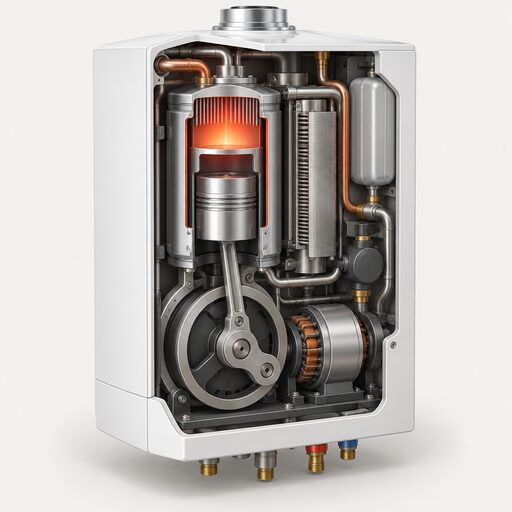
The estimate exists because micro-CHP is unusual among home generators. It produces heat and power together from a single energy source, so the electricity is a by-product of meeting heat demand rather than an independent output2. A unit cannot generate electricity without also generating heat, and it cannot run for more hours than the home needs heat. That coupling is the whole reason a performance estimate has to be dwelling-specific rather than a single number printed on a brochure.
Certification provides the foundation. MCS certification is offered for micro combined heat and power units, and the scheme assesses quality, performance and safety1. The Feed-in Tariff guidance set the accreditation route for CHP up to a total installed capacity of 2kW, which is the scale at which domestic micro-CHP sits5. In Wales, building regulations guidance is explicit that because micro-CHP systems operate within the context of the building, the equipment, installation and testing must all comply with the relevant standards7.
For a household, the estimate is the document that determines whether the unit's electricity output is worth anything. It is also the figure that a grant or export application may rest on. The Smart Export Guarantee requires a Microgeneration Certification Scheme certificate or equivalent for solar PV, wind and micro-CHP installations up to 50kW, so the certified performance data behind the estimate has a practical role beyond the sales conversation8.
The standard test conditions an estimate must be based on
An estimate is only as good as the test data underneath it. The Feed-in Tariff guidance set out the method: the annual performance figure should be calculated using DECC's Annual Performance Method, with performance data established by testing according to BSI PAS 6710. That pairing matters. The test standard defines how the unit is measured under controlled conditions; the annual method defines how those measured figures are converted into a year's output for a specific dwelling.
Testing to a published standard is what separates a performance estimate from a claim. The same principle runs through the wider certification landscape: MCS certification covers micro combined heat and power units as one of the technologies it assesses for quality, performance and safety1. The equipment, installation and testing must all comply with the relevant standards, which means the estimate cannot be built on a bench test alone if the installation does not match the tested configuration7.
There is a limit worth stating plainly. The standards and methods above are the framework the estimate must sit within, but no single current, universally binding test condition set for domestic micro-CHP is published in the way that heat pump performance is tied to specified source and sink temperatures. Heat pump efficiency is defined as a measure at specified source and sink temperatures, measured using the procedures in BS EN 14511-211. Micro-CHP has no equivalent single figure, which is precisely why the annual method and the dwelling's demand assumptions carry so much weight.
"using the methodology set out in DECC's Annual Performance Method (APM), and the performance data for the micro-CHP pack"
Heat and power output: the two figures every estimate must state
Every estimate must give heat output and electrical output as separate figures. Combining them into one efficiency number hides the thing a household actually needs to know: how much electricity the unit will produce, and whether that output arrives when the home can use it.
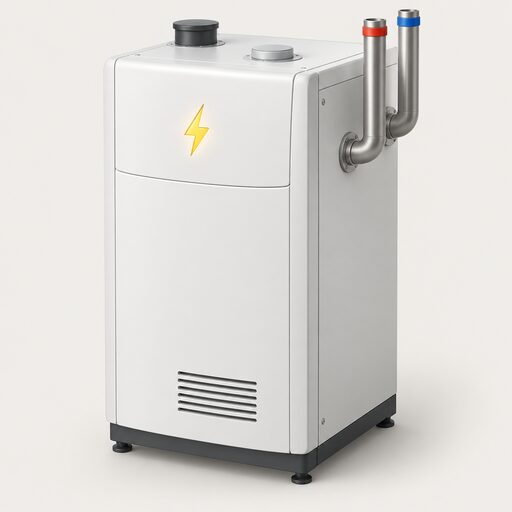
A typical domestic unit generates about 1kW of electricity while it is running3. That figure is the headline for the electrical side, and it is modest. It is not a substitute for a grid connection or a battery; it is a supplement that arrives whenever the unit is meeting heat demand. The heat output is the larger figure and is the unit's primary purpose.
The estimate should also state how the unit prioritises its operation. A micro-CHP system can be set up to prioritise either heating or electricity, depending on the household's needs2. That setting changes the annual output profile, because a unit configured to favour electricity will run differently from one configured to favour heat. An estimate that does not state the priority setting is incomplete.
| Figure the estimate must state | What it describes | Typical value |
|---|---|---|
| Heat output | Useful heat delivered to the dwelling | Unit-specific, from certified test data |
| Electrical output | Electricity generated while running | About 1kW3 |
| Combined efficiency | Heat and electricity together | More than 90%4 |
| Fuel input | Energy consumed to produce both | Derived from the above |
The distinction between heat and power output is also what makes the estimate comparable, or not, between units. Two units with the same combined efficiency can have very different electrical outputs, and it is the electrical figure that determines export income or bill offset. Comparing combined efficiency alone tells a household almost nothing about the value of the electricity.
Efficiency: how it is calculated and what counts as useful output
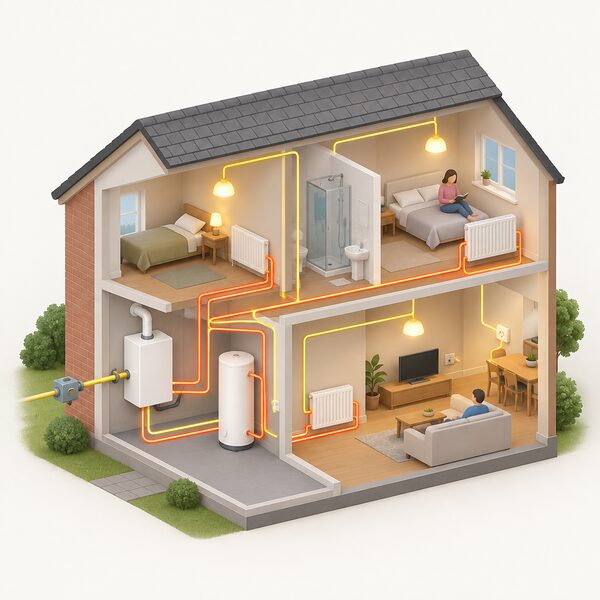
Efficiency in a micro-CHP estimate is a ratio of useful output to fuel input, and the definition of "useful" is doing a lot of work in that sentence. For a conventional power station, the heat is waste and efficiency sits at 35 to 45%. For micro-CHP, the heat is captured and used in the home, so it counts as useful output alongside the electricity. That is why combined efficiency figures of more than 90% are achievable4.
The calculation follows the same logic as the coefficient of performance used for heat pumps, where the ratio of output to input energy is the measure12. For heating, the coefficient of performance is calculated as heat output divided by power input11. Micro-CHP's combined efficiency applies the same output-over-input structure but counts both heat and electricity on the output side.
The independent evidence on primary energy saving is more striking than the efficiency figure alone. Analysis conducted by Cogen Europe suggests that micro-CHP can achieve primary energy savings of more than 25%4. That is a measure of fuel avoided at the system level, not just efficiency within the home, and it is the strongest independent case for the technology in the material here.
What counts as useful output also depends on whether the heat is actually needed. Heat delivered to a dwelling that is already warm, or hot water stored beyond demand, is not useful in the same sense. The estimate's demand assumptions, covered below, determine how much of the theoretical output is genuinely useful in practice.
Assumptions about running hours and demand that shape the result
Running hours are the single most influential assumption in a micro-CHP estimate, and they are not a fixed national figure. They are derived from the dwelling's annual heat demand and the unit's heat output. A home with high, steady demand gives the unit more hours; a well-insulated home with low demand gives it fewer. Because electricity output is tied to running hours, the demand assumption drives the electrical figure as much as the heat figure.
The annual method exists to make that derivation consistent. The Feed-in Tariff guidance's use of DECC's Annual Performance Method, with testing to BSI PAS 67, is the framework for turning measured performance into an annual figure for a specific dwelling10. The method's output depends entirely on the demand input, which is why two estimates for the same unit in different homes can differ substantially.
Demand assumptions in the wider modelling landscape are themselves under review. The Home Energy Model, the intended successor to SAP for the Future Homes Standard, has drawn concern about runtime: the National Insulation Association's view is that a runtime of 5 minutes, although not ideal, would most likely still be workable for industry, while a runtime of 15 minutes or more would represent a substantial challenge for SAP users and would significantly reduce the effectiveness of the model in practice13. That is a comment on the assessment tool rather than on micro-CHP directly, but it shows that the modelling behind dwelling-level performance figures is not settled.
Demand assumptions also shift over time. The Committee on Climate Change's 2035 power system modelling is based on an hourly representation of demand and generation, and historical annual weather patterns to simulate future years14. At the household level, the same principle applies: an estimate built on last year's weather and this year's occupancy will drift as both change.
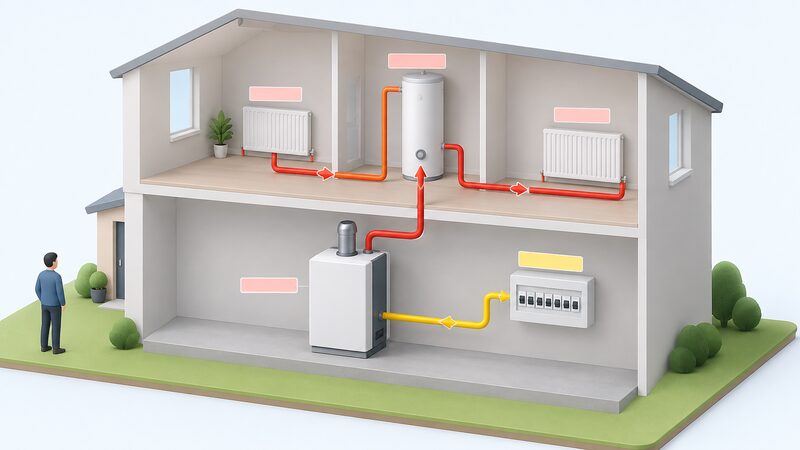
Where a manufacturer's estimate falls short of real-world performance
The gap between a manufacturer's estimate and real-world performance comes from three places: running hours, demand profile and the unit's own consumption.
Running hours are the largest. A manufacturer's figure typically assumes the unit operates whenever there is heat demand, which maximises both heat and electrical output. In practice, a home with low hot water demand or a well-insulated fabric gives the unit fewer hours, and the electrical output falls with them. The estimate should be recalculated against actual demand before any decision, because the unit cannot run more without wasting heat.
The unit's own consumption is the second. Pumps, fans and controls draw power, and that parasitic load sits on the input side of the calculation. An estimate that quotes electrical output without accounting for internal consumption overstates the net benefit. The 1kW figure is what the unit delivers while running, and the internal load is part of what it costs to deliver it3.
The third is the demand profile itself. Independent monitoring of heat pump systems during home visits found water temperature set points typically not optimised for efficiency, ranging between 50 and 70 degrees C15. That finding is about heat pumps, not micro-CHP, but it illustrates the general point: real installations often run at settings that differ from the assumptions in a performance estimate, and the resulting efficiency diverges from the modelled figure.
For a household, the practical consequence is that the estimate should be treated as a modelled figure with stated assumptions, not a guarantee. The assumptions that matter most are running hours, demand profile and internal consumption, and each should be visible in the document. Where they are not, the estimate cannot be checked against the home it is meant to describe.
How the estimate fits a household's energy independence
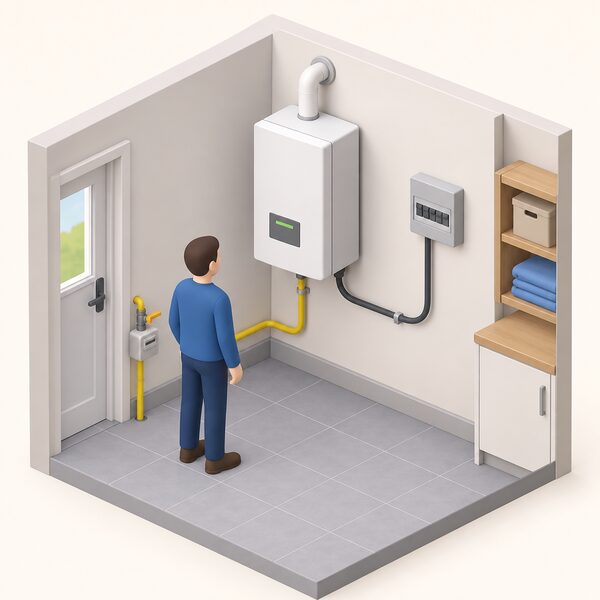
A micro-CHP unit reduces dependence on imported electricity by generating some of it at home, and it does so using the same gas connection that already heats the dwelling. That is a real but partial independence. The unit still depends on the gas grid, on a gas supplier, and on the manufacturer for parts and service. It does not make a home self-sustaining, and it does not remove the grid connection.
The electrical output is small, at about 1kW while running, and it arrives only when the unit is meeting heat demand3. A household wanting meaningful independence from the grid would need generation that runs independently of heat demand, which micro-CHP by design does not provide. What it offers is a reduction in imported electricity during the heating season, offset against continued gas consumption.
The certification and estimate framework is what makes that reduction measurable. MCS certification covers micro combined heat and power units, and the Smart Export Guarantee requires an MCS certificate or equivalent for micro-CHP installations up to 50kW1. Without a properly carried out estimate resting on certified test data, a household has no reliable basis for judging what the unit will actually deliver.
For the wider picture of how micro-CHP sits alongside other home generation technologies, the microgeneration pillar covers the field, and micro-CHP performance testing and certification goes deeper into the testing regime behind the estimate. Households weighing the technology against alternatives may find micro-CHP vs an air source heat pump and micro-CHP cost, output and running costs useful comparisons.
Sources17 cited
- MCS Microgeneration Certification Scheme, BSI Group
- Micro-CHP, MCS Certified
- Micro combined heat and power, nidirect
- Micro-CHP, HHIC
- Feed-in Tariffs: Guidance for renewable installations, Ofgem, 2021-12-13
- MCS Microgeneration Certification, BSI Group
- Building Regulations: Micro combined heat and power, Welsh Government
- Smart Export Guarantee: Generators, Ofgem, 2026-09-17
- Smart Export Guarantee Annual Report Year 5, Ofgem, 2025-12
- Draft Guidance: Domestic Building Services Compliance Guide, Scottish Government, 2010
- Approved Document L: Conservation of fuel and power, Volume 1, HM Government
- Heat pumps, REA
- The Home Energy Model: Future Homes Standard Assessment, NIA, 2024-04-16
- A reliable, secure and decarbonised power system by 2035, CCC, 2023-03-09
- Heat pump transition report, HM Government, 2026-05
- Feed-in Tariffs Quarterly Report Issue 63, Ofgem, 2026-03-30
- Feed-in Tariffs Quarterly Report Issue 64, Ofgem, 2026-06-29
 Micro-CHP Performance TestingHow well a micro-CHP boiler performs in your home decides what you get paid and what you save.
 Micro-CHP Cost and OutputDomestic micro-CHP costs more than a conventional boiler and produces roughly 1kW of electricity alongside its heat.
 Micro-CHP TypesWhich type of micro-CHP actually gets fitted in UK homes, and how much electricity does one make while it heats your house?
 Micro-CHP for HomesA micro-CHP boiler makes electricity while it heats your home, but only when the heating is on.
 Efficiency COP SCOP and SPFA heat pump can give out three or four times more heat than the electricity it uses, so what do the efficiency numbers on a quote actually mean?
 Energy Checks Before BuyingHow energy efficient is the house, and what will it cost to heat?