In this guide
- What Counts as Emerging
- Vehicle-to-Grid Basics
- V2G Earnings and Savings
- V2G Hardware and Charger Costs
- V2G Battery and Grid Impact
- V2X Types Explained
- Hydrogen Heating How It Works
- Hydrogen-Ready Boilers
- Hydrogen Heating Shortfalls
- Perovskite Solar Panels
- Other Technologies on Horizon
- Path to Energy Independence
Emerging Home Energy Technology: The Full UK Guide
Emerging home energy technology is the group of products that work in trials or early sales but are not yet a routine purchase for a UK household. The group includes vehicle-to-grid and other bidirectional charging, hydrogen for heat, perovskite solar, heat batteries and newer battery chemistries. The gap between promise and availability differs sharply between them. Vehicle-to-grid has real UK trial data behind it: Cenex estimates average UK revenue of £150 to £200 per year1. By the end of Britain's largest domestic trial, though, the hardware and installation still cost around £3,700 more than a one-way smart charger2.
Hydrogen heating is further back. Energy Systems Catapult describes it as not commercially available yet, with only a few trials of a blended approach3. The government said it intended to take strategic decisions on hydrogen's role in heating buildings in 20264. The solar change that has actually reached shops is plug-in solar, which has been legal to buy and use across Great Britain since 27 August 20265.
This page sets out how far each technology has reached, what the evidence says on cost and performance, and what it would and would not do for a household's energy independence. The detailed pages in the emerging technology section take each subject further.
What counts as emerging, and why the label matters
One practical test of whether a technology is mainstream is whether public schemes fund it. The Warm Homes Plan announcement of 20 January 2026 lists the following8:
- solar panels, both photovoltaic and thermal
- heat pumps, including ground source, air source and air to air
- home and heat batteries
- smart controls
- insulation
- draught proofing
The July 2026 rules for the Warm Homes: Local Grant go into more detail. They name solar PV, solar thermal, digital and smart controls, hot water cylinder measures and domestic batteries among the eligible measures9. Bidirectional chargers, hydrogen appliances and perovskite panels do not appear in either list.
Heat batteries sit on the boundary. MCS announced a pilot for a new installation standard covering thermal energy storage systems, a category that includes heat batteries. It noted that heat batteries are included in the Warm Homes: Social Housing Fund10. A technology with a funding route and an installation standard in development is close to mainstream. One with neither is still at the trial stage, and a buyer of it carries more risk on support, spare parts and resale. The pages on technology readiness levels and product claims and standards for emerging energy products explain how to read that stage from a product's paperwork.
Policy direction matters as much as engineering. The Department for Energy Security and Net Zero's stated position, recorded by the Public Accounts Committee, is that heat pumps and heat networks will be the main low-carbon heating technologies over the next decade. It sees potential for hydrogen to play a role in slower time in some locations11. Public awareness is also limited: 35% of respondents to the department's Winter 2025 attitudes tracker were aware of hydrogen-ready boilers12.
Battery chemistries beyond lithium-ion are covered on their own pages: sodium-ion home batteries, solid-state batteries and second-life EV batteries. The guide to early adopter costs and the record of energy technology company failures cover the commercial risk that comes with buying early.
Vehicle-to-Grid: your EV as a household battery
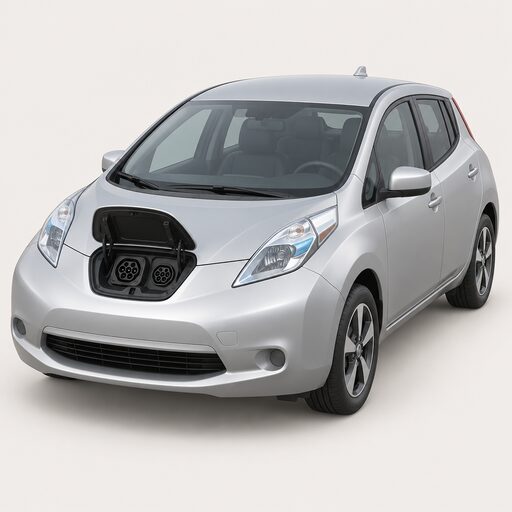
Vehicle-to-Grid (V2G) lets an electric vehicle draw power from the grid to charge and also send electricity back when it is needed, which earns money for the owner13. Uswitch's definition is wider: power is released back through the charger either for use in the building the car is connected to or into the grid generally14. Government guidance on registering energy devices uses the same framing. It describes a V2G-enabled chargepoint as able to charge the vehicle and export electricity from the car battery back to the home or the grid15.
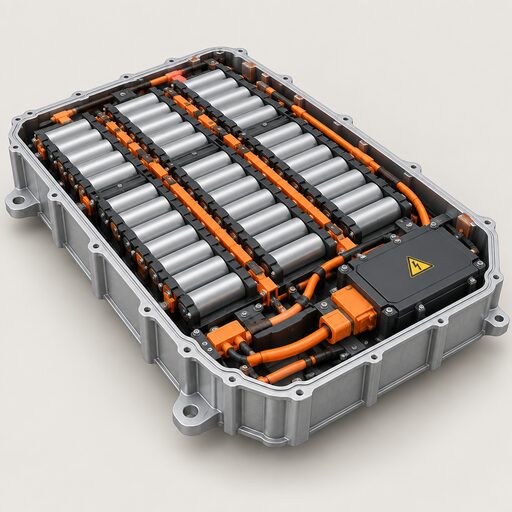
A car battery is large compared with a typical home battery, and it is parked most of the time. Energy Saving Trust describes a possible two-way movement of energy, in which electricity stored in the car is used in the home or sold back to the grid at times of peak demand16. For this to work, three things must be in place together.
"To use V2G, you need a smart meter, a compatible V2G charger and a car that supports the technology."
The charger is the unusual part. V2G relies on bi-directional chargers that let electricity flow back and forth between the grid and the EV battery18. Few cars and chargers support this, and Uswitch says V2G is still not widely available. Access is often through trials that require specific EV models and compatible chargers. These involve online registration, eligibility verification and coordination with installers and energy suppliers, and they may include a selection process17. The pages on cars that support bidirectional charging and bidirectional chargers list what qualifies.
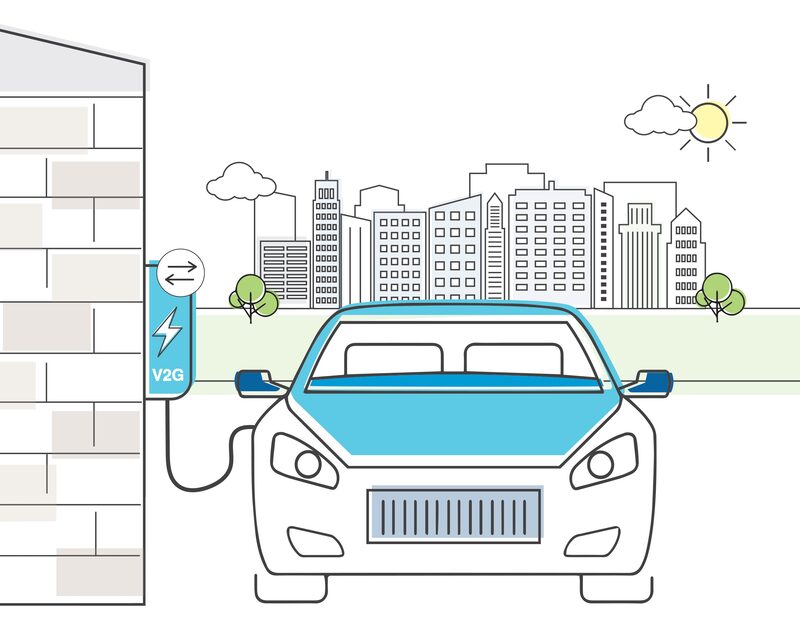
Bidirectional charging can let an EV power the home or export to the grid, and it can provide backup power during outages19. Cenex has pointed to a household using an EV as a supplementary energy source to power a heat pump, which would help grid flexibility and resilience20. Households that generate their own renewable electricity can already use it to charge the car21. V2G completes that loop by letting the stored energy come back out. It does not remove dependence on other parties. The household still relies on a supplier's tariff, the smart meter, the car maker's support for export, and the charger maker's software.
V2G earnings and savings: £150 to £400 a year, and what it takes to get them
The published figures cover a wide range because they measure different things. The most cautious headline is Cenex's estimate that average UK revenue from V2G is £150 to £200 per year1. The higher figures come from Project Sciurus, the domestic trial, and depend on which services the car is allowed to sell.
| Measure | Figure | Basis |
|---|---|---|
| Average UK V2G revenue | £150 to £200 per year | Cenex estimate1 |
| V2G using tariff optimisation | £340 per year | Simulated, Sciurus trial report, May 202122 |
| Value of V2G above smart charging | £220 per year | Sciurus trial report, May 202122 |
| V2G compared with unmanaged charging | around £410 per year | Cenex modelling of Sciurus data, January 202123 |
| With Firm Frequency Response | £513 | Sciurus trial report, May 202122 |
| With Dynamic Containment | £725 | Sciurus trial report, May 202122 |
| Commercial users, EV-elocity project | £400 per vehicle per year | Cenex, August 202224 |
The comparison baseline accounts for much of the spread. Around £410 per year is measured against unmanaged charging, where the car charges whenever it is plugged in23. Against an ordinary smart charger that already moves charging to cheap hours, the incremental value of V2G was £220 per year22. The £220 figure is the relevant one for a household that already has a smart charger and a time-of-use tariff. The £513 and £725 figures depend on providing frequency services to the system operator. Those markets are normally reached through an aggregator rather than by an individual home22. The £400 per vehicle per year figure relates to commercial users. The V2G Britain study's further savings of between £200 and £700 on demand transmission charges apply to large electricity consumers such as commercial fleet operators, not households24.
At system level, the V2G Britain work by a consortium including Nissan, Energy Systems Catapult, Cenex and National Grid ESO found that V2G could save an additional £40M to £90M annually in Great Britain by 2030, on top of smart charging savings. The result depends on limits to V2G energy throughput25. Cenex also states that V2G could defer network upgrades of £5bn, or £180 per household1. These are benefits to the system as a whole and do not arrive as payments to a driver.
For context, Energy Saving Trust's Flexible Futures work on smart tariffs combined with low-carbon home technologies found savings of up to around £800 a year possible across the whole home27. That figure covers more than the car. Separately, the chargepoint grant for households with on-street parking gives 75% off the cost to buy and install a socket, up to a maximum of £500. It is a charging grant, not a V2G subsidy28. Tariff structures are covered under V2G earnings and tariffs and the trial itself under Project Sciurus.
V2G hardware and charger costs today, and where prices are heading
Hardware cost is the reason V2G has stayed at the trial stage. Ofgem's case study records that by the end of the trial the V2G hardware and installation cost was around £3,700 higher than a smart, monodirectional charge point2. The Sciurus report gives the same incremental figure and notes that the lowest price point tested was £3,000 to £3,50022. In January 2021 Cenex estimated the premium for a V2G charger above a smart charger at around £4,000, with the Indra unit retailing to end users at approximately £5k including installation23.
One-way charging is far cheaper. Which? reported in February 2026 that a home EV charger typically costs between £500 and £1,200 to buy and install, with 7kW chargers costing around £90029.
| Item | Cost | Date or period |
|---|---|---|
| Home EV charger, bought and installed | £500 to £1,200 | February 202629 |
| 7kW home charger, bought and installed | around £900 | February 202629 |
| V2G premium over a smart charger | around £3,700 to around £4,000 | 2021 trial data2 |
| Indra V2G charger including installation | approximately £5k | January 202123 |
| Projected V2G premium over a smart charger | £656 to £1,164 | by 203024 |
| Predicted V2G charger cost | £1000 | by 20301 |
With annual value of a few hundred pounds, a premium of around £3,700 takes many years to recover, and the projections reflect that. Energy Systems Catapult states that the cost premium for 7kW V2G needs to drop below £1000 by 2030 for continued viability26. The V2G Britain projections, built both top-down from learning rates and bottom-up from components, arrived at a premium of roughly £650 to £1,150 in 2030. Cenex reports the same result as £656 to £1,16424. Cenex also predicted that hardware prices would fall below a £3,000 to £5,000 level by 2025 and that a V2G charger would cost £1000 by 20301. All of these are projections. No current published UK retail price for a domestic bidirectional charger is available, so today's prices are installer-quoted.
What V2G does for your battery, the grid and renewables
Battery wear
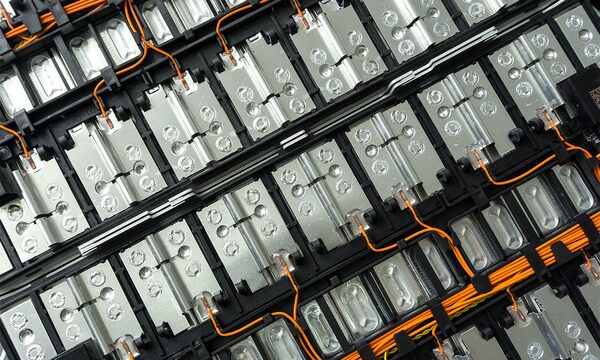
The common worry is that extra cycling wears out the car battery. Uswitch acknowledges concerns that frequent charging and discharging could shorten EV battery life. It says the impact should be relatively minimal within recommended guidelines17. E.ON Next, an energy supplier, says there might be a small reduction in battery life and that the technology is improving to reduce the impact18. Cenex presents the opposite possibility. It reports that capacity fade can be reduced by 9.1% over a year through battery management, which could extend useable battery life by 10% and give an annual depreciation saving of £2301. The two positions can both be true. Unmanaged heavy cycling adds wear, while software that holds the battery at a favourable state of charge can reduce it. How a car maker's warranty treats export is a separate matter, covered under V2G, battery degradation and vehicle warranties.
The grid and renewables
E.ON Next describes V2G as a way of using EV batteries to help balance the electricity grid18. Energy Saving Trust, whose best practice guide was updated on 5 May 2026, says that having electric vehicles as battery storage will allow better management of the UK's energy30. Cenex lists supplying energy to energy markets and increasing the use of localised renewables among the benefits31. It estimates that reduced renewable curtailment could save 6 MtCO₂e per year. It also estimates that storing generation from a 4 kWp domestic solar PV system in an EV battery over a weekend with 6 hours of sun per day could save over 600 kgCO₂e per year1. The V2G Britain case study adds that V2G could help to save £200m of cumulative distribution network investment by 203032.
Resilience
The Climate Change Committee's adaptation framework notes that further innovation in home batteries, vehicle-to-everything and solar can give households additional backup options during power outages33. Uswitch says vehicle-to-home can provide backup power during outages and support off-grid setups, but it is limited to certain EV models and compatible chargers17. Exporting to the network also requires agreement from the local network operator, covered under grid connection rules.
V2X: Vehicle-to-Grid, Vehicle-to-Home, Vehicle-to-Building and Vehicle-to-Load
V2X is the umbrella term. The Climate Change Committee defines it as allowing electric vehicles to operate bidirectionally, charging from the electricity grid and also discharging to the grid, building or home as needed33.
| Mode | Where the energy goes | What the evidence says |
|---|---|---|
| Vehicle-to-Grid (V2G) | The electricity network | Energy stored in EVs is fed back into the network34 |
| Vehicle-to-Home (V2H) | The home's own circuits | Backup power and off-grid support, limited to certain EV models and chargers17 |
| Vehicle-to-Building (V2B) | The building the car is connected to | Included in the CCC's definition of discharging to a building33 |
| Vehicle-to-Load (V2L) | Appliances plugged into the car | See the dedicated page linked below |
For energy independence the mode matters more than the hardware. V2G earns money but keeps the household tied to a tariff and an export agreement. V2H is the mode that reduces reliance on the grid, because the car's energy stays behind the meter. The comparison pages on V2G against V2H, vehicle-to-home and vehicle-to-load and V2G against a home battery develop this, and the communication protocols are explained under bidirectional charging standards.
Brands and product ranges seen in the UK
Few makers are named in the UK evidence, and the list below is descriptive only.
- Wallbox Quasar. E.ON Next calls it "probably the most well-known compatible bi-directional charger"18. See the Wallbox Quasar page.
- Indra. A UK maker whose V2G charger retailed to end users at approximately £5k including installation in January 202123. See Indra.
- Nissan. A member of the V2G Britain consortium alongside Energy Systems Catapult, Cenex, Moixa, Western Power Distribution, National Grid ESO and Element Energy32. See the Nissan LEAF and V2G.
- Toyota. Toyota Motor Europe has said it plans more advanced solutions including V2G integration as it extends its energy collaborations, so that EVs can return energy to the grid when needed35. This is a stated plan, not a product on sale.
Related pages cover Renault bidirectional charging, Hyundai's V2G plans and the Powerloop bundle.
Hydrogen heating: how it works and what it would mean for your home
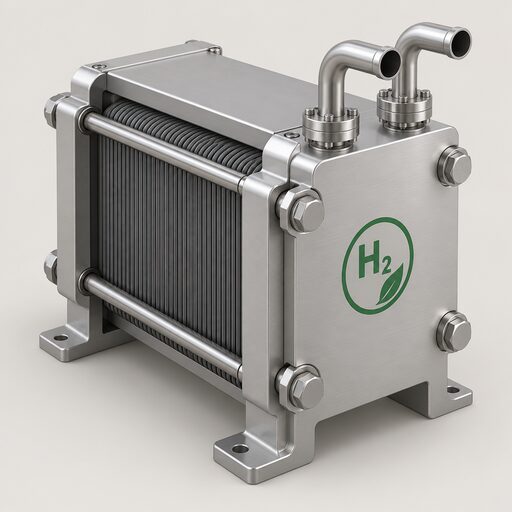
A hydrogen boiler works like a gas boiler but burns hydrogen instead of methane. Elmhurst Energy notes that when burned, hydrogen releases only water vapour, unlike fossil fuels, which emit carbon dioxide36. For a household the attraction is familiarity: the same radiators, the same kind of wall-hung boiler and the same gas supply pipe.
Parliament's 2022 report on decarbonising heat expected UK home heating to be decarbonised by one of three low-carbon technologies, alongside insulation upgrades: heat pumps, hydrogen, or heat networks37. The government's Heat and Buildings Strategy set out that by 2035 all new heating systems installed in UK homes would either be low-carbon technologies, such as electric heat pumps, or support new technologies like hydrogen-ready boilers38. The strategy planned a neighbourhood trial by 2023 and a village scale trial by 2025. It stated the intention to take strategic decisions on the role of hydrogen in heating buildings in 20264. The pages on hydrogen home heating trials, the cancelled hydrogen village trials and H100 Fife cover what happened to those plans.
Appliance development ran through the Hy4Heat programme. Under it, heating appliance manufacturers developed domestic hydrogen appliances to demonstrate the safe use of hydrogen for domestic heating, hot water and cooking39. The heating industry body HHIC has argued that hybrid heat pumps adapt the home for both low-electricity and low-carbon gas technologies, including 100% hydrogen40. This is a trade association's position and should be read as such.
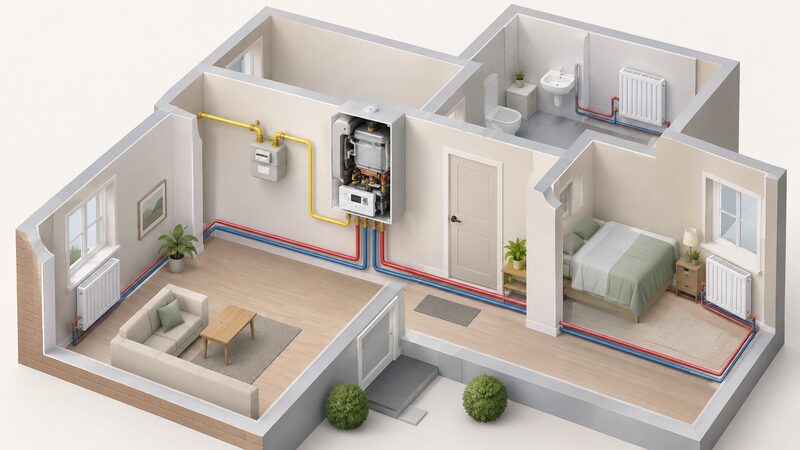
Hydrogen heating would replace a household's dependence on imported natural gas with dependence on a hydrogen supply that does not yet exist at scale. The gas network operator would control delivery and the household would remain a fuel customer. The independent think tank E3G says hydrogen for domestic heating would substantially increase consumer bills relative to other heating technologies41. Green hydrogen production and cost explains why.
Hydrogen-ready boilers: the 20% blend, conversion and cost

Two different things are often confused: a blend, and full hydrogen.
Most blend trials have used 20% hydrogen by volume. Energy Systems Catapult describes this as small quantities of hydrogen mixed into natural gas3. Cadent, a gas network, states that existing boilers and cooking appliances can run on a blend of up to 20% hydrogen with natural gas. It says the blend should not require a change to appliances such as boilers and gas hobs6. Nesta makes the same point and says this has been the case for many years42. Which? describes hydrogen-blend ready boilers as able to run on 20% hydrogen and 80% natural gas43. The carbon benefit is small: HHIC puts the saving from a 20% blend at around 7%40.
Nesta defines a hydrogen-ready boiler as one capable of taking up to a 20% hydrogen blend immediately, with the potential to run on 100% hydrogen following an alteration by an engineer42. No published cost for that alteration is available. The published costs relate to the boiler itself:
- Research for Cadent estimates hydrogen boilers at £2,300 to £3,800 to install, approximately £100 to £500 more than a natural gas boiler7.
- Which? reports that a number of leading manufacturers have made a joint price-promise commitment that a hydrogen-ready boiler will cost no more than a gas boiler does today43.
The first figure is an estimate in research commissioned by a gas network. The second is a manufacturers' pledge. Neither is a retail price.
"This means gas boilers, including hybrid and hydrogen-ready boilers, will not meet the proposed standards."
Further detail is on the pages about whether an existing gas boiler can run on hydrogen, converting a home to hydrogen heating, hydrogen boilers against gas boilers and hydrogen-ready boilers against heat pumps.
Where hydrogen heating falls short today
The first limit is availability. Elmhurst Energy states that hydrogen is not widely used to heat homes at present36, and Energy Systems Catapult that hydrogen for heating is not commercially available yet3. A household cannot buy a hydrogen supply at any price.
The second limit is the weight of independent opinion. Nesta's evidence to Parliament expected hydrogen to play a small role in home heating, with supplies targeted at harder to decarbonise areas instead45. E3G's February 2025 assessment is blunter.
"Hydrogen is a scarce and expensive resource that is not suitable for domestic heating"
E3G also calls hydrogen a poor option for domestic heating. It accepts that hydrogen will play a crucial role in decarbonising power and some heavy industry41. The official position is closer to these views than to the gas industry's. It gives heat pumps and heat networks the main role over the next decade and sees hydrogen as a possibility in slower time in some locations11. In Scotland, the Heat in Buildings Bill consultation likewise identified electric solutions, in particular heat pumps, and heat networks as the main technologies available for deployment46.
Safety and carbon monoxide
Trials are under way to assess the safety and performance of hydrogen-based heating36. Carbon monoxide comes from burning carbon-based fuels. Official guidance identifies incorrectly installed, poorly maintained or poorly ventilated appliances, such as cookers, heaters and central heating boilers, as the most common causes of accidental exposure47. It notes that incidents and fatalities also occur in holiday homes, caravans and boats, from faulty gas cookers, appliances or petrol-powered generators48. A 20% blend is still 80% natural gas, so the existing carbon monoxide precautions for gas appliances continue to apply to it. Hydrogen's own hazards are covered under hydrogen safety in homes, hydrogen appliance testing and certification and the Hy4Heat safety assessment.
Perovskite solar panels: the efficiency promise and UK availability
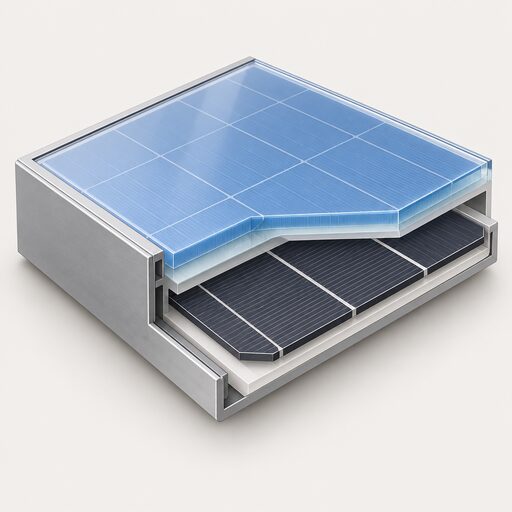
Perovskite cells promise more electricity from the same roof area, usually by layering a perovskite cell on top of silicon in a tandem panel. The physics and the efficiency claims are set out under perovskite solar cells, tandem perovskite-silicon panels and how efficient perovskite panels are. The UK manufacturer has its own page at Oxford PV.
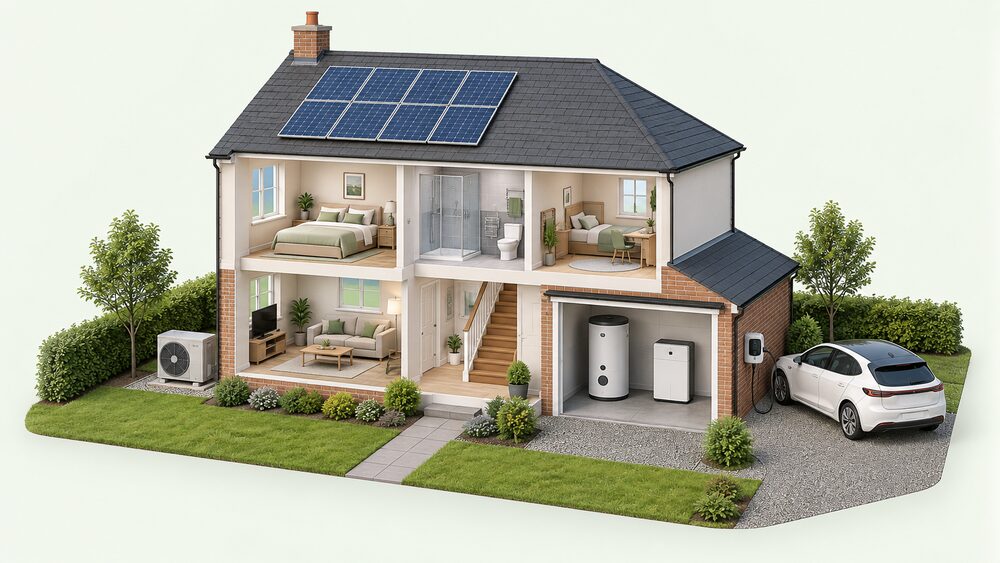
None of the official or independent UK sources behind this page gives a date on which a householder can buy perovskite panels, or a UK price. The page on when perovskite panels will be available tracks that question. Conventional silicon, meanwhile, is fully mainstream. Solar panels are the most common domestic renewable energy source in the UK21, with over 1.3 million homes generating electricity from them49. Energy Saving Trust's description of an energy efficient house of the future, dated July 2026, lists solar panels, a heat pump, battery storage, an EV charger, full insulation and smart heating controls. All of these can be bought now50.
The solar product that did reach shops in 2026 was a change to the rules. In March 2026 ministers told the Commons that plug-in solar would be made available for the first time in Britain, so that families could buy a low-cost panel straight from a supermarket and set it up on a balcony or in a garden51. In May the government said the panels would be in shops within months52. From 27 August 2026 they could be plugged into homes across Great Britain5.

A higher-efficiency panel would matter most for independence on small or shaded roofs, where panel area limits self-generation. Until perovskite products have UK certification and a track record in service, the perovskite against silicon comparison remains theoretical.
Other technologies on the horizon: green gas, thermal storage and hydrogen mobility

Thermal storage and heat batteries
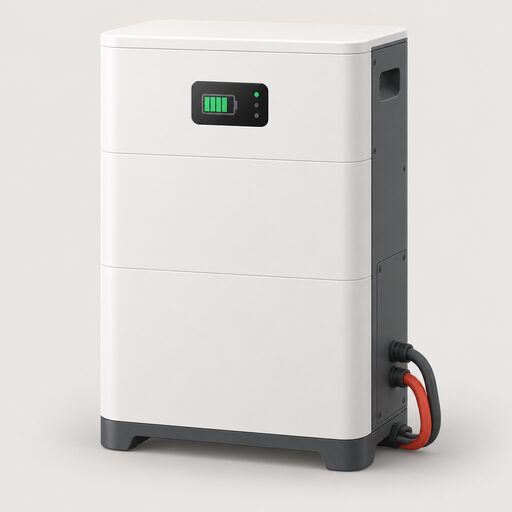
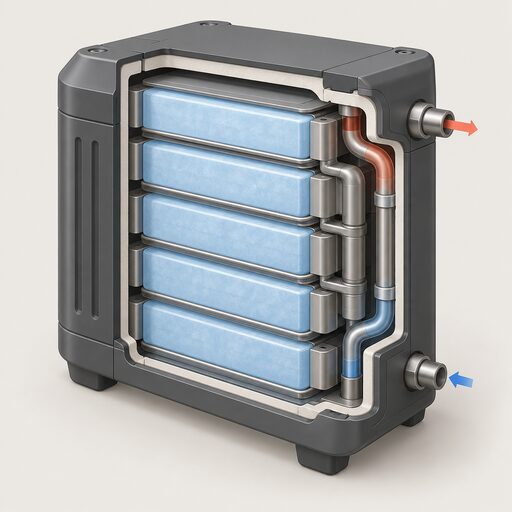
Thermal storage is the most mature technology on this page. Energy Saving Trust says thermal stores work particularly well with wood-fuelled biomass boilers, heat pumps, wind energy and solar water heating systems, and can also be used with a conventional boiler or immersion heater53. Electricity North West notes they can be used with solar, wind, biomass and hydro systems34. The newer form is the heat battery, which MCS includes within thermal energy storage systems and for which it has announced a pilot installation standard10. A heat store supports independence directly. It lets a household take in energy when its own generation or a cheap tariff is available and use it as heat later. Further reading: phase-change materials for heat storage, heat battery trials and field results, heat battery against hot water cylinder, Sunamp, Caldera, tepeo and Mixergy.
Green gas and liquid fuels
For homes off the gas grid, renewable liquid fuels are the nearest equivalent to hydrogen blending, covered under HVO for home heating. The Planning Portal notes that solar panels, wind turbines and biomass heaters are becoming increasingly popular54. None of these is new, but they still shape what a rural household can realistically install.
Hydrogen mobility
Hydrogen cars and vans are outside the home but share the same fuel supply question as hydrogen heating. See Hyundai hydrogen cars and the Hyundai NEXO. Other niche heating routes are covered under mine water heat, heating films and electric wallpaper, gas absorption and alternative heat pumps and emerging ventilation and cooling.
How these technologies fit a household's path to energy independence
Official guidance is consistent on the basics. The Planning Portal says renewable technologies help a household meet its own energy requirements and reduce carbon dioxide emissions54. Carmarthenshire County Council says they reduce reliance on fossil fuels such as gas and oil, and with it fuel bills and carbon emissions55. Measured against that aim, the emerging technologies fall into three groups.
| Technology | What it adds to independence | What dependence remains |
|---|---|---|
| V2H and V2G | A large store for home generation and outage backup33 | Compatible car and charger, smart meter, supplier tariff17 |
| Heat batteries and thermal stores | Shifts heat demand to the household's own or cheap energy53 | The electricity or fuel that charges them |
| Hydrogen heating | None on supply: fuel is still piped in | A hydrogen supply not commercially available yet3 |
| Perovskite solar | More generation per roof, in principle | No confirmed UK retail date |
Support differs across the four nations. The Warm Homes: Social Housing Fund covers English social housing56. In Wales, low-carbon measures such as heat pumps or solar panels with battery storage are in scope of the new Warm Homes Programme57. Scotland's heat policy centres on heat pumps and heat networks46. In Northern Ireland, nidirect notes that solar panels, heat pumps and other efficiency measures may offer an attractive payback to homeowners without grant support58, and the Housing Executive provides a home energy saving tool59. Plug-in solar's legal change is described by the government for Great Britain5. Nation pages: England, Scotland, Wales and Northern Ireland.
Energy Saving Trust notes that several schemes currently offer financial support for the established upgrades50. Its Home Renewables Selector identifies which renewable technologies suit a given home21. For the technologies that are not yet established, the practical routes are covered under taking part in a home energy trial, which technologies suit which homes and emerging technology and energy independence.
Sources59 cited
- More than money: finding the true power of V2G, Cenex
- Case study: UK electric vehicle-to-grid charging, Ofgem, 2021-07-06
- Starting a hydrogen dialogue, Energy Systems Catapult, 2023-12-06
- Heat and Buildings Strategy, GOV.UK
- Households can save as plug-in solar panels come to market, GOV.UK, 2026-08-27
- Hydrogen blending, Cadent
- Consumer choice research, Cadent, 2026
- Families to save in biggest home upgrade plan in British history, GOV.UK, 2026-01-20
- Warm Homes: Local Grant policy guidance, GOV.UK, 2026-07
- Pilot for new thermal energy storage systems installation standard, MCS, 2025-09-15
- Public Accounts Committee report on decarbonising home heating, UK Parliament
- DESNZ Public Attitudes Tracker: heat and energy use in the home, Winter 2025, GOV.UK, 2025
- Low carbon technology strategy, Energy Networks Association
- EV glossary, Uswitch, 2024-11-26
- Register energy devices in homes or small businesses, GOV.UK, 2021-03-31
- Smart homes and a lower carbon footprint, Energy Saving Trust, 2026-01-21
- Vehicle-to-grid charging guide, Uswitch, 2025-07-02
- Vehicle to grid: what is it and how does it work, E.ON Next, 2025-05-12
- Integrating solar panels with EV charging, Uswitch, 2025-07-02
- Drawing parallels between heat pumps and electric vehicles, Cenex, 2024-01-30
- Generating renewable electricity, Energy Saving Trust, 2025-12-11
- Project Sciurus trial insights report, Cenex, 2021-05
- Commercial viability of V2G, Cenex, 2021-01
- An introduction to vehicle-to-grid charging for electric vehicles, Cenex, 2022-08
- V2GB: Vehicle to Grid Britain, Cenex
- Vehicle to Grid Britain report, Energy Systems Catapult
- Flexible futures: integrating smart tariffs with low-carbon home technologies, Energy Saving Trust, 2026-07-10
- Electric Vehicle Chargepoint Grant for Households with On-Street Parking, GOV.UK
- Electric car charging at home, Which?, 2026-02-25
- Vehicle-to-grid best practice guide, Energy Saving Trust, 2026-05-05
- Vehicle-to-Grid (V2G), Cenex, 2021-08-23
- V2G Britain case study, Cenex, 2022-11-11
- Monitoring framework: well-adapted energy system, Climate Change Committee
- Energy storage, Electricity North West
- Toyota to expand EV charging ecosystem across the UK, SMMT, 2025-12-04
- Hydrogen heat: could it be the future of home heating?, Elmhurst Energy, 2025-07-04
- Decarbonising heat in homes: summary, UK Parliament, 2022-02-03
- Ditching costly gas and oil is cheaper thanks to heat pump scheme, GOV.UK
- Written evidence on Hy4Heat and hydrogen appliances, UK Parliament, 2020-10
- HHIC position paper on hybrids and hydrogen blending, Heating and Hotwater Industry Council
- Decisions on UK hydrogen heat, E3G, 2025-02-10
- Understanding the public view on hydrogen boilers, Nesta, 2023
- Hydrogen boilers: what you need to know, Which?
- The Future Homes and Buildings Standards: 2023 consultation, GOV.UK
- Written evidence on hydrogen's role in home heating, UK Parliament, 2023-08
- Heat in Buildings Bill consultation: strategic environmental assessment, Scottish Government, 2023-11-28
- Carbon monoxide poisoning, nidirect
- Gas safety and carbon monoxide, nidirect, 2025-11-24
- Are home renewables right for you?, Energy Saving Trust, 2025-12-11
- The energy efficient house of the future, Energy Saving Trust, 2026-07-15
- Heating Oil Support debate, Hansard, UK Parliament, 2026-03-16
- Britain continues to break clean power records, GOV.UK, 2026-05-28
- Thermal energy stores, Energy Saving Trust, 2025-05-15
- Home energy generation, Planning Portal, 2026
- Renewable energy, Carmarthenshire County Council, 2025-07-01
- Heat pump deployment tables, Q2 2026, GOV.UK, 2026-09-10
- New Warm Homes Programme: integrated impact assessment, Welsh Government, 2024-03-08
- Support to generate your own electricity, nidirect, 2025-09-22
- Energy, Northern Ireland Housing Executive