
In this guide
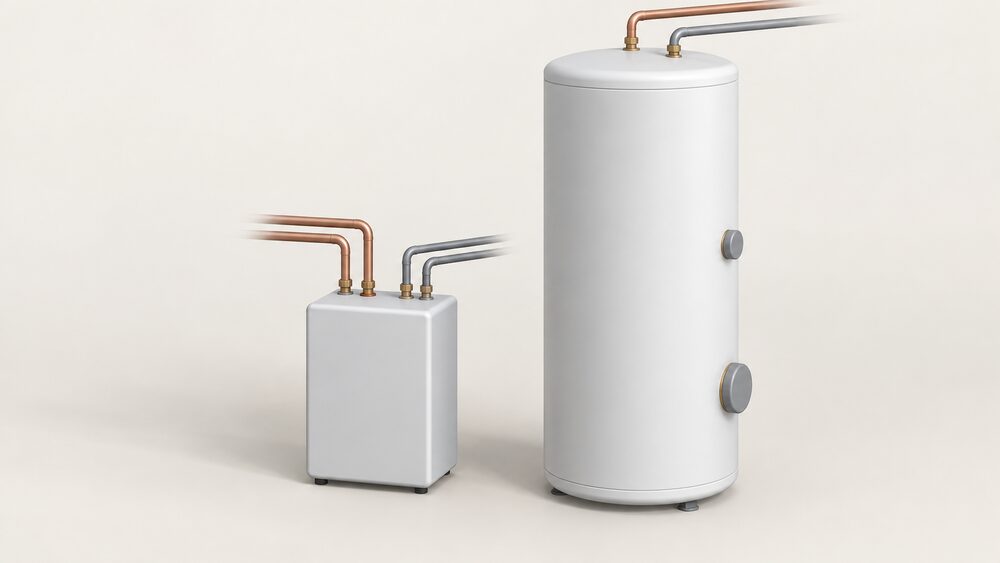
A Sunamp heat battery is a thermal store that holds heat in a phase change material rather than in water. The material, which Sunamp calls Plentigrade, absorbs and releases thermal energy as it melts and freezes, in the way the gel in a pocket handwarmer does1. The company states that melting and freezing its Plentigrade P58 formulation stores up to four times more energy than heating and cooling hot water, and elsewhere that its batteries store 4 to 10 times more energy than conventional materials2.
The practical consequence is size. Sunamp describes its thermal batteries as up to four times smaller than the equivalent hot water cylinders, and its Thermino range as up to four times smaller than the average family's cylinder4. A 12 kWh Thermino unit is stated to hold enough to provide a family's hot water needs for an entire day, covering multiple showers or baths, and delivers hot water at mains pressure on demand6.
Sunamp is headquartered in the United Kingdom, with offices in New York and Zurich, and its HQ and manufacturing facility is in Scotland8. The company states that over 30,000 units have already been installed by customers to replace hot water cylinders in homes9. For a household, the appeal is thermal storage that decouples hot water from the moment of heating; the dependence that remains is on whatever charges the battery, on an installer, and on a manufacturer's warranty.
What a Sunamp heat battery is: heat stored in phase change material
A Sunamp heat battery is an energy-saving thermal store containing Plentigrade, the company's high-performance phase change material1. It stores energy as heat and releases it when and where it is needed, giving hot water, heating or cooling on demand3. Unlike lithium-ion batteries, Thermino heat batteries store heat, not electricity6.
The distinction matters for how the product is understood. A lithium-ion home battery takes electricity from the grid or from solar panels and gives electricity back. A heat battery takes energy in, from electricity, a heat pump or a boiler, and gives hot water or space heating back. It is a thermal store in the same family as a hot water cylinder, but the storage medium is different.
The Energy Saving Trust describes the general category plainly: one type of heat battery stores heat in a material that changes from a solid to a liquid and back, and these materials are called phase change materials11. Sunamp's own description of the mechanism is that Plentigrade absorbs and releases thermal energy during a melting and freezing process, similar to the gel in a pocket handwarmer3. The materials are described as non-toxic9.
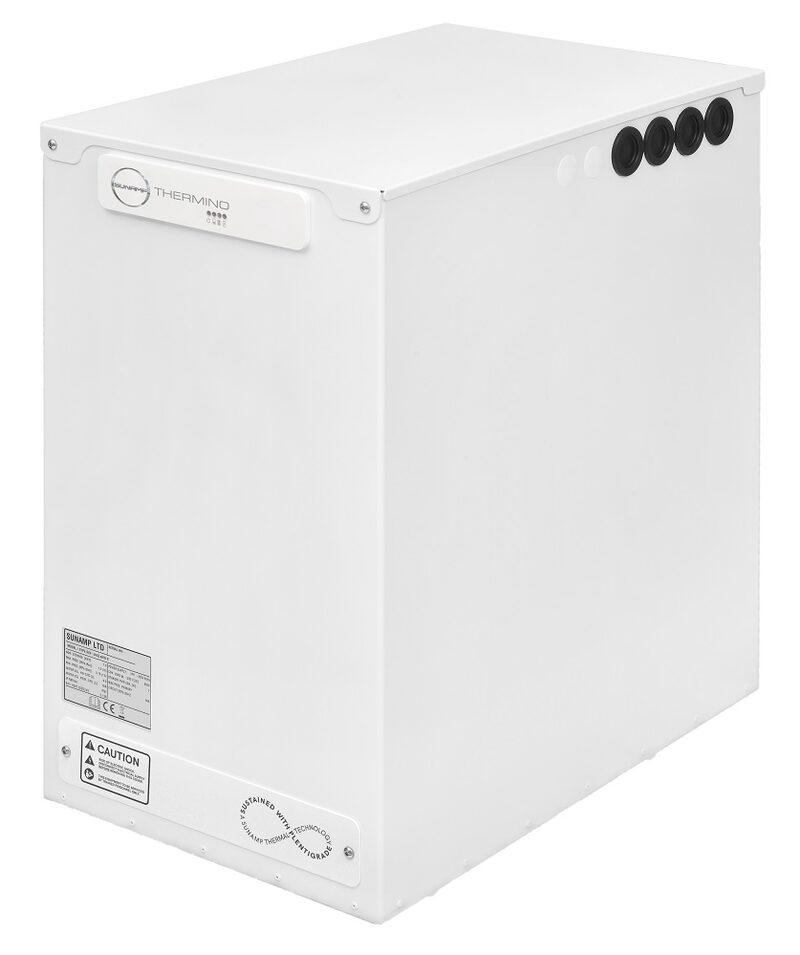
The Thermino range is the domestic hot water product. Sunamp describes these as compact, energy-efficient thermal storage systems that use high-performance phase change material to deliver reliable, mains-pressure hot water10. The units are described as modular and scalable, and can be connected in series4.
Plentigrade: the patented PCM at the core
Plentigrade is Sunamp's patented phase change material technology, which stores energy in high-performance phase change materials and releases it to give hot water, heating or cooling on demand3. The company describes it as a patented technology with a long lifespan and a best-in-class reliability rating3.
The energy density claim is the central one. Sunamp states that melting and freezing its Plentigrade P58 PCM formulation stores up to four times more energy than heating and cooling hot water3. The same four-times figure appears across the company's product literature: a Thermino heat battery stores energy in Plentigrade phase change material which is four times more energy dense than water12. A separate page puts the comparison more broadly, stating that the batteries store 4 to 10 times more energy than conventional materials3.
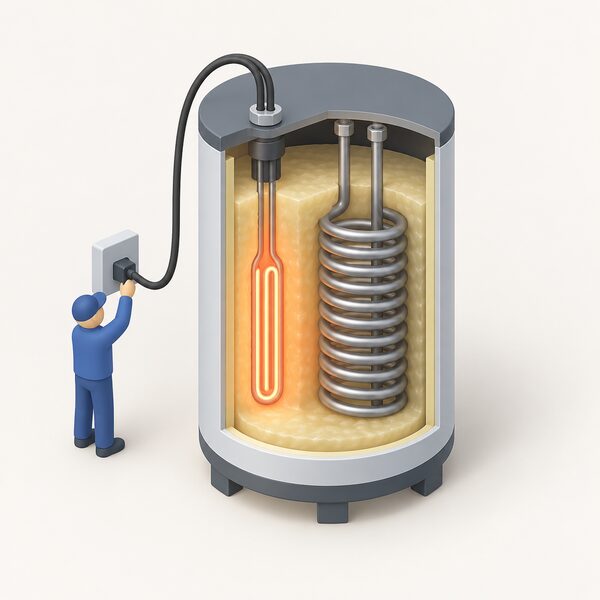
Charging is by a high-powered heat exchanger or heating element immersed in the PCM, which rapidly charges the thermal battery, with heat just as quickly extracted1. That is what allows the unit to deliver hot water at mains pressure on demand rather than recovering slowly between draws13.
The development of the material has academic backing. Sunamp and the University of Edinburgh's School of Chemistry received the Royal Society of Chemistry's 2022 Industry-Academia Collaboration Award for their partnership on phase change material formulations2. Sunamp states it is the only thermal battery manufacturer in the world to be awarded RAL certification for phase change material10.
"Melting and freezing our Plentigrade P58 PCM formulation stores up to four times more energy than heating and cooling hot water"
Size and output: four times smaller, mains pressure on demand
The space claim is consistent across Sunamp's product pages. Thermal batteries are up to four times smaller than equivalent hot water cylinders4. Thermino units are up to four times smaller than the equivalent hot water tank14. The systems are up to four times smaller than the equivalent hot water cylinder7. In a tower block case study the company puts it more simply: the unit is more compact than traditional hot water cylinders15.
Output is described as hot water at mains pressure on demand7. Sunamp's patented Plentigrade PCM technology ensures delivery of instant mains pressure hot water on showers and taps13. The 12 kWh Thermino unit is stated to hold enough to provide a family's hot water needs for an entire day, covering multiple showers or baths6.
| Attribute | Sunamp figure | Source |
|---|---|---|
| Size against a cylinder | up to 4 times smaller | 4 |
| Capacity of the unit cited | 12 kWh thermal storage | 6 |
| Daily hot water coverage | a family's needs for an entire day | 6 |
| Delivery | mains pressure on demand | 7 |
| Heat loss rate | 0.67 to 0.84 kWh/day | 16 |
| Connection | can be connected in series | 4 |
The heat loss figure is worth noting for a household comparing against a cylinder. Sunamp states that Thermino's heat loss rate, thanks to high-powered vacuum insulation, is 0.67 to 0.84 kWh/day, which it describes as less than a quarter of the loss from a typical cylinder16. That is the maker's comparison rather than an independent measurement.
Which energy sources can charge it
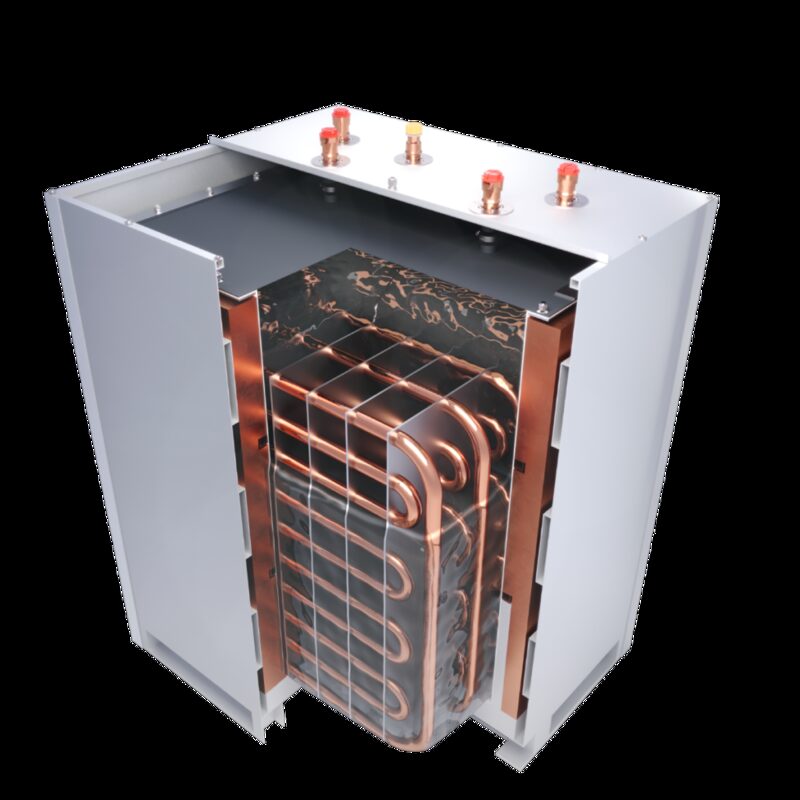
Sunamp's thermal batteries charge from renewable energy sources including air-source heat pumps, ground-source heat pumps, photovoltaics and electricity from the grid4. The company's broader list adds wind and solar, microgrid electricity, waste heat, combined heat and power and boilers3. Thermino heat batteries specifically are described as compatible with grid electricity, gas boilers, solar PV and heat pumps7.
The heat pump pairing is the one Sunamp pushes hardest, because it solves a siting problem. The company states that a heat battery means heat pumps can be installed where they do not normally fit, since hot water cylinders are not required17. A cylinder needs a cupboard, and a heat pump needs somewhere to put one; a cuboid battery four times smaller changes what is possible in a flat or a tight terrace.
Charging from grid electricity allows householders to benefit from off-peak tariffs18. That is the flexibility argument: the battery can take energy when it is cheap or when generation is abundant, and release it as hot water later. Sunamp frames the wider case as supporting the electrification of heat and optimising renewables3.
The company has also written about the limits of that model. In a piece on Dunkelflaute, the still, dark periods when wind and solar output falls away together, Sunamp argues that storage is what carries a household across them9. A heat battery sized for a day of hot water does that for hot water, not for space heating or for the whole house.
Running costs and efficiency: what the monitoring data shows

Running cost depends entirely on what charges the battery and on the tariff it charges under, so there is no single annual figure. The published numbers are the maker's own and come from specific trials.
Sunamp reports that a Thermino paired with 2.5kW of solar PV preheating a gas combi boiler delivered yearly cost savings of around £91, with a carbon emissions reduction of up to 86% during summer months18. Elsewhere the company states that its heat batteries can deliver savings of up to £485 on the cost of hot water energy bills, in a social housing context19. The two figures describe different setups and should not be read as a range.
On carbon, Sunamp states that in one social housing application carbon emissions will be reduced by an estimated 420 tonnes, or nearly 70% per year19. That is a modelled projection for a portfolio rather than a measured result for a single home.
The independent work sits with the Energy Systems Catapult. Sunamp was awarded £9.25 million through the Longer Duration Energy Storage Demonstration programme, part of the Net Zero Innovation Portfolio, to develop and trial its thermal storage system20. The proposed system uses smart control logic from myenergi and a significantly large thermal storage from Sunamp20. The Living Lab connects to the Whole Energy Systems Accelerator, allowing the benefits of Sunamp's heat battery technology to be tested against the wider electricity network using real-time data on real-world household behaviour20.
Where Sunamp fits in the UK market
Sunamp's own position is that deployment is being blocked by a lack of recognition in tools such as the Standard Assessment Procedure and its forthcoming replacement, the Home Energy Model18. The company states that Sunamp heat batteries are also excluded from retrofit subsidies like ECO4 and the Warm Homes: Social Housing Fund18.
That is a significant limit for a household weighing cost. A technology that does not score in SAP does not earn the compliance credit a developer needs, and one excluded from ECO4 and the Warm Homes fund does not attract grant support. Sunamp's counter-argument is that its thermal batteries help address a project's carbon emission reduction targets and the UK government's legislation for energy and environmental performance of dwellings using SAP4.
The company's market has therefore been new build and social housing rather than the retrofit grant schemes. Sunamp describes its thermal batteries as a low carbon, reliable, space-saving alternative to traditional hot water cylinders, and as suitable for retrofitting existing hot water systems4. In high-rise work, the answer has been an integrated system combining Sunamp's super compact heat batteries for hot water with Kensa Contracting's ground source heat pumps, replacing gas combi boilers in high-rise homes15.
The company's UniQ heat batteries are stated to be already installed in thousands of homes across the UK9. Sunamp also offers free CIBSE-approved CPD sessions covering phase change materials and their application in thermal storage, and publishes installation instructions, technical leaflets and training sessions through its UK information hub10.
For a household, the practical position is that a Sunamp heat battery is a specified product rather than a retail one. It is bought through an installer or a housing provider, and the subsidy routes that would offset a heat pump or insulation measure do not currently extend to it.
The company: Sunamp in Scotland and its reach

Sunamp's HQ and manufacturing facility is in Scotland9. The Scottish Government describes Sunamp as an East Lothian based manufacturer of heat batteries21. The company states it is headquartered in the United Kingdom, with offices in New York and Zurich8.
Its manufacturing presence has been international for some years. Sunamp's Scottish facility was described as already active in 17 countries worldwide, with a first factory under licence opened in Korea and a Sunamp factory in China expected under the Thumos agreement22. That agreement, announced in November 2021, was a £50 million deal to roll out thermal storage products in residential and commercial markets in China, with 400 heat batteries committed to high-end apartments in the Hitime projects in Shanghai22.
Sunamp has been a partner in UK network trials as well as product development. Project Re-HEAT was a large-scale trial led by the electricity distribution network operators SP Energy Networks and Scottish and Southern Electricity Networks, working with E.ON, the heat pump manufacturers Daikin and thermal storage unit manufacturers Sunamp23. A separate Highlands trial listed Sunamp among its industry partners as an East Lothian based energy storage company24.
The company's stated mission is to transform how heat is generated, stored and used, and its stated vision is a world powered by affordable and renewable energy sustained by compact thermal energy storage8. Andrew Bissell is CEO and co-founder17.
For a household, the relevant point is that Sunamp is an established manufacturer with a UK factory, not a startup with a single product line. The dependence it creates is the ordinary one: a warranty held by a company, and a product serviced through its installer network.
Where a Sunamp heat battery falls short
The limits are worth stating as plainly as the benefits. A heat battery stores heat, so it does nothing for a household's electricity supply, and it cannot shift power to the grid. Its independence value is confined to hot water and, in the EXTEND project's case, potentially space heating.
That project is exploring how Sunamp heat batteries can be optimised for space heating applications, which require more storage capacity but at much lower power9. Space heating is not what the current domestic range does.
The subsidy position is the second limit. Exclusion from ECO4 and the Warm Homes: Social Housing Fund, and the lack of recognition in SAP and the Home Energy Model, mean the cost falls on the household or the developer18. The indicative figures are around £3,400 MRRP for a 12 kWh unit, with the installed price running up to about £4,7006. Those are the maker's own published figures and should be read as indicative rather than as a quote.
The third limit is the installer. Sunamp's route to market runs through trained installers and housing providers, and the technical literature and CPD sessions exist to build that network10. A householder cannot simply order a unit and fit it.
Sources24 cited
- How thermal batteries work, Sunamp, 2026-09-17
- Plentigrade, Sunamp, 2026-08-18
- How heat batteries work, Sunamp, 2024-07-28
- Housing development solutions, Sunamp, 2026-03-24
- Housing development solutions, Sunamp, 2026-03-20
- Electric batteries vs heat battery, Sunamp, 2025-11-13
- Social housing solutions, Sunamp, 2026-03-24
- Sunamp, Sunamp, 2026-05-21
- We need to talk about Dunkelflaute, Sunamp, 2025-07-03
- Thermino frequently asked questions, Sunamp, 2026-08-17
- Storing energy, Energy Saving Trust, 2026-07-15
- Future Homes Standard, Sunamp, 2025-02-03
- Decarbonising domestic hot water for specifiers, Sunamp, 2025-11-12
- Thermino hot water overview, Sunamp, 2026-03-17
- Replacing gas boilers in UK high rise tower blocks, Sunamp, 2024-12-11
- Decarbonising the built environment, Sunamp, 2024-08-06
- Futureproofing UK homes in 2025, Sunamp, 2025-01
- New research on PCM heat batteries, Sunamp, 2025-11-17
- Decarbonising social housing, Sunamp, 2024-08-06
- Sunamp heat batteries, Energy Systems Catapult, 2021-11-04
- Heat Pump Sector Deal expert advisory group, Scottish Government, 2021-12-02
- Our Homes Net Zero Toolkit, Energy Systems Catapult, 2025-07-31
- Re-HEAT programme reaches landmark, SSEN, 2022-12-07
- Industry first trial to decarbonise heat launched in the Highlands, SSEN, 2022-01-27