
In this answer
Short answer
A Sunamp heat battery does not need an annual service visit of the kind a gas boiler does. The maker states that thermal batteries require no regulatory annual maintenance, unlike domestic gas boilers and unvented cylinders, and that no mandatory maintenance is required for the heat battery itself1. The appliances are described as maintenance-free, with only the external components needing regular attention3.
What the unit does carry is a ten-year warranty on the heating element, stated across the Thermino range and the wider thermal battery line4. Sunamp puts the lifespan of its Thermino heat batteries at 50+ years, against a ten-year warranty on the heating element6. Registration is handled through the maker's FAQ page7.
The maintenance question matters because it is the point where a heat battery diverges most sharply from the technology it usually replaces. A gas boiler carries a regulatory service regime and a safety check; an unvented cylinder carries its own. A sealed thermal store with no combustion and no outdoor unit sits outside both, which is why the servicing line in a household budget looks different.
What a Sunamp heat battery is and what sits inside it
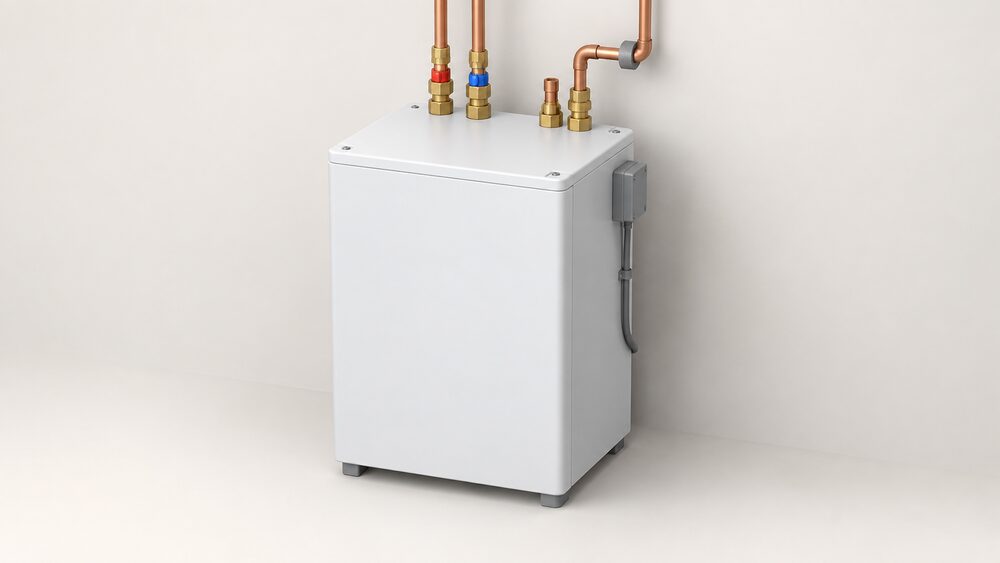
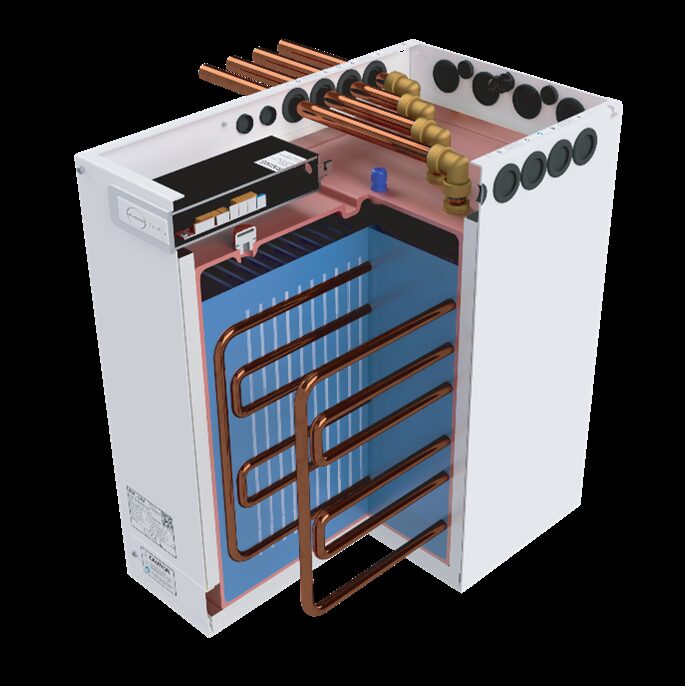
A Sunamp heat battery is a thermal store rather than an electrical one. The maker describes its heat batteries as energy-saving thermal stores with Plentigrade at their core, Plentigrade being its high-performance phase change material10. The same material is described in the Thermino range as a phase change material that is much more energy-dense than water, which is what allows the unit to be small7.
The physical format is a super-compact heat battery, sized to fit neatly in a cupboard1. A Thermino unit offers 12 kWh of thermal storage capacity6. Each battery holds less than 15 litres of water within the heat exchanger, so the stored energy is not sitting in a large body of water the way it is in a cylinder8.
The platform is not limited to domestic hot water. Sunamp states that its thermal batteries can be used to freeze at minus 30°C, refrigerate at 5°C, warm at 58°C and even sterilise at 118°C, and that they work with heat pumps, wind and solar, grid and microgrid electricity, waste heat, combined heat and power and boilers1. For a household, the relevant configuration is the warm one: storing heat from low-carbon sources and releasing it for mains-pressure hot water when needed5.
Scale gives some sense of how established the product is. Sunamp states that over 30,000 units have already been installed by customers to replace hot water cylinders in homes11. An independent trial run through the Energy Systems Catapult's Homes Net Zero toolkit covered 100 homes across the UK12.

Why maintenance demands are low: no outdoor unit, no combustion
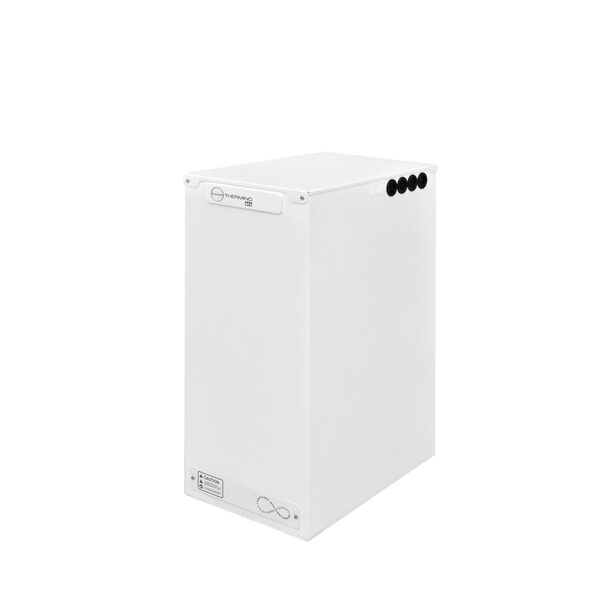
The maintenance position follows from what the product is not. There is no combustion, so there is no flue, no burner and no gas safety check. There is no outdoor unit, so there is no fan, no coil and no refrigerant circuit exposed to weather. What remains is a sealed store with an electrical heating element and a heat exchanger.
Sunamp states plainly that thermal batteries require no regulatory annual maintenance, unlike domestic gas boilers and unvented cylinders1. The Thermino range page repeats that no mandatory maintenance is required for the heat battery5. A case study on a fuel poverty project records that the batteries require no mandatory annual maintenance13. The maker's comparison page goes further, describing the appliances as maintenance-free and noting that only the external components need regular maintenance3.
That last qualification is the honest limit. "External components" is doing real work in that sentence: pumps, valves, controls and any associated pipework sit outside the battery and are maintained on their own terms. A heat battery removes the combustion service from the household calendar; it does not remove every moving part from the system around it.
For context on what other low-carbon heating carries, the Energy Saving Trust states that heat pumps in general need about as much maintenance as a gas boiler14. A heat battery paired with a heat pump therefore does not remove maintenance from the property entirely, it removes it from the storage side.
Warranty: 10 years on the heating element
The warranty term is consistent across the maker's product pages: a market-leading ten-year warranty on the heating element4. The same term appears on the Thermino xPlus page16, on the Thermino 300 EPLUS and Thermino 210 EPLUS pages17, and in the housing development material19.
Two things are worth separating. First, the warranty covers the heating element, not the whole assembly, and not the phase change material. Second, the term is the maker's own statement about its own product, which is the correct weight to give it: it is a manufacturer's warranty commitment, not an independent assessment of reliability.
Registration is the step that puts the warranty on record. Sunamp states that any of its hot water products can be registered by clicking the link on its FAQ page7. That is the whole published process; there is no separate registration portal described in the material.
| Product | Stated warranty | Source |
|---|---|---|
| Thermino range | 10-year warranty on the heating element | Sunamp4 |
| Thermino xPlus | 10-year warranty on the heating element | Sunamp16 |
| Thermino 300 EPLUS | Market-leading 10-year warranty on the heating element | Trianco17 |
| Thermino 210 EPLUS | Market-leading 10-year warranty on the heating element | Trianco18 |
A ten-year element warranty against a stated 50+ year unit lifespan leaves a long tail in which the household carries the risk. That is not unusual for thermal storage, but it is the shape of the cover and worth stating plainly.
Lifespan: phase change materials versus electrical batteries
Sunamp states that its Thermino heat batteries feature a lifespan of 50+ years6. The reason given is the storage medium. Unlike lithium-ion batteries, Thermino heat batteries store heat, not electricity6. There is no electrochemical cell to cycle, no capacity fade in the sense a home battery owner would recognise, and no chemistry degrading with each charge.
The material itself is described as non-toxic phase change material11, and as Plentigrade phase change materials that are highly effective at storing thermal energy20. The Thermino range page describes the phase change material as much more energy-dense than water7.
The comparison with an electrical battery is one the maker draws directly, and it is a fair one to set out because the two products are often considered together. A solar battery storage system carries a typical price range of £2,000 to £12,500 depending on capacity, chemistry and lifespan, according to independent guidance21. A Thermino heat battery offers 12 kWh of thermal storage capacity for around £3,400 (MRRP), with an installed price that can go up to about £4,700, and a cost per kWh of approximately £3906.
Those are different products doing different jobs. A heat battery cannot run a lighting circuit or a fridge; Sunamp states that Thermino heat batteries are not designed for whole-home electrical use6. What it can do is hold hot water energy across time, which is the load a household draws every morning regardless of what the grid is doing.
Cost and running cost: £1,200 to £4,700 plus installation
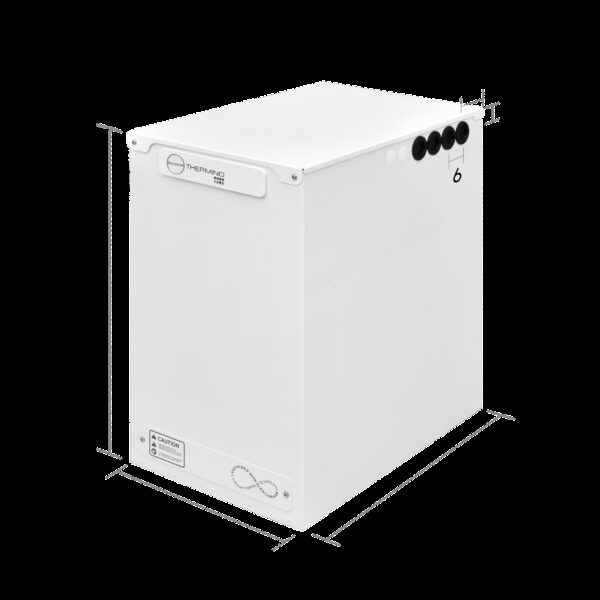
A Sunamp Thermino heat battery offers a 12 kWh thermal storage capacity for around £3400 (MRRP), and the installed price can go up to ~£47001. That works out at approximately ~£390 per kWh of storage1. Solar battery costs can vary widely, typically ranging from £2,000 to £12,500, depending on several factors2. Running costs are a separate matter from purchase price: heat pumps cost around £800 to £1,050 a year to run, making them one of the cheapest electric heating options3. Where a heat battery is paired with 2.5kW solar PV preheating for a gas combi boiler, this simple adjustment delivered yearly cost savings of around £914.
Published pricing for the Thermino range is limited, and where it exists it comes from the maker or a distributor rather than from an official source. Sunamp states that a Thermino heat battery offers 12 kWh of thermal storage capacity for around £3,400 (MRRP), that the installed price can go up to about £4,700, and that the cost per kWh is approximately £3906. Prices are installer-quoted, and the figures above are the maker's own.
On running cost, the evidence is thinner and should be read carefully. Sunamp reports that pairing a heat battery with 2.5 kW of solar PV preheating for a gas combi boiler delivered yearly cost savings of around £9122. That is a specific configuration in a specific study, not a general running cost figure for a heat battery household.
For the wider electric heating picture, the Centre for Sustainable Energy gives heat pumps an annual running cost of around £800 to £1,050 a year, describing them as one of the cheapest electric heating options23. A heat battery charged by a heat pump sits within that system cost rather than adding a separate fuel bill.
The independence question is where cost and control meet. A heat battery charged from rooftop solar or a heat pump reduces the share of hot water energy bought from a supplier, and it can absorb cheap or surplus electricity when it is available. It does not remove the household from the grid, and it does not generate anything itself. The dependence that remains is on whatever charges it: a heat pump, a solar array, a tariff, or the grid at times when none of those are producing.
Grants and VAT: why heat batteries are not yet eligible
This is the section where the product's status is least settled, and the official position is the one that counts. Warm Homes scheme policy guidance states that phase change material heat batteries cannot currently be installed through the scheme until there is a formally approved convention or they are formally recognised in SAP9. That is a scheme rule, dated July 2026, and it is the binding constraint.
Sunamp's own material frames the same problem from the manufacturer's side, stating that deployment is being blocked by a lack of recognition in tools such as the Standard Assessment Procedure22. The maker's grant guidance notes that the Boiler Upgrade Scheme supports a Sunamp heat battery as thermal storage24. That wording describes the battery as an eligible component alongside a funded measure, not as the funded measure itself, and the distinction matters when reading grant pages.
On VAT, the position is starker. Independent guidance states that heat batteries are currently the only major heating technology that does not qualify for VAT relief26. That is a cost difference applied at the point of purchase, and it applies across the UK rather than varying by nation.
"they cannot currently be installed through the scheme until there is a formally approved convention or they are a formal"
The practical effect for a household is that a heat battery is bought at full VAT with no grant offset, while a heat pump in the same property may attract support. That is a policy gap rather than a product limitation, and it is the single largest financial difference between the two routes at present.
Where a heat battery fits, and what it does not replace
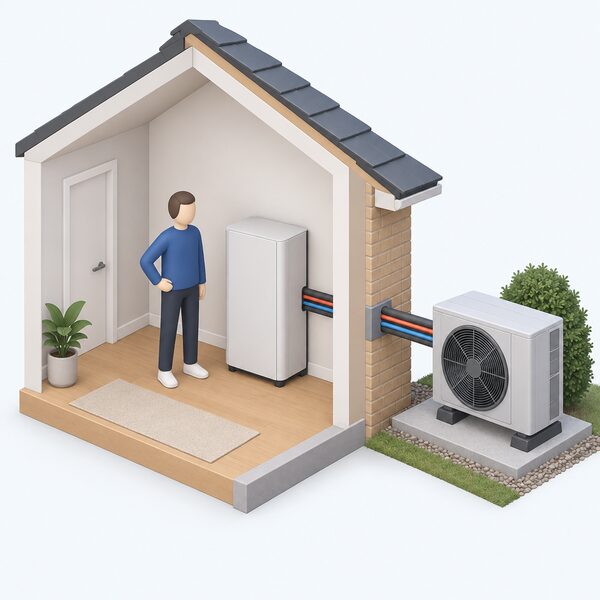
The case for a heat battery in a household is mostly about space and about removing a combustion appliance from the home. Sunamp states that its thermal batteries are up to four times smaller than equivalent hot water cylinders, and that this means heat pumps can be installed where they do not normally fit because hot water cylinders are not required8. The same space claim appears in the housing association material, which states that because the energy is stored as latent heat, the heat batteries take up to four times less space than an equivalent hot water cylinder27.
Retrofit is part of the pitch. The maker positions thermal batteries as a low carbon, reliable, space-saving alternative to traditional hot water cylinders, suited to retrofitting existing hot water systems19. They can be charged by renewable energy from an air-source or ground-source heat pump2, and by photovoltaics19. Sunamp also states that installation is quick and that there is no need for residents to move out2.
What a heat battery does not do is supply a central heating circuit in the way a boiler does, or run a home's electrical circuits. It stores heat and releases it as mains-pressure hot water on demand2. For a household weighing it against a cylinder, the comparison is worth reading alongside heat battery vs hot water cylinder and the wider Sunamp heat batteries overview.
On the independence ledger: a heat battery shifts hot water energy storage into the home, lets a heat pump or solar array charge it, and removes a gas connection from the hot water side. It leaves the household dependent on electricity to charge it, on a manufacturer for the element warranty, and on a policy framework that does not yet recognise it in SAP or offer it VAT relief. Those are the terms as they stand.
Sources27 cited
- How thermal batteries work, Sunamp, 2026-09-17
- Thermal batteries for social housing, Sunamp, 2026-03-24
- Heat pump water heater vs Sunamp Thermino heat battery, Sunamp, 2026-09-10
- Thermino range hot water solutions, Sunamp, 2026-03-17
- Thermino frequently asked questions, Sunamp, 2026-08-17
- Comparing home battery storage: electric batteries vs heat battery, Sunamp, 2025-11-13
- Sunamp frequently asked questions, Sunamp, 2023-05-04
- Thermal batteries for public housing, Sunamp, 2026-03-24
- Warm Homes Local Grant policy guidance, UK Government, 2026-07
- How heat batteries work, Sunamp, 2024-07-28
- We need to talk about Dunkelflaute, Sunamp, 2025-07-03
- Our Homes Net Zero Toolkit, Energy Systems Catapult, 2025-07-31
- Tackling fuel poverty by lowering energy use, Sunamp, 2024-08-15
- Heat pump fact check, Energy Saving Trust, 2026-07-01
- Thermal batteries for housing development, Sunamp, 2026-03-20
- Thermino xPlus installer zone, Sunamp, 2026-03-24
- Thermino 300 Electric EPLUS, Trianco, 2026-09-20
- Thermino 210 Electric EPLUS, Trianco, 2026-09-20
- Housing development solutions, Sunamp, 2026-03-20
- How heat pumps work with Sunamp Thermino for retrofit, Sunamp, 2025-07-03
- Battery storage and solar panels, The CPA, 2026-01-06
- New research says PCM heat batteries could be key to renewables adoption, Sunamp, 2025-11-17
- Electric heating advice, Centre for Sustainable Energy, 2026-06
- UK grants for homeowners for renewable upgrade, Sunamp, 2024-01
- UK grants for homeowners for renewable upgrade, Sunamp, 2024-08-08
- No home left behind: supporting lower income homes in the heat transition, Association for Decentralised Energy, 2026-09-20
- What ECO cuts and the Warm Homes Plan mean for housing associations, Sunamp, 2025-12-10
 Manufacturer WarrantiesHow long does a boiler, heat pump or solar panel warranty actually last, and what do you have to do to keep it valid?
 Servicing and MaintenanceHow often does a heat pump need servicing, and what actually happens during the visit?
 Home Battery WarrantiesHow long does a home battery warranty really last, and what does it actually promise?
 Boiler WarrantiesHow long does a boiler warranty actually last, and what do you have to do to keep it?
 Cycle Life and DegradationHow long will a home battery actually last, and what decides that?
 Solid-State BatteriesAre solid-state batteries on sale yet, and should you wait for one?