
In this answer
Short answer
Solar thermal panels are enough to cover all of a household's hot water in summer, and nowhere near enough in winter. Independent guidance states that during summer solar thermal panels can meet all of your hot water needs, but a backup system is still needed, especially during winter1. Over a full year, a well-designed system satisfies up to 70% of a home's annual domestic hot water needs, and a typical well-sized system around 50 to 70%2.
The seasonal split is the whole story. Consumer body figures put solar water heating at about 90% of hot water needs in summer and 25% in winter4. Off-grid guidance goes further in summer, saying a system may satisfy 100% of the need in the summer months2. Official Northern Ireland guidance gives a flatter annual figure of up to 60% of a household's domestic hot water needs over a year5.
So the honest answer is: enough for hot water only, and only with a backup heater. Solar thermal does not heat rooms, does not send hot water to radiators, and cannot be sold back to the grid. What it does is cut the amount of gas, oil or electricity a household buys to heat water, most sharply in the months when a boiler would otherwise run for hot water alone.
What solar thermal panels actually do: heat water, not space
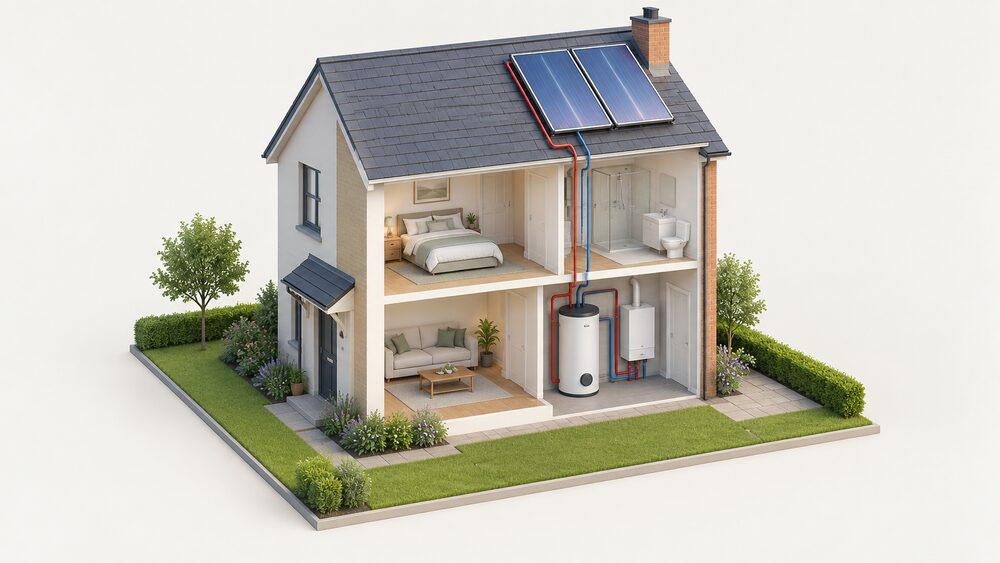
Solar thermal panels produce hot water only, reducing the amount of energy needed to heat water for hot taps, baths and showers1. Most systems are designed to provide hot water for baths, showers and hot taps only, and they do not send hot water to radiators, so another way of heating the home is needed, such as a heat pump8. Planning guidance describes the technology as using energy from the sun to work alongside a conventional water heater6.
The distinction matters because it sets the ceiling on what the technology can ever deliver. A household's total energy demand splits between space heating, hot water and appliances; solar thermal addresses one slice. Historic grant rules for solar thermal under the Domestic RHI required installations to exclusively provide domestic hot water, not space heating, and not to generate electricity9. The scheme is closed, but the rule describes the technology's design intent.
One manufacturer states that collectors capture heat directly using a specialised fluid to provide hot water, primarily for taps and outlets, and that they can be integrated into central heating systems10. That is a maker's description of a possible configuration rather than the mainstream design, and it sits against the independent position that solar thermal does not feed radiators8. For a household weighing independence, the practical reading is that solar thermal displaces water-heating fuel, not space-heating fuel.
How much of your hot water they cover: roughly half over the year
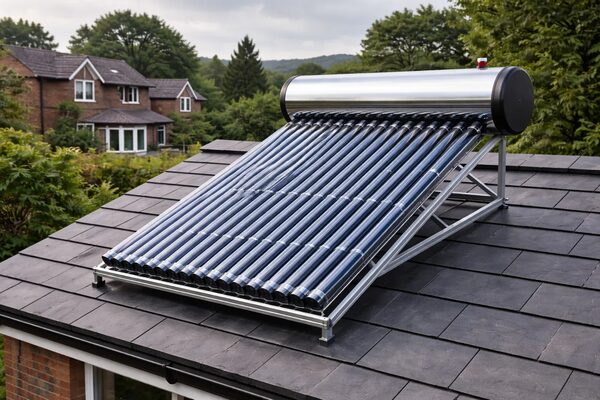
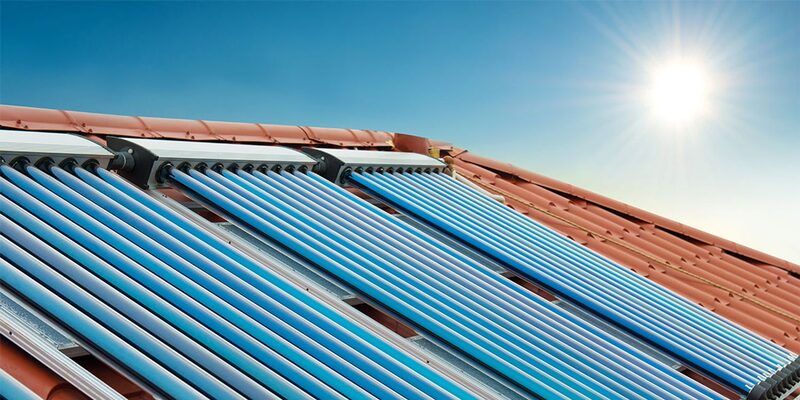
The headline annual figure from independent guidance is that solar water heating systems normally provide roughly half of your hot water needs, on average8. The upper end of the range, for a well-designed system, is up to 70% of a home's annual domestic hot water needs2. A typical well-sized system is put at around 50 to 70% of the domestic hot water requirements of the home3.
Official figures sit slightly lower. Northern Ireland guidance states the panels can supply up to 60 per cent of a household's domestic hot water needs over a year5. Council guidance for a English local authority area gives 55% to 70% of a home's hot water requirements, with a corresponding cut in carbon footprint11. The spread between 55% and 70% is not disagreement about the physics so much as about the household: roof orientation, collector area, cylinder volume and how much hot water is actually drawn all move the number.
| Source type | Annual hot water coverage | Basis |
|---|---|---|
| Independent guidance | roughly half, on average | Typical system8 |
| Independent guidance | up to 70% | Well-designed system2 |
| Maker support article | around 50 to 70% | Typical well-sized system3 |
| Official guidance (Northern Ireland) | up to 60% | Household over a year5 |
| Council guidance | 55% to 70% | Home's hot water requirements11 |
What drives the difference is sizing and behaviour. A household that takes long showers in the evening, after the collectors have stopped gaining, will see less of the solar heat used than one that draws hot water through the day. A cylinder that is too small for the collector area will dump heat it cannot store; one that is too large will sit lukewarm.
The seasonal swing: up to 90% in summer, around 25% in winter
Summer and winter are two different systems in one installation. Independent guidance gives around 90% of hot water in summer and around 25% in winter12, and the same figures appear as about 90% of hot water needs in summer and 25% in winter4. Off-grid guidance is more generous at the top of the range, stating that in the summer months a system may satisfy 100% of the need2.
Makers quote higher winter figures. One states that solar thermal can produce up to 60% of hot water during winter and up to 100% in the summer13. Another gives up to 80% to 90% in summer14, and a third states that during the warmer summer months up to 100% of the hot water demand can be covered15. These are maker estimates for their own equipment and sit above the independent winter figure of around 25%4; where they conflict, the independent range is the safer planning assumption.
The mismatch runs deeper than sunshine hours. Solar PV produces most of its output during summer months, when demand is lower, while heating and hot water demand peaks in winter16. Hot water use itself rises in the cold months: a study of 25 low-energy dwellings found that all used more hot water on average in winter than summer, with a mean difference of 25% more in winter17. So the season when the panels work least is the season when the cylinder is drawn down most.
"all the dwellings used more hot water on average in the winter months compared to the summer, with a mean difference of 25% more hot water used in winter months"
Why you still need a backup system
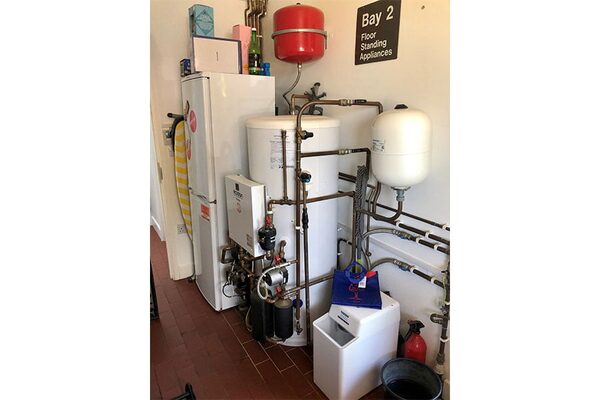
Solar thermal is a pre-heat technology, not a standalone supply. A regular boiler or immersion heater can be used to make the water hotter, or to provide hot water when solar energy is unavailable7. One manufacturer states plainly that solar thermal requires a boiler backup18. The same logic applies across renewable heating: many heat pump systems include backup electric resistance heating for extremely cold days19, and most air-to-air heat pump models do not usually provide hot water, so a separate system is needed20.
A cylinder is not optional. Along with solar collector panels on the roof, a hot water cylinder is needed, ideally inside the home, though a garage or similar space can work8. Cylinder volume scales with collector area: each square metre of panel area needs between 30 and 60 litres of water-tank volume4. A solar assisted heat pump cannot provide hot water on demand like a combi boiler, so a way to store hot water is needed, and because it produces a low volume continuously, the cylinder can take time to recover after heavy use21.
Combi boilers are the awkward case. Solar thermal can be installed alongside other renewable or traditional heating systems, though it is not so easy to combine with a combi boiler12, largely because a combi has no cylinder to pre-heat. Some immersion heaters can use electricity from solar panels, so the water is heated without buying grid electricity22.
What a well-sized system delivers: 50 to 70% of domestic hot water
Sizing starts at the roof. Planning guidance for a domestic system gives 3 to 4 square metres of southeast to southwest facing roof receiving direct sunlight for the main part of the day6. Orientation and shading decide how much of the theoretical yield arrives; a roof that faces the wrong way or sits under a chimney will underperform the figures above regardless of collector quality.
The cylinder is the second half of the design. At 30 to 60 litres of tank volume per square metre of panel4, a 4 square metre installation implies a cylinder sized in proportion to the array, though the exact figure is a design decision for the installer. A cylinder that is too small for the array will reach its set temperature and stop the collectors gaining; one that is too large will dilute the solar heat below a useful temperature.
Delivered performance for a well-designed system is up to 70% of annual domestic hot water needs2, with a typical well-sized system at around 50 to 70%3 and official guidance at 55% to 70%11. The gap between design and delivery is a familiar theme in low-energy housing: the Passivhaus performance gap work found measured outcomes diverging from modelled ones across a sample of dwellings17. For solar thermal, the practical variables are how much hot water the household uses, when it uses it, and whether the backup heater is set to top up rather than take over.
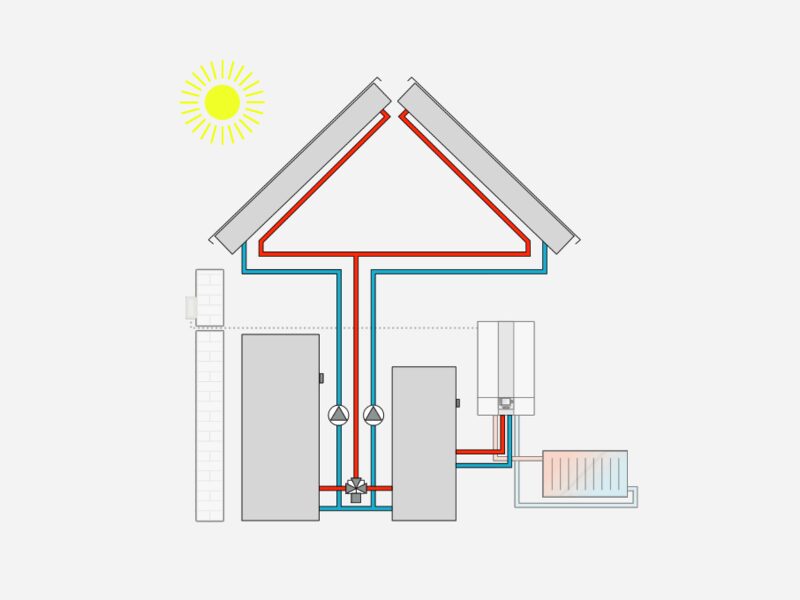
So are they enough? Only with a backup, and only for hot water
For hot water alone, in summer, solar thermal can be enough: independent guidance states that during summer the panels can meet all of your hot water needs, though a backup system is still needed, especially during winter1. For the year as a whole, the answer is no. Solar water heating will not give 100% of hot water needs, and is best used alongside a boiler or an immersion heater to make up the difference24.
The independence this buys is partial and worth being precise about. A household with solar thermal still depends on a boiler or immersion heater, still depends on a fuel supplier for that backup, and still depends on the electricity grid to run the pump and controls. Boilers and heat pumps will not work during a power cut unless supported by backup power, because they are typically powered by electricity25. Solar thermal adds no export income and no storage beyond the cylinder: you won't be able to sell back any additional heat generated to the grid, as all hot water is for your use only23.
What it does deliver is a measurable cut in bought energy for water heating, concentrated in the months when a boiler would otherwise fire for hot water alone. For a household on oil or LPG off the gas grid, that is a real reduction in deliveries and in exposure to fuel prices. For a household already on gas, the saving is smaller in cash terms but still real. The technology is a complement to a heating system, not a replacement for one.
Sources25 cited
- The best heating for your home, Which?, 2025-09-22
- Your home guide to solar water heating, OFTEC, 2026-09-20
- How cost effective are solar thermal panels, Worcester Bosch, 2026-09-17
- Solar water heating with solar thermal panels, Which?, 2026-05-15
- Solar thermal panels, nidirect, 2024-10-22
- Solar thermal water heating, Planning Portal, 2026-09-17
- Renewable energy, Consumer Council for Northern Ireland, 2026
- Solar water heating, Energy Saving Trust, 2026-05-20
- Domestic RHI essential guide, Ofgem, 2022-03
- Are combi boilers being phased out, Intergas Heating, 2026-02-18
- Solar equipment on residential buildings, Hart District Council, 2025-01
- Heating your home with renewable energy, Which?, 2025-09-22
- 20 ways to add value to your home, Nu-Heat, 2026-07-22
- Solar water heater, Fuse Energy, 2026-04-19
- Solar thermal energy, Wolf, 2026-09-17
- Future Homes Standard risks overlooking biggest household energy use, CIPHE, 2026-05-19
- Passivhaus and the performance gap, Passivhaus Trust and University of Bath, 2020
- With a heat pump do I still need a boiler, Worcester Bosch, 2026-09-20
- Heat pump fact check, Energy Saving Trust, 2026-07-01
- Five ways to make air-to-air heat pumps take off, Nesta, 2025-12-02
- Solar assisted heat pumps, Energy Saving Trust, 2025-06-13
- Immersion heaters, Which?, 2026-06-01
- Plumbing with renewables, CIPHE, 2026-09-17
- Boilers, Energy Saving Trust, 2026-05-20
- How to prepare for and stay safe during a power cut-a-power-cut), NICEIC, 2025-01-24
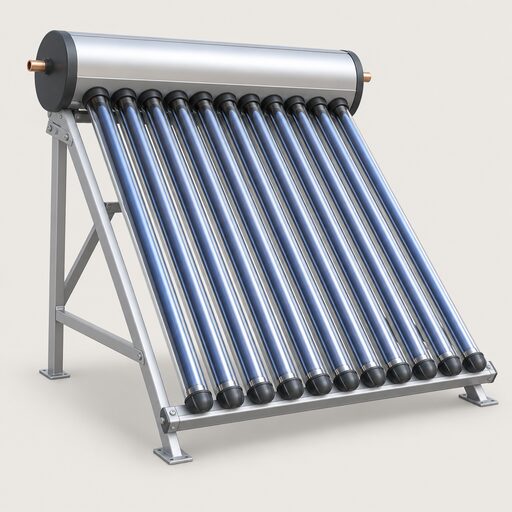 Solar Thermal Water HeatingSolar thermal panels heat your water using the sun, working alongside your boiler rather than replacing it.
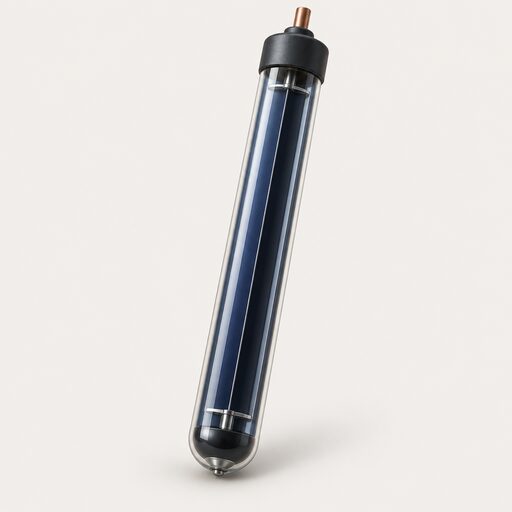 Solar Water Heating CollectorsSolar water heating uses panels on your roof to warm the water in your cylinder, working alongside your boiler rather than replacing it.
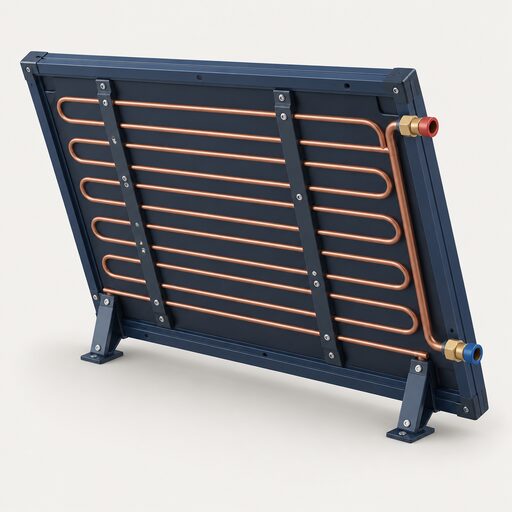 PVT Hybrid PanelsA PVT panel makes electricity and heats water from one roof space, so it suits homes without room for two separate systems.
 Cooling with Solar PanelsCan solar panels run an air conditioner, and will they cover the whole bill?
 Cylinders and ControlsHow much of the sun's heat can your home actually keep?
 Infrared Heating and PanelsDo infrared heating panels cost less to run than normal electric heaters, and how much do they add to a bill?