
In this guide
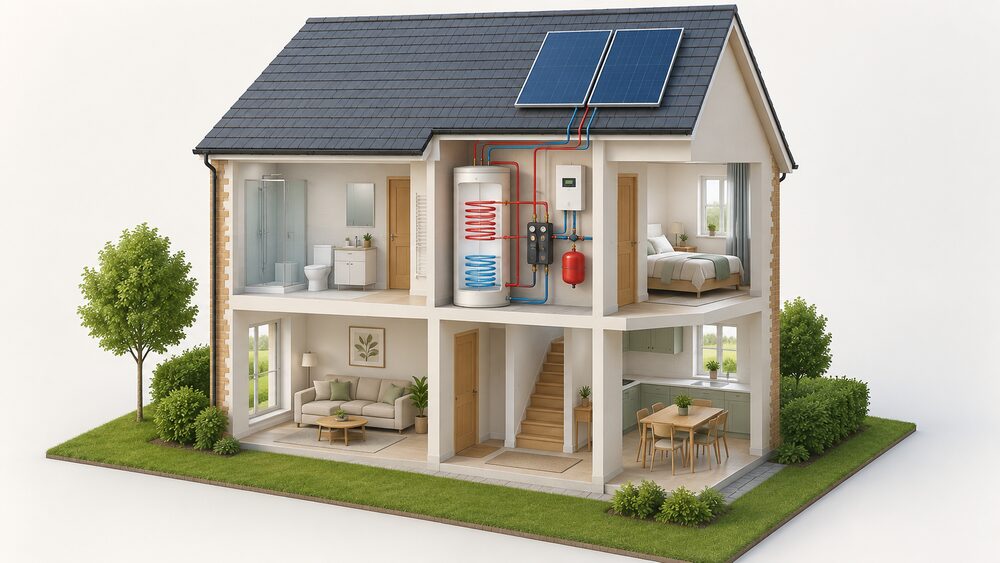
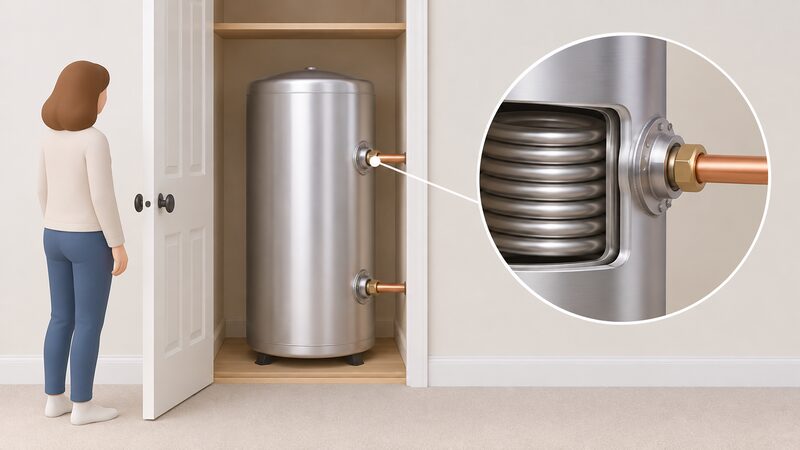
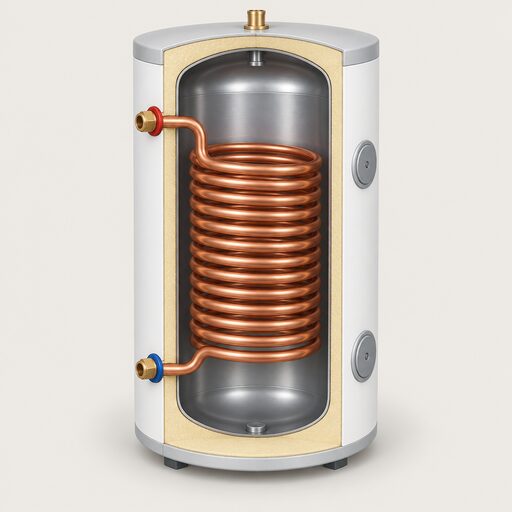
A solar thermal cylinder is the indoor half of a solar water heating system, and it is the part that decides how much of the sun's heat a household can actually keep. Solar water systems comprise three main components: the solar collectors, the hot water cylinder, and the plumbing system that connects them1. The cylinder is not a passive tank. It carries a dedicated solar coil, made from a high-efficiency finned tube with a large surface area, that transfers heat from the collector loop into the stored water2.
The cylinder is also the point at which solar heat meets the rest of the house. Solar water heating uses energy from the sun to work alongside your conventional water heater, so the store is topped up by a boiler, heat pump or immersion when the collectors cannot keep up3. A domestic system needs 3 to 4 square metres of southeast to southwest facing roof receiving direct sunlight for the main part of the day, and space to locate an additional water cylinder if required3. Where a thermal store is used instead of a twin-coil cylinder, it can be designed to prioritise solar thermal heat above all other sources, so that if solar heat is available, no other heat source will come on4.
Costs and savings are modest and should be read as such. Solar thermal hot water could save you money on your hot water bills, and independent guidance puts the estimated annual saving at £210 in England, Scotland and Wales, with a second figure of £110 in the same guidance that is not reconciled with the first5. The system is a heat source, not a power station: it does nothing for electricity, and it depends on a cylinder, a controller, a pump and a backup heat source being present and working.
What a solar thermal cylinder is and how the system works
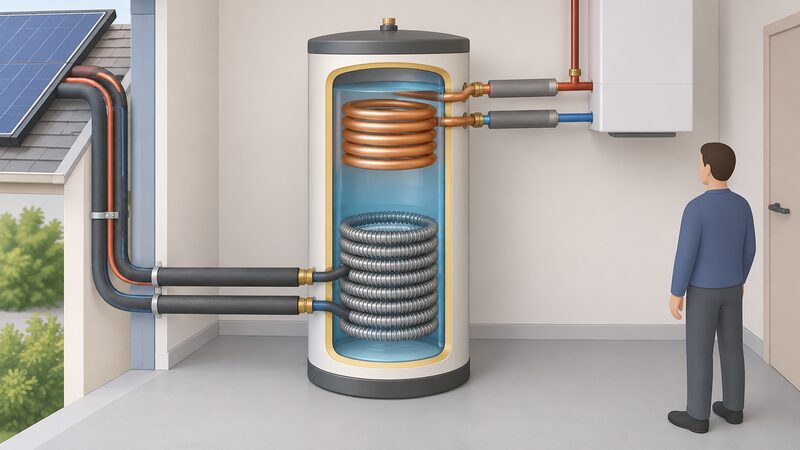
The cylinder is the interface between an outdoor collector loop and an indoor hot water supply, and everything about its design follows from that. The collector loop contains a heat transfer fluid, and the cylinder's solar coil sits in the stored water so that heat can pass across without the two liquids mixing. The coil is manufactured from a high-efficiency finned tube with a large surface area, which is what allows a relatively small volume of collector fluid to give up its heat efficiently to a much larger body of water2. A high-efficiency 1.6m2 solar coil is fitted with 15mm or 22mm compression connections, and the maker quotes a minimum coil heating surface of 1.5m²2.
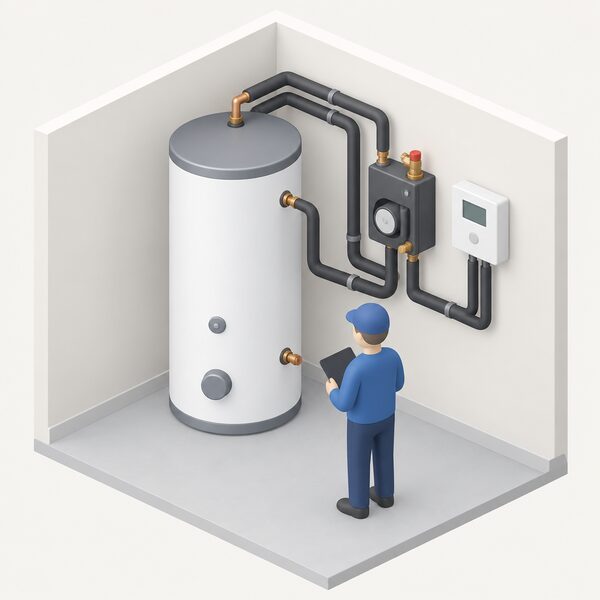
The cylinder is not the only component that matters. Solar water systems comprise three main components: solar collectors, a hot water cylinder, and a plumbing system1. The plumbing system is where the pump station, the controller, the sensors, the expansion vessel and the safety discharge arrangements live, and it is the part that determines whether the collectors run at all on a given day. A solar thermal system always includes a thermal storage unit, which is the general principle that the cylinder embodies8.
In a retrofit, the cylinder replaces what was there. A solar thermal hot water cylinder is designed for use with solar panels and will replace the existing hot water cylinder in retro-fit situations5. That replacement is the moment when the household's hot water stops being purely a function of the boiler and starts being partly a function of the weather. It is also the moment when the household takes on a second heat source, a second set of controls and a second thing that can fail.
Dedicated solar cylinder or thermal store: which fits which home
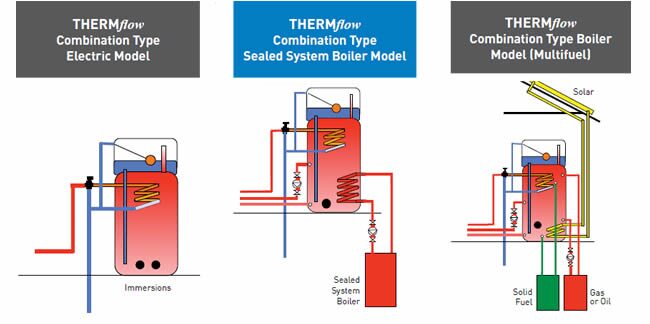
The choice between a twin-coil cylinder and a thermal store is really a choice about how the household wants solar heat to interact with its other heat sources. A twin-coil cylinder keeps the two circuits separate: the solar coil heats the water in the cylinder, and the boiler coil does the same when the sun cannot. A thermal store works differently. Heated water is usually stored in a large, well-insulated cylinder often called a buffer or accumulator tank4. The store is a body of hot water that other systems draw from, rather than a cylinder that is itself the domestic hot water.
That difference matters most where a household has, or expects to have, more than one heat source. A thermal store might store heat from a biomass boiler, solar water heating system, or a heat pump, provided it is designed and sized to work with them all4. It can also be designed to prioritise solar thermal heat above all other sources, which means that if solar heat is available, no other heat source will come on4. For a household with a heat pump, that priority logic is the difference between using the sun when it is there and using the compressor instead.
The trade-offs run in both directions. A thermal store typically holds a larger volume of water than a twin-coil cylinder and needs the space and the structural support to match, and it introduces a de-stratification pump in many designs to move heat around the store. A twin-coil cylinder is simpler, smaller and closer to what most UK homes already have. Where a household has one heat source plus solar, the twin-coil cylinder is the conventional answer. Where it has two or more, or expects to add a heat pump, the store's ability to accept and prioritise multiple inputs is the reason to choose it.
STEELflow solar cylinders: capacities, dimensions and configurations
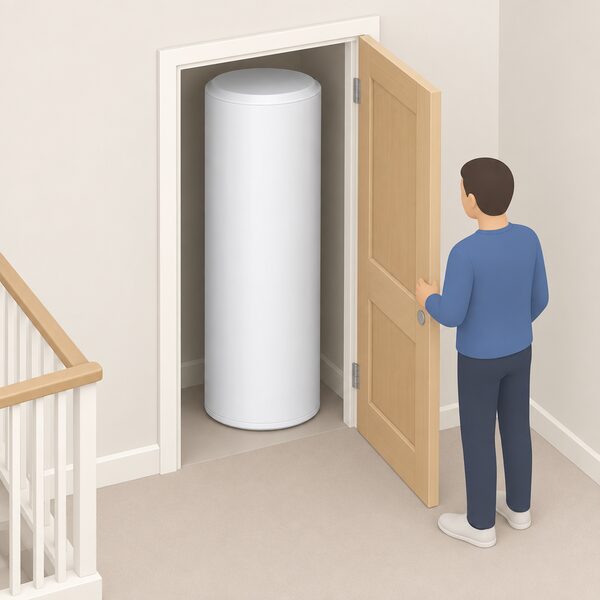
The STEELflow range, sold under the THERMflow name in the maker's datasheet, is the clearest example of how a solar cylinder range is laid out in practice. The 120, 140, 180 and 210 litre models share a cylinder diameter of 570 mm, so the footprint is constant and only the height changes as capacity rises6. The 180 litre model has a cylinder height of 1360 mm6. The 250 litre model steps up to a 590 mm diameter, the 300 litre model to 640 mm, and the 400 litre model to 740 mm, with the 400 litre model standing 1670 mm high6.
| Model | Cylinder diameter | Cylinder height |
|---|---|---|
| 120, 140, 180, 210 litre | 570 mm | 1360 mm (180 litre) |
| 250 litre | 590 mm | Not stated |
| 300 litre | 640 mm | Not stated |
| 400 litre | 740 mm | 1670 mm |
The range also covers coil configurations and coil volumes. Twin coil and triple coil solar cylinders are specifically designed to work in conjunction with the domestic heating system, and the coil fluid content is quoted at 1.28L and 4.03L depending on the coil2. Larger commercial cylinders in the same family carry dedicated solar volumes of 113.1, 153.3, 197.9, 307.9, 460.8, 499.0 and 483.0 litres across 300L, 400L, 500L, 800L, 1000L, 1250L and 1500L capacities respectively7.
The practical point for a household is that cylinder choice is a space decision as much as a heat decision. A 570 mm diameter cylinder will pass through most UK airing cupboard doors and fit the footprint of the cylinder it replaces; a 740 mm diameter store will not. Height is usually the more flexible dimension, which is why the range holds diameter constant across the smaller models and grows upward instead.
Warmflow cylinders: duplex stainless steel construction
Warmflow's Cyclone cylinders are manufactured from high grade Duplex stainless steel7. The material choice is the substance of this section, because it is what determines how the cylinder behaves over a long service life in a hard water area and how much it weighs when it is being manoeuvred into place.
Duplex stainless steel sits between the common austenitic grades and the more highly alloyed super-duplex materials. It is chosen for cylinders because it combines high strength with good resistance to chloride stress corrosion cracking, which is the failure mode that matters most where a cylinder holds chlorinated mains water at temperature for years. A stronger material allows a thinner wall for the same pressure rating, which reduces the weight of a full cylinder and the load it places on the floor of an airing cupboard or loft.
The construction detail also bears on the coil. A cylinder built to take a solar coil has to accept a second penetration through its shell, with the coil assembly welded or mechanically fixed in place, and the shell material has to tolerate that without introducing a weak point. The same brochure covers the wider Cyclone range, so a household comparing a solar cylinder against a standard one is comparing products from the same maker and the same material specification7.
Bespoke thermal stores: compatible heat sources beyond solar
A bespoke thermal store is the option for a household whose heat sources do not fit the standard twin-coil pattern. The store is built around the inputs it has to accept, and the inputs it can accept are broad. A thermal store might store heat from a biomass boiler, solar water heating system, or a heat pump, provided it is designed and sized to work with them all4. That "provided it is designed and sized" is doing real work in the sentence: a store that is undersized for the combined output of a biomass boiler and a heat pump will not perform as intended, and a store whose coil or plate heat exchanger is too small for the solar array will throttle the collectors.
The solar priority function is the feature that most distinguishes a bespoke store from a standard cylinder. A thermal store can be designed to prioritise solar thermal heat above all other sources, which means that if solar heat is available, no other heat source will come on4. In a well-designed system this is not just an efficiency measure; it is what makes the solar contribution visible in the household's fuel use, because the store will not quietly run the boiler while the collectors are hot.
Heat pump compatibility is the other reason households commission a bespoke store. Heat pump cylinders can be combined with solar heating to achieve a very environmentally friendly and highly efficient result, and the wider practice of coupling a solar collector with a heat pump is established in the sector2. The combination works because a heat pump runs at lower flow temperatures than a boiler, so a large, well-insulated store can hold water at a temperature the heat pump can produce efficiently while the solar coil adds to it whenever the collectors are warmer than the store.
Cost: around £6,200 and what VAT relief covers

The headline cost figure for a solar thermal installation is around £6,200, and the VAT position is the part households most often get wrong. The reduced rate of VAT for energy saving materials excludes the installation of solar panels, wind and water turbines from the reduced rate9. Solar thermal equipment is not within that relief, so the installation does not attract the reduced rate on the same basis as the excluded technologies.
Where a mixed installation is priced, the split between materials and labour determines the VAT treatment. In an official worked example, an installer charges a total of £5,385 excluding VAT, made up of £3,500 for materials and £1,885 for labour; because materials are 65% of the total, standard rate VAT applies to the materials and the reduced rate to the labour10. That example concerns solar panels and battery storage in Northern Ireland, where materials exceed 60% of the total cost, and it illustrates the principle rather than setting a rate for solar thermal.
The practical consequence is that a solar thermal quote should state the VAT treatment explicitly, and the position at the date of the quote governs. Reliefs and rates change, and a household comparing quotes from different periods may be comparing different tax treatments without realising it. Prices for solar thermal cylinders and complete systems are installer-quoted, and no published price range is available for the cylinder itself.
| Item | Figure | Basis |
|---|---|---|
| Solar thermal installation | Around £6,200 | Headline cost |
| Worked VAT example, materials | £3,500 | 65% of total, standard rate applies |
| Worked VAT example, labour | £1,885 | Reduced rate applies |
| Worked VAT example, total | £5,385 excluding VAT | Northern Ireland, materials over 60% |
Savings: £210 to £230 a year and winter performance
The savings case for solar thermal is real but small, and the published figures differ. Energy Saving Trust projects an estimated annual saving of £210 for a household in England, Scotland or Wales with an existing electricity system, and £230 in Northern Ireland, where the same guidance gives £160 on the alternative basis5. A separate figure of £110 also appears in that guidance, and the two are not reconciled, so the range is best treated as uncertain rather than settled on the higher number. The wider range of £210 to £230 a year reflects the spread across sources rather than a single agreed figure.
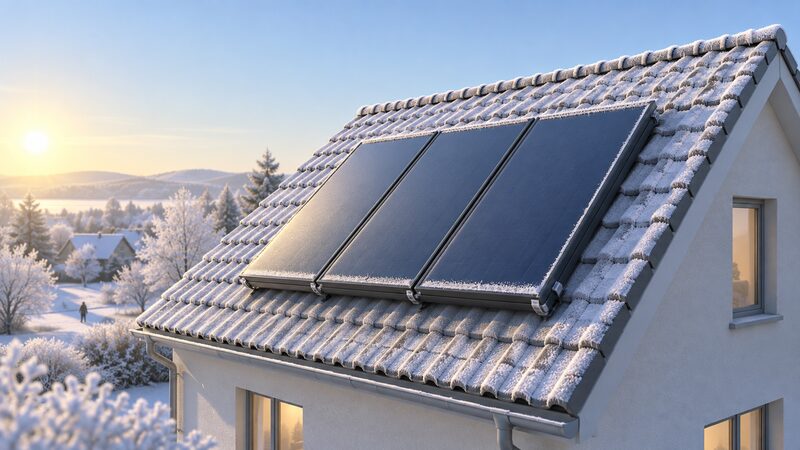
Winter is where the technology's limits are clearest. Solar water heating uses energy from the sun to work alongside your conventional water heater, so the cylinder is not self-sufficient in December and January3. The collectors still contribute on bright cold days, because a clear sky delivers irradiance even when the air temperature is low, but the volume and temperature of that contribution fall. The backup heat source does the rest, and the household's hot water bill in winter is close to what it would have been without solar.
The comparison with solar PV is worth stating plainly, because the two are often confused. Independent modelling of a 4.6kWp ten-panel solar PV system on a south-facing, 35-degree pitched roof with no shading gives an annual bill saving of £285 in London and £270 in Edinburgh, with total annual benefits of £655 and £605 respectively and payback of 11 years 3 months and 12 years 2 months11. An east-facing system with modest shading in Cardiff gives a £225 annual bill saving and £470 total annual benefit, with payback of 15 years 8 months11. Those are electricity figures from a different technology, and they are given here only to show the scale against which solar thermal's £210 is being measured.
Planning permission and where extra rules apply
Solar thermal equipment sits inside the same permitted development framework as solar PV, and the framework is more permissive than many households expect. Solar photovoltaics and solar thermal equipment are not permitted development under Class C, but they may not require an application for planning permission if they meet the requirements set out under Part 14 of the rules on permitted development in Schedule 2 to the Order12. Part 14 is the route that matters, and it applies to roof-mounted equipment whose primary purpose is to provide heat or energy for use within the curtilage of the dwellinghouse13.
Conservation areas are where the exceptions bite. Solar panels fitted to roofs in conservation areas do not require planning permission provided they meet the general rules, and planning permission is not usually required to install solar panels on the roof of a house or block of flats in a conservation area, even if the roof faces a highway14. What does require permission is equipment on a wall fronting a highway within a conservation area, which includes roads, paths and public rights of way16. Any such equipment proposed to be installed on a flat roof in a Conservation Area may require prior approval with respect to the impact of its appearance on the Conservation Area17.
Article 4 Directions remove the permitted development rights entirely in some areas. In Swindon's Railway Village Area and in Bishopstone Conservation Area, Article 4 Directions apply, so planning permission is required to install solar panels18. Where an Article 4 Direction is in force, it removes permitted development rights for solar panel installations, and planning permission must be applied for16. Local rules can add further requirements beyond the national framework3.
Northern Ireland has its own regime. You may have to get planning permission to fit solar thermal panels, especially in conservation areas or on listed buildings5. The Planning Portal's guidance is based on national rules, but additional local rules may also affect what permissions are needed, and details of the current planning regulations for the installation of solar thermal equipment are set out in Leaflet 3, Generating Your Own Energy3.
What owning a solar thermal cylinder means for household energy independence
A solar thermal cylinder moves a household part of the way towards independence on hot water, and no further. The system's primary purpose, in the words of the permitted development rules, is to provide heat or energy for use within the curtilage of the dwellinghouse, which is exactly the scope of what it delivers: heat, on site, for the home13. It does not generate electricity, it does not store electricity, and it does not disconnect the household from the grid or from a gas supplier.
What it does change is the source of a meaningful share of the household's hot water energy. Installing solar thermal hot water could save you money on your hot water bills, and the saving is delivered by the collectors rather than by a supplier5. Where a thermal store is designed to prioritise solar thermal heat above all other sources, the household gets a system that will not run the boiler while the collectors are hot, which converts the solar resource into a visible reduction in fuel use rather than a theoretical one4.
The dependencies that remain are worth naming. The household still needs a backup heat source, because solar water heating works alongside a conventional water heater rather than replacing it3. It still needs mains water, because the cylinder is filled from the supply. It still needs electricity for the pump, the controller and the sensors, so a power cut stops the solar loop even on a bright day. And it depends on the cylinder, the controller and the pump station continuing to work, which is why the indoor half of the system deserves as much attention at specification stage as the collectors on the roof.
For households weighing solar thermal against other options, the honest framing is that this is a hot water technology with a modest financial return and a genuine but partial independence benefit. It pairs naturally with a heat pump or a biomass boiler in a thermal store, and it sits alongside solar PV without competing with it, since one produces heat and the other produces electricity. The solar water heating page covers the collectors themselves, and solar thermal vs solar PV sets out how the two compare for a UK household.
Sources18 cited
- Generating Your Own Energy: Solar Water, Welsh Government, 2018
- Solar heat pump cylinders, Newark Cylinders, 2026
- Solar thermal water heating, Planning Portal, 2026
- Thermal energy stores, Energy Saving Trust, 2025
- Solar thermal panels, nidirect, 2024
- THERMflow data sheet: heat losses, McDonald Water Storage, 2019
- UK Cyclone complete brochure, Joule, 2026
- Solar thermal in Europe, Solar Heat Europe, 2019
- Draft explanatory notes, clause 48, HM Revenue and Customs, 2008
- VAT on energy saving materials, HM Revenue and Customs, 2026
- Are solar panels worth it?, Which?, 2025
- Permitted development rights for householders: technical guidance, Ministry of Housing, Communities and Local Government, 2026
- The Town and Country Planning (General Permitted Development) (England) Order 2015, Schedule 2, Part 14, legislation.gov.uk, 2015
- Planning and solar, Frome Town Council, 2025
- Solar panels guidance, City of York Council, 2026
- Renewable energy: solar panels and heat pumps, Rother District Council, 2026
- Solar photovoltaic (PV) panels, London Borough of Bromley, 2026
- Solar Together, Swindon Borough Council, 2026
 Hot Water Cylinder ControlsWhat temperature should a hot water cylinder thermostat be set to, and does it need its own timer apart from the heating?
 Controls and Smart OperationWhy does a heat pump need different controls from a boiler, and what does weather compensation actually do?
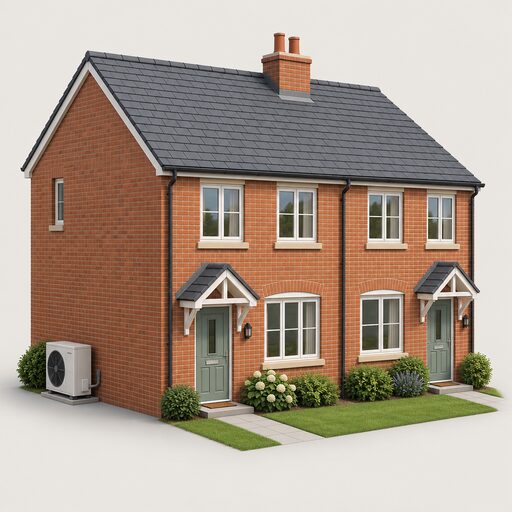 Which Homes Suit a Heat PumpMost UK homes can have a heat pump fitted, so the real question is whether yours makes it easy or expensive.
 Hot Water CylindersWhich hot water cylinder suits your home, and what is the real difference between a vented one, an unvented one and a thermal store?
 Sizing and Heat LossHow do installers work out what size heat pump your home needs, and why can a unit that is too big cost more to run than one that is slightly small?
 Hot Water CylindersA heat pump needs a cylinder to store hot water, so swapping a combi means getting one.