In this guide
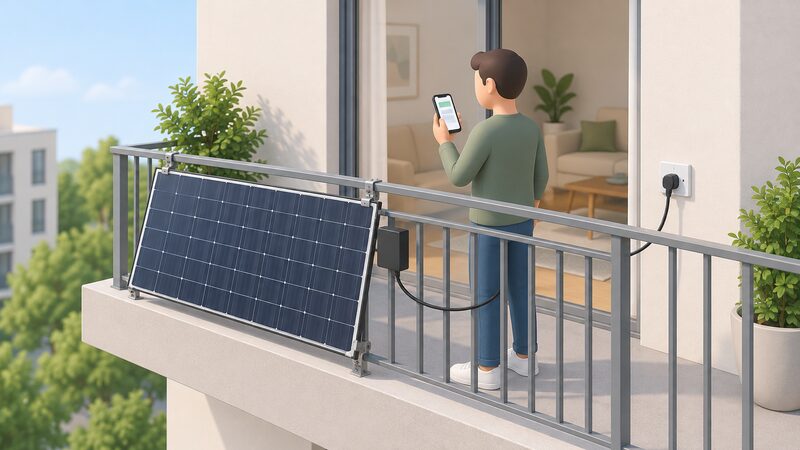
A balcony solar system is a small photovoltaic kit that a householder buys, carries home and plugs into an ordinary UK socket. It is the same idea that has hung off German balconies and terraces for years, and it arrived in Britain on 27 August 2026, when plug-in solar panels became legal to buy and use across Great Britain1. The kit is deliberately modest: one or two panels, a microinverter, a mounting frame and a lead with a three-pin plug.
The appeal for a flat dweller is obvious. English Housing Survey figures for 2023 to 2024 put PV panels on 7% of houses and bungalows but only 3% of flats, so the households with the least roof access have the least solar3. A balcony kit sidesteps the roof entirely. It also sidesteps the installer, the scaffolding and the several thousand pounds that a full domestic system costs.
The limits are just as clear. UK-compliant devices are capped at a maximum output of 800W on average, which is enough for everyday appliances but not for the whole house4. A north-facing balcony is not recommended at all4. And in a leasehold block, the panel itself may be permitted while the fixing to the building is not, because the wall or railing usually belongs to someone else5.
What a balcony solar system is and what is in the kit
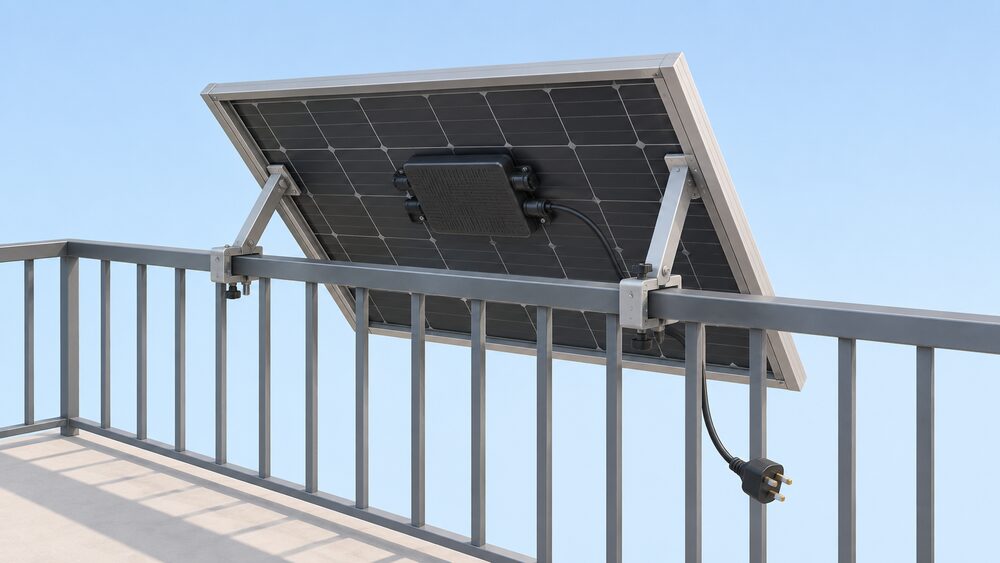
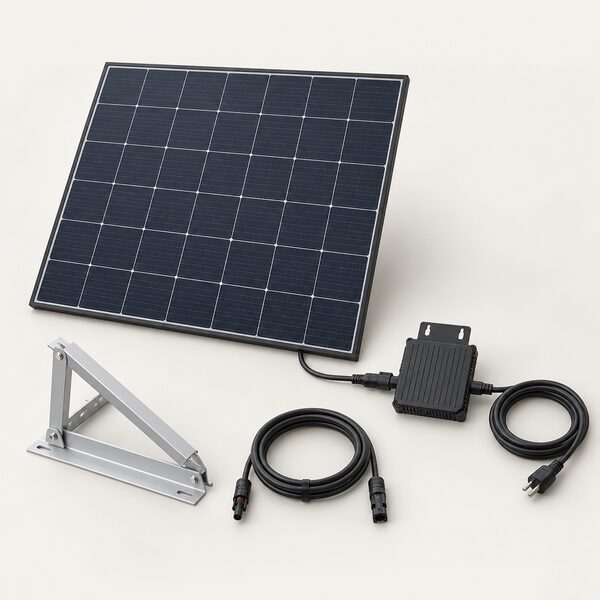
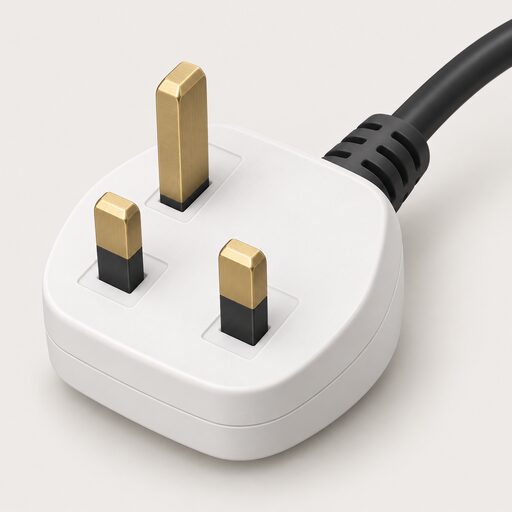
A plug-in solar device is defined in the government's interim product specification as at least one PV module, a grid-following inverter, a connection lead fitted with a plug complying with BS 1363, and a mounting system for the panel6. That is the whole product. There is no consumer unit work, no separate export circuit and no installer sign-off in the basic design, because the device is intended for connection to an existing low-voltage electrical installation using a standard UK mains plug and socket6.
In practice, kits sold in Britain follow that shape. Which? describes the typical contents as one or two solar panels, a microinverter that converts direct current to usable alternating current, a lead fitted with a standard three-pin plug, mounting brackets and an app for monitoring9. The Centre for Sustainable Energy gives the same list in slightly different words: one or two panels, an inverter, mounting equipment, cable and a standard three-pin plug7.
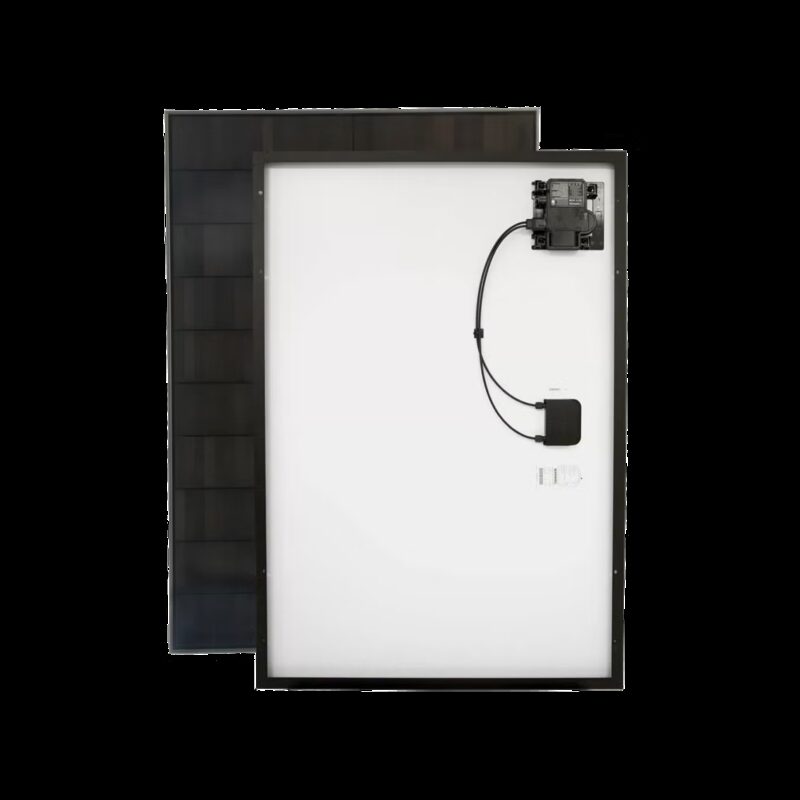
The microinverter is the part that makes the format work. It is usually attached to the back of the panel and converts DC to AC at the panel rather than at a central box10. That matters for a small array because each panel then works independently, so shade falling on one does not drag the other down.
What a balcony kit is not is a substitute for a roof system. A maker's guidance is blunt that, despite the marketing language, plug-and-play balcony systems in the UK are generally not exempt from regulatory requirements11. The device has to meet the published specification, and the household still has to satisfy whatever consent regime applies to the place it is fixed.
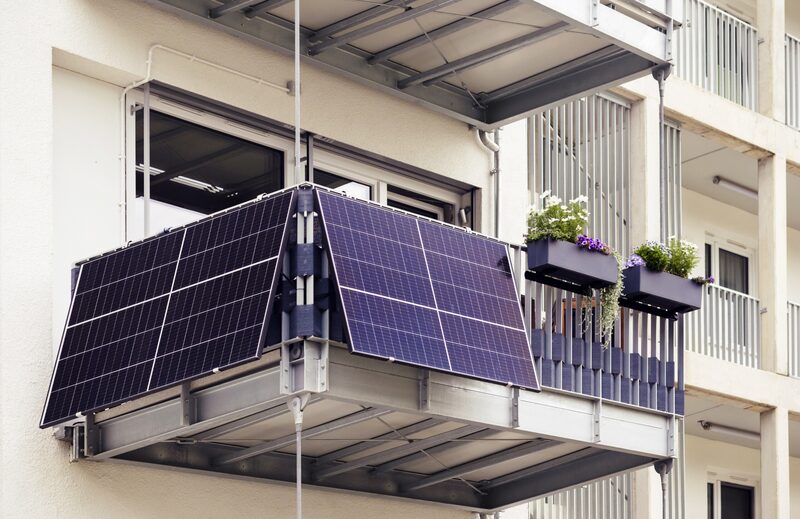
Plug-in solar panels are now on sale in the UK
The change of status is recent and specific. Electrical Safety First records that plug-in photovoltaic solar panels, also known as balcony solar, are now available to buy and self-install in the UK5. Which? dates retail availability to the end of August 2026, when kits appeared online and on the high street9. Home Energy Scotland confirms that major retailers worked with the UK government on the rollout and that panels are now available in stores and online1.
The political commitment came earlier. A Commons statement in March 2026 said plug-in solar would be made available for the first time in Britain so that families could buy a low-cost panel straight from a supermarket and set it up on a balcony or in a garden12. Government press material in May 2026 said the panels would be available in shops within months13, and the August announcement confirmed that from 27 August the panels could be plugged into homes across the country2.
The continental comparison is worth stating because it explains the expectations people bring. NAPIT notes that plug-in panels are common in places such as Germany, where people already hang them on balconies, in gardens or on terraces14. The British version arrived with a different compliance framework and, at least at launch, a different physical emphasis.
How a plug-in kit works: panel, microinverter and three-pin plug
The electrical path is short. The panel produces direct current, the microinverter converts it to alternating current at mains voltage, and the lead feeds it into a ring main or socket circuit through a BS 1363 plug6. The device is grid-following, meaning it matches the grid's voltage and frequency rather than creating its own supply, and it shuts down when the grid does.
That design choice is what keeps the kit simple and what keeps it limited. Because it connects through a plug rather than a dedicated circuit, it needs no isolator, no generation meter and no installer. Because it is grid-following, it cannot run the house in a power cut. And because it feeds a socket circuit rather than a consumer unit, the output has to stay small enough that the circuit is never overloaded, which is where the 800W ceiling comes from4.
The specification also fixes the plug type. Plug-in solar intended for connection to UK sockets must use plugs designed to BS 1363-16. That is a safety requirement rather than a performance one, and it is the reason a kit bought abroad may not be compliant even if the panel and inverter are otherwise sound.
Monitoring is part of the standard package. Which? lists an app among the typical kit contents9, and the app is usually the only way to see what the array is producing, since there is no separate generation meter. That makes the app the first diagnostic tool when output falls.
Sizes and output: from 300W to 800W
Panel capacity in balcony kits spans a wide band. A maker's guidance puts individual panel capacity at 300W to 800W11, while the compliance ceiling applies to the device as a whole rather than to a single panel. Energy Saving Trust states that UK-compliant plug-in solar panel devices are limited to a maximum output of 800W of electricity, on average4.
That distinction matters when reading product listings. A kit with two 460W panels has a panel capacity of 920W but an inverter limited to 800W, so the array is deliberately oversized against the inverter and clips at the top of its range. The clipping is not a fault; it is how the kit stays inside the limit while still producing well in weaker light.
| Kit shape | Panel capacity | Inverter | Notes |
|---|---|---|---|
| Single panel | 300W to 800W per panel11 | Microinverter | Entry-level format, around £200 to £300 as a Europe-based estimate8 |
| Two panel | Two panels, often 435W to 465W each9 | 800VA microinverter9 | The common UK retail format |
| Whole device | Not applicable | Capped at 800W on average4 | The compliance limit applies to the device |
The practical output question is harder to answer than the capacity question, because no official annual yield figure exists for a 300W or 600W kit. The nearest published estimate is a maker's figure for a well-positioned 400W panel in the UK, put at around 265 to 450 kWh annually depending on location and conditions11. That is a maker's estimate rather than an official one, and it should be read as such.
What a kit can power and what it saves
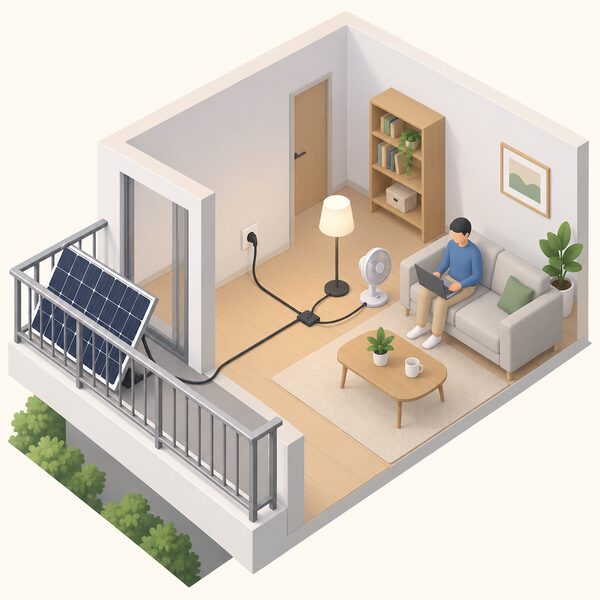
The honest answer to what an 800W kit can power is: appliances, not a house. Energy Saving Trust states that 800W is enough for everyday appliances but that higher-use appliances will still need grid electricity, and answers the whole-house question with a plain "probably not"4. A kit of this size offsets background load and daytime appliance use rather than replacing a supply.
Savings figures come from two different directions and should not be blended. A maker's estimate puts a typical 800W system with good self-consumption at roughly £144 to £192 a year at current electricity prices11. Separately, an independent press release covering a heatwave week in June 2026 reported that British households with solar panels sold 4.6 kWh back to the grid per household per day, earning 55p, with savings adding up to £21.27 over the seven days for those households15. That second figure describes installed rooftop systems with export arrangements, not plug-in kits, and the two are not comparable.
| Measure | Figure | Applies to |
|---|---|---|
| Annual saving, maker estimate | £144 to £192 a year11 | Typical 800W system with good self-consumption |
| Weekly saving, heatwave week | £21.27 per household15 | Households with installed solar panels |
| Weekly saving, average usage | £17.44 for a seven-panel system, 2,700 kWh annual consumption15 | Installed rooftop systems |
The reason a plug-in kit cannot earn export income is structural. Which? states that unlike rooftop solar, you cannot use plug-in kits to sell excess power back to the grid, so the electricity does need to be used in the home9. Government and parliamentary guidance describing export to the grid applies to solar panel electricity systems generally16, not to plug-in devices. A balcony kit is therefore a bill-reduction measure, and its value depends on how much of its output is consumed on the spot.
Where they are allowed: planning, flats and renting
Planning and consent are two separate questions, and conflating them is the most common mistake. On planning, the position for domestic solar is permissive. Wirral Council notes that placing solar panels on the roof of a house or flat, or on a building within its grounds, is considered in most cases permitted development under the Town and Country Planning (General Permitted Development) (England) Order 2015, Schedule 2, Part 14, Class J18. Cornwall Council sets out Class A and Class B permitted development rights for solar panels on domestic premises19, and Bromley Council confirms that installation on residential buildings may be permitted development with no need to apply20. The Commons Library adds that planning permission is not normally needed for solar panels on domestic roofs, with some exceptions, as they are covered by permitted development rights21.
Which? states that plug-in solar panels will also be considered permitted development for flats, subject to restrictions9. The exceptions are the ones that catch people out: Which? notes that listed buildings, conservation areas, World Heritage Sites and other designated areas may need planning permission22, and Energy Saving Trust lists listed buildings, conservation areas and national parks as the cases where the usual position does not apply23. Richmond Council adds that in many cases, even in conservation areas, homes can have solar panels without requiring planning permission under permitted development24.
Consent is the harder gate in a block of flats. Energy Saving Trust states that renters and flat owners will need permission from their landlord or freeholder before installing plug-in solar panels4. Islington Council advises that a leaseholder may need permission from the landlord, freeholder or management company25, and Richmond Council repeats that a leaseholder may still need permission from the landlord, freeholder or management company24. Which? is equally direct: a leaseholder will also need the permission of the freeholder to install solar panels26. The government's own launch material lists landlord, building owner or freeholder permission, planning permission and listed building consent among the consents that may be required2.
The Scottish position has its own vocabulary. The Scottish building standards technical handbook for domestic buildings, published in March 2026, defines a specified attachment to include a balcony, solar shading or a solar panel attached to an external wall27. That framing matters for anyone in Scotland planning a wall-mounted panel, because the attachment is treated as part of the building's envelope rather than as loose equipment.
Balcony, wall or garden: which mounting suits your home
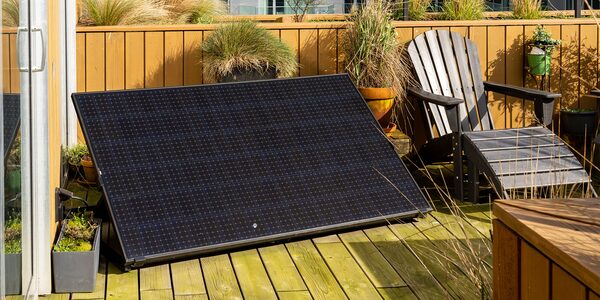
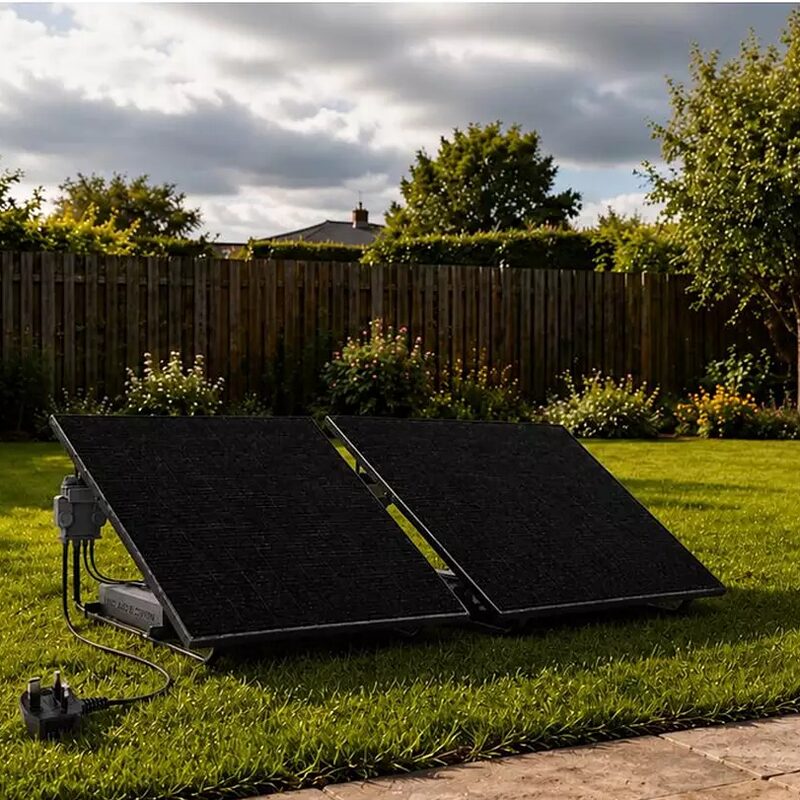
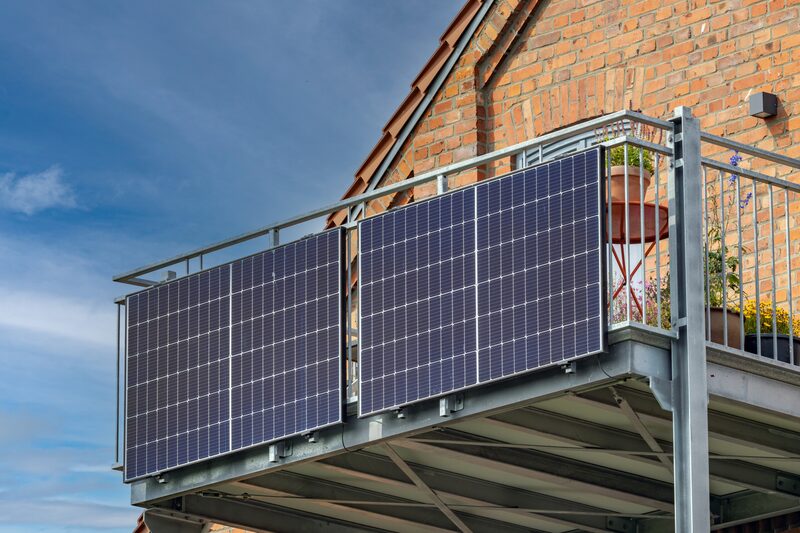
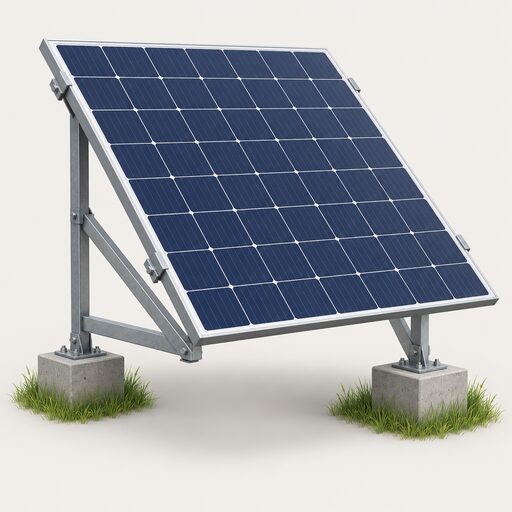
The mounting question has a practical answer that may surprise buyers. Home Energy Scotland states that current devices available in the UK are generally more suitable for garden locations than balconies1, and Energy Saving Trust repeats that current devices available in the UK are more suitable to garden locations rather than balconies, with permission and an appropriate frame, fixing or anchors needed4. The British launch range leans towards ground and wall mounting rather than the German-style railing hook.
That is visible in the products. Which? describes an InstaGen kit with two 435W bifacial all-black panels, an 800VA microinverter and a universal mounting frame that suits gardens, balconies and walls, with a manually adjustable tilt angle9. A PowerXpress kit is listed with two 460W panels and an adjustable mounting bracket suitable for installation on walls, floors and balconies9. UKSOL's Compact 460W and Duo 890W kits are both listed as ground mount only9.
| Mounting | Suits | Considerations |
|---|---|---|
| Garden ground mount | The format most current UK devices are designed for1 | Needs a frame or anchors and a clear south-facing position |
| Wall mount | External walls, where permitted27 | In Scotland a wall-mounted panel is a specified attachment27 |
| Balcony railing | The continental format | Needs permission and an appropriate frame, fixing or anchors4 |
| Adjustable tilt frame | Gardens, balconies and walls9 | Tilt can be set manually to suit the season |
Tilt matters as much off the roof as on it. Which? puts the best roof pitch at around 30 degrees22, and for plug-in panels specifically describes them as working best at an angle of around 30 degrees, unshaded and south-facing9. Energy Saving Trust gives a slightly wider band for plug-in panels, calling south-facing panels at a tilt of 30 to 40 degrees the best set-up in the UK7. Balcony railings and wall brackets rarely allow that angle to be held exactly, so output falls short of the figures quoted for an optimally pitched roof.
Orientation, shading and getting the most from a small array
A small array has no spare capacity to waste, so position does more work here than it does on a roof. Energy Saving Trust states that it does not recommend installing plug-in solar panels facing north because there is not enough sunlight hitting the panels4. The same source describes the best set-up as south-facing panels mounted at a tilt of 30 to 40 degrees7, and Which? gives around 30 degrees, unshaded and south-facing9.
The wider solar guidance points the same way. Which? notes that a mainly south-facing roof gives the best power output, with southwest or southeast-facing roofs also good22. Energy Saving Trust describes an unshaded, south-facing roof as ideal for maximum performance28. Uswitch frames the plug-in case as needing south-facing outdoor space, such as a balcony, to get the most out of the panels10.
Shade is the variable a household can sometimes control. Energy Saving Trust notes that where shading is unavoidable an installer might recommend microinverters or power optimisers, which let each panel work independently, and trimming trees that cause partial shade29. A plug-in kit already has a microinverter per panel, so the module-level independence is built in, but that does not create energy that the shade has removed.
The published performance figures come with their test conditions attached, and those conditions are worth reading before comparing claims. Energy Saving Trust's plug-in solar figures are modelled on panels installed in Manchester, facing south, angled at 30 degrees from the horizontal, with no shading4. A balcony that faces east, sits under an overhang or looks onto a neighbouring wall will not match that model, and the gap between the model and the balcony is the honest measure of what a household should expect.
Costs, prices and what to pay for a kit
Kit prices sit in a band that is an order of magnitude below a full installation. The Centre for Sustainable Energy puts plug-in solar kits typically at between £500 and £1,0007. A maker's guidance gives the same range for a full 800W system covering panels and a microinverter11, and separately estimates a basic 400W single-panel setup at approximately £300 to £50011. For a single-panel entry kit, the Centre for Sustainable Energy gives a Europe-based estimate of around £200 to £300, noting that entry-level single-panel kits are not officially priced for the UK yet7.
Retail listings give firmer numbers. Which? reports that the PatioSun range runs from £449 for the 445W PatioSun Lite to £779 for the 2x465W PatioSun Max Plus kit, that the UKSOL Compact 460W Plug-In Solar Pro Kit starts at £599.00 as ground mount only, that the UKSOL Duo 890W Plug-In Solar Pro Kit starts at £899.00 as ground mount only, and that The Solar Centre has two kits in the pipeline, a rigid 430W panel kit and a lightweight 200W semi-flexi kit, both with a planned base kit price of £3309.
| Product | Price | Notes |
|---|---|---|
| PatioSun Lite 445W | £4499 | Part of a five-kit range |
| PatioSun Max Plus 2x465W | £7799 | Top of the PatioSun range |
| UKSOL Compact 460W Plug-In Solar Pro Kit | from £599.009 | Ground mount only |
| UKSOL Duo 890W Plug-In Solar Pro Kit | from £899.009 | Ground mount only |
| The Solar Centre rigid 430W and semi-flexi 200W kits | £330 planned base kit price9 | Both kits, in the pipeline |
For scale, a professionally installed domestic system costs far more. Which? puts a typical domestic system at around £6,100 to install22, and Energy Saving Trust describes domestic systems as generally around 4.5 kWp and costing around £7,60028. Those are installed systems with scaffolding, mounting, electrical work and certification, and they are not a like-for-like comparison with a plug-in kit, but they explain why the plug-in format attracts flat dwellers who cannot use a roof.
Prices are as read at the dates given and are not a quotation. Where no published price exists, kits are installer-quoted or retailer-quoted, and no range should be assumed.
Installation, maintenance and fixing low output
Installation of a plug-in kit is a household task rather than a trade one, but it is not a task without rules. The device connects to an existing low-voltage installation through a standard UK mains plug and socket without requiring a separate electrical circuit for export6. The mounting, however, is a fixing job: Energy Saving Trust notes that permission and an appropriate frame, fixing or anchors are needed4, and the anchors are what keep a panel on a balcony in high wind.
Before buying, the compliance check comes first. Home Energy Scotland advises making sure the specific model is on the list of devices that meet UK standards, checked through the ENA Connect Direct LCT Device Register1. That register is the practical gate: a kit that is not listed does not carry the compliance status that the 27 August 2026 change established.
Maintenance is light. Panels need to be clear of leaves, dust and bird droppings, and the frame and fixings need checking for movement over time. The monitoring app is the main diagnostic tool, and a fall in output usually traces back to shade, soiling or a tripped circuit rather than to the panel itself. Where shading is the cause, Energy Saving Trust notes that trimming trees causing partial shade is one remedy, alongside module-level electronics that let each panel work independently29.
Portability is the quiet advantage of the format. Energy Saving Trust describes plug-in solar panels as portable devices that can be taken with you if you move home4. That is a real difference from a roof system, which stays with the building, and it matters for renters who expect to move. The panels and microinverter travel; the frame, brackets and anchors may not fit the next balcony or garden.
What balcony solar does for energy independence
A balcony kit moves a household a short but real distance towards self-supply. It generates behind the meter, so every kilowatt-hour it produces while the home is drawing power is a kilowatt-hour not bought from a supplier. It needs no installer, no roof and no landlord's roof access, and it can move house with the tenant. For a flat dweller who has been excluded from solar by tenure and building type, that is a genuine change in what is available.
The dependence that remains is substantial and worth stating plainly. The kit is grid-following, so it stops when the grid stops and provides nothing in a power cut. It is capped at 800W on average, so the home still buys most of its electricity, and higher-use appliances still need grid supply4. It cannot export, so surplus output at midday is lost rather than sold9. And it depends on a manufacturer for the microinverter, the app and any warranty service, which is a different kind of dependence from the grid but a dependence all the same.
There is also a consent dependence that no product specification can remove. In a leasehold block, the panel may be permitted development while the fixing is not, because the wall, railing or shared structure belongs to the freeholder or management company4. A household that clears that gate has a small, portable, self-installed generator. A household that does not has a panel it cannot legally fix.
For the wider picture of how solar changes a household's relationship with its supplier, the solar and energy independence guide sets out the full position. Households weighing a plug-in kit against a professionally installed system can compare the two in plug-in solar vs installed solar, and the practical questions of socket safety and rented flats are covered in plug-in solar socket safety and plug-in solar for renters.
Sources29 cited
- What you need to know about plug-in solar panels, Home Energy Scotland, 2026-09
- Households can save as plug-in solar panels come to market, GOV.UK, 2026-08-27
- English Housing Survey 2023 to 2024: low carbon technologies in English homes, GOV.UK, 2023
- Plug-in solar panels, Energy Saving Trust, 2026-09-17
- Plug-in solar consumer guide, Electrical Safety First, 2026-08
- Plug-in solar interim product specification, GOV.UK, 2026-07
- Plug-in solar, Centre for Sustainable Energy, 2026-09
- Plug-in solar explained, Low Carbon Hub, 2026-07-09
- Plug-in solar panels, Which?, 2026-09-15
- Plug-in solar panels guide, Uswitch, 2026-09-04
- Balcony solar panels, Fuse Energy, 2026-08-12
- Heating oil support, Hansard, 2026-03-16
- Britain continues to break clean power records, GOV.UK, 2026-05-28
- NAPIT welcomes Future Homes Standards announcement, NAPIT, 2026-03-24
- Britain's homes with solar panels reap £40 million during the heatwave, Uswitch, 2026-06-28
- Solar panels, Oxfordshire County Council, 2026-09-17
- Solar panels and the grid, House of Commons Library, 2026-09-17
- Solar panels, Wirral Council, 2026-09-17
- Solar panels and planning permission, Cornwall Council, 2026-09-17
- Solar photovoltaic panels, Bromley Council, 2026-09-17
- Planning permission for solar panels, House of Commons Library, 2024
- Solar panel myths: five common concerns debunked, Which?, 2026-06-09
- UK solar panel hotspots, Energy Saving Trust, 2026-08-13
- Solar panels and permitted development, Richmond Council, 2026-07-06
- Solar panels guidance, Islington Council, 2026-09-17
- Solar panel installation, Which?, 2026-08-12
- Building Standards Technical Handbook, Domestic (April 2026), Scottish Government, 2026-03
- Solar panels, Energy Saving Trust, 2026-08-27
- Solar panel installation, Energy Saving Trust, 2026-09-07
 Panels by Home TypeCan your house have solar panels, and how many will fit?
 Plug-In Solar KitsCan you really plug solar panels into a normal wall socket in the UK, and is it legal now?
 Solar Mounting SystemsWill your roof take the extra weight of solar panels, and will it still keep the rain out afterwards?
 Planning Permission EnglandMost homes in England can have solar panels fitted without planning permission, but does yours count as one of the exceptions?
 Plug-In Battery StoragePlug-in batteries are not legal in a grid-connected British home, even though plug-in solar panels are.
 Ground-Mounted SolarGround-mounted solar panels sit on a frame in your garden instead of on your roof, which helps if your roof is shaded, small or facing the wrong way.