In this guide
UKSOL is a British solar brand that sells modules made in the European Union, and it is unusual among panel names in the UK for two reasons: it markets directly to householders as well as to installers, and it has a plug-in solar range that reached regulatory compliance ahead of the consumer launch. The company is UKSOL UK Ltd, described as a British solar PV module producer based in Gerrards Cross, Buckinghamshire1.
The main product line is MCS certified monocrystalline PV with Tigo optimisers built in at the factory, approved as an ECO4 innovation measure and carrying a 25-year manufacturer's warranty2. The plug-in side is separate: the Compact 460W Plug-In Solar Pro Kit starts from £599.00, and the kits carry a 10-year UKSOL warranty with UK-based customer service and technical support5.
For a household, the appeal is a European supply chain, a British warranty address and a route into grant-funded work. The dependence is the same as any grid-tied array: the modules make electricity, but the grid, an inverter and a supplier relationship still sit between the roof and the bill.
What UKSOL is: a British family-owned brand with EU-made modules
UKSOL UK Ltd is a British solar PV module producer based in Gerrards Cross, Buckinghamshire1. The company presents itself as a British family-owned brand, and its trading history runs back to 2015, when it began supplying more than 50 countries. Its case studies include a solar-powered water pumping project in Sinobong and a rooftop system at VinUni visited by the British Ambassador in August 2020, and it won the Buckinghamshire Business Award in 2021.
The manufacturing position is the part that matters most to a buyer reading a datasheet. UKSOL is a British brand, but the modules are produced in the European Union. When Smith Bros (Caer Conan) Wholesale Ltd became its exclusive UK distributor in July 2021, the agreement covered solar PV modules produced in Spain and supported with a 30-year British warranty1. That is a different proposition from the bulk of the UK market: around 80% of panels available in the UK are made in China, including those from Trina Solar, and around 80% of those sold in the UK are made in China7.
A European module with a British warranty address shortens the distance between the household and the party answering a claim. It does not make the panel British-built, and it does not remove the dependence on an overseas factory for the physical product. What it changes is the paperwork and the shipping lane.
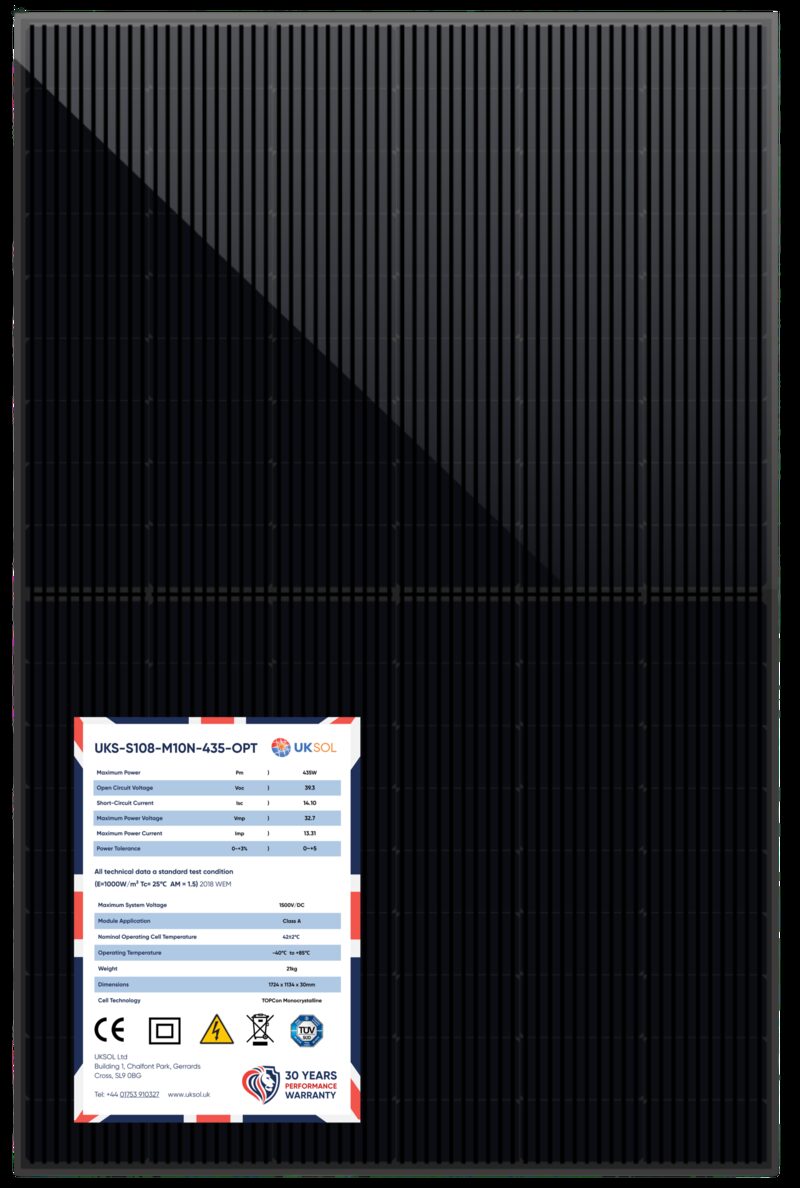
The range: TOPCon N-Type, flexible HJT and plug-in solar kits
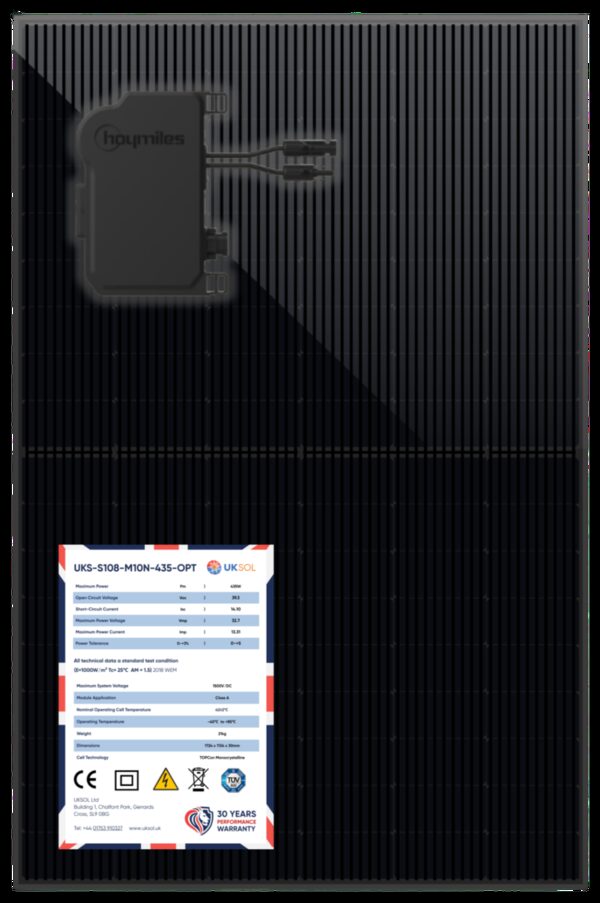
UKSOL's range divides into three groups. The core is the MCS certified monocrystalline PV module with built-in Tigo optimisers, the product that carries the ECO4 approval and the 25-year warranty2. The plug-in range is the second group, sold as complete kits rather than bare panels. The third is the mounting and kit hardware that turns a module into a plug-in system.
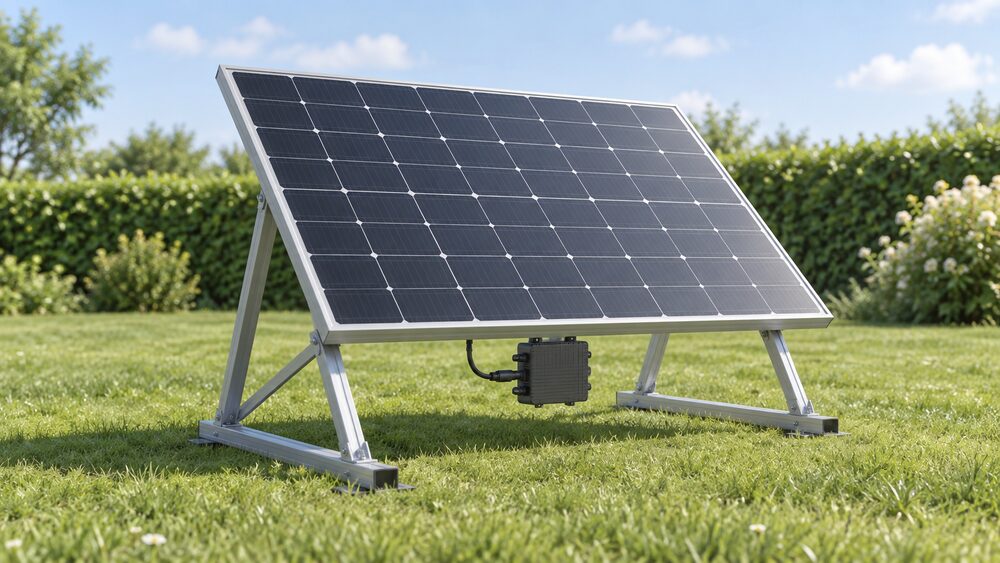
On the plug-in side, the type test register lists the PatioSun kits as comprising UKSOL solar panels and Hoymiles microinverters, so the panel is paired with a microinverter rather than a string inverter5. UKSOL plug-in solar kits are also available online at Argos, with hybrid mount kits listed as coming soon5. The Hybrid Mount range, with wall or ground mounting and four power options from 515W to 1260W, is listed as launching on 1 October 2026.
The company also runs a replacement service for existing arrays, covering failing poly or mono panels on rooftop arrays and utility-scale farms, replacing aging or faulty legacy solar panels with high-quality modules10. That service is aimed at the retrofit market rather than new build.
| Product group | What it is | Key figure |
|---|---|---|
| MCS certified monocrystalline PV | Core module with built-in Tigo optimisers | 25-year manufacturer's warranty6 |
| Plug-in Solar Pro kits | Panel plus microinverter, ground or hybrid mount | From £599.005 |
| PatioSun kits | UKSOL panels with Hoymiles microinverters | Listed on the type test register5 |
| Replacement service | Swap out failing poly or mono panels | Rooftop or utility-scale10 |
Specifications and certifications: MCS, TÜV and Tigo optimisers
The certification story is the strongest part of the UKSOL case, because it is documented by the scheme administrator rather than by the maker. The system consists of MCS certified monocrystalline PV modules with optimiser units factory fitted during the manufacturer's assembly process2. Factory fitting matters: a Tigo optimiser added on site is an installer's accessory, while one fitted during assembly is part of the module as tested.
The ECO4 innovation listing names the product precisely as UKSOL MCS certified monocrystalline solar PV panels with built in Tigo optimisers, and the same wording appears across successive versions of the approved measures document2. The listing also records that additional CCA/TAP modules are included at no cost to the homeowner, and that a data plan has been provided to households without Wi-Fi at no cost to the end user for a minimum of 10 years2. That data plan is unusual: it acknowledges that monitoring a system with built-in electronics needs a connection, and it puts the cost of that connection on the supplier for a decade.
The product approval date under the innovation measure is 26/09/20234. The related InstaGen Solar PV specification lists MCS certified monocrystalline solar panels with Tigo optimisers and CCA/TAP modules specified6.
Module-level electronics are worth understanding before buying. Optimisers sit between the panel and the inverter and manage the output of individual modules, which helps where shade or orientation varies across an array. The trade-off is more components on the roof and a monitoring chain that depends on a data connection. More on how these devices work is at power optimisers, and the certification framework itself is explained at MCS certification for solar.
Warranty: 30 years and what it covers

The warranty position has two layers, and they are not the same number. The MCS certified panel system carries a 25-year manufacturer's warranty, stated consistently across the ECO4 innovation documents from 2023 through to the 2026 version2. Separately, the distribution agreement that brought UKSOL into the UK market in July 2021 covered modules produced in Spain supported with a 30-year British warranty1.
Those two figures are both in the record and they refer to different things: a 25-year manufacturer's warranty on the certified panel system, and a 30-year British warranty attached to the supply arrangement. A household reading a quote should establish which term applies to the modules being fitted, because the documents give both.
The plug-in kits sit on a shorter term. They come with a 10-year UKSOL warranty, plus UK-based customer service and technical support5. Independent guidance puts typical plug-in solar warranty at 10 years, so UKSOL is in line with the market rather than ahead of it12.
For context on what a panel warranty normally covers, and how degradation thresholds work, see solar panel warranties and degradation. Independent guidance notes that regular upkeep will keep panels working efficiently for their full lifespan, which is around 30 years13. A 25-year product warranty therefore sits inside the expected service life rather than beyond it.
Pricing and buying: ex-VAT pricing, UK stock and delivery
UKSOL does not publish a list price for a supplied-and-fitted rooftop array, and prices for installed systems are installer-quoted. The published figures are for the plug-in range and for the wider market. The Compact 460W Plug-In Solar Pro Kit starts from £599.00 on a ground mount only basis5. For comparison, the Bolt 460W plug-in solar kit is listed at £549.99 and the Bolt 920W plug-in solar kit at £749.995.
On VAT, the position is favourable and time-limited. Solar panels are zero rated UK wide until 31 March 202714. Solar panels are also named in the legislation covering energy-saving materials, which is the basis for the relief15. Where a solar installation is eligible for relief, the installation of solar panels qualifies, though the treatment depends on the contract structure: in a worked example, an installer charges £5,385 excluding VAT, made up of £3,500 materials and £1,885 labour, and because materials are 65% of the total the standard 20% rate applies to materials while 5% applies to labour17. That example applies to Northern Ireland, where materials exceed 60% of the total cost.
For installed systems generally, independent guidance puts solar panels at an average cost of £4,600 to £8,000 among the suppliers Uswitch works with18. That is a market figure, not a UKSOL price.
Plug-in solar: the Compact 460W kit and ENA listing
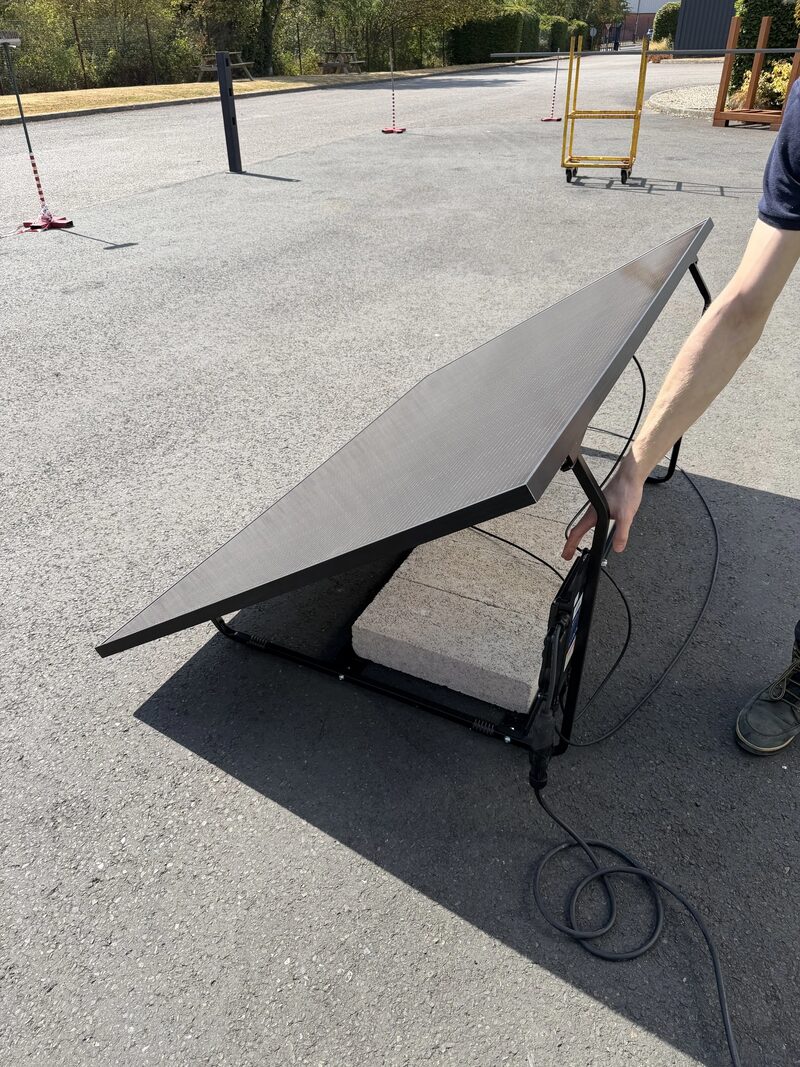
The plug-in range is where UKSOL has moved fastest. UKSOL is the first solar company that has reached significant regulatory compliance through the Energy Network Association Register, with four products listed as Compliant19. The listings are specific: the UKSOL Plug-In Solar Pro Compact 460W Single Panel Ground Mount Kit under system reference UKSOL/21002/V1/A2, the Compact 515W Single Panel Hybrid Mount Kit under UKSOL/21008/V1/A4, and the Advanced 920W Two Panel Hybrid Mount Kit under UKSOL/21014/V1/A419.
The target market is stated plainly: renters and households with balconies, terraces, gardens or other suitable outdoor areas who cannot install a conventional rooftop solar system19. That is the group for whom a plug-in kit changes the position most, because it does not require a roof, a landlord's consent to structural work, or an installer visit.
The regulatory picture is still forming. Freestanding and portable panels are available to buy in the UK already, but they are only legal for off-grid use12. Official statements describe plug-in solar as coming to shops within months and saving people money on their bills20, and independent reporting describes availability in shops within months for existing homeowners21. Plug-in solar can be classified into device types: compact device, two-component device and multi-component device22.
The practical limits are worth stating. A plug-in kit generates a fraction of a rooftop array, it is not eligible for export payments in the way a registered installation is, and its output depends on where it is placed. The comparison with a full installation is set out at plug-in solar vs installed solar, and the kit landscape is covered at plug-in solar kits.
Recycling and end-of-life: the Environment Agency-approved facility
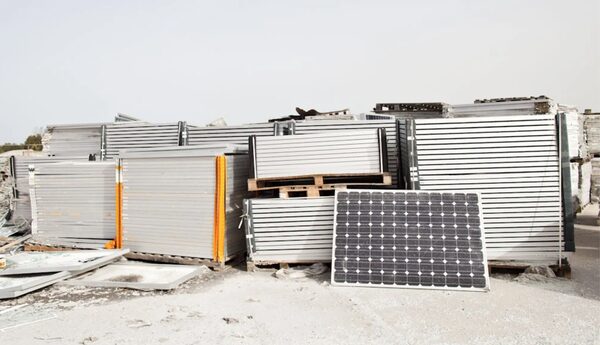
End-of-life handling is a genuine differentiator for UKSOL, and the claim is specific. The company states that its recycling facility is the only factory approved by the Environment Agency in the UK10. That is a maker's claim about its own operation, and it is the kind of statement a household can check with the regulator before relying on it.
The process is described as transforming retired solar panels into reusable raw materials, with panels converted into reusable raw materials that can be manufactured into new products and given a second life, and the stated purpose is stopping harmful and toxic materials going to landfill10. The scheme accepts both rooftop arrays and utility-scale farms, covering the case where a household is clearing out a rooftop array or a farm is being repowered10.
This matters for independence in a way that is easy to overlook. A panel that cannot be recycled cleanly at end of life is a future waste liability attached to the house, and the UK has limited dedicated PV recycling capacity. A brand with a domestic take-back route reduces that exposure. The wider picture, including what happens to panels that are not recycled through a scheme, is at solar panel recycling.
Who UKSOL serves: installers, housing associations and ECO4 projects
UKSOL sells through installers and distributors rather than direct to householders, which is the normal structure in the UK market: solar panels are sold via installers rather than direct to consumers23. Trade supply runs through distribution, and Smith Bros (Caer Conan) Wholesale Ltd was appointed exclusive UK distributor in July 20211.
The grant-funded route is the ECO4 innovation measure. ECO4 is a UK Government scheme which offers free renewable energy installations, such as heat pumps and solar PV, to low-income and poorly-insulated homes24. It covers a range of energy-saving solutions that can be applied to existing homes, and solar PV panels are among the measures funded25. The scheme targets low income, fuel-poor and other vulnerable households, and suppliers must actively help those households to effectively heat and insulate their homes27. It can fund insulation, heating and even solar panels28.
Applying runs through the local council or an energy supplier directly29. Installers working in the scheme operate under government oversight, and the Welsh Government has recorded action to suspend installers and protect consumers where problems arise30. ECO4 Flex extends the scheme in some areas through council-run routes31.
For a household, the ECO4 listing means UKSOL panels can be specified in grant-funded work, which is a form of third-party validation that a maker's own marketing cannot provide. It also means the panels are most likely to be encountered through an installer or a scheme rather than bought off a shelf. The grant landscape more broadly is covered at solar panel cost, and the independence question, including what a grid-tied array does and does not deliver, is at solar panels and household energy independence.
Sources31 cited
- Smith Bros becomes UKSOL's distributor for the United Kingdom, Flexi-Orb, 2021-07-13
- ECO4 Innovation Approved Innovation Measures v1.6, Ofgem, 2024-01
- ECO4 Innovation Approved Innovation Measures v1.5, Ofgem, 2023-10
- ECO4 Innovation Approved Innovation Measures v1.10, Ofgem, 2024-07
- Plug-in solar panels, Which?, 2026-09-15
- ECO4 Innovation Approved Innovation Measures v1.17, Ofgem, 2026-02
- AIKO solar panels review, Which?, 2026-08-12
- Trina Solar panels review, Which?, 2026-08-12
- SolarEdge solar panels review, Which?, 2026-08-12
- Solar panel recycling, UKSOL, 2026-09-17
- ECO4 Innovation Approved Innovation Measures v1.11, Ofgem, 2024-11
- Plug-in solar panels vs rooftop systems, Which?, 2026-04-27
- Solar panel cleaning and maintenance, Energy Saving Trust, 2026-08-25
- VAT on energy saving materials: zero rate, HM Revenue and Customs, 2026-09-17
- Value Added Tax Act 1994, Schedule 8, legislation.gov.uk, 2026-09-17
- VAT (Energy Saving Materials) Regulations 2022, legislation.gov.uk, 2022-03-23
- VAT on energy saving materials: mixed supplies, HM Revenue and Customs, 2026-09-20
- Are solar panels worth it?, Uswitch, 2026-09-16
- UKSOL Plug-In Solar Pro first to reach key UK compliance, Solar Energy UK, 2026-08-20
- Britain continues to break clean power records, GOV.UK, 2026-05-28
- NAPIT welcomes Future Homes Standards announcement, NAPIT, 2026-03-24
- Plug-in solar interim product specification, Department for Energy Security and Net Zero, 2026-06
- How we test solar panels, Which?, 2026-08-12
- ECO4 consumer grants and incentives, MCS Certified, 2026-09-07
- ECO4 Flex, South Cambridgeshire District Council, 2026-09-17
- Energy Company Obligation schemes, Elmhurst Energy, 2026-09-20
- ECO4, Elmhurst Energy, 2026-06-30
- Energy Company Obligation guide, Uswitch, 2025-06-27
- Energy saving at home, Centre for Alternative Technology, 2025-06-27
- Written statement: response to UK Government action on GBIS and ECO4, Welsh Government, 2025-01-23
- The Warm Homes Plan: what it means for homeowners, NICEIC, 2026-04-22