In this guide
Trina Solar is one of the largest panel manufacturers in the world, and its Vertex modules turn up on a large share of UK roofs. The company makes and sells solar PV panels for homes and businesses, as well as energy storage for large commercial customers, and says it spans more than 180 countries and regions globally1. Around 80% of panels available in the UK are made in China, including those from Trina Solar1.
For a household, the practical questions are narrower than the company's global footprint. What is on the datasheet, what the warranty actually covers, and what happens when a model is superseded. The current Vertex S+ line runs from 425W to 450W in the 450W variant's family and 455W to 500W in the 475W family, with module efficiency of 22.5% and 23.8% respectively2. Product warranty is 25 years, with a power warranty of 30 years on the maker's own pages2.
The dependence that remains is the same as for any grid-tied array: the panels generate, but the grid, an inverter and a supplier sit between the roof and the socket. Trina's own storage business is aimed at utility and commercial sites, not single homes, so a UK household wanting a battery buys that separately.
Trina Solar: what the company makes and sells
Trina Solar's UK-facing business is solar PV panels for homes and businesses, plus energy storage aimed at large commercial customers1. That split matters when reading the company's news: most of its recent announcements are utility-scale projects and storage deals, not domestic products.
The panels sold in the UK are made in China, which is the norm rather than the exception. Around 80% of panels available in the UK are made in China, including those from Trina Solar1. For a household, that means the supply chain, the warranty counterparty and any future spares all sit offshore, and the practical relationship is with the UK installer and distributor rather than the factory.
Trina Solar was named Tier 1 for both PV modules and energy storage systems on S&P Global's 2026 Cleantech Companies List, reported in August 20264. Tier 1 is a bankability measure used by project financiers. It says something about the maker's standing as a counterparty on large contracts; it says nothing about the efficiency, build quality or suitability of a particular module for a particular roof.
The company's project work gives a sense of scale. Trinasolar supplied 184,328 Vertex N 695W modules to the 126 MW Sarimay Solar PV power plant in Uzbekistan, described as fully commissioned in September 20264. In July 2026, TrinaTracker presented integrated solar projects in Spain combining Vanguard 1P trackers with Trinasolar Vertex N modules4. None of this is domestic product information, but it explains why the brand is familiar: it is a volume manufacturer that also sells into the residential market.
For a household, the useful conclusion is that Trina is a large, established maker with a genuine UK residential presence, and that the brand name alone does not tell you which module you are being quoted. That is what the datasheet is for. The wider market context sits in types of solar panel sold in the UK.
The Vertex range: what it covers
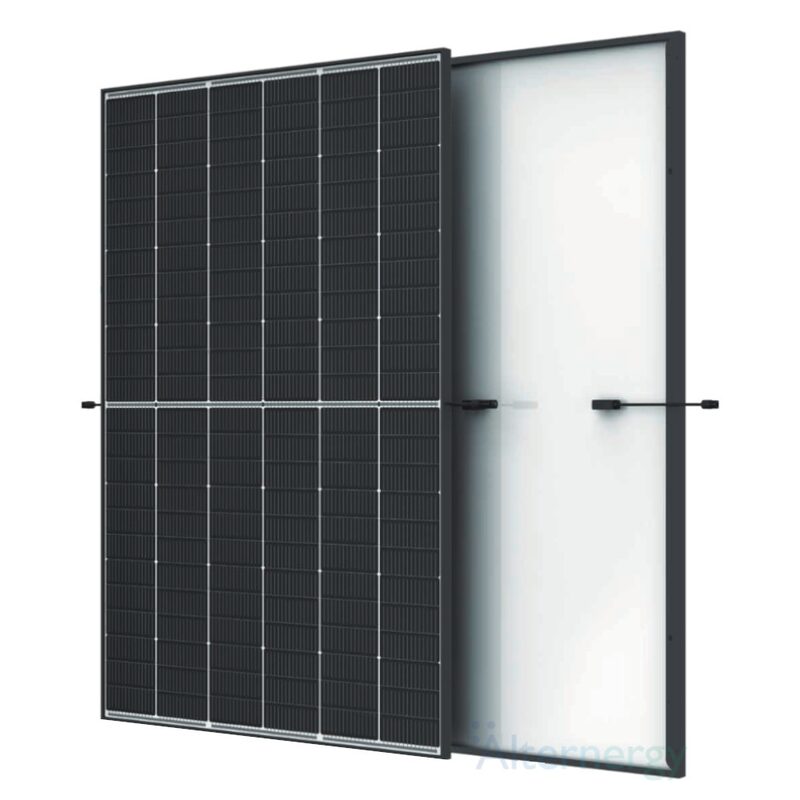
The Vertex S+ is the family a UK householder is most likely to be offered. Two variants appear in the product pages: a 450W module with a panel power range of 425W to 450W, and a 475W module with a range of 455W to 500W2. Both are described as suitable for residential and commercial rooftop installations3.
The construction is dual glass. The 450W module uses 1.6mm strengthened front glass and a black glass rear of the same thickness, with a white backsheet and 144 half cells arranged in a 6 by 24 layout2. The 475W module uses 1.6mm AR-coated heat-strengthened front glass and 1.6mm heat-strengthened rear glass, and is described as a half-cut, monofacial dual-glass module3. Glass on both faces is a durability choice rather than an efficiency one; it removes the polymer backsheet as a failure point. The trade-offs are covered in bifacial and glass-glass solar panels.
| Specification | Vertex S+ 450W | Vertex S+ 475W |
|---|---|---|
| Panel power range | 425W to 450W2 | 455W to 500W3 |
| Module efficiency | 22.5%2 | 23.8%3 |
| Cells | 144 half cells (6x24)2 | Half-cut, monofacial dual glass3 |
| Front glass | 1.6mm strengthened2 | 1.6mm AR-coated heat-strengthened3 |
| Rear glass | 1.6mm strengthened black glass2 | 1.6mm heat-strengthened3 |
| Dimensions | 1762 x 1134 x 30mm2 | Not stated |
| Connector | TS4 (MC4 EVO2 compatible)2 | TS4 (MC4 EVO2 compatible)3 |
| MCS number | BABT8804-123-450W2 | BABT8804-123-475W3 |
| Product warranty | 25 years2 | 25 years3 |
| Power warranty | 30 years2 | 30 years3 |
The MCS numbers matter more than they look. An MCS number is what allows a system to be registered for the Smart Export Guarantee and to satisfy building control and permitted development conditions, and it is the reference an installer or a buyer checks against the certified product list5. A module without one is not a like-for-like substitute.
Vertex N G3: the current module line
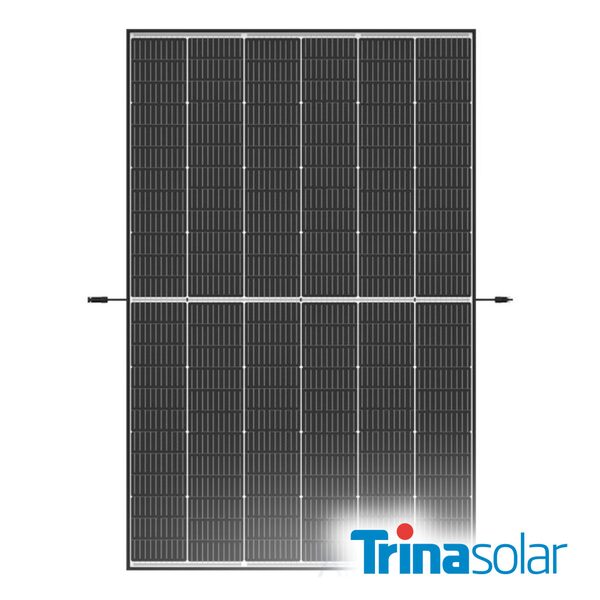
Trina's current module line is the Vertex N G3, built on n-type cells. The company announced a supply agreement in September 2026 to provide Vertex N G3 modules to MaxSolar for five solar projects in Germany4. That is a commercial deal rather than a UK residential listing, but it identifies the generation of product the maker is currently pushing.
The naming is worth decoding, because it is where most confusion arises. The Vertex S+ modules described above are n-type TOPCon products, which is the cell technology behind the efficiency figures of 22.5% and 23.8%2. The "N" in the model names refers to n-type silicon, and the G3 designation marks a product generation. The differences between cell technologies are set out in solar cell technology: PERC, TOPCon, n-type and heterojunction.
What this means in practice is that a quote naming a Trina panel may refer to a current G3 module, a Vertex S+ module still in distributor stock, or an older line being cleared. The model number on the datasheet is the only reliable identifier, and it should be checked against the MCS certified product list before a contract is signed5.
Panel specifications: what the datasheets tell you
A Trina datasheet gives you a small number of figures that decide whether the module suits the roof. The headline is module efficiency: 22.5% for the 450W Vertex S+ and 23.8% for the 475W2. Efficiency is the share of incident sunlight converted to electricity, and it determines how much roof area a given output needs.
That connects directly to UK building rules. Approved Document L's reference sizing basis assumes photovoltaic panels with an efficiency of 0.22kWp per m27. A module at 22.5% or 23.8% sits at or above that reference, which means a roof sized on the standard basis will need no more area than the regulations assume. The relationship between efficiency, area and output is worked through in reading a solar panel datasheet.
The other figures that matter are physical. The 450W module measures 1762 x 1134 x 30mm2. Roof space, rail spacing and the number of panels that fit between obstructions all follow from that, and the layout drawing required before contract award exists precisely to test it6. The connector type, TS4 with MC4 EVO2 compatibility, determines what the installer can mate it to2.
Two further points are easy to miss. First, the standard test conditions behind a wattage rating are not UK roof conditions; the SAP reference array assumes a south-facing roof at a 30 degree pitch with modest overshading, and anything else changes the yield8. Second, the panel is one component in a system whose inverter, cabling and mounting all have their own specifications. The system-level view is in solar panel specifications and efficiency and solar DC cabling and connectors.

Warranty and registration
Trina Solar's warranty position is strong on paper and conditional in practice. The maker's product pages list a 25-year product warranty and a 30-year power warranty for the Vertex S+ modules2. An independent review lists Trina Solar at 25 years product cover and 25 years at 89.4% output1. The two agree on the product term and differ on the power term, so the datasheet for the exact model is the governing document.
The condition attached to the product warranty is the one to read carefully. Trina Solar has stated that while fitting its modules, its own User Manual must be followed, as improper fitting can invalidate the product warranty2. That places the installation method, not just the invoice, at the centre of any future claim. A mounting system that clamps the module outside the permitted zones, or a wiring arrangement outside the manual, is a warranty risk.
Registration is not a single national portal. The grid connection itself must be registered with the distribution network operator, usually done by the installer9. In scheme work, deadlines are tight: one Welsh scheme specification requires inverter product registrations to activate guarantees and warranties to be completed within 48 hours of commissioning10. That is a scheme rule rather than a Trina rule, but it shows how quickly the paperwork window can close.
For context, a 25-year product warranty is at the long end of the market. Independent guidance describes solar panels as usually coming with a 25-year performance warranty and a five to 10-year product warranty11. Trina's 25-year product term is well above that norm. Plug-in solar kits, by contrast, typically carry a 10-year warranty12. The wider picture is in solar panel warranties, degradation and lifespan.
Efficiency and performance in practice
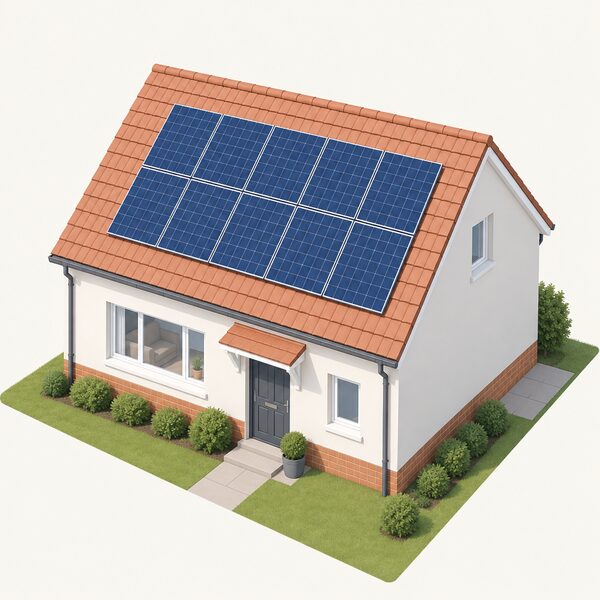
The published efficiency figures are 22.5% for the 450W Vertex S+ and 23.8% for the 475W2. An independent review of the brand cites 450W at 22.5% based on the most efficient panel it had recently tested1. Those are laboratory figures under standard test conditions, and they describe the module, not the roof.
What a household actually gets depends on orientation, pitch and shading. The SAP reference array assumes a south-facing roof at a 30 degree pitch with modest overshading8. A roof that faces east or west, sits at a steeper pitch, or has a chimney shadow across part of the array will produce less than the datasheet implies. The effect of orientation and shading is covered in roof orientation, pitch and shading.
The system around the panel also sets the ceiling. String inverters are the most common and cheapest option because they connect solar panels in series, which means the weakest panel in the string can limit the rest13. On a roof with shading or multiple orientations, module-level electronics change what the array delivers. That is a system design question rather than a Trina question, and it is worked through in string inverters for home solar and power optimisers.
In practice, a household should expect the array to perform close to its modelled yield in an unshaded, well-oriented installation, and to fall short where the roof departs from the reference assumptions. The efficiency figure tells you how much roof area the output needs; it does not tell you how much electricity the roof will make.
Storage: Elementa and Electra for larger sites
Trina Solar's storage business is not aimed at single homes. Trina Storage announced the launch of the Elementa + Electra energy storage solution in September 2026, showcased at Middle East Energy 20264. The same month, Trina Storage was selected to supply the battery energy storage system for Stage One of Frontier Energy's Waroona Renewable Energy Project in Western Australia, and signed a memorandum of understanding with AMP-lify covering approximately 1 GWh of grid-connected battery storage equipment for projects in Japan4.
That is utility and commercial scale. A UK householder looking at a Trina panel quote should not expect a matching domestic battery from the same brand. Home storage is a separate purchase, and the case for it is well established: home storage batteries store your electricity to use later, making your energy system more independent from the National Grid14. A battery lets a household store excess solar electricity or charge when a tariff is cheap, then use the stored energy at night or when prices are high15.
The economics depend on the household. Installing energy storage may save money if there is a renewable electricity generator like solar panels, or a large electricity demand such as a heat pump14. Battery storage works with solar panels, wind turbines and hydro turbines, and can store energy generated by any of them14. In Scotland, Home Energy Scotland provides separate guidance on battery storage17.
For a Trina owner, the practical position is that the panels and the battery are separate decisions from separate suppliers, and the battery is what converts daytime generation into evening independence. The options are set out in adding battery storage to a solar system.
What owning Trina panels means for household energy independence
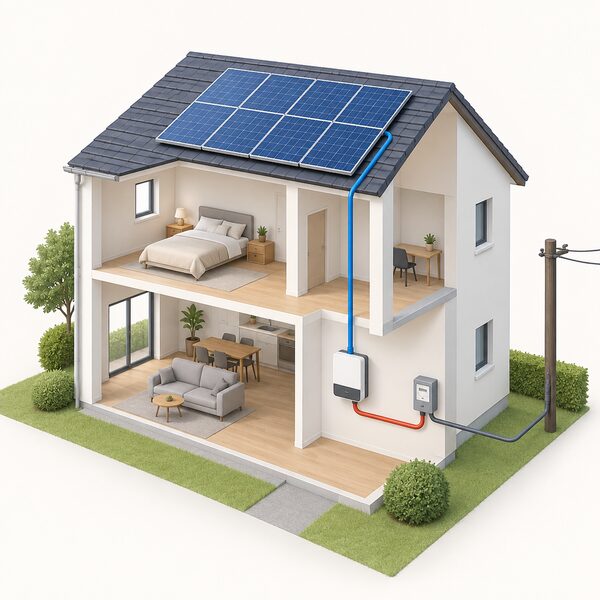
A Trina array does one thing well: it generates electricity on the roof, and once the installation is paid for, the electricity it generates is free to use, though grid electricity and maintenance still cost money18. That is the core of the independence case, and it is real.
The limits are equally real. Rates for selling electricity to the grid are much lower than tariffs for using electricity from the grid, so using solar electricity yourself is much more cost-effective than exporting it9. That means the value of the array depends on how much of its output the household consumes on site, which in turn depends on whether anyone is home during the day, whether there is a battery, and whether a diverter sends surplus to hot water.
The grid connection remains. A grid-tied system needs the network for export, for import when generation is short, and for the inverter to synchronise. The panels reduce reliance on the grid and can improve an Energy Performance Certificate, but they do not remove the connection19. Independent guidance puts the potential saving at as much as a third on electricity bills20.
There is also a paperwork dimension to independence. If a house with panels is bought or sold, the ownership question matters: a buyer should check whether they own the panels or whether they belong to a private company11. Panels installed under a free-ownership model are an asset; panels owned by a third party under a lease or rent-a-roof arrangement are not.
Finally, the planning position is broadly permissive across the UK. In Scotland, the installation, alteration or replacement of solar PV or solar thermal equipment on a dwelling falls within permitted development21. More homegrown energy means greater energy independence, which is the industry's framing of the same point22. The full picture is in solar panels and household energy independence.
Sources22 cited
- Trina Solar solar panels review, Which?, 12 August 2026
- Trina Solar 450W Vertex S+ N-type TOPCon module, Alternergy, 19 September 2026
- Trina Solar 475W Vertex S+ N-type TOPCon module, Alternergy, 19 September 2026
- Trina Solar product and project pages, Trina Solar, September 2026
- MCS for consumers, MCS Certified, 23 June 2026
- MCS 032 solar PV installation standard, MCS Certified, 2025
- Approved Document L: energy and greenhouse gas emissions FAQ, GOV.UK, 8 September 2026
- SAP 10 reference array assumptions, BRE Group, 12 February 2024
- Solar panels, London Borough of Hammersmith and Fulham, 17 September 2026
- Barcud Solar Panel Installation Scheme specification, Sell2Wales, 15 June 2026
- Buying a house with solar panels, Energy Saving Trust, 1 May 2026
- Plug-in solar panels vs rooftop systems, Which?, 27 April 2026
- Solar panels safety advice, Electrical Safety First, 17 September 2026
- Storing energy, Energy Saving Trust, 15 July 2026
- Solar panel battery storage, Which?, 14 May 2026
- Wind turbines, Energy Saving Trust, 20 May 2026
- Battery storage, Home Energy Scotland, 20 September 2026
- Solar power, Electricity North West, 19 September 2026
- How do solar panels work, Smart Energy GB, 16 March 2026
- Free energy saving tips, Uswitch, 14 October 2025
- Householder permitted development rights circular, Scottish Government, 28 May 2024
- Solar Energy Scotland manifesto, Solar Energy UK, 17 September 2026
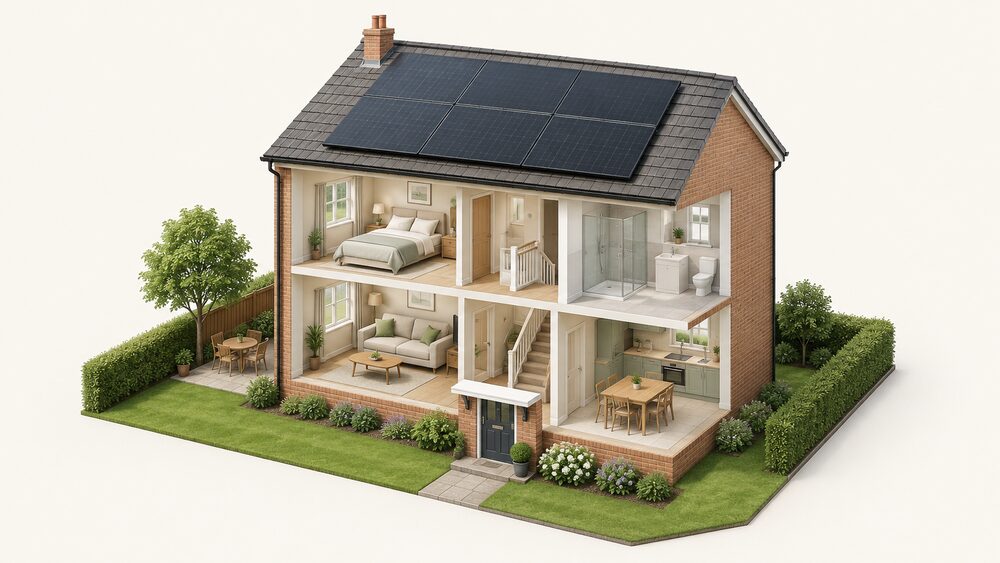 Trina Solar panels and home storageTrina Solar panels are a popular choice for UK homes, but are they any good, and how do they compare on price and performance?
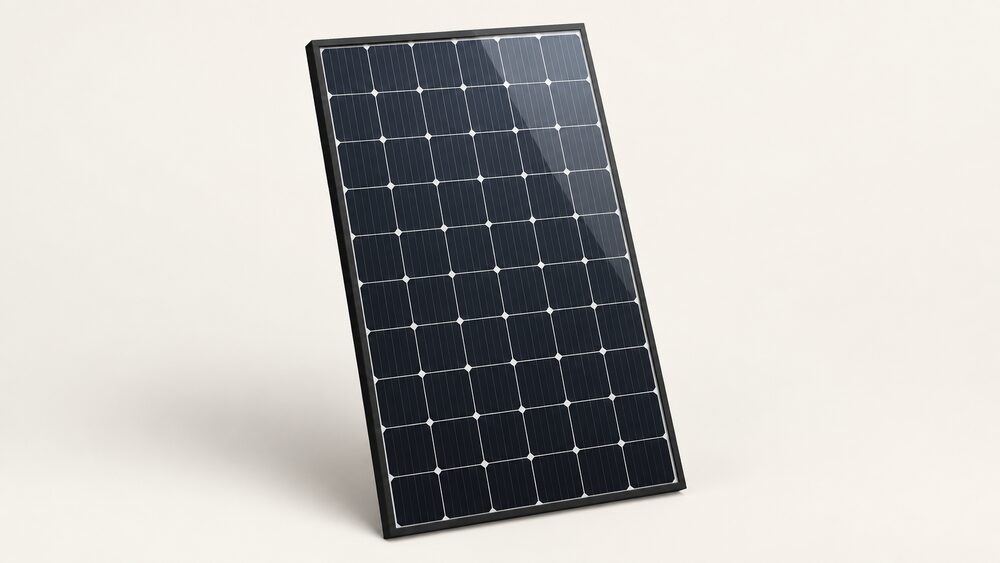 Trina Vertex S+ panelsThinking about a Trina Vertex S+ panel for your roof?