In this guide
Solar panels on a house or flat in Scotland are usually granted planning permission automatically by the Town and Country Planning (General Permitted Development) (Scotland) Order 1992, known as the GPDO. The Scottish Government's planning circular on householder permitted development rights explains the mechanism: Schedule 1 of the GPDO sets out those developments which are granted planning permission, and the schedule is organised into a series of separate classes, each specifying the development for which permission is granted1. Solar PV and solar thermal equipment on a dwelling sits in one of those classes.
The rights are not unconditional. Most classes of permitted development right are subject to conditions and limitations, which may specify the maximum size or scale of what is permitted and restrict or disapply the rights in certain locations, conservation areas and National Scenic Areas among them1. Where a condition is not met in full, the development cannot benefit from that permitted development right at all, and a planning application becomes necessary.
Two things are commonly confused. Planning permission is one consent; a building warrant is a different one, administered under the building standards system rather than the planning system. A third, listed building consent, applies to any works to a listed building, including works that have planning permission by virtue of the GPDO2. This page sets out what the Scottish rules say, what drives the exceptions, and what the position means for a household's energy independence.
The short answer
For the great majority of Scottish houses and flats, solar panels go ahead without a planning application. The installation, alteration or replacement of solar PV or solar thermal equipment on a dwelling is one of the classes of development granted permission by the GPDO, and the Scottish Government's householder circular describes the GPDO as providing fairly extensive permitted development rights for domestic and non-domestic renewables technologies, such as solar panels, wind turbines and heat pumps2.
The rights are lost in three broad situations. The first is where a condition or limitation attached to the class is not met: the circular is explicit that all of the limitations and conditions that apply to that class must be met in full, otherwise the development cannot benefit from that permitted development right1. The second is where the rights have been removed in a particular location, either by the terms of the class itself or by an Article 4 direction. Article 4 of the GPDO contains provisions which allow planning authorities or the Scottish Ministers to make directions restricting permitted development rights for particular types of development or classes of development in specified locations, and planning authority directions are subject to approval by the Scottish Ministers2.
The third is where a separate consent is engaged regardless of planning permission. Listed building consent is required for any works to a listed building, including works that have planning permission by virtue of the GPDO2. That is a distinct regime with its own application and its own tests, and permitted development rights do not displace it.
Where the rights do not apply, the route is a householder planning application to the local planning authority. The circular also notes that permitted development rights do not apply in relation to a development or use of land or buildings which is itself unlawful, which matters for anyone looking at an installation already in place1.
The figures: no domestic output limit, 45kW non-domestic
The figures that matter for Scottish solar planning fall into three groups: the limits written into the permitted development classes, the fees that apply where an application is needed, and the scale of solar already installed.
On limits, the domestic and non-domestic sectors diverge sharply. For solar panels on domestic properties the installation is not limited by the potential output of the panels3. For non-domestic buildings, permitted development rights exist for non-domestic solar panels up to 45kW electricity or 50kW thermal, and that threshold is the total for all solar panels installed on the building rather than a per-panel figure4.
On fees, the schedule to the regulations sets non-domestic solar applications at £202 for each 0.1 hectare of the site area, subject to a maximum of £2,0164. The Scottish Government's impact assessment put the fee income planning authorities would lose if those applications fell away at around £168,000 per year, and worked the figure from the 831 registered non-domestic installations then on the Feed-in Tariff register4.
| Figure | Value | Applies to |
|---|---|---|
| Domestic output limit | None stated | Solar panels on domestic properties in Scotland3 |
| Non-domestic output limit | 45kW electricity or 50kW thermal | Non-domestic solar panels in Scotland4 |
| Non-domestic application fee | £202 per 0.1 hectare, maximum £2,016 | Non-domestic solar planning applications4 |
| Estimated lost fee income | Around £168,000 per year | Scottish planning authorities, solar panels4 |
| Dwellings with solar | An estimated 7% | All dwellings in Scotland, 20235 |
| Solar share of installed capacity | 37.87% | Scotland, as of 29 June 20266 |
On installed scale, the Scottish House Condition Survey 2023 key findings report that an estimated 7% of all dwellings in Scotland had either solar panels, solar PV, or both installed5. Ofgem's Feed-in Tariff quarterly report, issue 64, records that in Scotland solar PV makes up only 37.87% of total installed capacity, a figure dated 29 June 20266. The word "only" is Ofgem's, and it reflects the fact that Scotland's renewable capacity is dominated by wind rather than solar.
The older Feed-in Tariff data shows how the domestic base built up. The Scottish Government's microgeneration strategy recorded almost 15,000 installations in Scotland at the time of writing, with solar PV the predominant technology7. The same strategy set out a breakdown of 16,261 photovoltaic installations registered under the scheme, of which 15,995 were domestic8.
What drives the conditions
The conditions attached to the permitted development class are what decide whether a household needs an application, and they are worth reading as a list of things that can go wrong rather than as a formality.
The first driver is siting. Guidance issued by councils elsewhere in the UK describes the standard condition as requiring the equipment to be sited, so far as is practicable, to minimise its effect on the external appearance of the building, and the amenity of the area9. That is a judgement about the specific building and its surroundings, not a fixed measurement, and it is the condition most likely to be argued about where an array is prominent.
The second is the number and type of mounting. Guidance from Wirral Council states that planning permission is required where more than one stand-alone solar panel would be installed10. Stand-alone equipment, as distinct from panels mounted on the roof of the building, is treated more restrictively.
The third is the interaction with protected areas. The Scottish Government's circular on householder permitted development rights notes that conditions and limitations may restrict or disapply the rights in certain locations, giving conservation areas and National Scenic Areas as examples1. Where a class is disapplied in a conservation area, the householder needs an application even though the same array on the same house elsewhere would not.
The fourth is the environmental assessment overlay. The Scottish Government's phase 3 review of permitted development rights states that permitted development rights would not apply where an environmental impact assessment would be required under The Town and Country Planning (Environmental Impact Assessment) (Scotland) Regulations 2017, and that an additional approval from the planning authority and appropriate assessment would be required for works likely to have significant effects on a European Site under The Conservation (Natural Habitats &c.) Regulations 19942. For a domestic rooftop array these are unlikely to bite, but they are part of the framework.
The fifth is the general condition on access. Permitted development rights are removed if the proposed development is to create or materially widen a means of access to a trunk road or classified road, or creates an obstruction that is likely to cause a hazard for people using the road1.
How the four UK nations differ

Scotland, England, Wales and Northern Ireland each run their own permitted development regime, and the differences are real rather than cosmetic.
In England, the equivalent rights sit in the Town and Country Planning (General Permitted Development) (England) Order 2015, Schedule 2, Part 14, Class J, and guidance from Wirral Council describes placing solar panels on the roof of a house or flat, or on a building within the grounds of a house or flat, as considered in most cases permitted development under that class10. England's rules were amended by the Town and Country Planning (General Permitted Development) (England) (Amendment) Order 2026, which was laid before Parliament on 30 July 2026 and comes into force on 27 August 202611. A transitional period runs to 26 August 2027, during which development permitted under the pre-amendment rules may be completed11.
Scotland's framework is older and has been amended in stages. The GPDO was made on 11 February 1992, laid before Parliament on 21 February 1992 and came into force on 13 March 199212. Domestic microgeneration was added by the Town and Country Planning (General Permitted Development) (Domestic Microgeneration) (Scotland) Amendment Order 2009, laid before the Scottish Parliament on 6 February 2009 and in force from 12 March 200913. The most recent change is the Town and Country Planning (General Permitted Development) (Scotland) Amendment Order 2024, laid before the Scottish Parliament on 28 March 2024 and intended to come into force on 24 May 2024, which supports the roll-out of electricity network infrastructure14. Scottish Ministers have also said they want parity in permitted development rights between Scotland and England for air source heat pumps and solar panels7.
The Scottish Government has consulted repeatedly on closing the gap with England. Its 2015 consultation on non-domestic solar panels and domestic air source heat pumps set out the objective of providing enhanced permitted development rights for non-domestic solar panels and domestic air source heat pumps, and noted that similar rights did not then apply to the non-domestic sector3. The phase 3 review in 2023 restated that the GPDO already provides fairly extensive permitted development rights for domestic and non-domestic renewables technologies, such as solar panels, wind turbines and heat pumps, as well as a wide range of development carried out by electricity undertakers2.
For a householder, the practical consequence is that a Scottish installation is judged against Scottish classes and Scottish conditions. Guidance written for England, including the conservation area and flat roof rules, describes a different legal instrument and should not be read across.
The rules at three levels
The rules operate at three levels: the class that grants permission, the conditions attached to it, and the local restrictions that can remove it.
At the level of the class, the GPDO grants permission for the installation, alteration or replacement of solar PV or solar thermal equipment on a dwelling1. The Scottish Government's 2015 consultation confirms that for solar panels on domestic properties the installation is not limited by the potential output of the panels, so a large domestic array does not lose the right by virtue of its size alone3.
At the level of conditions, the circular is clear that compliance is all or nothing. All of the limitations and conditions that apply to that class must be met in full, otherwise the development cannot benefit from that permitted development right1. A limited number of classes carry a notification condition requiring the developer to notify the planning authority and provide certain details before development is carried out, though the circular gives replacing or altering windows as its example rather than solar1.
At the level of local restriction, Article 4 directions allow planning authorities or the Scottish Ministers to restrict permitted development rights for particular types or classes of development in specified locations, with planning authority directions subject to approval by the Scottish Ministers2. Councils elsewhere in the UK publish examples of Article 4 directions covering solar, including the Swindon Railway Village Area and the Bishopstone Conservation Area, where planning permission is required to install solar panels15. Those are English designations, but they illustrate the mechanism that Scottish planning authorities can use.
Two further overlays apply. Permitted development rights do not apply in relation to a development or use of land or buildings which is itself unlawful1. And listed building consent is required for any works to a listed building, including works that have planning permission by virtue of the GPDO2.
Where the permitted development rights do not reach
Some installations fall outside the classes entirely, and it is worth being precise about which.
Flat roofs are the clearest case in the guidance published by councils elsewhere in the UK. Frome Town Council states that planning permission is required for panels on flat roofs in conservation areas17. The same source states that planning permission is required if panels are fitted to a wall facing a public road, defined in planning terms as a highway, which includes adopted roads but not footpaths17. York Council states that planning permission is required when installing solar panels or other equipment on a wall fronting a highway within a conservation area16.
Conservation areas are the recurring theme. Richmond Council notes that in many cases, even in conservation areas, homes can have solar panels without requiring planning permission from the Council under permitted development18. That is a statement about the general position rather than a guarantee for a specific address, and it sits alongside the Scottish circular's warning that conditions and limitations may disapply the rights in conservation areas and National Scenic Areas1.
Where an application is needed, the process is the standard householder route. Bristol Council's guidance sets out the test in the same terms as the Scottish condition: the equipment must be sited, so far as is practicable, to minimise its effect on the external appearance of the building, and the amenity of the area, and if any of the listed points apply then an application for planning permission is needed9.
For non-domestic buildings the position is different again. The Scottish Government's 2015 consultation records that permitted development rights exist for non-domestic solar panels up to 45kW electricity or 50kW thermal, and that the threshold is the total for all solar panels installed on the building4. The same consultation set out options that would have removed the step of design and external appearance consideration by the planning authority and removed the restriction on application within 3 kilometres of an aerodrome or technical site, but those were proposals rather than the rules in force3.
What it means for energy independence
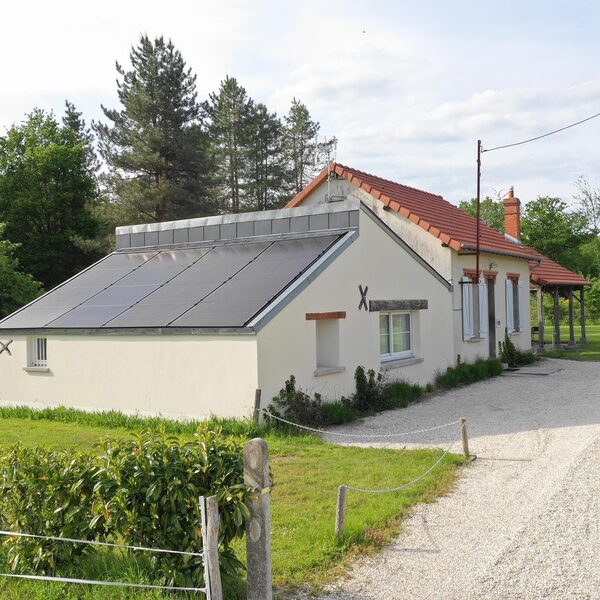
Planning permission is the gate a household passes through once, and the terms on which it passes shape what the installation can do afterwards.
The Scottish position is generous on the point that matters most for self-consumption: there is no output limit on domestic solar under the permitted development class, so the size of the array is set by the roof, the budget and the connection rather than by the planning system3. That is a meaningful difference from the non-domestic sector, where the 45kW electricity and 50kW thermal thresholds cap what can be installed without an application4.
What the planning rules do not change is the underlying dependence. A grid-connected array still relies on the distribution network to export surplus and to supply the house when the panels are not generating, and the connection itself is governed by separate engineering standards rather than by planning permission. The Scottish Government's 2024 amendment order, in force from 24 May 2024, was made to support the roll-out of electricity network infrastructure, which is a reminder that the grid side of the system is being actively reshaped14.
The scale of Scottish domestic solar is modest. An estimated 7% of all dwellings had solar panels, solar PV, or both installed as of 20235, and Ofgem records solar PV at 37.87% of total installed capacity in Scotland as of 29 June 20266. The Scottish Government's own figures on the Home Energy Scotland Grant and Loan Scheme show 3,368 solar PV measures installed in the 2023-24 financial year and 1,319 in 2024-25, so the domestic base is growing from a low starting point19.
For a household, the practical reading is this: the planning system in Scotland is unlikely to be the constraint on a domestic array, and the constraints that remain are the roof, the connection, the building standards position and the cost. Where the rights have been removed locally, or where the building is listed, the planning system becomes the first step rather than an afterthought, and the timescale for the installation is set by the application rather than by the installer.
Sources20 cited
- Circular 1/2024: Householder Permitted Development Rights, Scottish Government, 2024-05-28
- Scottish Government review of permitted development rights: phase 3 consultation, Scottish Government, 2023-05-31
- Permitted development rights for non-domestic solar panels and domestic air source heat pumps: page 1, Scottish Government, 2015-06-22
- Permitted development rights for non-domestic solar panels and domestic air source heat pumps: page 4, Scottish Government, 2026-09-17
- Scottish House Condition Survey 2023: key findings, Scottish Government, 2023
- Feed-in Tariffs Quarterly Report, Issue 64, Ofgem, 2026-06-29
- Microgeneration Strategy for Scotland: page 3, Scottish Government, 2012-06-22
- Microgeneration Strategy for Scotland: page 4, Scottish Government, 2012-06-15
- Planning permission for solar panels, Bristol City Council
- Solar panels, Wirral Council, 2026-09-17
- The Town and Country Planning (General Permitted Development) (England) (Amendment) Order 2026, legislation.gov.uk, 2026-07-30
- The Town and Country Planning (General Permitted Development) (Scotland) Order 1992, legislation.gov.uk, 1992-02-11
- The Town and Country Planning (General Permitted Development) (Domestic Microgeneration) (Scotland) Amendment Order 2009, legislation.gov.uk, 2009-03-12
- The Town and Country Planning (General Permitted Development) (Scotland) Amendment Order 2024, legislation.gov.uk, 2024-05-24
- Solar Together, Swindon Borough Council, 2026-09-17
- Solar panels guidance, City of York Council, 2026-09-17
- Planning and solar, Frome Town Council, 2025-09-02
- Solar panels and permitted development, London Borough of Richmond upon Thames, 2026-07-06
- Heat in Buildings progress report 2025, Scottish Government, 2024-25
- Heat in Buildings progress report 2024, Scottish Government, 2023-24
 Home Energy Planning ScotlandDo you need planning permission for solar panels or a heat pump in Scotland?
 Planning Permission EnglandMost homes in England can have solar panels fitted without planning permission, but does yours count as one of the exceptions?
 Using an Installer in ScotlandYou live in Scotland and want solar panels or a heat pump fitted.
 Planning Permission in ScotlandDo you need planning permission for a home battery in Scotland?
 Permitted Development by HomeCan you put up solar panels or a heat pump without asking the council?
 Planning Permission WalesDo you need planning permission for solar panels on your house in Wales?