In this guide
A solar panel datasheet is a claim; a test certificate is the evidence behind it. The two standards that matter most for a UK module are IEC 61215, which covers design qualification for performance and durability, and IEC 61730, which covers safety qualification against electrical shock and fire1. A module that holds both has been type-approved to a defined sequence of tests, on a defined number of samples, by a laboratory working to a published procedure.
The headline numbers are worth knowing before reading any certificate. IEC 61215 includes a hail test in which a 25 mm ice ball is fired at 23 m/s at 11 specified locations in the module glass, and the power loss afterwards cannot be more than 5% from the original measurement2. The base sequence also includes thermal cycling, humidity-freeze cycles and mechanical load tests1. IEC 61730 sits alongside it and verifies the module's safety design against electrical shock, fire hazards and other potential dangers1.
What a certificate does not do is guarantee field behaviour. IEC 61215 is a type approval test, not a warranty, and it does not capture every failure mode a module can meet in service. The sections below set out what each standard covers, how the tests work, where the limits lie, and how to check a certificate before buying.
What IEC 61215 covers: performance and durability
IEC 61215 is the design qualification and type approval standard for terrestrial photovoltaic modules. Its scope is performance and durability, and it is the standard a maker points to when it wants to show that a module will survive open-air service rather than merely work on a test bench1. BISOL states that its PV modules comply with IEC 61215 and IEC 61730, describing the pair as ensuring electrical safety, long-term performance, and durability in harsh conditions7. AIKO makes the same claim in different words, stating that the IEC 61215 certification ensures its modules meet stringent performance and durability standards, essential for reliable operation in general open air climates8.
The standard is published in parts. IEC 61215-2 is the part that sets out the test procedures, and it is the document a laboratory works to when it runs the sequence9. That distinction matters when reading a certificate: a module may be certified to IEC 61215 as a whole, while a specific test within it, such as PID, is cited against a part number or a separate technical specification.
The durability claim is bounded by the test sequence, not by the climate the module will actually meet. A module certified to IEC 61215 has passed a defined set of accelerated tests; it has not been tested for twenty-five years on a UK roof. The certificate is evidence that the design survived the sequence, and the sequence is designed to represent the stresses a module meets in general open air climates8.
For a household, the practical meaning is that IEC 61215 is the baseline evidence that a module is a serious product rather than an unbranded import. It sits underneath the warranty, not in place of it, and it is one of the documents an MCS installer will expect to see. The MCS certification route and the warranty and degradation terms are separate claims that a buyer checks alongside it.
What IEC 61730 covers: safety, shock and fire
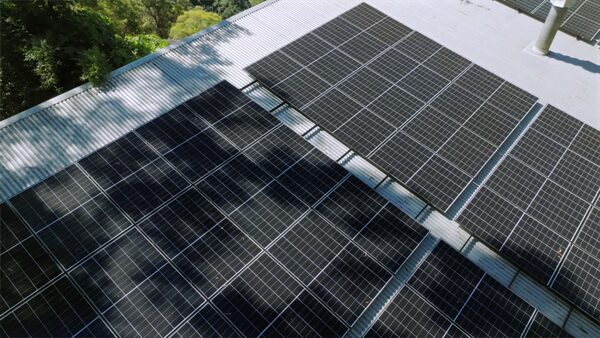
IEC 61730 is the safety qualification standard. Its scope is safety, and it verifies the module's safety design against electrical shock, fire hazards and other potential dangers1. Where IEC 61215 asks whether a module will keep working, IEC 61730 asks whether it is safe to have on a roof and safe to work on.
The fire element is the one most visible to a householder, because it feeds into how a module behaves in a roof fire. Government fire research classifies glass-backed panels as class A to IEC 61730-2 and plastic-backed panels as class C to the same standard, and found that fire spread was much less significant on the glass-backed panels4. That is a classification under the safety standard, not a statement that one product is better than another, and it is the kind of figure a specifier looks for when the roof construction or the building type makes fire performance relevant.
Safety qualification also draws on the wider electrical safety family. BS EN IEC 60335-1 covers the classification and marking of electrical equipment, protection against live parts, heating, leakage currents, electric strength at operating temperatures, moisture resistance, resistance to heat and fire, stability and mechanical hazards, internal wiring and supply connections10. IEC 61140 sets out protection against electric shock as common aspects for installation and equipment11. These are not module standards, but they are the framework the module safety standard sits inside, and they are why a certificate references more than one document.
For a household, IEC 61730 is the certificate that matters when an insurer, a building control officer or a fire risk assessment asks what is on the roof. It is also the standard that a fire and electrical safety review will look for. The classification is a property of the module construction, so it is fixed at the point of purchase and cannot be improved by the installation.
How the two standards work together, and where UL 61730 fits
The two standards are designed as a pair. IEC 61215 establishes that the design is durable enough to be a product; IEC 61730 establishes that it is safe enough to install. A datasheet that lists only one of them is telling the reader that half the qualification is missing, and a certificate that names both is the normal state of affairs for a module sold into the UK market7.
UL 61730 is the North American counterpart, and it is harmonised with the IEC standard1. Harmonisation means the two documents share a technical basis, so a module tested to one is not starting from scratch for the other, but they remain separate certificates issued for separate markets. A maker's datasheet may therefore list IEC 61215 and IEC 61730 for Europe and UL 1703 or UL 61730 for the United States, as the Canadian Solar KuPower datasheet does when it lists IEC 61215 and IEC 61730 alongside VDE, CE, CQC, MCS and INMETRO, and separately notes UL 1703 and IEC 61215 performance with CEC listing for the US13.
For a UK buyer, the IEC route is the one that appears on the certificate that matters. UL 61730 is not a substitute for IEC 61730 in a UK installation, and a datasheet that lists only the UL document is describing a product qualified for a different market. The practical check is to read the certificate, not the marketing line, and to confirm that the standard named is the IEC one and that the model on the certificate matches the model being sold.
"The key standard for solar modules is UL 61730"
The tests behind the certificate: thermal cycling, humidity-freeze and mechanical load
The certificate is the output; the tests are the substance. IEC 61215 includes thermal cycling, which simulates extreme day-to-night temperature swings, humidity-freeze cycles, and mechanical load tests1. Each of these represents a stress a module meets in service, compressed into a laboratory sequence so that a design can be judged in weeks rather than decades.
Thermal cycling is the test that speaks to the daily expansion and contraction of a module as it warms in sun and cools at night. Over years, that cycling works on solder joints, cell interconnects and the laminate, and the test is designed to differentiate designs that tolerate it from those that do not. The IEC family also includes a dedicated thermal cycling test for concentrator modules, IEC 62925, which exists to differentiate increased thermal fatigue durability in that specific product class9.
Humidity-freeze cycles add moisture to the temperature stress, which is the combination that drives corrosion and delamination in a laminate. Mechanical load tests apply pressure to the module face, representing wind and snow load on an installed array. Together these three form the core of the durability claim, and they are the tests a maker is referring to when it says a module is built for harsh conditions7.
The sequence is run on samples, and the certificate records the result for the module type. It does not record the margin by which the design passed, and it does not test every unit that leaves the factory. A household reading a certificate is reading a statement about a design, verified on a sample, and the production consistency behind it is a separate matter of factory quality control.
The hail test: 25 mm ice at 23 m/s, 11 impact points
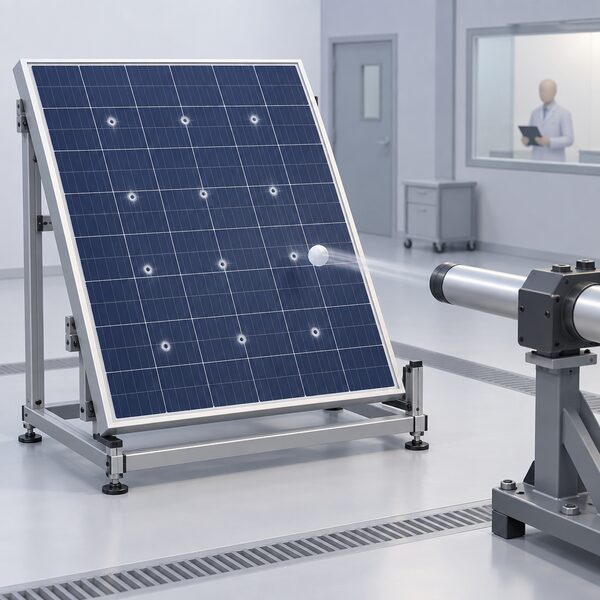
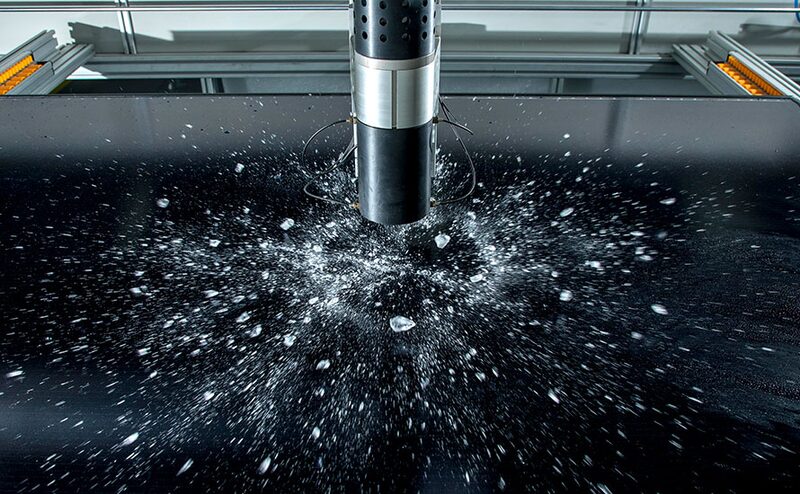
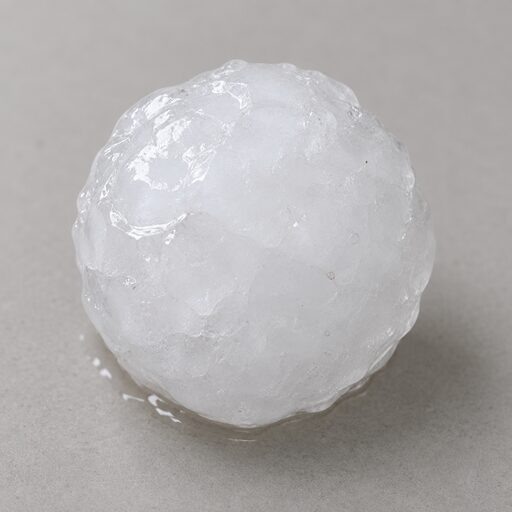
The hail test is the most quotable part of IEC 61215, and the numbers are consistent across the sources that describe it. All IEC 61215-certified photovoltaic modules must undergo hail impact tests, and the common certification level is a 25 mm diameter ice sphere launched at 23 m/s14. The impacts are placed at 11 specified locations in the module glass2. After the sequence, the power loss cannot be more than 5% from the original measurement2.
| Element of the hail test | Value | Source |
|---|---|---|
| Ice ball diameter | 25 mm | 2 |
| Impact velocity | 23 m/s | 2 |
| Impact locations | 11 specified locations in the module glass | 2 |
| Maximum permitted power loss | 5% from original measurement | 2 |
The test is a pass or fail on the module type, and the 5% figure is the tolerance allowed after the impacts. A module that loses more than that has failed the sequence, even if it still produces power. The 11 locations are specified rather than chosen by the laboratory, so the test is repeatable across sites and across certificates.
Some makers offer modules tested beyond the base requirement. FuturaSun describes its Silk Rhino range as offering hail protection, in a market where the base standard already requires the 25 mm ball at 23 m/s14. That is a maker's claim about its own product, and it sits on top of the standard rather than replacing it. The base requirement is what every IEC 61215-certified module has met, and it is the figure to compare against when a datasheet quotes a higher impact speed or a larger ice ball.
For a UK household, the hail test is less about British weather than about what the test represents: resistance to a hard, localised impact on the glass. A roof in a hail-prone region, or one where the array is exposed to falling debris, is the case where the figure earns its place on the datasheet. The certificate records that the module type passed; it does not record how close to the limit it came.
What IEC 61215 does not catch: hot spots, LeTID and the limits of testing
A module can hold IEC 61215 and still develop problems in the field. The standard is a type approval test on a small number of samples, and it does not model every failure mode a module can meet in service. Hot spots, where a shaded or mismatched cell dissipates power as heat, and light and elevated temperature induced degradation, known as LeTID, are the two most cited examples of behaviour that the base sequence does not fully capture.
The response from the industry has been to certify to a stronger version of the claim. SOLARWATT lists IEC 61215 including LeTID on its Panel vision XL, alongside IEC 61730, PID to IEC TS 62804, IEC 61701 and IEC 627165. That is a maker's statement about its own product, and it is a more specific claim than the base standard alone. A datasheet that says IEC 61215 including LeTID is telling the reader that the module was tested against that degradation mode as well as the base sequence.
The limits of testing are not confined to modules. The wider certification landscape has the same shape: a certificate covers the thing it names and not the thing next to it. The Heat and Energy Efficiency Technical Suitability Assessment in Scotland, for example, focuses only on the assessment process itself, the methodologies used and the skills and qualifications of the practitioners, and does not cover subsequent installation of measures15. An Ofgem-approved innovation measure carries the limitation that the system is not certified for use in high rise buildings16. BS 7671:2018 Section 753 excludes heating systems for industrial and commercial applications complying with IEC 60519 and IEC 6239510. In each case the certificate is precise about its scope, and the reader has to supply the rest.
For a household, the practical reading is that a certificate is a floor, not a ceiling. It establishes that a module met a defined sequence; it does not establish that the module will not degrade in a particular way on a particular roof. The PID power loss question is the clearest example, because PID is covered by a separate technical specification rather than by the base design qualification.
Which certifications to look for on a panel datasheet

A datasheet line is a summary; the certificate is the document. The certifications worth looking for on a UK module are IEC 61215 for design qualification and IEC 61730 for safety, with the environmental and degradation tests listed separately where the maker has run them1. The SOLARWATT Panel vision XL datasheet is a useful model of how a full list reads: IEC 61215 including LeTID, IEC 61730, PID to IEC TS 62804, IEC 61701 and IEC 627165.
| Certification | What it covers | Example on a datasheet |
|---|---|---|
| IEC 61215 | Design qualification: performance and durability | SOLARWATT Panel vision XL5 |
| IEC 61730 | Safety qualification: shock and fire | SOLARWATT Panel vision XL5 |
| IEC TS 62804 | PID testing | SOLARWATT Panel vision XL5 |
| IEC 61215-2:2021 | PID test procedure | Panel vision GM and H variants6 |
| IEC TS 62804-1:2015, method b) | PID test method | Panel vision GS and Vision glass variants6 |
| IEC 61701 | Salt mist corrosion | SOLARWATT Panel vision XL5 |
| IEC 62716 | Ammonia corrosion | SOLARWATT Panel vision XL5 |
The environmental tests are the ones a household is least likely to need and most likely to see on a premium datasheet. IEC 61701 covers salt mist corrosion, which matters for coastal installations, and IEC 62716 covers ammonia corrosion, which matters near agricultural buildings. Neither is part of the base design qualification, and a module without them is not defective; it is simply not certified for those specific exposures.
The PID tests are the ones with the most variation in how they are cited. SOLARWATT lists PID to IEC TS 62804 on one product and PID qualified in accordance with IEC 61215-2:2021 on others, with a further variant qualified to IEC TS 62804-1:2015, method b)5. The different citations reflect different test methods and different revisions, and a buyer comparing two datasheets is comparing two claims that are not identical even when both say PID.
Standards and UK panel availability: what certified models are on the market
Certification is only useful if the certified model is the one actually on sale. The UK market carries modules from a range of makers, and the certificate is the link between the datasheet claim and the product in the box. Canadian Solar publishes a customer note explaining where to find the module's UL or IEC certification, which is the practical answer to the question of how a buyer checks a claim3. The same maker's KuPower datasheet lists IEC 61215 and IEC 61730 alongside VDE, CE, CQC, MCS and INMETRO13.
The plug-in solar route has its own standards check. The specific model must be on the list of devices that meet UK standards, checkable on the ENA Connect Direct LCT device register18. The interim product specification for plug-in solar requires that all connectors fulfil the requirements of BS EN 62852 for DC-side connectors17. Energy Saving Trust notes that compliant panels are safe and compatible with UK wiring19. Freestanding and portable panels are available to buy in the UK already, but they are only legal for off-grid use20.
Installation standards sit underneath the product standards. BS 7671, the British Standard for electrical installations, sets out requirements that solar panel installations must meet to be considered safe and compliant21. That is the standard an installer works to, and it is separate from the module certificate. A module can hold IEC 61215 and IEC 61730 and still be installed in a way that does not meet BS 7671, which is why the two checks are made separately.
Independent testing programmes add a further layer. Which? uses tests based on the international standards for photovoltaic modules, EN50380:2003 and IEC61215:2005, in its solar panel testing programme22. That is an independent body working to the same standard family, and it is a reminder that the standard is a common reference point rather than a single certificate.
Checking a certificate before buying
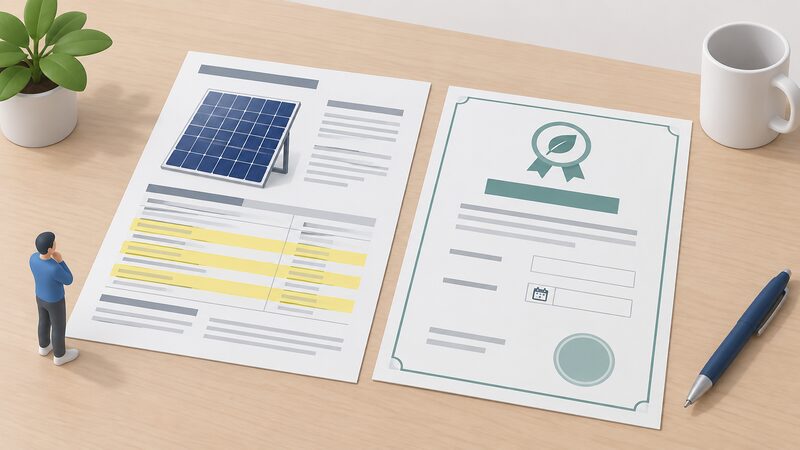
The check is straightforward and it is worth doing before any deposit is paid. Verify the datasheet, request the certificates, and match the certifications to the region the module is being installed in1. The certificate should name the exact module type, the standard and its revision, the testing body and an expiry date. If the model on the certificate is not the model on the quotation, the certificate does not apply.
For plug-in solar, the check is different in form but the same in principle: the specific model must be on the list of devices that meet UK standards on the ENA Connect Direct LCT device register18. That register is the reference point for whether a particular unit can be connected, and it is separate from the module certificate.
Accreditation is the last piece. Independent inspection bodies work to ISO/IEC 17020:2012, the conformity assessment standard for the operation of various types of bodies performing inspection23. A certificate issued by a body working to that standard carries more weight than one issued without it, and the accreditation is a matter of public record.
Sources23 cited
- Your guide to solar panel certifications: understanding IEC, UL and TUV, Astronergy, 2026-09-17
- Do I need to clean my modules?, Canadian Solar, 2026-09-17
- Where can I find the module's UL or IEC certification?, Canadian Solar, 2026-09-17
- Fire spread over pitched roofs fitted with solar panels: summary, GOV.UK, 2025-12-22
- SOLARWATT Panel vision XL datasheet, SOLARWATT, 2026-02-05
- SOLARWATT Panel vision datasheet, SOLARWATT, 2023-05-31
- Certified, qualified, ready, BISOL, 2025-07-24
- AIKO achieves prestigious IEC certifications, AIKO, 2024-07-31
- IEC 61215-2 Ed. 1.0: Test procedures, IEC, 2017-07-17
- The impact of the 18th Edition, Sections 722, 753 and new 730, IET, 2026-09-17
- IEC 61140:2016 RLV: Protection against electric shock, IEC, 2016-01-07
- BS EN IEC 60335-1:2023+A11:2023, BSI, 2024-01-31
- Canadian Solar KuPower CS3K-P datasheet, Canadian Solar, 2020-05
- Silk Rhino: unmatched hail protection for reliable, long-lasting solar power, FuturaSun, 2024-11-18
- HEETSA scoping consultation, Scottish Government, 2025-06-06
- ECO4 Innovation Approved Innovation Measures v1.6, Ofgem, 2024-01
- Plug-in solar interim product specification (withdrawn), GOV.UK, 2026-06
- Plug-in solar, Electricity North West, 2026-09-20
- Plug-in solar panels now available, Energy Saving Trust, 2026-08-27
- Plug-in solar panels vs rooftop systems, Which?, 2026-04-27
- Solar panel installation, maintenance and repair, NICEIC, 2026-09-17
- How we test solar panels, Which?, 2026-08-12
- Accreditation and net zero policies, UKAS, 2023-07-11
 How Energy Products Are TestedWhy does a solar panel's datasheet power rating look better than what you actually get on a UK roof?
 Warranties and DegradationHow long do solar panels actually last, and what do the warranties really cover?
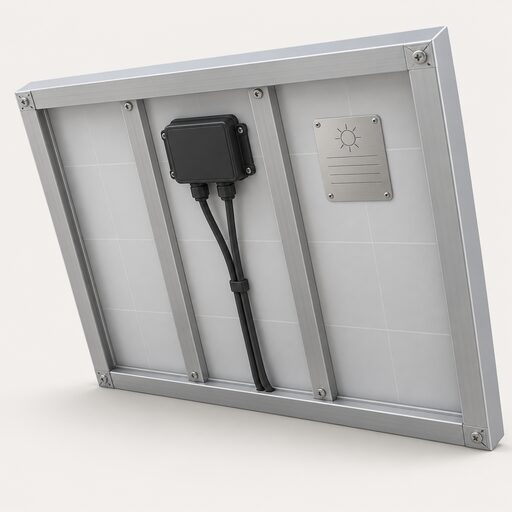 Panel SpecificationsA panel's quoted wattage comes from lab conditions, not a cloudy British roof, so what will it really produce at home?
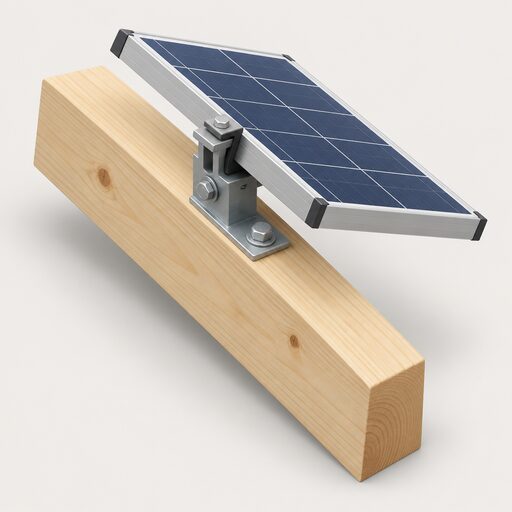 Building RegulationsExplains the building control position for a solar installation across the four nations, the structural assessment of the roof, and the fire performance requirements for roof-mounted and integrated arrays.
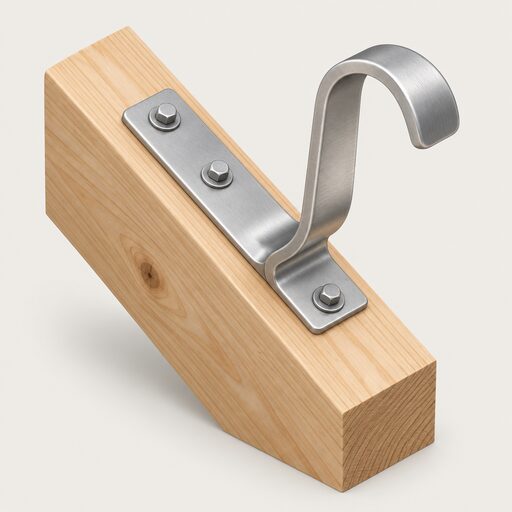 Solar Mounting SystemsWill your roof take the extra weight of solar panels, and will it still keep the rain out afterwards?
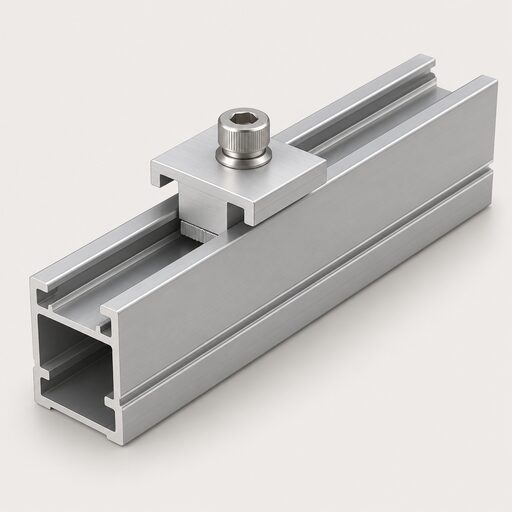 Solar Mounting System MakersWhich solar mounting brands might appear on your quote, and does the maker actually matter?