In this guide
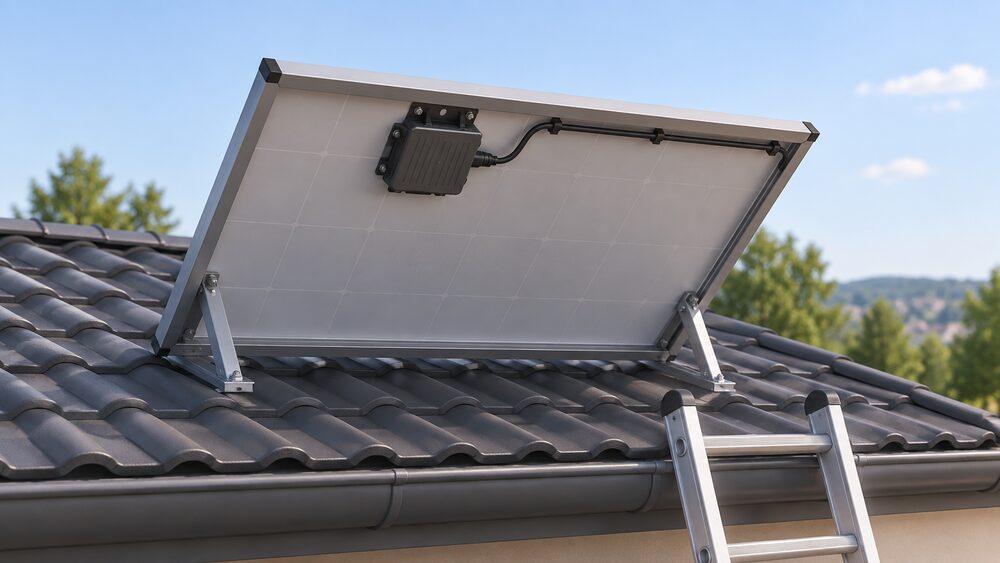
A microinverter is a small inverter mounted at or near an individual solar module that converts that module's DC output into AC power1. Instead of running high-voltage DC down from the roof to one central box, the conversion happens on the roof, panel by panel, and what travels to the consumer unit is mains-voltage AC. Each unit is attached directly to its panel, usually on the rear side2, and each tracks its own panel's operating point using Maximum Power Point Tracking3.
The practical consequences follow from that architecture. Each panel operates independently, so the performance of one does not hinder the others4. Modern microinverters achieve efficiency ratings of 96 to 97%5, with one manufacturer quoting its own range at 95 to 97%6. They operate at low DC voltage, described by one range as 60V or less7, which reduces the risk of electrical hazards such as arc faults8. They are generally more expensive than solar optimisers9 and more expensive than a plain string inverter arrangement10. Warranties commonly range from 10 to 25 years11, against a UK norm for inverters of five years as a minimum12 or ten years as standard13.
The independence they offer is real but narrow. A microinverter array is still strictly grid-tied: by law, if the grid goes down, the units must shut off to protect network workers14. It still depends on a manufacturer's cloud and app for panel-level monitoring, and on that manufacturer surviving long enough to honour a 25-year warranty. What it does buy is resilience against shade, mixed roof planes and single-panel faults, and an array that can grow a panel at a time.
What a microinverter is and how it works
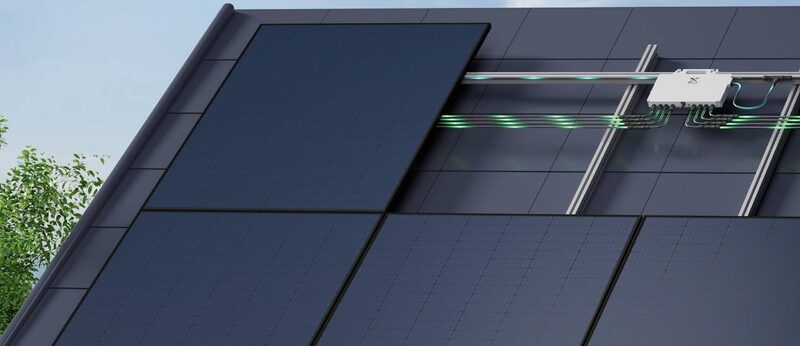
A microinverter is a small, independent inverter installed on each solar panel or on a small group of panels16. Its primary function is to convert the direct current generated by the panel into alternating current, the form households use16. In a string system that conversion happens once, in a wall-mounted box, for the whole array. Here it happens many times over, at the point of generation.
Each unit runs its own MPPT loop, tracking the operating point of its connected panel3. That is the source of most of the behaviour people buy microinverters for. Because the tracking is local, variations in panel type and orientation are tolerated without any significant decline in performance2, and a panel that is shaded, dirty or faulty does not set the operating point for its neighbours16.
Ratings determine how many modules one unit serves. For most homes a 400W microinverter supports one panel, an 800W to 1200W model supports two, and a 1600W to 2000W microinverter supports four11. Multi-input units allow a single inverter to manage several panels at the same time18 while keeping the inputs separately tracked, which lowers the unit count and the cost per panel but groups more of the array behind one device.
Output side, the units are wired into an AC trunk cable that runs to the consumer unit. Protection is built in: type test documentation for one family of micro-generation units records that where the solid state switching device fails to disconnect, the voltage on the output side of the switching device is reduced to a value below 50 V within 0.5 s19. Electrical Safety First notes more generally that some systems use micro-inverters or power-optimisers to limit power generation when a fault develops20.
Microinverters, string inverters and optimisers: which fits which roof
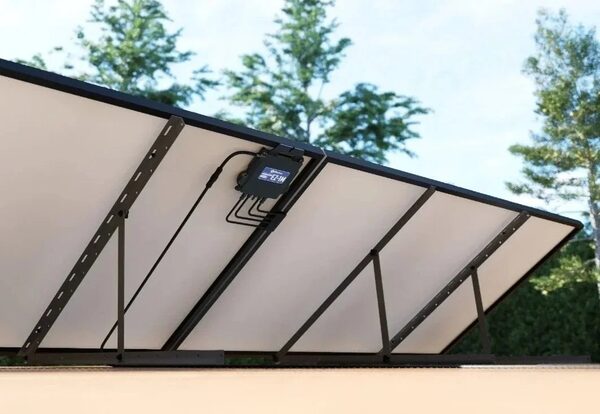
Three architectures compete for the same job. A string inverter is the most common and affordable type, suited to roofs with no shading issues10. Power optimisers work similarly to microinverters but are used with a string inverter, improving the performance of individual panels while the conversion still happens centrally21. A microinverter is fitted to each panel individually and is better for partially shaded roofs, since one shaded panel will not drag down the rest10.
| String inverter | Optimisers plus string | Microinverters | |
|---|---|---|---|
| Conversion point | Central | Central | Per panel, independent7 |
| Shade handling | Weakest of the three; DC optimisers can mitigate string shading losses14 | Panel-level tracking with central conversion21 | Excellent, independent panels14 |
| Servicing | Ground level15 | Ground level for the inverter | Roof access required14 |
| Cost position | Lower upfront on a large, unshaded, consistently oriented roof with identical modules3 | Cheaper than microinverters9 | Generally more expensive than optimisers9 |
| Best suited to | Mid to large residential and commercial7 | Mixed roofs where central servicing is preferred | Residential, shaded, small-scale solar7 |
The counterargument deserves equal weight. Microinverters and optimisers help with shaded or complex roofs but add cost and more potential points of failure, and for most homes with unshaded roofs a standard string inverter is more reliable, efficient and easier to service22. That is not a small qualification on a plain south-facing rectangle of roof with identical modules, where a string inverter system may offer a lower upfront cost3.
Where the module-level approach pulls ahead is growth. Because inversion takes place at panel level, systems with microinverters can be easier to expand than systems using optimisers and a central string inverter9, which is constrained by the string design and the inverter's rating. Further reading on the alternatives sits under string inverters, power optimisers and the direct comparison of microinverters vs string inverters.
Efficiency: 96 to 97% conversion at the panel
Modern microinverters achieve efficiency ratings of 96 to 97%5. One manufacturer describes microinverter efficiency as slightly lower than its string products, at 95 to 97%6, and quotes for one of its own residential units, the X1-Micro 2 in 1 G2 in 800W, 1000W and 1200W sizes, a maximum efficiency of 97.00% with MPPT efficiency of 99.90%6.
Those two numbers describe different things and the distinction matters. Maximum efficiency is the DC-to-AC conversion loss at the moment of conversion. MPPT efficiency describes how closely the unit holds the panel at its best operating point as light and temperature change. A microinverter is not necessarily better than a string inverter on peak conversion efficiency, but it can produce more usable energy over time when panels experience different shading, orientations or operating conditions15, because the tracking loss on the second measure is what the architecture attacks.
For a household, the honest framing is that the headline percentage is not where the gain lies. Microinverters are rated at 96 to 97% efficiency, and string and hybrid inverters occupy much the same band: LuxpowerTek hybrid models reach maximum conversion efficiencies between 96.0% and 97.5% depending on the model and power rating. On a uniform, unshaded roof that difference is too small to repay the price premium, and microinverters are generally more expensive than solar optimisers. On a roof where half the array is compromised for part of the day, the annual yield difference comes from per-panel tracking, not from the conversion figure. Datasheet reading for the modules themselves is covered under solar panel specifications and efficiency.
Shading and mixed orientations: where microinverters earn their keep
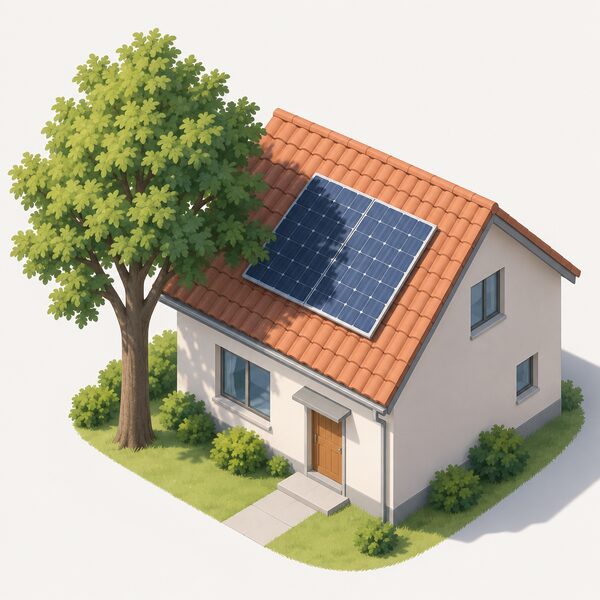
The Energy Saving Trust puts this plainly: where shading is unavoidable, an installer might recommend microinverters or power optimisers, which let each panel work independently, alongside measures such as trimming trees causing partial shade23. That is the core use case.
Each panel operating independently means production is optimised at panel level, preventing losses due to shading or partial obstruction8. If one panel experiences shading, dirt accumulation or a malfunction, the rest of the system remains unaffected16. Microinverters may produce more energy under uneven shade or mixed panel orientations because each input has its own MPPT15, and the versatility extends to variations in panel type as well as orientation2.
In UK housing the mixed-orientation case is common: an east-west split on a hipped roof, a rear extension at a different pitch, a chimney or a dormer casting a moving shadow across one string through the morning. A string inverter with multiple MPPT inputs can handle a two-plane split; it copes less well with a shadow that crosses several panels in sequence. Optimisers are the middle path, and adding DC optimisers can help mitigate string shading losses14.
What microinverters do not do is remove the loss. A shaded panel still produces less; the array simply stops multiplying that loss across its neighbours. Tree removal, panel placement and roof plane selection remain the first-order decisions, covered under orientation, shading and roof suitability and how shade affects solar panel output.
Safety: low DC voltage across the roof
Microinverters operate at a lower DC voltage than string inverters, reducing the risk of electrical hazards such as arc faults or fire risks16. One range is specified at 60V or less7, with a safety position described by its maker as excellent on account of that low DC voltage7. One manufacturer's units are designed to handle no more than 60V DC25, and another describes its product as a low-voltage system26. APsystems states that its microinverters operate at low-voltage DC27.
The physical reason is straightforward. In a string system, modules are wired in series and the DC voltage of the string rises with every panel added, so long DC runs at several hundred volts pass through the roof space and down to the inverter. With microinverters, each module's DC circuit is short, local and limited to that module's own voltage; everything beyond the back of the panel is AC at mains voltage, protected by conventional AC devices.
Fault behaviour is part of the safety case too. Micro-inverters and power-optimisers separate panels so that a single panel failure does not affect the whole system, though they may be more expensive20. Which? makes the same point: micro-inverters separate the panels so that if one panel fails, the whole system will not be affected, and these are more expensive28.
What microinverters cost
No published UK retail price for a domestic microinverter array can be given here, because prices are installer-quoted and vary with the number of panels, the unit rating and the roof. What the evidence supports is the direction of the difference: microinverters are generally more expensive than solar optimisers9, more expensive than a conventional string arrangement28, and more expensive initially, though the premium can make sense for shaded or complex roofs15.
For context on replacement rather than first fit, independent UK advice puts the cost of replacing a conventional central solar inverter at about £500 to £1,00029, and another independent guide at perhaps £500 to £1,00030. Neither figure applies to a microinverter, where the failed component is one small unit rather than the whole conversion stage, and where the labour includes roof access.
Two cost features are specific to the architecture. First, scaling is granular: a SolaX microinverter product is marketed on the basis of adding panels over time without a large upfront expense31, spreading investment rather than sizing a central inverter for a future array. Second, a multi-panel unit lowers the cost per module compared with one unit per panel, at the cost of grouping more of the array behind one device11. Whole-system costs are set out under how much solar panels cost in the UK and returns under solar panel savings and payback.
Warranty and lifespan: 10 to 25 years, and who covers what
Microinverters are generally designed to operate for around 20 to 25 years, and warranties commonly range from 10 to 25 years11. That is longer than the UK norm for inverters generally: most inverters have warranties of five years as a minimum, which can often be extended by up to 15 years12, and it is standard for inverters to have warranties for 10 years13.
| Product | Stated warranty | Source type |
|---|---|---|
| Enphase IQ Microinverters | 25-year limited warranty26 | Maker |
| ATMOCE microinverters | 25 years25 | Distributor news |
| APsystems microinverters | 10 to 25 years, when connected to an ECU27 | Maker |
| SolaX microinverters | 7 years standard, extendable to 1211 | Maker |
| SolaX microinverter solution | 12-year warranty31 | Maker |
| Octopus Optimised Solar + Battery | 25 years for the microinverters, 15 for the battery32 | Supplier package |
Two conditions are easy to miss. One maker's longest terms apply when the microinverters are connected to its own communication unit27, which ties the warranty to keeping the monitoring hardware in service. And panel and microinverter warranties are separate documents. Maxeon, addressing microinverters attached to panels it produced for SunPower, states:
"are not included in the warranty being issued by Maxeon."
Those microinverters were produced by another manufacturer33, which carries its own obligation on its own terms.
Long-term field evidence remains thin. Micro-inverters have yet to undergo a sufficiently extended period of usage to generate comprehensive long-term performance data2. And the mounting position works against them: situated in one of the solar panel's most heat-prone locations, extended exposure to high temperatures over several years may potentially elevate the likelihood of experiencing failures34. For UK consumer protection, the Microgeneration Certification Scheme certifies and quality assures microgeneration installations and installers, including solar photovoltaic panels35; see MCS certification for solar PV and solar panel warranties and degradation.
Monitoring: panel-level data and the gateway question
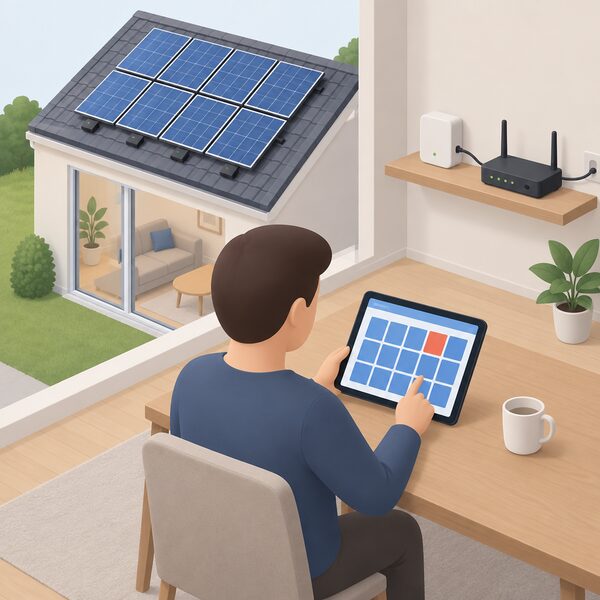
Microinverters usually provide panel-level monitoring, making underperforming panels easier to identify15, and micro inverters often come with advanced monitoring capabilities at the panel level2. On a large array this changes fault-finding from an inference about a whole string to a direct reading of the affected module.
How the data reaches an app varies. Some systems require a separate data transfer unit gateway for cloud monitoring11. The Hoymiles DTU-Lite-S provides real-time microinverter data and alarms on the maker's toolkit and allows remote operation and maintenance of the microinverter system36. Other product families build communication into the microinverter: APsystems published information on 1 September 2026 stating that its EZ1 Series microinverter has built-in Wi-Fi and Bluetooth and does not need a gateway for monitoring.
For independence, this is a dependence rather than a freedom. Panel-level visibility relies on the manufacturer's cloud service, its app and its continued operation, and on a working home internet connection. The electricity flows regardless, but the diagnostic layer does not. Monitoring a solar PV system covers the wider picture.
Batteries and power cuts: AC coupling and grid-tied limits
Standard microinverter systems are strictly grid-tied, and by law, if the grid goes down, they must shut off to protect network workers14. Most grid-tied microinverters shut down when the grid fails11. A microinverter array therefore offers no backup capability on its own unless retrofitted with batteries, and it is not battery-ready in the way a hybrid inverter is: it requires a separate AC battery14.
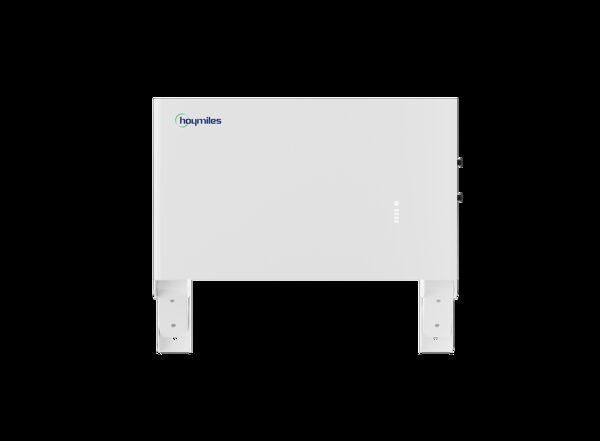
Storage is added by AC coupling: usually through an AC-coupled battery system or a compatible energy management platform11. One battery product states that its system is compatible with any grid-tied inverter, PV inverter or microinverter, and that grid-tied inverters, string or microinverters, can be connected to its generator port37. Capacity can be expanded afterwards by adding multiple energy storage units or microinverters, with battery storage and system output power both growing38.
The reason microinverters are not DC-coupled to storage is thermal. A DC-coupled system must work at night as well as during the day, and running 24/7 without rest can significantly reduce the microinverter's lifespan38.
Storage also earns its keep outside power cuts: a battery can draw power from the grid when it is at a cheaper rate than normal42. That is a bill saving rather than independence. More detail sits under adding battery storage to a solar system and do solar panels work in a power cut.
Maintenance, replacement and adding panels later
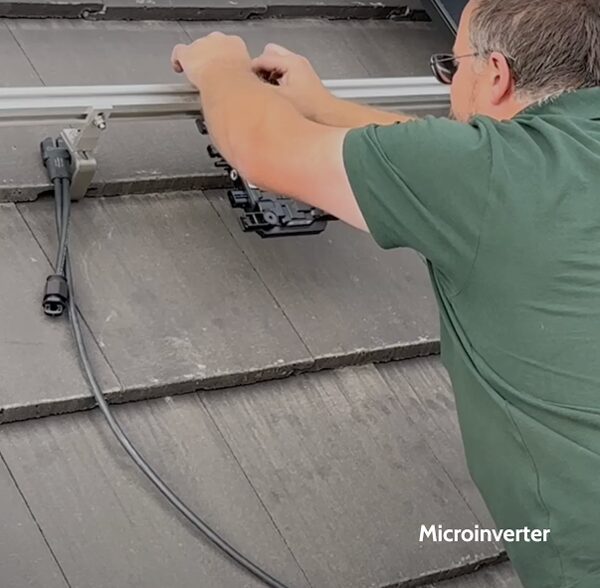
The single structural drawback is access. Microinverters are installed at panel level on the roof14, attached to each panel, so if they need maintenance it will be at roof level9. Repairing a microinverter may require roof access and panel removal, whereas string inverters are easier to service at ground level15. That means scaffolding or a tower, an installer visit and a warranty claim process, for a unit that may be one of twelve on the roof.
Set against that, the failure is contained. A microinverter failure normally affects only its connected panel or panels15, and if a fault occurs with one panel, only that panel will shut down rather than the entire system9. With a central inverter, one panel failure could impact the whole system20. A household with one dead microinverter loses a fraction of output and can schedule the repair; a household with a dead string inverter loses everything until it is replaced.
Expansion is the other side of the ledger. Systems with microinverters can be easier to expand than systems using optimisers and a central string inverter9, and adding panels over time spreads the investment31. Any addition still needs the grid connection position checked, since it changes the declared generation capacity: see G98 and G99 grid connection. Network operators have noted that connecting multiple low carbon technologies at a single location can lead to over-voltage causing equipment shutdown at protective limits, which is the background to statutory voltage reform consultation opened on 22 January 2026.
For routine care, the panels themselves need the usual attention set out under solar panel maintenance and cleaning; dirt on one module now costs only that module's output16. Where roof work requires the array to come off, the microinverters come with it, covered under removing and refitting solar panels for roof repairs.
What this means for household energy independence
Microinverters improve the yield a difficult roof can deliver and make an array modular, both of which serve self-supply. What they do not do is disconnect the household from anything. The array cannot run in a power cut without added storage arranged to island14; monitoring depends on a manufacturer's cloud11; the warranty depends on a company still trading in fifteen or twenty years' time; and any surplus still goes to a supplier under an export arrangement, covered under getting paid for solar export.
The decision point is the roof, not the technology. On a uniform unshaded roof a string inverter is more reliable, efficient and easier to service22. On a roof with shade, several planes or plans to grow, per-panel conversion is what the premium buys. Broader context sits on the solar PV pillar and under solar panels and household energy independence.
Sources42 cited
- Microinverter definition, Tigo Energy, 2026-09-17
- Solar string inverters vs micro inverters, Sungrow, 2026-09-17
- A comprehensive guide to micro inverter solar systems, SolaX Power, 2025-09-19
- String inverters vs micro inverters (UK), Sungrow, 2026-09-17
- Types of solar inverters, SolaX Power, 2025-12-16
- High efficiency solar inverters, SolaX Power, 2026-05-27
- Microinverters and battery storage, SolaX Power, 2026-07-24
- Installing a balcony solar system, Sungrow, 2025-04-23
- Are solar panel optimisers worth it?, E.ON Next, 2026-09-17
- Solar power for your home, Bluetti UK, 2026-08-06
- Best microinverters for solar panels, SolaX Power, 2026-08-11
- Solar panels advice, Energy Saving Trust, 2026-08-27
- How to choose a good solar installer, Low Carbon Hub, 2025-10-20
- Microinverter vs hybrid inverter, SolaX Power, 2026-08-25
- Microinverter vs string inverter, SolaX Power, 2026-07-22
- Microinverter complete guide, Sungrow UK, 2025-04-23
- What is a microinverter?, Deye, 2023-02-13
- APsystems microinverters, UKSOL, 2026-09-17
- Type test verification report for MI-700, MI-600 and MI-500, Energy Networks Association, 2026-09-17
- Solar panel safety advice, Electrical Safety First, 2026-09-17
- What type of inverter is best for solar, Marley, 2026-09-17
- Worst mistakes to make installing solar, Spirit Energy, 2025-08-22
- Solar panel installation, Energy Saving Trust, 2026-09-07
- Microinverter complete guide, Sungrow, 2025-04-23
- The UK's missing microinverter market, Midsummer Wholesale, 2026-09-19
- Home solar systems and the IQ9 microinverter, Enphase, 2026
- Homeowner information, APsystems EMEA, 2026-07-20
- Buying advice for solar panels, Which?, 2026-08-12
- A complete guide to solar PV, Centre for Sustainable Energy, 2025-11
- Solar photovoltaic information, Centre for Alternative Technology, 2026-03-10
- Microinverter solutions, SolaX Power, 2026-09-17
- Solar and battery options, Octopus Energy, 2026-09-17
- Support: warranty questions, Maxeon, 2026-09-17
- String inverters vs micro inverters, Sungrow, 2026-09-19
- ECO flexibility funding and MCS scope, Ceredigion County Council, 2026-09-17
- DTU-Lite-S product page, Hoymiles, 2026-09-17
- HIT energy storage system, Hoymiles, 2026-09-17
- DC-coupled vs AC-coupled vs hybrid battery storage, Hoymiles, 2025-09-23
- Storage and renewable energy, Electricity North West, 2026-09-19
- AC coupling guidance, Victron Energy, 2026-09-19
- Plug-in solar consumer guide, Electrical Safety First, 2026-08
- Battery storage for consumers, MCS, 2026-09-17
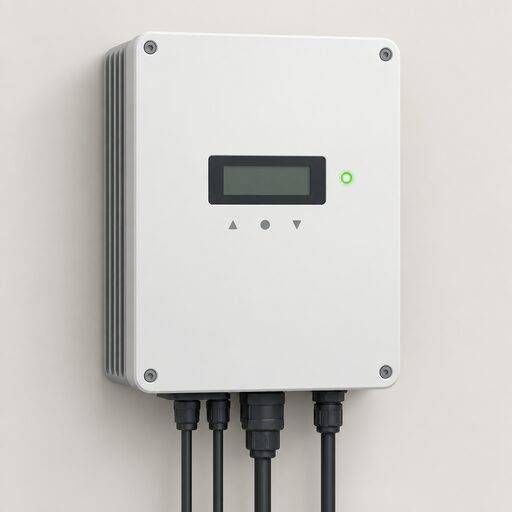 Solar InvertersWhat does the box on the wall next to your solar panels do, and how long will it last?
 Microgrids and Local EnergyA microgrid shares electricity between neighbours, using local solar and batteries instead of relying only on the national grid.
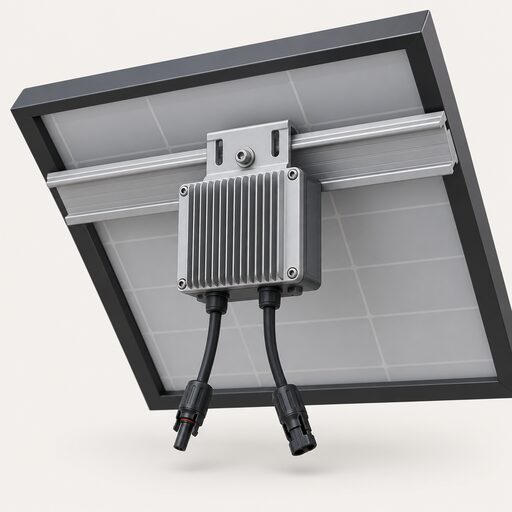 Power OptimisersIf one panel is shaded, does it drag the whole roof down?
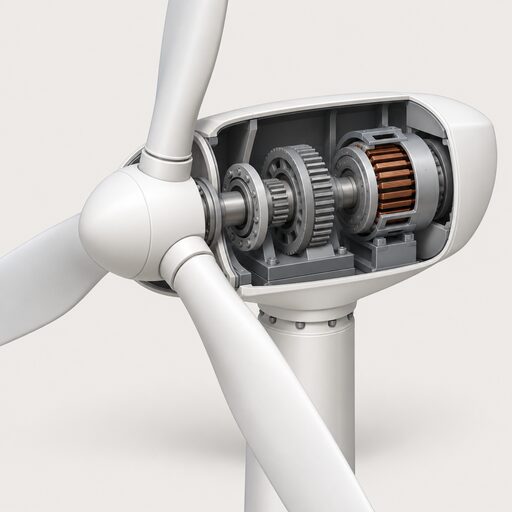 Domestic Wind TurbinesCan a wind turbine really power a home, and is your site windy enough?
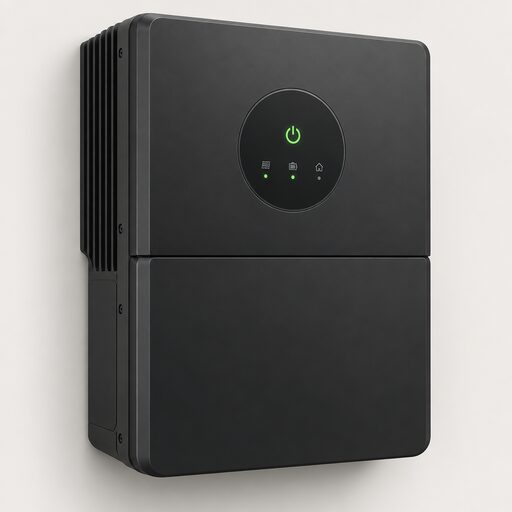 Hybrid InvertersA hybrid inverter lets you store solar power in a battery and use it later, all through one unit instead of two separate boxes.
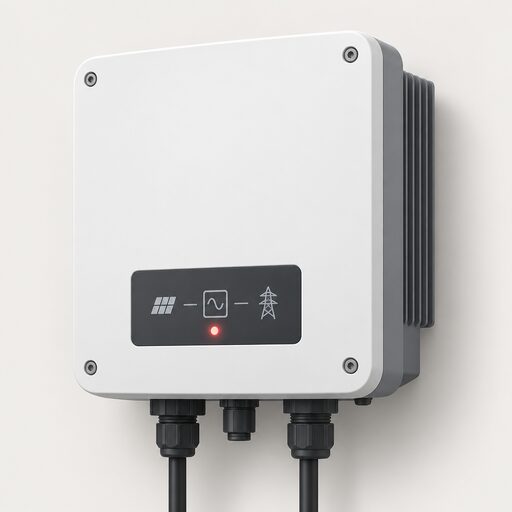 Islanding and Anti-IslandingWhy do solar panels switch off in a power cut, and can you keep the lights on anyway?