In this guide
APsystems is a module-level power electronics manufacturer founded in Silicon Valley in 2010, now serving customers in over 160 countries and describing itself as a global leader in the field1. Its microinverters convert direct current at the panel rather than at a central string inverter, and the company states that its installations are typically 5 to 15 percent more efficient than comparable string systems3.
For a UK household the practical questions are narrower than the company's global portfolio. A microinverter runs without any monitoring hardware attached, the DS3 series is backwards compatible with earlier APsystems units, and the warranty ladder runs from 10 years to a maximum of 25 years depending on model, region and whether an ECU is connected1. The technology has also become the standard building block of plug-in solar, the self-install category now being specified for the UK market6.
What follows covers the range sold into the UK and Europe, how the units are monitored, the safety and grid-compliance position, the warranty terms and their limits, and what the whole arrangement means for a household trying to generate its own power.
What APsystems makes and where the company stands
APsystems describes its product line as microinverters, energy storage and rapid shutdown devices, and its microinverters as suitable for all residential and commercial applications1. The company was founded in Silicon Valley in 2010 and now encompasses six global business units, with brands including APsmart and APstorage2. It reports more than 8 TWh of clean renewable energy produced across its installed base8.
The portfolio has widened considerably. At SNEC 2026 the company launched seven new product lines spanning four energy storage solution categories: AC coupling, hybrid AC-DC coupling, off-grid and string-type energy storage9. A separate announcement at Intersolar Europe 2026 set out a comprehensive energy storage portfolio covering micro-site, residential and commercial and industrial applications, with dynamic charge-discharge optimisation and virtual power plant compatibility10. APsystems states that it develops core technologies in-house across battery management, power conversion and energy management systems10.
That matters for a household because it indicates a manufacturer investing across the whole system rather than only the inverter. It does not, on its own, say anything about UK support arrangements, spare parts or how quickly a replacement unit arrives. Those are the questions that decide whether a microinverter installation is genuinely independent of the maker, and they are covered below.
How a microinverter differs from a string system
The headline claim from APsystems is that its microinverter installations are typically 5 to 15 percent more efficient than comparable string systems3. A separate APsystems page puts the gain at up to 20 percent, describing it as boosting system efficiency3. The two figures come from the same maker on different pages and are not reconciled, so the 5 to 15 percent range is the more conservative of the two and the one to work from.
The mechanism is not conversion efficiency. Independent guidance from SolaX is explicit that microinverters are not necessarily better in terms of peak DC-to-AC conversion efficiency, and that they can produce more usable energy over time when panels experience different shading, orientations or operating conditions5. Microinverter efficiency is quoted at 95 to 97 percent, slightly lower than the best string inverters11. The gain comes from the array, not the box.
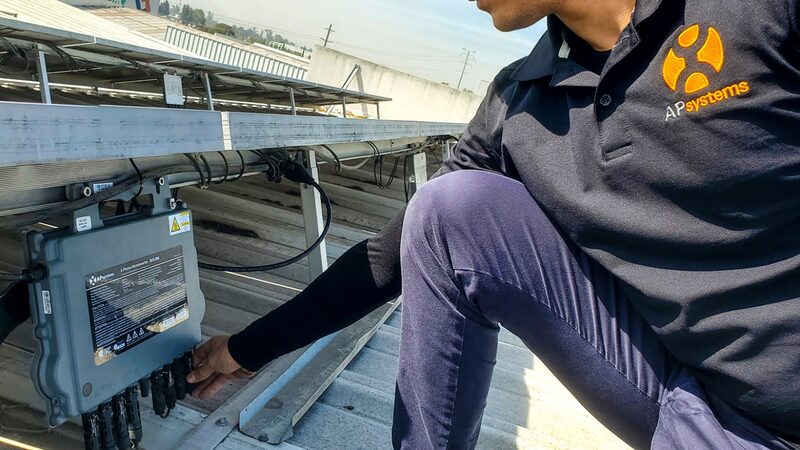
What drives it is panel independence. Electrical Safety First notes that microinverters and power optimisers separate panels so that a single panel failure does not affect the whole system, and that they may be more expensive12. APsystems states that each microinverter handles multiple PV modules and independently optimises the output from each one3. A shaded chimney, a dormer or a panel on a different roof pitch stops dragging down the rest of the array.
Two further differences matter for a household planning to expand. Microinverter systems are generally easier to add to, because new panels can be added with their own inverter inputs, and systems with microinverters can be easier to expand than systems using optimisers and a central string inverter5. Against that, string inverters are lower cost and appealing for large-scale or residential installations13. The trade is straightforward: more output from a compromised roof, at a higher equipment cost.
The range: EZ1, DS3, QT2 and the discontinued YC600
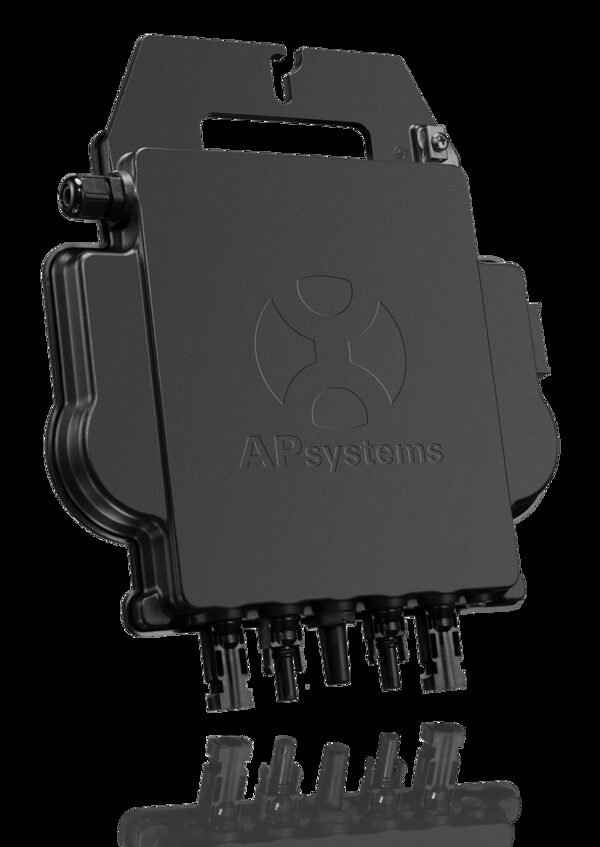
APsystems sells dual-module residential models and native three-phase products for commercial installations14. The EZ1 series is the plug-in and DIY end of the range, the DS3 series the mainstream residential dual unit, and the QT2 the second generation of native three-phase quad microinverters3.
| Series | Position | Key published detail |
|---|---|---|
| EZ1 | DIY and plug-in | Up to two high-powered panels; AC extension cable supplied by APsystems15 |
| DS3 | Residential dual | 10 years standard, 20 years optional; encrypted ZigBee to ECU; backwards compatible with QS1 and YC60016 |
| QT2 | Commercial three-phase | Native three-phase quad microinverter3 |
| YC600 | Discontinued | Listed as discontinued; still compatible with DS3 and ELT-5K retrofit16 |
The DS3 series is described as fully backwards compatible with the QS1 and YC600 microinverters, and it communicates to the ECU over encrypted ZigBee16. The EZ1 series connects through an AC extension cable provided by APsystems15. The Q series is described by the maker as having low start-up voltage and a wide voltage range18.
The YC600 is the one to know about if buying used equipment or extending an older array. It is listed as discontinued, but the DS3 remains compatible with it and the ELT-5K storage unit pairs with QS1 and YC600 microinverters for retrofit applications16. Existing owners are not stranded, though new YC600 stock is not part of the current line-up. For the wider field, see solar inverter and microinverter manufacturers and the Enphase comparison.
Monitoring: standalone operation, the ECU and the EMA platform
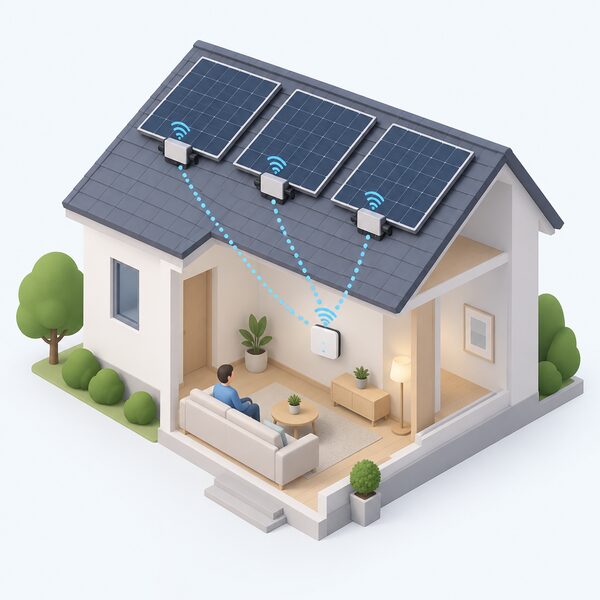
The most useful fact about APsystems monitoring is that it is optional. The microinverter will operate in standalone mode without connecting to either the ECU or the EMA, and it also works with the ECU alone1. Generation continues either way. What standalone mode gives up is visibility: no module-level data, no alerts, no performance history.
Where monitoring is fitted, the ECU is the information gateway. APsystems describes it as collecting module performance data from each individual microinverter, gathering individual module and microinverter statistics, and providing electricity data monitoring, power grid environment monitoring and rapid shutdown control19. The EMA is the software layer, described as wireless energy monitoring and analysis software that monitors and allows analysis of each solar module and microinverter, shows performance issues and alerts the user to inverter events19.
Full web analysis has a condition attached: the ECU must be connected to and logged into the APsystems EMA1. The storage products integrate with the same platform, with the ELT-12 and ELT-12K described as fully integrated into the EMA and EMA Manager monitoring system, and the ELS-5K into the EMA and EMA Manager intelligent monitoring system8.
That is the dependence the range creates. A household with an ECU and an EMA account has detailed per-panel data and fault alerting, and depends on the manufacturer's servers and platform to keep it. A household without them has a system that generates silently. Neither arrangement affects whether the panels produce, but only one tells the owner when a panel stops.
Safety and grid compliance: rapid shutdown and grid profiles
APsystems states that all its microinverters are engineered to inherently comply with rapid shutdown requirements out of the box, and that the rapid shutdown functionality required under NEC 2014 is built into every unit3. The company also lists arc-fault protection and rapid system shutdown among the safety features included in its microinverters4.
The architecture behind this is described as proprietary and chip-based, which APsystems says ensures maximum efficiency and allows easy programming for any grid profile1. Grid profiles are the settings that determine how the inverter behaves on the local network, and the ability to reprogram them matters where a network operator changes requirements. The microinverters connect to the public power grid via standard AC voltages and tie directly to the low-voltage PV module, which is the basis of the safety argument: the high-voltage DC string that a conventional system runs across a roof does not exist1.
For UK plug-in solar specifically, the compliance route sits with the manufacturer rather than the householder. The interim product specification states that manufacturers shall register devices on the ENA Type Test Register and obtain confirmation that the device has been assessed and identified as compliant before placing them on the market6. Independent guidance confirms that all devices verified as compliant must be registered on the Energy Network Association Connect Direct register7. Only plug-in solar devices compliant with the interim specification will be able to be sold in the UK and plugged in under the amendment20.
Warranty: 25 years on DS3 and QT2 in the U.S.
The warranty position needs reading carefully, because the longest term is regional. APsystems introduced a 25-year standard warranty for DS3 and QT2 microinverters in the United States, effective from February 202521. That announcement is a US one, and it is the origin of the 25-year figure that circulates.
The EMEA position is expressed differently. APsystems' European homeowner pages describe microinverter warranties ranging from 10 to 25 years when connected to an ECU, with an optional 13-year extension for microinverters bringing the full available warranty period up to 25 years1. The DS3 datasheet states 10 years standard and 20 years optional16. Across the market generally, microinverter warranties commonly range from 10 to 25 years14.
| Source | Term stated | Applies to |
|---|---|---|
| APsystems US announcement, February 2025 | 25 years standard | DS3 and QT2 in the U.S.21 |
| APsystems EMEA homeowner page | 10 to 25 years, when connected to an ECU | Microinverters4 |
| APsystems EMEA product page | Optional 13-year extension, up to 25 years | Microinverters1 |
| DS3 datasheet | 10 years standard, 20 years optional | DS3-L and DS316 |
Two conditions recur. The longer terms are tied to ECU connection, which means the monitoring hardware is not purely optional if the warranty is to be relied on. And the terms differ by model, so a DS3 and a QT2 bought in the same order may not carry the same period. For how these terms compare across makers, see manufacturer warranties and registering a warranty.
Storage and the wider APsystems portfolio
APsystems has moved well beyond microinverters. The company launched seven new product lines spanning four energy storage solution categories at SNEC 2026, covering AC coupling, hybrid AC-DC coupling, off-grid and string-type energy storage9. A hybrid and off-grid announcement at the same exhibition set out solutions aimed at systems that operate independently of the grid21.
The storage units are designed to work with the microinverter range rather than alongside it. The ELT-12 and ELT-12K are described as optimised for energy management with APsystems DS3 or QT2 microinverters, and the ELT-5K pairs with QS1 and YC600 microinverters for retrofit applications8. All three integrate with the EMA and EMA Manager monitoring platform8.
The company frames the whole arrangement as a complete solution integrating grid-tied microinverters and energy storage with intelligent networking and monitoring systems for residential or commercial solar1. It also states that its microinverters are designed for the same lifespan as the solar module, which is the design intent behind pairing module-level electronics with module-level storage1.
For a household, the significance is that a microinverter array is not a dead end. Storage can be added later on the same monitoring platform, and the retrofit compatibility with older QS1 and YC600 units means an existing array is not excluded. The dependence that remains is the same as elsewhere in the range: the storage integrates through the EMA platform, so the intelligence sits with the manufacturer's software rather than in the home. Wider context is at home battery storage manufacturers.
What APsystems microinverters mean for UK plug-in and self-install solar
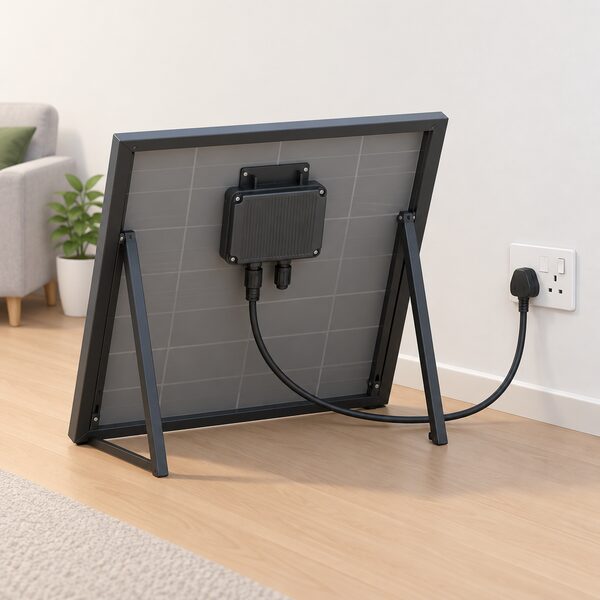
Plug-in solar is the category where APsystems microinverters have their clearest UK role. Plug-in photovoltaic panels, also known as balcony solar, are now available to buy and self-install in the UK7. The government consultation defines plug-in solar systems as those without batteries, designed to be connected directly to a standard UK mains socket and to operate alongside the electricity network20.
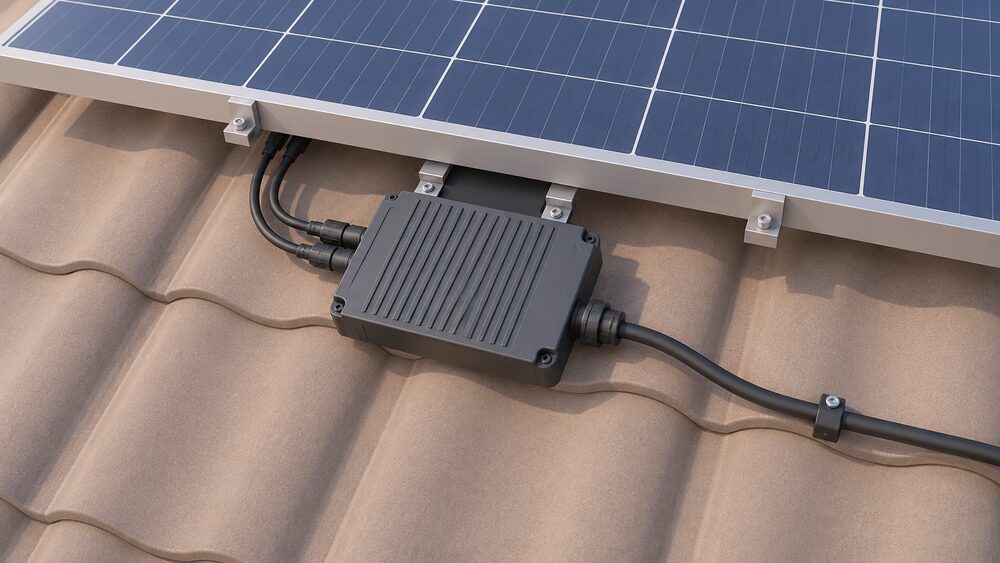
The technical shape of the category is a microinverter on the back of the panel. Independent guidance describes the electricity being converted to AC via a micro-inverter, usually attached to the back of the solar panel or panels22. The interim specification describes connection to an existing low-voltage electrical installation using a standard UK mains plug and socket, without requiring a separate electrical circuit for export6. UKSOL's self-install plug-in solar kits are powered by the APsystems EZ1-M dual microinverter, which plugs directly into a standard household wall outlet and takes up to two high-powered panels23.
The limits are set by regulation, not by the inverter. Up to four PV modules may be connected to the inverter, and a maximum of one inverter of up to 800 VA may be plugged in per household circuit6. Independent guidance states that only one plug-in solar panel system up to 800 W is permitted per household, and the Energy Saving Trust confirms one plug-in solar panel device per home7. The legislation adds that a plug-in microgenerator is not designed to import electrical energy from a low-voltage consumer's installation for the purpose of storing energy for later supply, other than for control or auxiliary functions permitted by the specification19.
What this means for independence is mixed and worth stating plainly. A plug-in system with an APsystems microinverter generates behind the meter, needs no installer, no MCS certificate and no separate circuit, and reduces the electricity drawn from a supplier during daylight. It does not remove the grid connection, does not store anything, and is capped at one device per household at 800 W. The household remains a customer of a supplier for every unit it does not generate itself. The microinverter is the component that makes the category possible, not a route off the network. For the wider picture, see manufacturers and energy independence and the solar panel manufacturers guide.
Sources24 cited
- APsystems EMEA products, APsystems, 2026
- APsystems global products, APsystems, 2025
- APsystems microinverter range, APsystems, 2025
- APsystems for homeowners, APsystems, 2026
- Microinverter vs string inverter, SolaX Power, 2026
- Plug-in solar interim product specification, UK Government, 2026
- Plug-in solar consumer guide, Electrical Safety First, 2026
- APstorage product line, APsystems, 2026
- APsystems hybrid and off-grid storage at SNEC 2026, APsystems, 2026
- APsystems energy storage portfolio at Intersolar Europe 2026, APsystems, 2026
- High efficiency solar inverter, SolaX Power, 2026
- Solar panels safety advice, Electrical Safety First, 2026
- How efficient is a solar string inverter, SolaX Power, 2025
- Best microinverters for solar panels, SolaX Power, 2026
- APsystems EZ1 DIY, APsystems, 2026
- DS3 microinverter series datasheet, APsystems, 2026
- APstorage global, APsystems, 2026
- Q series microinverter, Fox ESS, 2026
- APsystems monitoring products, APsystems, 2026
- Plug-in solar consultation, UK Government, 2026
- APsystems 25-year warranty announcement, APsystems, 2026
- Plug-in solar panels guide, Uswitch, 2026
- UKSOL APsystems plug-in kits, UKSOL, 2026
- Plug-in solar panels advice, Energy Saving Trust, 2026