
In this answer
Short answer
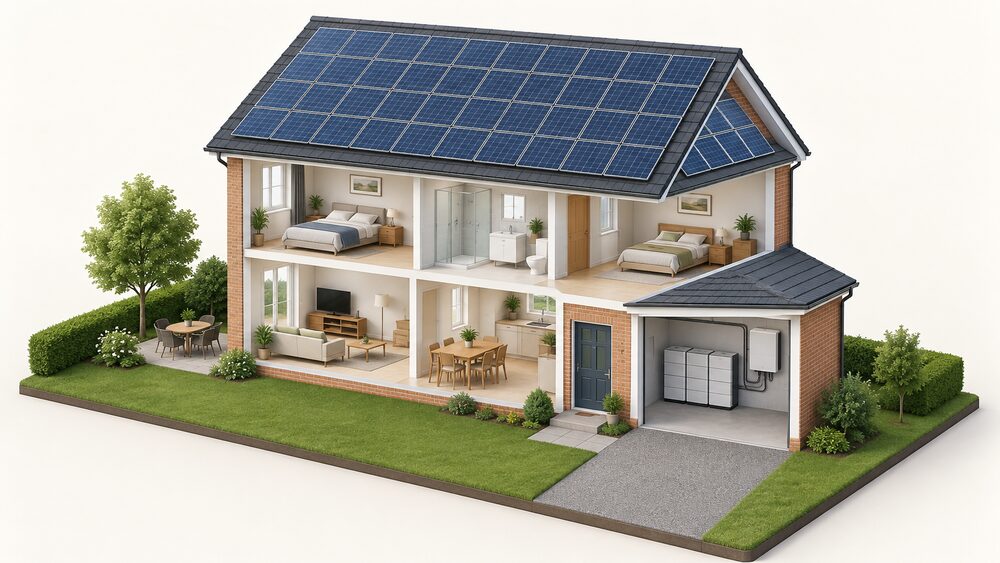
For year-round off-grid living in the UK, most homes would need at least 20 to 30 high-efficiency solar panels, along with a large battery system, to cover all their needs1. That is roughly double the 10 to 14 panels of a typical grid-tied system2, and the gap is the whole point: an off-grid array has to carry the household through winter, when panels can be 25% to 50% less effective than in summer3.
The panel count is only half the calculation. Off-grid systems require batteries to store electricity for use when the sun is not shining4, and one maker's guidance puts off-grid daily demand for sizing purposes at 15 to 25 kWh, with a battery bank large enough to keep critical loads running for several days5. The array and the battery bank are sized together, against the worst week of the year rather than the average one.
This page sets out the sizing maths, the smaller setups where a handful of panels is genuinely enough, and the point at which a grid-tied array stops being able to pretend it is off-grid.
How many panels: 20 to 30 for year-round off-grid living
The headline figure comes from a maker's sizing guidance: most UK homes would need at least 20 to 30 high-efficiency panels, along with a large battery system, to cover all their needs off-grid1. A second maker's figure is lower, putting a typical UK household at anywhere between 10 and 20 panels, each with an output of 350W or more7. The two are not measuring the same thing. The 20 to 30 figure is for covering all needs year-round; the 10 to 20 figure is for meeting a household's demand without specifying how much of the year is covered or what happens in December.
For comparison, grid-tied sizing is a different order of magnitude. A typical system will likely include 10 to 14 solar panels2. A large detached house is put at 16 panels, a small detached house at 12, and an end-terrace or semi-detached house at eight8. A medium home of three to four bedrooms is put at 7 to 9 panels9. Those systems are designed to offset a share of consumption, not to replace the grid.
The reason off-grid sizing runs so much higher is that nothing tops the system up. A grid-tied array can be undersized and the shortfall is simply imported. An off-grid array that is undersized means the batteries run down. That is why the design case is the darkest, cloudiest week rather than the annual average, and why the panel count lands at roughly double a comparable grid-tied installation.
The maths: daily use, panel output and the 7 to 10 panel example
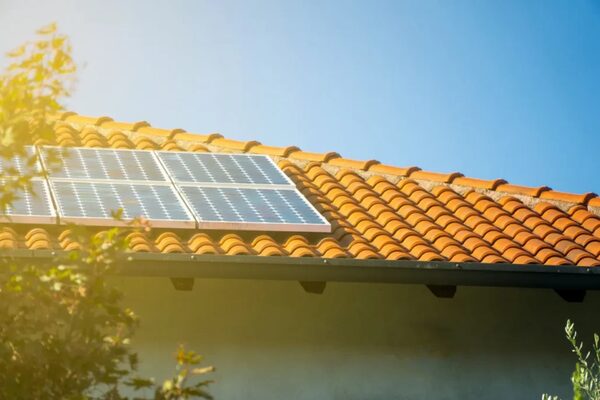
Sizing starts with daily consumption in kilowatt hours. Ofgem's typical domestic consumption value is 2,500 kWh a year, which is the figure behind most grid-tied sizing advice10. Off-grid system designers often work from a much higher daily demand: one maker's guidance uses 15 to 25 kWh per day5. The difference is what the electricity is doing. A grid-tied household's 2,500 kWh typically excludes space heating and hot water; an off-grid home usually has to run everything from the array.
The worked example that appears most often is smaller than a whole house. If your total is 6 kWh per day and each panel produces about 0.3 kWh per hour in full sun, you would need around 7 to 10 panels11. A second maker's example, for 7,500Wh of daily consumption using 250W panels, arrives at 10 panels12. Both examples assume full sun and a daily total well below the 15 to 25 kWh used for whole-home off-grid sizing, which is why they land at 7 to 10 rather than 20 to 30.
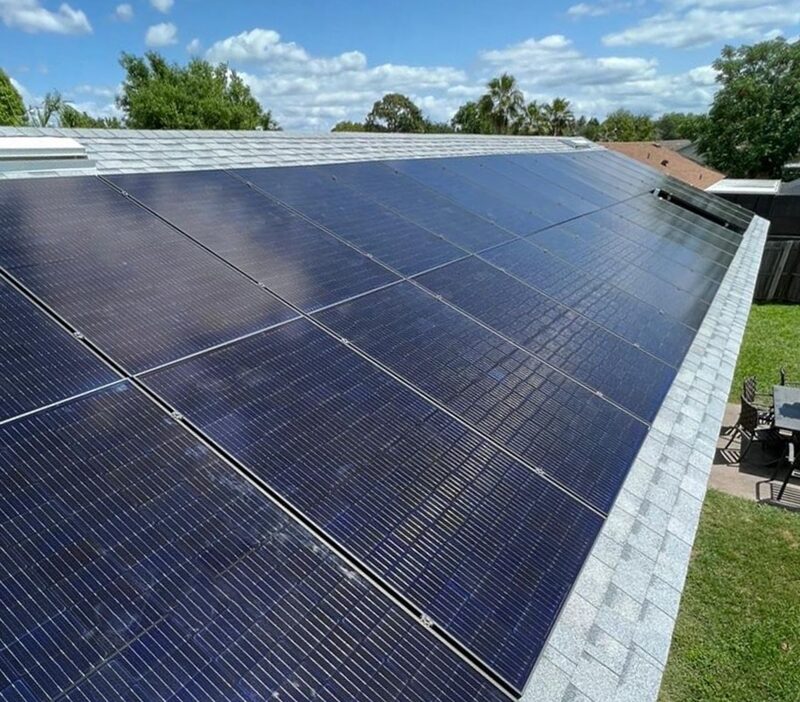
The arithmetic is straightforward once the inputs are fixed: daily kWh divided by the usable output per panel per day gives the panel count. The difficulty is the output figure. A panel's rated wattage is a laboratory peak, and UK conditions deliver less than that for most of the year. The 0.3 kWh per hour in full sun used in the worked example is a realistic full-sun figure, not an average across a winter day.
For a grid-tied household, the same maths produces a partial offset rather than independence. A medium-use household with a 10-panel solar system will save £682 on their energy bills each year, per Octopus Energy calculations13. A medium home of three or four bedrooms is commonly sized at 7 to 9 panels, and a small detached house at 12 panels14. Those savings are real, but they are a bill reduction, not a supply.
Why a large battery system matters as much as the panel count
For off-grid systems, batteries are essential15. There is no grid to import from at night or in a cloudy spell, so every kilowatt hour the household uses after dark has to have been stored. Off-grid systems typically require batteries to store electricity for use when the sun is not shining4, and the system's capacity depends on the battery size16.
Batteries are essential for off-grid systems, because the array alone cannot cover the hours when the sun is not shining5. Storage is the part of the system that most often surprises householders comparing quotes: an off-grid installation needs a big investment in batteries to make sure charging is reliable17. Off-grid inverters require batteries, which significantly increases system cost and maintenance, and available power is limited by the battery and inverter capacity; the system may run out of power if solar generation is low and batteries are depleted unless a backup generator is available17.
The battery also changes how the household uses electricity. Because capacity depends on battery size, users may need to manage their energy usage carefully16. That is a genuine difference from grid-tied living, where the grid absorbs the mismatch between when power is generated and when it is wanted.
For a grid-connected home, a battery plays a different and smaller role: it reduces the amount of electricity drawn from the grid, and therefore the amount paid in bills18. Combining solar panels with a home battery lets a household store free, renewable electricity to power a heat pump, making it less reliant on grid electricity19. That is a reduction in dependence, not the removal of it.
Smaller setups: cabins, RVs, boats and rural sites with no grid access
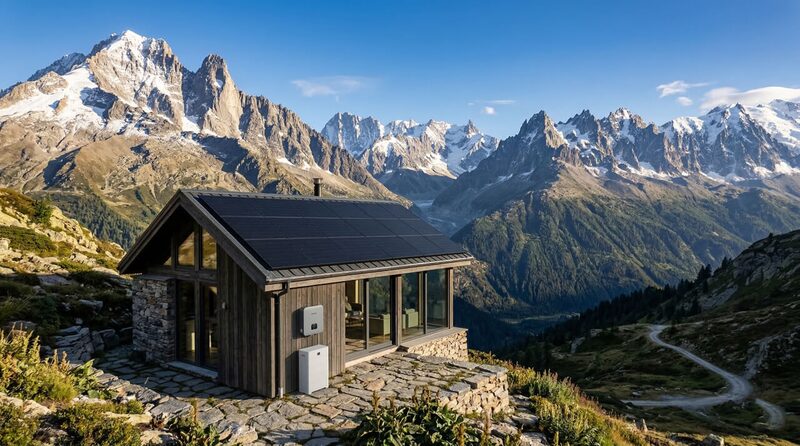
Not every off-grid installation is a house. Off-grid inverters are marketed for cabins, RVs, boats, and rural areas with no grid access17. Small solar PV panels are sold for off-grid use, solar fountains, caravans, boats, remote lighting and power supplies, telemetry and electric fencing21. These are low-power systems where a handful of panels and a modest battery are proportionate to the load.
Panels can be fitted on a roof, most commonly, in a garden, or on an external building like a shed or garage22. That flexibility matters for remote sites where the main dwelling has no suitable roof. Panels can also be installed on an outbuilding, provided the building roof is strong enough6.
At the smallest end, plug-in solar panels can be self-installed without an installer, mounted on a balcony or wall and plugged into an approved indoor or outdoor socket10. These are not off-grid systems, but they illustrate the bottom of the range: a single panel or two serving a specific load rather than a whole building.
For sites genuinely off the electricity grid, there is also a non-solar option worth knowing about. Hydropower systems might be a cheaper option if your home is off the electricity grid23. Where a stream or river with adequate head is available, that is a different generation profile from solar, and one that does not fall away in winter.
Where 8 to 10 panels is enough, and where it falls short
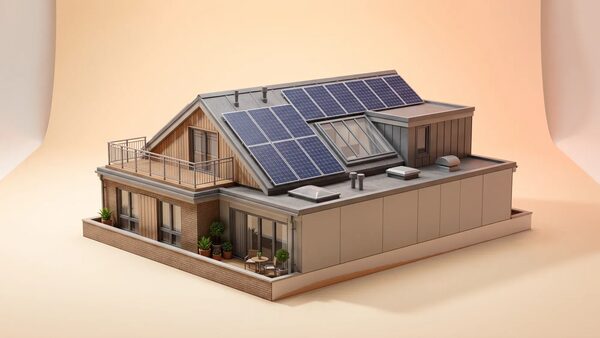
Eight to 10 panels is a sensible grid-tied figure. Covering a typical 2,900 kWh a year with solar generally takes 8 to 10 panels, depending on roof exposure and local sunlight conditions1. Most UK homes need between 8 and 16 panels to cover their typical energy needs1. A one-bedroom house needs around six solar panels, while a standard three-bedroom house requires 1013.
That is enough to cut a bill substantially. It is not enough to leave the grid. The distinction is worth stating plainly, because the two figures are often quoted side by side without it. A 10-panel system offsets a share of consumption; a 20 to 30 panel array with a battery bank sized for several days of critical loads is attempting to replace the supply entirely.
Roof space is the practical constraint on scaling up. A 4.5 kWp system typically covers between 20 to 30m² of roof surface area, typically using around 12 panels6. A 4 kWp system requires at least 20 square metres24. A 3.5 kWp system typically covers between 10 to 20m²25. Domestic PV systems are commonly between 3 and 4 kilowatts, taking up 20 to 30 square metres of roof26. Scaling to 20 to 30 panels therefore needs a roof well beyond the average domestic array.
The number of panels that can be installed may be limited by the roof shape, skylights, shading from nearby buildings or trees, local planning or conservation area requirements, local grid capacity and export limits8. A roof sloped at an angle of around 30 to 40 degrees is ideal for solar panels27. Planning authorities generally expect a suitable roof with sufficient space28.
Winter output and the limits of an off-grid array
Solar panels work in winter, but they generate less electricity than in summer31. They can be 25% to 50% less effective in winter than they are in summer due to winter's shorter days and increased cloud cover3. For an off-grid household this is the defining constraint: the array and battery must be sized so that the worst weeks are covered, which is why the panel count is so much higher than a grid-tied equivalent.
The same winter penalty affects electric vehicle charging. Solar panels can charge an electric car, though solar power alone is unlikely to be relied on year-round in the UK, especially in winter20. A household planning to run a car from an off-grid array is adding a large winter load to an already stretched system.
There is a further limit that catches people out. Typically solar panels cannot power your home during a power cut. However, they can if your home is off the grid or has additional equipment31. A grid-tied array is not a standby generator, and an off-grid array is not a grid-tied array with the cable unplugged.
The dependence that remains in an off-grid setup is worth naming. The household depends on a battery bank that will need replacing, on an inverter, and on the manufacturer of both. It depends on its own discipline in managing load when the battery is low. It may depend on a backup generator in a hard winter. What it does not depend on is a supplier, a standing charge or an import price. That is the trade: capital and maintenance in exchange for the removal of the bill.
Sources31 cited
- How many solar panels do you need?, So Energy, 2025-11
- Solar energy, Solar Energy UK, 2026-09-17
- Do solar panels work in winter?, Uswitch, 2026-09-15
- Inverter technologies compared, Sungrow, 2025-01-07
- What size LiFePO4 battery for solar energy storage do you really need?, LuxpowerTek, 2026-07-15
- Solar panels, Energy Saving Trust, 2026-08-27
- How many solar panels do you need?, Viessmann, 2025-03-26
- Solar panel installation, Energy Saving Trust, 2026-09-07
- Are solar panels worth it?, Uswitch, 2026-09-16
- Plug-in solar panels, Energy Saving Trust, 2026-09-17
- Off-grid solar system UK, EcoFlow, 2025-06-11
- Solar panel sizes in the UK, Jackery, 2026-04-29
- How long do solar panels last?, Uswitch, 2026-07-13
- Plumbing with renewables, CIPHE, 2026-09-17
- Small wind turbines, MCS Certified, 2026-08-18
- Small solar PV panels, Wind & Sun, 2026-09-20
- Off-grid vs hybrid inverter, SolaX Power, 2026-03-13
- Batteries in the home, Solar Energy UK, 2026-09-17
- How to ensure a heat pump runs efficiently, Energy Saving Trust, 2026-05-19
- Charge your EV with solar panels, E.ON Next, 2026-09-17
- Solar photovoltaic (PV), MCS Certified, 2026-07-30
- Plug-in solar panels, Which?, 2026-09-15
- Renewable energy, Consumer Council, 2026-09-17
- Buying advice for solar panels, Which?, 2026-08-12
- Solar panels, London Borough of Hammersmith & Fulham, 2026-09-17
- Solar photovoltaic, CAT, 2026-03-10
- Solar panel installation, maintenance and repair, NICEIC, 2026-09-17
- Solar photovoltaic (PV) panels, London Borough of Bromley, 2026-09-17
- Solar panels, East Herts Council, 2026-09-17
- Buying a house with solar panels, Energy Saving Trust, 2026-08-13
- Solar power facts, Energy Saving Trust, 2026-08-13
 Sizing a Self-Sufficient HomeHow many solar panels and how much battery storage does a home need to stop relying on the grid?
 System SizingMost UK homes need a solar system of around four kilowatts, which takes up roughly twenty square metres of roof.
 The Full Solar Panels GuideHow much do solar panels cost, and what could they save you each year?
 Solar and Energy IndependenceHow far domestic solar cuts dependence on suppliers and the grid, what self-consumption really looks like across the year, what a battery, diverter or EV adds, and the grid-outage limit of ordinary inverters.
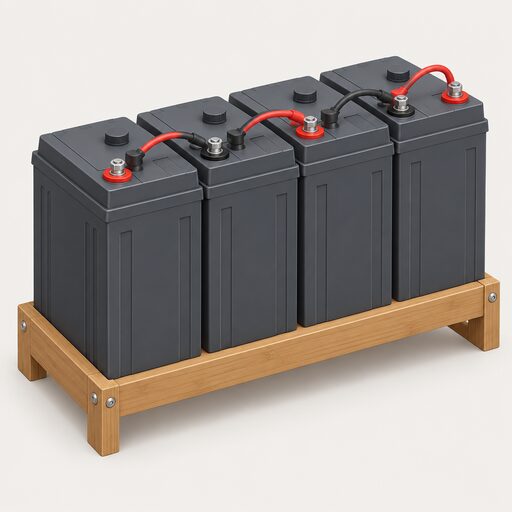 Off-Grid Battery SystemsHow many days of power do you need when there is no sun?
 Solar Panel CostsA typical UK home pays somewhere between four and eleven thousand pounds for solar panels fitted, with most landing in the middle.