In this guide
Solar self-consumption is the share of the electricity your panels generate that is used inside your own home rather than exported to the network. It can be stated in kilowatt hours or as a percentage of total generation, and it is the number that decides how much of your solar output actually displaces electricity you would otherwise buy from a supplier1.
For a home with panels and no battery, the reported range is roughly a third to a half. Great British Energy, as reported by the Parliamentary Office of Science and Technology, puts self-consumption without storage at 30 to 40%, rising to 70 to 80% once a battery is added2. Uswitch gives 30 to 50% without a battery and "80% or more" with one3, and its 2026 data for households with a 10kWh battery shows a self-consumption rate of 70%4. The gap between the lower and upper figures is mostly about when people are at home and how much electricity they use during daylight.
Installers certified under MCS must estimate self-consumption before you buy, using a set method, and state it in writing both in kWh and as a percentage, clearly saying whether storage is included5. A typical 3.5 kWp system costs around £6,100 to install6, so how much of its output you use yourself largely decides how quickly that outlay is recovered.
What self-consumption means: the share of your solar you actually use
The MCS standard for solar PV self-consumption defines it as "the amount of solar electricity generated by a domestic solar PV system which is subsequently consumed within the property and not exported to the distribution network"1. Everything else the panels produce leaves the house through the meter and is exported. Domestic solar PV systems convert sunlight into electricity that can be used in the home, and in doing so they can reduce energy bills7, but only the self-consumed part replaces electricity bought at the retail price.
Self-consumption is different from self-sufficiency, although the two are often confused. Self-consumption asks how much of your generation you use. Self-sufficiency asks how much of your total demand your own generation meets. A home with a large array and low daytime use can have a low self-consumption rate and still cover a good part of its annual demand in summer; a home with a small array and a battery can use nearly all its generation and still import most of its electricity. The self-sufficiency ratio page explains the second measure.
The rate has long been built into policy. Under the Feed-in Tariff, it was assumed that a domestic property with PV would, on average, self-consume 50% of the solar electricity it generated5. That flat assumption has since been replaced by a more detailed estimate based on how a household lives and how much it uses, set out below.
For energy independence, the self-consumed share is the part of your solar output that you truly own in use: it never passes through a supplier's meter. The exported part still depends on an export tariff and on the network accepting it.
How the self-consumption rate is calculated
The calculation itself is simple. Solar electricity used in the home is divided by total solar generation over the same period, and the result is expressed as a percentage; the MCS standard allows the figure to be quoted in kWh or as a percentage of total PV generation1. In practice, the self-consumed kWh are found by taking total generation (shown by the inverter) and subtracting what was exported (shown by an export or smart meter).
Before installation there is no measured data, so the MCS method estimates the figure from three things: how many hours the household is at home, its annual electricity consumption and the size of the solar system. The resulting estimate is "the average self-consumption for a sample of domestic properties with similar occupancies, electricity consumption and solar PV systems"1. It is not a prediction for one specific house.
The method has firm boundaries1:
- it applies to domestic buildings only;
- the home's total annual electricity consumption must be between 1,500 kWh and 6,000 kWh per year;
- the estimated self-consumption "cannot exceed 95% of the total annual generation".
The earlier guidance, MGD 003, used lookup tables for each combination of occupancy and consumption band: for example, one table covers homes that are "in half the day" using 3,500 kWh to 3,999 kWh a year, and another covers homes that are "out during the day" in the same consumption band5.
Two worked examples
The 2025 MCS standard includes worked examples that show how much occupancy and system size matter1:
| Worked example | Occupancy | Annual consumption | Annual solar generation | Self-consumption without storage |
|---|---|---|---|---|
| Example 1 | Home all day | 3,879 kWh | 4,059 kWh | 29% |
| Example 2 | In half the day | 5,783 kWh | 2,456 kWh | 39% |
The home that is occupied all day ends up with the lower rate, because its solar system produces more than its annual consumption and much of that output arrives when demand is low. The second home has a smaller system relative to a larger demand, so more of each kWh generated finds a use inside the house. The rate depends as much on the balance between array size and demand as on lifestyle.
National Energy Action's long-term analysis of PV likewise starts from the factors that affect the electricity generated and the methods commonly used to estimate annual generation, before turning to how self-consumption can be raised8.
What installers must tell you before you buy
Self-consumption is one of the figures MCS Certified Contractors must put in writing. Under MGD 003 the self-consumption "shall be communicated in both the estimated annual kWh and percentage of solar PV electricity consumed", in writing, clearly stating whether it is with or without storage5. The 2025 standard repeats the requirement to give both units1.
The estimate also comes with a fixed statement that sets its limits. MGD 003 requires this wording:
"The solar PV self-consumption has been calculated in accordance with MGD 003: Solar PV Self-Consumption. The self-consumption is valid before the impact of power diverters, electric space and water heating and electric vehicle charging are considered."
This matters for reading a quotation. The written figure excludes the very equipment that most raises self-consumption in practice: a solar diverter sending surplus to a hot water cylinder, electric heating, and EV charging. A household planning any of those can expect its real rate to differ from the quoted one.
The installation standard for solar PV, MIS 3002, includes a separate field for "Expected solar PV self-consumption (with EESS)" in kWh, where EESS means an electrical energy storage system, that is, a battery9. A quotation that includes a battery should therefore show both the baseline estimate and the estimate with storage, which makes the value of the battery visible in the paperwork rather than left to a sales claim.
Typical rates: around 30 to 50% without storage, 70 to 80% with a battery
The published UK figures fall into two clear bands.
| Setup | Self-consumption | Who reports it |
|---|---|---|
| Solar without a battery | 30 to 40% | Great British Energy, via Parliamentary Office of Science and Technology2 |
| Solar without a battery | 30 to 50% | Uswitch3 |
| Solar with a battery | 70 to 80% | Great British Energy, via Parliamentary Office of Science and Technology2 |
| Solar with a battery | 80% or more | Uswitch3 |
| Solar with a 10kWh battery | 70% | Uswitch data, June 20264 |
| MCS worked examples, no battery | 29% and 39% | MCS1 |
The ranges differ because they describe different samples. The official figure from Great British Energy is a general range; the Uswitch figures come from a comparison site's own data and guidance; the MCS figures are single modelled households. None contradicts the others: they agree that storage roughly doubles the share of generation used at home.
What drives the result in a given house is the timing of demand. Solar output peaks around the middle of the day, and without storage it can only be used as it is generated. A household that is out at work has little daytime demand beyond fridges and standby loads, so most of the midday output is exported. A household at home in the day, or one that has moved washing, dishwashing and water heating into daylight hours, uses more of it directly.
Other electric loads add to this. The Energy Saving Trust notes that a solar battery can increase savings further by storing solar energy to power a heat pump later in the day10. Heat pumps and EVs both add large, flexible demand that can be matched to solar, although in winter a heat pump's demand is high exactly when solar output is lowest. The page on how much a battery increases self-consumption looks at battery sizing in more detail.
Using solar at night: how battery control works
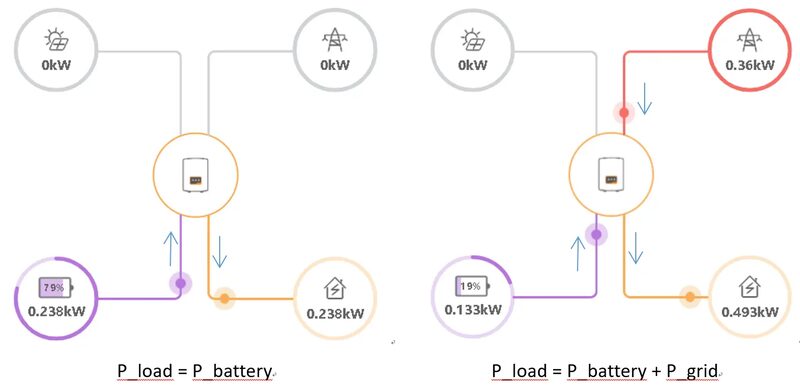
A battery changes the question from "when is the sun shining?" to "when is the electricity needed?". The Energy Saving Trust describes two ways a home battery can be used: to store any excess electricity generated by the panels, or to charge when the tariff is cheap, then use the stored energy at night or when prices are high11. Stored daytime surplus can then be used at times when the panels generate less, such as at night12.
Independent guidance describes the same pattern: electricity generated during the day is stored and then used at night13, or used in the evening, with the added possibility of special export tariffs and lower EV charging costs when paired with an overnight EV tariff14. Solar Energy UK puts it simply: with a battery, any excess power produced during the day can be stored and used at another time when demand is higher15. MCS lists battery storage as a way to "store excess energy to keep your home powered day and night"16.
Solar charging and tariff charging
A battery's control settings decide which of these roles it plays. The Energy Saving Trust describes the tariff-led behaviour in a home with a battery but no panels: the battery stops charging when it is full, and discharges when the next cheap tariff period ends, automatically11. In a home with panels, the same battery can be set to fill from surplus solar in the day and from cheap grid electricity overnight in winter, when there is little solar to store.
Those two roles pull in different directions for independence. Charging from solar raises self-consumption and cuts imports. Charging from the grid on a cheap tariff lowers bills but does not reduce dependence on the grid; it only moves imports to a cheaper time.
Adding a battery to existing panels
Storage does not have to be installed at the same time as the panels. Birmingham's group-buying scheme lets households register to have battery storage added to their existing solar panels to maximise the benefits of the system17, and MCS describes pairing a PV system with a battery to store excess electricity for when it is most needed18. How the battery connects, through a hybrid inverter or as a separate AC-coupled unit, is covered in hybrid inverter vs AC-coupled battery.
How an energy management system raises self-consumption
An energy management system, in a home, is the control layer that decides where each kilowatt hour of solar goes: to appliances running now, into a battery, into a hot water cylinder, into an EV, or out to the grid. Flexi-orb describes electrical energy storage as "a way of increasing your self-consumption and reducing your reliance on the grid"19, and notes that with battery storage consumers can gain control of their own supply and demand for when they need it most20.
The main levers, in rough order of how they are usually added, are:
- Load shifting. Running washing machines, dishwashers and other flexible loads when the panels are generating. This costs nothing but depends on someone being at home or on appliance timers.
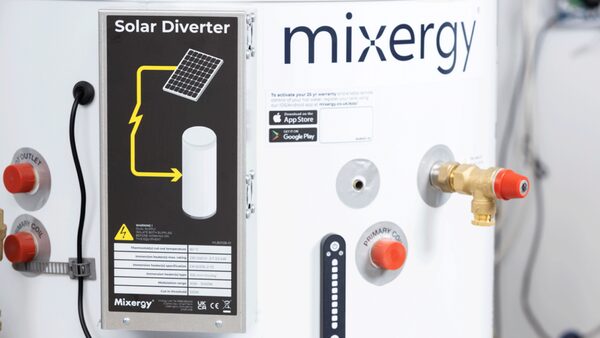
- A solar diverter. Surplus that would otherwise be exported is sent to an immersion heater, storing it as hot water. MCS explicitly excludes diverters from the written estimate5, so the effect is on top of the quoted figure. The trade-offs are set out in solar diverter vs battery and can a hot water tank store energy.
- EV charging from surplus. An EV is a large battery that can absorb midday surplus if it is at home. Uswitch reports that payback for a full solar, EV and battery setup can range from seven to 12 years depending on the initial investment21. See charging an EV from solar vs a cheap overnight tariff.
- A home battery, as described above.
The regulatory position on smart controls is changing. The Energy Act gives government powers to make regulations requiring energy smart appliances to meet requirements regarding "cyber security, data privacy, interoperability, and grid stability"22, and government expects to introduce secondary legislation covering energy smart appliances and load controllers in October 2026. Until those rules apply, how a controller handles data, and whether it keeps working without the maker's online service, depends on the maker; local control versus the manufacturer's cloud and who owns your home energy data cover those questions.
Where self-consumption falls short
Two limits apply to every grid-connected solar home, however high its self-consumption rate.
The first is timing. Which? states plainly that "without an accompanying battery you can only use solar electricity as it's being generated"23. A home without storage imports every kilowatt hour it uses after sunset, whatever its panels produced at midday.
The second is the power cut. A high self-consumption rate does not mean the house keeps its lights on when the grid fails.
The Energy Saving Trust notes that solar panels typically can't power a home during a power cut, except where the home is off the grid or has additional equipment12. The network operators explain why. SSEN states that panels "will automatically switch off during a power cut", a safety feature that prevents electricity flowing back into the network, and that they usually restart on their own once power returns24. Electricity North West gives the same rule, that panels stop working during a power cut for safety reasons25, and adds that most restart automatically after power is restored26. Plug-in solar panels are also designed to switch off if there is a power cut27.
During an emergency rota disconnection, SSEN states that household generation "will not be able to export electricity to the wider electricity network" for the period the home is disconnected28. On the positive side, SSEN says equipment such as solar panels, heat pumps, EV chargers and batteries "should not be damaged and will be ready to use again once power is restored"24.
A battery on its own does not remove this limit: whether stored energy can be used in an outage depends on whether the system can separate from the grid and supply the house independently, which is explained in islanding and anti-islanding.
Roof, orientation and shading shape how much you generate
Self-consumption is a ratio, so it depends on generation as well as on use. How much the panels generate depends first on the roof.
South is the best direction. The Energy Saving Trust notes that panels generate the most electricity facing south because they capture as much sunlight as possible29, and Renewables First describes a roof facing directly south as ideal to maximise exposure and generate the most energy30. Other directions still work, with lower output31:
| Roof condition | Effect on output |
|---|---|
| East or west facing | 15% less energy |
| North facing | around 30% less |
| Roof more than 80% shaded | output reduced by as much as 50% |
Plymouth Energy Community likewise states that a south-facing, unshaded roof offers the best conditions, that east or west-facing roofs can also work well, and that north-facing roofs are less effective32. An east-west split has a side effect that matters for self-consumption: it spreads generation into the morning and evening, when many households use more electricity, rather than concentrating it at midday.
Size is the other constraint. CIPHE gives a general rule that 10m² to 20m² of PV panels will generate between 20 and 40% of a typical household's electricity needs33. The Energy Saving Trust lists what may limit the number of panels: roof shape, skylights, shading from nearby buildings or trees, local planning or conservation area requirements, and local grid capacity and export limits29. RECC describes a large, unshaded, predominantly south-facing roof as ideal34, and NICEIC notes that roof size may dictate the type or number of panels35.
Cloud reduces output but does not stop it. Oxfordshire County Council states that even on a cloudy day good generation can be achieved36; Which? explains that panels use light, not heat, so they work in daylight even when it is overcast37; MCS states they can still generate on cloudy days and in winter, though they are more efficient in direct sunlight18. Winter output is still far lower than summer output, which is the subject of the winter gap.
What a solar PV system costs
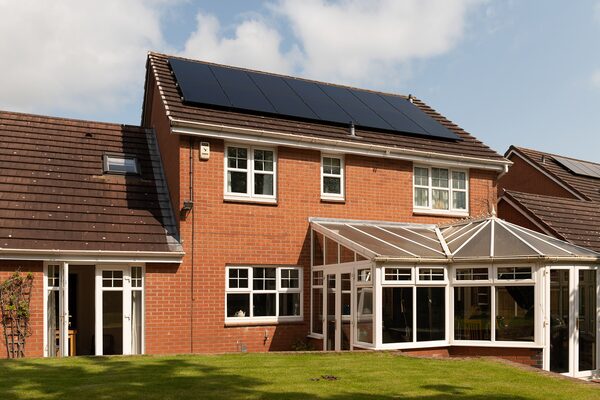
The most widely quoted UK figure is the Energy Saving Trust's: a typical system of around 3.5 kWp costs around £6,100 to install, a figure repeated by councils, Which? and others6. Other published figures are higher because they describe larger systems or different data.
| System | Installed cost | Source and date |
|---|---|---|
| Typical system, around 3.5 kWp | around £6,100 | London Borough of Hammersmith and Fulham, October 20256 |
| Average installation | around £6,100 | Energy Saving Trust, May 202638 |
| Typical system, around 4.5 kWp | around £7,600 | Energy Saving Trust, August 202639 |
| Certified system, average | just over £7,000 | MCS Data Dashboard, 202518 |
| Range by property size | £6,100 to £11,000 | Confused.com, July 202640 |
| 4.6kWp, ten panels, 35 degree pitch | £7,400 | Which?, as of 1 June 202541 |
| Plug-in solar panels | from around £450 | Energy Saving Trust, September 202627 |
The VAT position is not stated alongside these figures; actual prices are installer-quoted and vary with roof, access and equipment. Batteries, diverters and controls add to the cost.
The saving comes largely from self-consumption. In a Which? example for a 4.6kWp east-facing system with modest shading in London, the total annual benefit is £460 a year41. Uswitch frames the self-consumed share differently: a household that uses its own solar is "effectively locking in a portion of your energy costs at 0p per kWh for the next 25 years"3. Every kilowatt hour moved from export to self-consumption is worth the difference between the retail import price and the export rate, which is why raising the rate is where most of the value lies. The full picture of spending on independence is in what energy independence costs.
Payback: typically 10 to 13 years for rooftop solar
Published payback periods for a rooftop system cluster between about ten and thirteen years, with shorter figures for plug-in panels and for setups built around self-consumption.
| Setup | Payback | Source |
|---|---|---|
| Rooftop solar | 10 to 12 years | Hammersmith and Fulham council6 |
| Typical rooftop system | 10 to 13 years | Which?37 |
| Rooftop solar | 10.9 to 12.2 years | Which?, April and September 202642 |
| Plug-in solar | 3.6 to 7.1 years | Which?42 |
| Plug-in solar, £500 panels saving £110 | under five years | Uswitch44 |
| PV optimised for self-generation | 6 to 10 years | ClimateXChange, Scotland45 |
| Plug-in solar | five to ten years | Centre for Sustainable Energy46 |
| Solar, EV and battery together | seven to 12 years | Uswitch21 |
The spread has clear causes. Larger systems cost more but also produce more; plug-in panels are cheap and almost everything they produce is used in the home, so their payback is short even though their output is small. The ClimateXChange figure for Scotland applies where PV is used to optimise self-generation45, which shows the central point of this page in cost terms: the higher the self-consumption rate, the more each kilowatt hour is worth and the faster the system pays back. Payback also moves with electricity prices and export rates, so any figure is an estimate tied to the prices assumed when it was made.
What a self-consumption setup means for your independence
A high self-consumption rate means more of a household's electricity comes from its own roof and less from a supplier. That is a real gain in independence: the self-consumed share is insulated from price rises. The limits are just as real.
Some makers present self-consumption as near-independence. myenergi states that the main benefit of a self-consumption system is "that you will be almost entirely self-sufficient"47. That is a maker's claim, and the evidence above qualifies it. Self-consumption measures how much generation is used, not how much demand is met. A home using 80% of its solar can still import much of its electricity in winter and every night without storage.
The dependencies that remain:
- The grid. Grid-connected panels stop in a power cut24, and winter shortfalls are met by imports.
- A supplier and tariffs. Batteries charged on cheap overnight rates move imports rather than end them11.
- The manufacturer. Batteries, diverters and controllers are managed through makers' apps and, often, online services; how they behave if a company changes its service is a question for local control versus the cloud.
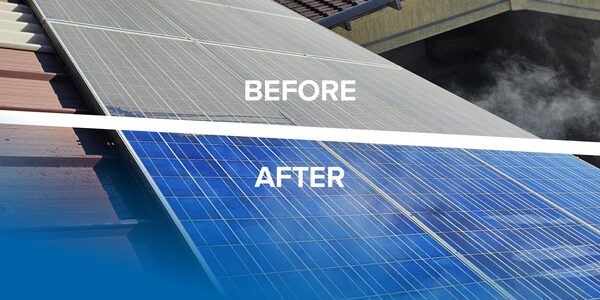
- Maintenance. Most PV systems need little or no maintenance, with an annual check that panels are not too dirty48; the Energy Saving Trust suggests inspecting panels, mountings and visible wiring every one to two years49. Bristol's guidance for listed buildings asks for maintenance by a licensed electrician or the installer at least once a year50.
Self-consumption is therefore one measure among several. The self-sufficiency ratio, sizing generation and storage and designing a whole-home energy system pages take the next steps, and the household energy independence guide sets them in context.
Sources50 cited
- MCS 032: Solar PV Self-Consumption, MCS, 2025-01-01
- POSTnote 771, Parliamentary Office of Science and Technology, 2026-06-25
- Solar panels guide, Uswitch, 2026-09-16
- Britain's homes with solar panels during the heatwave, Uswitch, 2026-06-28
- MGD 003: Solar PV Self-Consumption, MCS, 2022-04-01
- Solar panels, London Borough of Hammersmith and Fulham, 2026-09-17
- Solar PV advice leaflet, National Energy Action, 2026-04-23
- Increasing self-consumption of solar PV: long-term PV analysis, National Energy Action, 2023-06-09
- MIS 3002 Solar PV Systems V4.0, MCS, 2025
- Is now a good time to get a heat pump?, Energy Saving Trust, 2025-12-12
- Battery storage, Energy Saving Trust, 2026-08-19
- Solar power facts, Energy Saving Trust, 2026-08-13
- Solar PV panels, Agility Eco, 2026-09-20
- How to decide if solar panels are right for your home, Ivie, 2026-09-20
- Batteries in the home, Solar Energy UK, 2026-09-17
- MCS for consumers, MCS, 2026-06-23
- Switch Together Birmingham, Birmingham City Council, 2026-01-27
- Solar photovoltaic (PV), MCS, 2026-07-30
- Electrical energy storage systems, Flexi-orb, 2025-04-22
- Flexi-orb for my home, Flexi-orb, 2025-04-10
- Integrating solar panels with EV charging, Uswitch, 2025-07-02
- Energy Act research briefing, House of Commons Library, 2026-09-20
- Solar panels: how much of your electricity can they produce?, Which?, 2024-06-27
- Planned power cuts, SSEN, 2026-09-19
- Tips to help you during a power cut, Electricity North West, 2026-09-19
- FAQs, Electricity North West, 2026-09-20
- Plug-in solar panels, Energy Saving Trust, 2026-09-17
- Emergency planning portal: residential, SSEN, 2026-09-19
- Solar panel installation, Energy Saving Trust, 2026-09-07
- What makes a good solar PV roof?, Renewables First, 2026-04-08
- Buying advice for solar panels, Which?, 2026-08-12
- Solar photovoltaic panels, Plymouth Energy Community, 2026-09-20
- Plumbing with renewables, CIPHE, 2026-09-17
- Consumers, RECC, 2026-09-17
- Renewables and electrics, NICEIC, 2026-09-17
- Solar panels, Oxfordshire County Council, 2026-09-17
- Solar panel myths, Which?, 2026-06-09
- Energy saving upgrades for home renovation, Energy Saving Trust, 2026-05-05
- Solar panels, Energy Saving Trust, 2026-08-27
- Make your home more energy efficient, Confused.com, 2026-07-06
- Are solar panels worth it?, Which?, 2025
- Plug-in solar panels vs rooftop systems, Which?, 2026-04-27
- Plug-in solar panels, Which?, 2026-09-15
- Plug-in solar panels guide, Uswitch, 2026-09-04
- Balancing investment in clean heat and energy efficiency in Scottish housing retrofit, ClimateXChange, 2026-06-03
- Plug-in solar, Centre for Sustainable Energy, 2026-09
- Self-consumption of green energy: how does it work?, myenergi, 2022-06-10
- A complete guide to solar PV, Centre for Sustainable Energy, 2025-11
- Solar panel cleaning and maintenance, Energy Saving Trust, 2026-08-25
- Clifton Local Listed Building Consent Order guidance, Bristol City Council, 2025-02
 Sizing a Self-Sufficient HomeHow many solar panels and how much battery storage does a home need to stop relying on the grid?
 MGD 003 Self-ConsumptionBuying a battery with solar panels means asking how much of your own solar you will actually use instead of sending it to the grid.
 Baseline Your Energy UseBefore spending money on a heat pump, solar panels or a battery, you need to know what your home actually uses now.
 Solar and Energy IndependenceHow far domestic solar cuts dependence on suppliers and the grid, what self-consumption really looks like across the year, what a battery, diverter or EV adds, and the grid-outage limit of ordinary inverters.
 Data and Energy IndependenceHow many UK homes actually make their own power, and is that number really growing?
 Home Battery Install StatisticsHow many homes in the UK actually have a battery, and is that number growing quickly?