In this guide
A zero bills home is one where the household pays nothing for its energy across a year, because the home generates more energy than it uses over that period. That is the arrangement documented in the Cambridge and Octopus Energy study of Zero Bills homes, which found that those homes "generated more energy than they used over the year" and "had no home energy costs at all"1. It is a commercial guarantee attached to a particular property and tariff, not a property type you can buy off a shelf.
A net zero energy home is a different idea. It is a building performance claim: the home produces as much energy as it consumes, which is how the Welsh Government describes net zero housing developments2. The legal underpinning is the nearly zero-energy building definition, which requires a very high energy performance with the very low amount of energy required "covered to a very significant extent by energy from renewable sources, including energy from renewable sources produced on-site or nearby"3. Neither phrase means the home uses no energy. Both mean the annual balance is settled by generation rather than by the grid.
The two are converging in new build policy. The Future Homes Standard is intended to make new-build homes in England "ready for net zero" from 2025, with low carbon heating and no fossil fuel connection4. What follows sets out what each term commits a household to, what the standard actually requires, what it costs and saves, and where the guarantees and the regulations stop.
What "zero bills" actually means: a home that generates more energy than it uses
The phrase describes an outcome measured over a year, not a meter reading of zero. Zero Bills homes generated more energy than they used over the year, and the study records that they had no home energy costs at all1. Octopus Zero Bills homes are already a reality for hundreds of customers who pay nothing for their home energy bills each month1. The mechanism is a tariff arrangement: the home's generation, storage and heating are specified to a standard the supplier accepts, and the supplier then guarantees the billing outcome.
The guarantee has a term. At Templegate, 48 of the homes are eligible for an Octopus Energy Zero Bills tariff, and this results in no energy bills for at least five years1. That is the part a householder needs to read carefully. The zero bill is a contractual period, not a permanent property of the building. After it ends, the household is on whatever tariff applies then, with a home that is well equipped to keep its import low but no longer insulated from prices by the supplier's promise.
The wider policy language is looser. The European Union's nearly zero-energy building definition sets a performance bar rather than a billing one, requiring very high energy performance with the residual demand covered to a very significant extent by renewables produced on site or nearby3. Demand side response, the shifting of consumption to times that suit the grid, "could make household energy bills cheaper" according to parliamentary research9. The older Green Deal model promised energy efficiency improvements at no up-front cost, with consumers repaying through the savings they make on their energy bills10, which is a financing structure rather than a zero bill.
For a household's independence, the distinction matters. A zero bills home is independent of energy prices for the length of the guarantee, but it remains connected to a supplier, a meter and a contract. It is a managed dependence, not an exit from the system.
Net zero energy homes: net zero carbon in operation, not no energy use
Net zero in operation is an accounting statement about carbon, not a statement that the home draws nothing. Zero Bills homes are described as net zero carbon in operation1. Net zero housing developments aim to create homes that produce as much energy as they consume2. The national frame is a target to achieve net zero carbon emissions by 205011.
The practical meaning is that over a year, the carbon associated with the home's operation balances out. A home can do this while importing heavily in winter and exporting heavily in summer, because the balance is annual. That is why the term sits alongside, rather than instead of, the measures that make a home efficient. Making buildings waste less energy through energy efficiency is described in Scotland's Heat in Buildings Strategy as the first step to zero emissions12.
The Welsh Government's modelling shows what happens when that first step is skipped. A light retrofit scenario, without renewables, produces a SAP rating of 54, which is EPC band D13. That is the starting point many existing homes occupy, and it is a long way from a net zero balance. The gap is closed by fabric first, then generation, then a change of heating fuel.
For independence, net zero in operation is a weaker claim than zero bills. It says the annual carbon account is settled. It does not say the household avoids a bill, avoids a supplier, or avoids the grid. A home can be net zero carbon in operation and still pay a monthly direct debit every month of the year.
How a home gets to zero bills: solar, heat pump, insulation and fabric first
The route is consistent across the sources: reduce demand first, then electrify heat, then generate and store. Scotland's strategy puts energy efficiency first, describing making buildings waste less energy as the first step to zero emissions12. The Future Homes Standard is designed to ensure new build homes are future-proofed with low carbon heating and high levels of energy efficiency14.
Approved Document L sets out how a new dwelling can meet its target primary energy rate: fabric energy efficiency, efficient building services, and low and zero carbon technologies integrated in an appropriate mix, provided minimum fabric standards are satisfied15. That is the regulatory expression of the same sequence. The Etopia Homes project in Wales illustrates it at the level of a single scheme, with low carbon features across its first 10 homes including structurally insulated panel construction, triple glazing and a ground source heat pump to provide space and water heating14.
The tax system supports the same list. Energy saving materials installed in residential accommodation and certain charitable buildings carry VAT relief at 0% until 31 March 202716. The materials covered include air source heat pumps, wood fuelled boilers, central heating and hot water controls, draught stripping, ground source heat pumps, insulation, micro combined heat and power units, solar panels, water and wind turbines, water source heat pumps, electrical storage batteries and smart diverters16. In Northern Ireland, installations of energy-saving materials including solar panels and heat pumps benefit from a zero rate of VAT17.
For a household, this is the sequence that produces independence: fabric first cuts the demand that has to be met, a heat pump moves the remaining heat demand onto electricity, solar meets part of that electricity directly, and a battery or a smart diverter shifts the rest. Each step reduces what the grid has to supply. None of them removes the connection.
The Future Homes Standard: what new homes in England must now include
The standard is the regulatory floor for new build in England. Its stated purpose is to improve the energy efficiency and reduce the carbon emissions of new dwellings and non-domestic buildings, to ensure they are zero carbon ready19. The commitment is that new-build homes in England are "ready for net zero" from 20254, and that all new build homes must be carbon zero ready5.
The requirement is expressed as an outcome rather than a technology list. The standard will ensure that new build homes are future-proofed with low carbon heating and high levels of energy efficiency14. The Government's position is that new homes will not be built with fossil fuel heating, such as a natural gas boiler20. The detailed specification was consulted on from November 2023 to March 20247.
The retrofit question is answered directly. Government guidance states that no further energy efficiency retrofit work will be necessary to enable new homes to become zero carbon as the electricity grid continues to decarbonise20. That is the sense in which the standard is "zero carbon ready": the building is prepared for a decarbonising grid rather than required to be carbon neutral on day one.
"No further energy efficiency retrofit work will be necessary to enable them to become zero-carbon as the electricity grid continues to decarbonise"
The standard applies to new dwellings in England. Scotland, Wales and Northern Ireland set their own building and heat policy, and the sources here describe separate Scottish and Welsh strategies rather than a single UK standard12. A householder in an existing home is not caught by it at all.
What the Future Homes Standard requires: solar, heat pumps and no gas connection
The heating requirement is the clearest part. The consultation states that gas boilers, including hybrid and hydrogen-ready boilers, will not meet the proposed standards, and that fossil fuel heating will not meet this standard, including hydrogen-ready and hybrid boilers7. That closes off the argument that a hydrogen-ready appliance is a compliant route in a new home.
Solar is the part with the most variation between proposals. One option consulted on would have required solar PV panels covering the equivalent of 40% of a new home's ground floor area21. The New Homes (Solar Generation) Bill 2024-25 proposed that solar PV systems must cover an area equivalent to at least 40% of the new home's ground floor area21. Under that option, solar PV panels would not be required for blocks of flats over 15 storeys21. There is no single figure in force that a householder can point to as the mandated roof coverage.
| Requirement | Position | Source |
|---|---|---|
| Heating fuel | Gas, hybrid and hydrogen-ready boilers will not meet the proposed standards | 7 |
| Fossil fuel heating | Will not meet the standard | 7 |
| Solar coverage option | 40% of ground floor area, consulted on | 21 |
| Flat exemption under that option | Blocks over 15 storeys | 21 |
| Retrofit for new homes | None necessary as the grid decarbonises | 20 |
For a household, the significance is that a new home bought after the standard takes effect should not need a gas connection, should have a heat pump or equivalent low carbon heating, and should have solar in many designs. That is a materially lower import profile than a home built to earlier regulations. It is not self-sufficiency: the home still draws from the grid in winter and still relies on a supplier.
Bill savings and build costs: solar savings against the cost of a higher specification
The savings case rests on the difference between a standard home and a zero bills home. The Cambridge and Octopus Energy study found that Zero Bills homes could command a price premium of up to 16%, based on five million property transactions analysed1. That is a market signal about running costs, not a bill saving in itself.
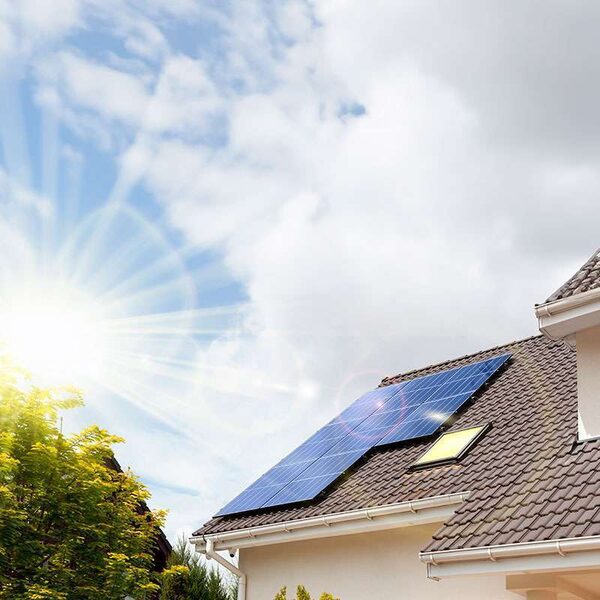
The bill saving from solar alone is documented for ordinary homes. Solar photovoltaic panels save between £530 and £650 a year on electricity bills for a typical home without electrical heating or an electric vehicle6. That is the figure a household can use as a baseline for what generation contributes before any change of heating fuel.
For the least efficient homes, the ECO4 scheme was designed to deliver a maximum bill reduction of up to £1,60022. That is a different measure, aimed at the bottom of the efficiency range rather than at new build, and it shows how much of the saving comes from fabric rather than from generation.
The build cost side is where the numbers are thinner. The sources here do not give a published per-dwelling build cost for a Future Homes Standard home, and prices for the equipment and installation are installer-quoted rather than published. What the sources do establish is the direction: the standard raises the specification of a new home, and the specification is what carries the cost.
For independence, the saving is the visible part of a larger effect. A home that generates its own electricity, heats with a heat pump and stores some of its output is buying less from the grid every year. The bill is the symptom; the reduced import is the substance.
Where the standard falls short: no mandated battery storage and retrofit risks
Battery storage is not required. The Building Regulations do not require that high-efficiency alternative systems or other low or zero carbon systems are installed21. That is the regulatory position, and it means a compliant new home can be built without any storage at all. The consequence is that generation and demand do not have to be matched within the home, so surplus goes to the grid and shortfalls come from it.
Consumer awareness is a documented obstacle. Ofgem found low awareness among consumers a significant obstacle to adopting home battery storage, and described low awareness as unlikely to adopt low carbon technologies23. A standard that does not mandate storage therefore leaves adoption to a market where awareness is already weak.
The retrofit risk sits with existing homes. The Welsh modelling shows a light retrofit without renewables landing at SAP 54, EPC band D13. Scotland's Heat Pump Sector Deal Expert Advisory Group recommended announcing a specific date by which new heating systems fitted to existing properties, both domestic and non-domestic, must be zero-carbon, phased with an earlier date off the gas grid and a later one on the gas grid24. Scotland's consultation sets a target for all buildings across all tenures to achieve a good level of energy efficiency by 2035 and use zero emissions heating and cooling by 204525.
For a household, the shortfall is the gap between "zero carbon ready" and "zero bills". The first is a building standard. The second is a commercial arrangement that requires storage, control and a supplier willing to underwrite the balance.
Passive House: the German design standard built on airtightness
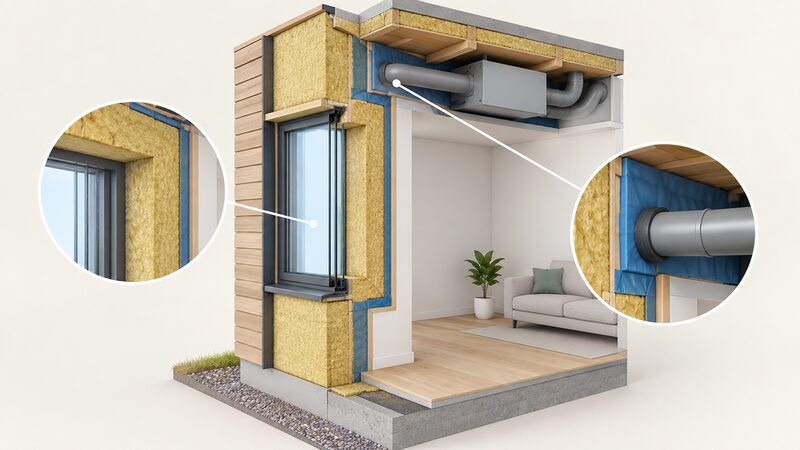
Passivhaus, literally passive house in English, refers to buildings created to rigorous energy efficient design standards8. The Passivhaus Institute in Germany developed the energy efficient building principles8. The standard is a design and construction method, not a billing arrangement, and it is the most demanding fabric route described in these sources.
The defining feature is airtightness, at around 20 times more than a standard build8. The aim is stated plainly: a Passivhaus building aims to reduce the need to heat the building to such an extent that you don't need a conventional heating system8. That is a fabric-led route to very low demand, which is why it appears in the same conversation as zero bills homes even though it is a different kind of claim.
The social evidence is notable. Hastoe Housing Association in the south of England claimed that rent arrears were virtually zero on its Passivhaus development8. That is a housing management outcome rather than an energy one, but it is the kind of evidence that carries weight with landlords and developers.
The distinction for a householder is this: a Passivhaus reduces how much energy the home needs. A zero bills home guarantees what the household pays. A home can be one without being the other. A Passivhaus with a conventional tariff still receives bills, and a zero bills home need not be built to Passivhaus airtightness.
What the terms mean for existing homeowners and for energy independence
For an existing home, none of the new build standards apply directly. The Future Homes Standard governs new dwellings19. The routes available to existing homes are separate. In Wales, the New Warm Homes Programme states that eligible homes without a current EPC will not be prevented from applying, and applicants who meet the low income threshold will receive an assessment of the current EPC rating of their home26. That is a support programme rather than a mandate.
The direction of travel for existing homes is set out in the Scottish documents. The Heat Pump Sector Deal Expert Advisory Group recommended announcing a specific date by which new heating systems fitted to existing properties must be zero-carbon, phased with an earlier date off the gas grid and a later one on the gas grid24. The Scottish consultation target is a good level of energy efficiency across all tenures by 2035 and zero emissions heating and cooling by 204525. The Social Housing Net Zero Heat Fund requires homes benefiting from fabric first support to install or connect to zero emissions heating by 203227.
For independence, the honest summary is this. A zero bills home removes the energy bill for the length of the guarantee, and it removes most of the household's exposure to wholesale prices over that period. It does not remove the grid connection, the supplier relationship or the meter. A net zero energy home balances its annual carbon account but can still pay a bill every month. A Passivhaus cuts demand so far that a conventional heating system is not needed, but it still needs a supply for whatever demand remains.
The dependence that remains is real and worth naming: the grid for winter and for peak loads, a supplier for the tariff and the guarantee, the gas network for any home not yet converted, and the manufacturer for the control system, the app and the warranty. A household that wants to go further can look at self-consumption and how much of its own generation it actually uses, at sizing generation and storage for a self-sufficient home, and at the winter gap that no amount of summer surplus closes. The full guide to household energy independence sets out the whole picture.
Sources27 cited
- Watt a Save: Zero Bills homes research, Home Builders Federation, 2026-02
- UK's largest net zero housing development to be delivered in Wales, Welsh Government, 2025-10-02
- Energy Performance of Buildings Directive 2010/31/EU, legislation.gov.uk
- The Future Homes Standard, House of Commons Library
- Future Homes Standard timeline, Planning Portal
- Solar panels: energy improvement options, London Borough of Hammersmith and Fulham, 2025-10
- The Future Homes and Buildings Standards 2023 consultation, GOV.UK, 2026-09-17
- Passivhaus: what you need to know, Energy Saving Trust, 2026-02-16
- Demand side response and household bills, Parliamentary Office of Science and Technology, 2026-06-07
- The Green Deal, Energy and Climate Change Committee, 2026-09-20
- Decarbonising heat in homes, Business, Energy and Industrial Strategy Committee, 2022-02-03
- Heat in Buildings Strategy: easy read, Scottish Government, 2022-03-07
- Homes of today for tomorrow: decarbonising Welsh housing 2020 to 2050, Welsh Government, 2024-02
- Building for 2050: low cost, low carbon homes, GOV.UK, 2022-12-05
- Approved Document L, Volume 1: Dwellings, GOV.UK, 2026
- VAT rates on different goods and services, GOV.UK, 2026-07-10
- Support to generate your own electricity, nidirect, 2025-09-22
- VAT on energy saving materials and heating equipment (Notice 7086), GOV.UK, 2024-02-01
- RPC opinion: Future Homes and Buildings Standards impact assessments, GOV.UK, 2026-03-25
- Government response to the Future Homes Standard consultation, GOV.UK, 2021-01
- New Homes (Solar Generation) Bill 2024-25 and Future Homes Standard solar options, House of Commons Library, 2026-09-17
- ECO4 government response, GOV.UK, 2022-04-01
- Tracking energy consumers' use of low carbon and flexible products and services 2025, Ofgem, 2025-06
- Heat Pump Sector Deal Expert Advisory Group interim report, Scottish Government, 2021
- Heat in Buildings Strategy: achieving net zero emissions in Scotland's buildings, Scottish Government, 2021-02-05
- New Warm Homes Programme policy statement, Welsh Government, 2023-06-15
- Heat Networks Delivery Plan, Scottish Government, 2022-03
 Heating and Energy IndependenceCan you heat your home without relying on gas or oil, and what would that take?
 Suppliers and IndependenceCan you really cut your energy bills by making your own power, and how much of your supplier do you still need?
 New Build Homes and EnergyWhat heating will a new build actually have, and will it be a heat pump rather than a gas boiler?
 Energy Security for HouseholdsCan a household really protect itself from gas and electricity price shocks, and what actually makes a difference?
 Grants and Energy IndependenceCan you get a grant for solar panels or a battery?
 Planning Energy IndependenceCutting what you use, moving heating off gas, putting solar on the roof and adding a battery all help, but none of them takes you off the grid completely.