In this guide
The Future Homes Standard is the performance level that new homes in England must meet so that they are built without fossil fuel heating. The government's own consultation states the intent plainly: new homes will not be built with fossil fuel heating, such as a natural gas boiler1. The 2023 consultation goes further and names the technologies that fail: "This means gas boilers, including hybrid and hydrogen-ready boilers, will not meet the proposed standards."1
The headline numbers are emissions, not fuel. An average semi-detached home built to the standard is expected to have 75% lower emissions than one built to 2013 standards1, and the government has put the reduction at 75% to 80% against then-current Building Regulations2. Solar panels are required as standard on new homes, with the standard to be implemented in early 20263. Scotland has moved first and separately: the New Build Heat Standard has been in force since 1 April 2024, and fossil fuel gas and oil boilers cannot be used as a mains heating system in new-build homes and buildings there4.
For a household, the practical meaning is narrow but firm. The standard governs what is built, not what already stands. It does not require anyone to remove a working boiler from an older home, and it does not apply to existing dwellings. What it does is remove gas from the new-build market, which changes what a buyer of a new home is choosing between, and it sets the direction that retrofit policy is expected to follow later.
What the Future Homes Standard is and what it requires
The standard is a performance level for new dwellings, expressed as carbon and energy outcomes rather than as a list of permitted appliances. Its stated aim is to improve the energy efficiency and reduce the carbon emissions of new dwellings and non-domestic buildings so that they are zero carbon ready5. The government's earlier position was that the standard would ensure new build homes are future-proofed with low carbon heating and high levels of energy efficiency2.
The emissions figures have been consistent across documents. The introduction of the standard, the government said, will ensure that an average home produces at least 75% lower CO2 emissions than one built to current energy efficiency requirements1. A separate statement put an average semi-detached home at 75 to 80% less carbon dioxide than one built to current requirements2. The parliamentary briefing gives 75% lower emissions than under 2013 standards for an average semi-detached home1.
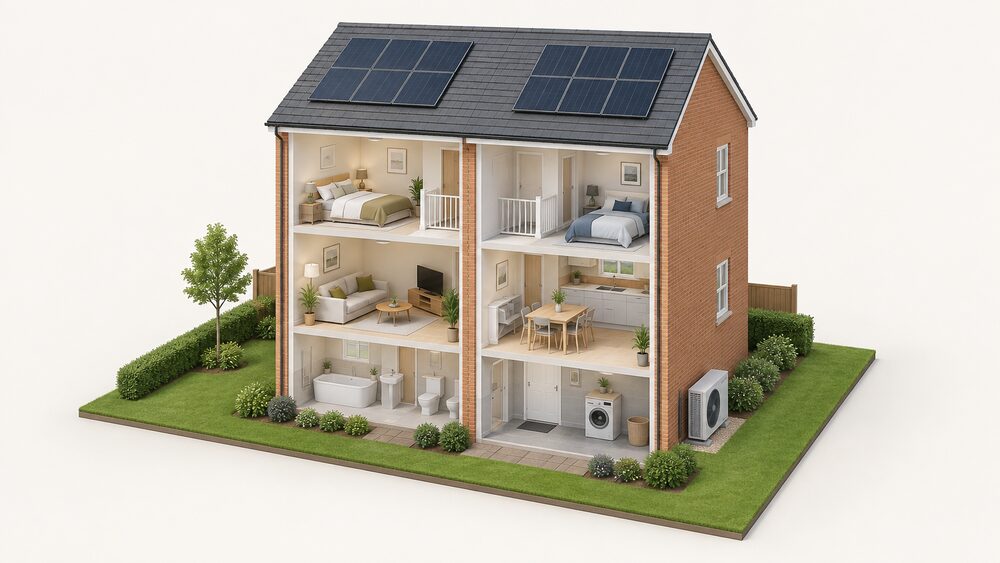
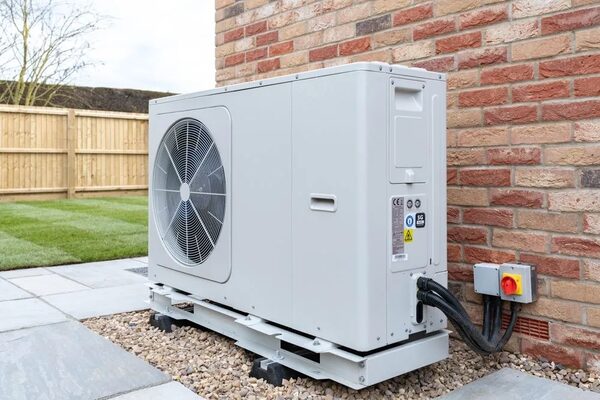
What drives that reduction is the removal of the gas boiler and the addition of on-site generation. Heat pumps become "the primary heating technology"1, and solar panels are required as standard3. The standard is not, on the evidence published so far, a fabric revolution: the proposed new standard does not currently require an uplift to insulation requirements compared to existing standards1. That is a significant point for anyone assuming the new homes will be sealed to a much higher level than current ones. The carbon saving comes mainly from the heat source and the roof, not from the walls.
For a household's energy independence, this is a real shift. A new home with a heat pump and solar generates part of its own heat and power and is not exposed to a gas connection for its heating. What remains is dependence on electricity: the grid, a supplier, and the tariff the household is on. A heat pump without a battery still draws from the grid at the times it runs, and solar output does not match evening demand without storage.
England or Scotland: which standard applies where
Two different regimes are running in parallel, and the difference matters more than any single figure.
In England, the Future Homes and Buildings Standards will be implemented via the Building Regulations etc. (Amendment) (England) Regulations 20265. The 2023 consultation applies to England1. The parliamentary briefing notes planned updates to requirements for new homes across England and Wales in 2025, Scotland in 2024 and Northern Ireland in 2026 or 20271, which is the clearest single statement of how the four nations diverge.
In Scotland, the New Build Heat Standard is already law. It is a requirement set out in law and comes into force from 1 April 20244. It applies to all new buildings applying for a building warrant from April 2024, which need to install clean heating systems, and it also applies to some conversions4. Its purpose is to make sure that any new buildings are future-proofed by using clean heating systems which will not require future retrofit4.
Wales and Northern Ireland sit at different points again. The Welsh government maintains mandatory quality standards for new, rehabilitated and existing homes, consulted on between 18 January 2016 and 11 April 20166, which is a separate and older strand of work. Northern Ireland is placed at 2026 or 2027 for its update1.
The practical consequence is that a householder buying a new home needs to know which nation the property is in before assuming anything about its heating. A new home in Scotland cannot have a gas or oil boiler as its mains heating system4. A new home in England is being built towards a standard that gas boilers, hybrids and hydrogen-ready boilers will not meet1, with the regulations made under an England-only instrument5.
Timeline: consultation, commencement and full compliance
The consultation history is longer than the implementation. The government consulted on the Future Homes Standard between 2019 and 20201, then on its technical proposals for meeting the standard from November 2023 to March 20241. The 2023 consultation was scheduled for 12 weeks from 13 December 2023 to 6 March 20241, and the deadline was extended another three weeks to 11:59 on 27 March 20241. The government response to that consultation was added on 24 March 20261.
On commencement, the published dates differ, and the difference is worth stating rather than smoothing over. The consultation said the standards would come into force from 20251. The planning portal timeline records 2025 as the year the Future Homes Standard comes into force, with all new build homes required to be carbon zero ready, and 2024 as the year the standard would be published with related legislation implemented7. The government's 2022 position was that the standard would be brought into force in 20252. A later independent report describes the standard as coming into effect December 2026, described there as a planning assumption8. The government news release places implementation in early 20263.
The honest reading is that the standard has been repeatedly restated and the operative date has moved. The consultation response was published in March 20261, and the implementing instrument is the Building Regulations etc. (Amendment) (England) Regulations 20265. A householder or a buyer should treat any single date as provisional and check the current position for the specific development.
Separately, revised building regulations preventing new homes being connected to the gas grid are set to be implemented from 20271. That is a different instrument from the heating standard, and it addresses the connection rather than the appliance.
What a new home must have: heat pumps, solar and fabric standards
Three elements define a compliant new home, and they are not equally demanding.
Heating. Heat pumps become the primary heating technology1. The standard will ensure new build homes are future-proofed with low carbon heating2. The 2021 position was that the performance standard would be set at a level meaning new homes will not be built with fossil fuel heating such as a natural gas boiler1.
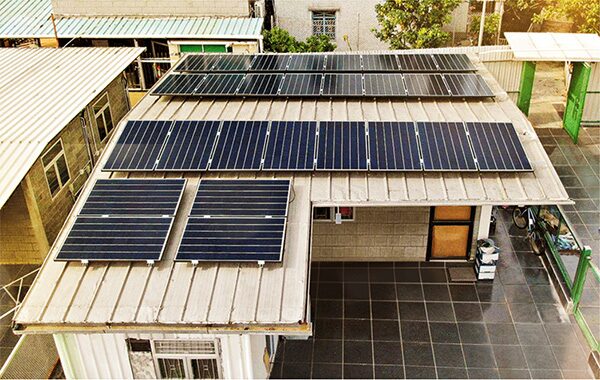
Solar. Solar panels are required as standard on new homes3. The detail sits in the consultation response: the exception to the general approach is solar, which is handled differently4. One option considered would have required solar PV panels covering the equivalent of 40% of a new home's ground floor area1. That option is described as an option, not as the adopted rule, so the exact coverage requirement should be read from the final regulations rather than from the consultation.
Fabric. The proposed new standard does not currently require an uplift to insulation requirements compared to existing standards1. This is the element most often assumed and least supported. A new home under the standard is not, on the published evidence, a much better insulated home than one built to current rules; it is a differently heated one.
| Element | Requirement | Source position |
|---|---|---|
| Heating | Heat pumps as primary heating technology | Official briefing1 |
| Fossil fuel heating | Gas, hybrid and hydrogen-ready boilers will not meet the standard | Official consultation1 |
| Solar | Panels as standard on new homes | Government news release3 |
| Solar coverage | 40% of ground floor area was one option considered | Official briefing1 |
| Fabric | No current uplift to insulation requirements proposed | Official briefing1 |
For energy independence, the combination is meaningful but partial. A heat pump removes gas from the heating load. Solar reduces the electricity drawn from the grid in daylight hours. Neither removes the connection to the grid, and without storage the solar output is exported or used immediately rather than banked for the evening.
Why gas boilers, hybrids and hydrogen-ready boilers do not qualify
The exclusion is explicit and covers the technologies households most often ask about. Gas boilers, including hybrid and hydrogen-ready boilers, will not meet the proposed standards1. Fossil fuel heating will not meet the standard, including hydrogen-ready and hybrid boilers1.
That closes off three routes at once. A conventional gas boiler fails on emissions. A hybrid, which pairs a heat pump with a gas boiler for peak demand, fails because the gas boiler is still fossil fuel heating. A hydrogen-ready boiler fails because it is a gas boiler at the point of installation, whatever it can be converted to later. The consultation language does not distinguish between them.
Biofuel systems are also unlikely to be permitted. The standards proposed are unlikely to allow the installation of biofuel systems, including wood and manufactured solid fuels1. That is a consultation position rather than a settled rule, and it is stated as unlikely rather than prohibited.
There is a related point about grants that catches new-build buyers. New-build homes and social housing are not eligible for the Boiler Upgrade Scheme9, and the scheme guidance confirms that new builds by commercial property developers are not eligible at the point of being built, with eligible self-builds the only eligible new builds10. Social housing is not eligible11. So a household moving into a new home cannot look to the Boiler Upgrade Scheme to fund a later change of heating system. The Warm Homes: Local Grant is also closed to gas and oil boilers, which are not eligible improvements under that scheme12.
Exemptions and higher-risk buildings

The standard is not applied uniformly to every building type, and the exemptions are specific.
For blocks of flats, one option considered would not require solar PV panels for blocks of flats over 15 storeys1. That is a height threshold, and it is described as an option rather than as the final rule. The solar requirement is the element most likely to be varied by building type, because the consultation response states that solar is handled differently from the rest of the standard4.
Higher-risk buildings carry their own regulatory regime, and the published material on the Future Homes and Buildings Standards does not set out a separate heating exemption for them. What the documents do show is that the standards are implemented through the Building Regulations, which already contain the higher-risk building provisions, so the interaction is a matter for the regulations rather than for the standard itself.
The practical position for a householder is that exemptions exist mainly for practical constraints: roof area, building height, and the feasibility of fitting the required technology. They are not exemptions from the direction of travel. A flat above 15 storeys may not carry solar panels, but it is still a new building under a regime that does not permit fossil fuel heating as the mains system in Scotland4 and that gas boilers will not meet in England1.
What it means for existing homeowners
The single most important point is that the standard does not reach existing homes. It governs new build. Nothing in the Future Homes Standard requires a householder in an older property to replace a working gas boiler, and the 2021 statement of intent was about the performance standard for new homes, not retrofit1.
What does reach existing homes is a separate and slower set of proposals. The Scottish Government has proposed a new Heat in Buildings Bill to require homeowners in Scotland to meet a minimum energy efficiency standard by 20331. The New Build Heat Standard consultation described similar requirements in existing buildings from 2025 onwards as the direction of travel13. The Heat in Buildings Strategy sets a target for over 1 million homes in Scotland to convert to zero emissions heating by 2030, and the equivalent of 50,000 non-domestic buildings7.
For England, the parliamentary briefing places the update to new home requirements in England and Wales in 2025, Scotland in 2024 and Northern Ireland in 2026 or 20271. The 2035 date that circulates for gas boiler phase-out is a strategy ambition rather than a regulation, and no legally binding decision has been made on it.
The independence picture for an existing household is therefore unchanged by this standard. A home on gas remains on gas, dependent on the grid for electricity and on a supplier for both. What changes is the resale and comparison landscape: as new homes come to market without gas heating, the running cost and comfort comparison between an older gas home and a new heat pump home becomes a live question for anyone buying. The site's guide to home heating running costs by fuel sets out how those costs compare, and heat pumps compared with boilers covers the technology difference directly.
Scotland's New Build Heat Standard and the Heat in Buildings Strategy
Scotland is the part of the UK where this is already settled law rather than a proposal. The New Build Heat Standard is a requirement set out in law and comes into force from 1 April 20244. All new buildings applying for a building warrant from April 2024 need to install clean heating systems, and it also applies to some conversions4. Fossil fuel gas and oil boilers cannot be used as a mains heating system in new-build homes and buildings4.
The regulations were laid in the Scottish Parliament in the week commencing 5 June 2023, and the building standards Technical Handbooks were to be updated later in 202313. The standard opened on 1 April 202413. The Scottish Government administers it, and the published contact address is 2024heatstandard@gov.scot4. The Heat in Buildings Regulations Unit is named in the consultation material13.
Behind the new-build rule sits the Heat in Buildings Strategy, which is broader and slower. It sets a target for over 1 million homes in Scotland to convert to zero emissions heating by 2030, and the equivalent of 50,000 non-domestic buildings7. Emissions from heat in buildings will have to fall by 68% by 2030 compared with 20207. On energy efficiency, the target for homes is at least equivalent to an EPC Band C, with all homes meeting at least this standard by 20337. A new Heat in Buildings Strategy and Delivery Plan is due by the end of 202614.
The funding attached to the strategy is £1.8 billion to 20264. The Scottish Government has also assessed the employment effect: research suggests the additional jobs supported in 2030 will exceed those displaced by an estimated 16,400 as a result of investment in zero emissions heat jobs15.
"The purpose of the New Build Heat Standard is to make sure that any new buildings are future-proofed by using clean heating systems which will not require future retrofit."
For a Scottish household, the independence effect is the clearest in the UK. A new home has no gas heating connection to depend on, and its heat comes from electricity. The dependence that remains is on the grid, the supplier and the tariff, plus whatever the heat pump's own controls and any app require. The site's boiler and heating grants in Scotland page covers the support that exists for existing homes rather than new ones.
Expected savings and emissions reductions
The emissions figures are the most consistent numbers in the whole subject. An average semi-detached home under the standard will have 75% lower emissions than under 2013 standards1. The government has stated 75% to 80% lower emissions than homes built to then-current Building Regulations2, and at least 75% lower CO2 emissions than one built to current energy efficiency requirements1. The standard's stated purpose is to improve energy efficiency and reduce carbon emissions so that new dwellings and non-domestic buildings are zero carbon ready5.
The bill savings are less settled, and the two figures in circulation measure different things. A parliamentary briefing cites MCS and Solar Energy UK saying the Future Homes Standard would save the average household around £1,000 a year1. A separate independent report gives a saving of around £530 a year, based on a 3.5kW south facing installation8. The second is tied to a specific solar installation size and orientation; the first is a household average. They are not directly comparable, and neither should be read as a guaranteed figure for a particular home.
| Measure | Figure | Basis |
|---|---|---|
| Emissions vs 2013 standards | 75% lower | Average semi-detached home1 |
| Emissions vs current Building Regulations | 75% to 80% lower | Government statement2 |
| CO2 vs current energy efficiency requirements | At least 75% lower | Government statement1 |
| Annual bill saving | Around £1,000 | MCS and Solar Energy UK, cited in briefing1 |
| Annual bill saving | Around £530 | 3.5kW south facing installation8 |
What drives the saving is the combination of a heat pump running on electricity instead of a gas boiler, and solar generation reducing imported electricity. What limits it is the same thing that limits independence: without storage, solar output is not available in the evening, and the heat pump's running cost depends on the electricity tariff and the flow temperature it is set to. The site's boiler flow temperature page explains why that setting matters for running cost, and solar thermal water heating covers the separate solar hot water route.
Sources15 cited
- The Future Homes and Buildings Standards: 2023 consultation, GOV.UK, 2023-12-13
- Building for 2050: low cost, low carbon homes, GOV.UK, 2022-12-05
- Families to save in biggest home upgrade plan in British history, GOV.UK, 2026
- New Build Heat Standard factsheet, Scottish Government, 2025-01-01
- RPC opinion: Future Homes and Buildings Standards impact assessments, GOV.UK, 2026-03-25
- Mandatory quality standards for new, rehabilitated and existing homes, Welsh Government, 2016-01-18
- Heat in Buildings Strategy summary document, Scottish Government, 2021-10-07
- Future Homes Standard DESNZ announcement, Future Homes, 2025-06-06
- Boiler Upgrade Scheme leaflet, GOV.UK, 2022-05
- Boiler Upgrade Scheme guidance for installers, Ofgem, 2023-09-25
- Boiler Upgrade Scheme guidance for installers, Ofgem, 2023-05-18
- Warm Homes: Local Grant, Greater Manchester Combined Authority, 2026-09-17
- New Build Heat Standard consultation, Scottish Government, 2023
- Heat in Buildings Strategy: achieving net zero emissions in Scotland's buildings, Scottish Government, 2021-10-07
- Heat in Buildings Strategy: business and regulatory impact assessment, Scottish Government, 2021-10-07
 Future Homes StandardWill your new build still have a gas boiler, and when do the new rules actually start?
 Future Homes Standard FabricWill a new home be cheaper to heat than an older one?
 New Build Heat StandardScotland's New Build Heat Standard means gas and oil boilers are no longer allowed in new homes from April.
 New Build Homes and EnergyWhat heating will a new build actually have, and will it be a heat pump rather than a gas boiler?
 Overheating StandardsScotland and Northern Ireland handle overheating in new homes differently from England and Wales.
 Building RegulationsReplacing a boiler or heating system usually needs building regulations approval, and the rules differ across England, Scotland, Wales and Northern Ireland.