
In this answer
Short answer
Yes. There is no ban on replacing a gas boiler in an existing UK home, and no requirement to switch fuel at the moment the old one is swapped out. Independent guidance is explicit: "There are no plans yet to ban replacement gas boilers in existing homes"1. The Northern Ireland consultation on building regulations states the same position for existing dwellings: "There is no requirement, at this stage, to prevent fossil fuel boiler replacements"2.
What the rules do require is narrower than a ban. A replacement will probably have to be a condensing boiler unless there is sufficient reason why one cannot be installed, and that assessment is carried out by a registered installer3. The work itself must be done by a Gas Safe registered engineer; doing the gas work yourself is both dangerous and illegal4.
The direction of travel is real but slow. Government policy aims to phase out the installation of new and replacement natural gas boilers by 2035 at the latest5. That is a target for the end of fossil fuel installations, not a rule that stops a household replacing a broken boiler today.
When a replacement is worth doing: the 10 to 15 year rule of thumb
The advice from consumer bodies and advisory services clusters around a decade. One advisory service asks directly whether your boiler is more than 10 years old8. A consumer body suggests considering a new boiler if yours is 10 to 15 years old, frequently has issues or breaks down a lot6. Another flags the 10 year mark as the point to start thinking about replacement7.
The upper end of the band is where the case becomes stronger. One consumer body suggests replacement once a boiler is over 15 years old9, and a comparison table gives a lifespan of 10 to 15 years10. A think tank works from an average boiler life span of 15 years when modelling the phase-out11.
The range across these sources is not a disagreement about physics so much as about what triggers action. A boiler at 10 years old that is serviced annually and runs well is not in the same position as one at 15 years that has had three repairs. The 10 to 15 year band is a planning horizon, not a deadline.
For a household's energy independence, the calculation is modest either way. A new gas boiler still runs on gas bought from a supplier, still depends on the gas network, and still leaves the household exposed to wholesale gas prices. Replacing like with like improves reliability and efficiency; it does not change where the heat comes from.
No need to replace if your boiler is in good working order

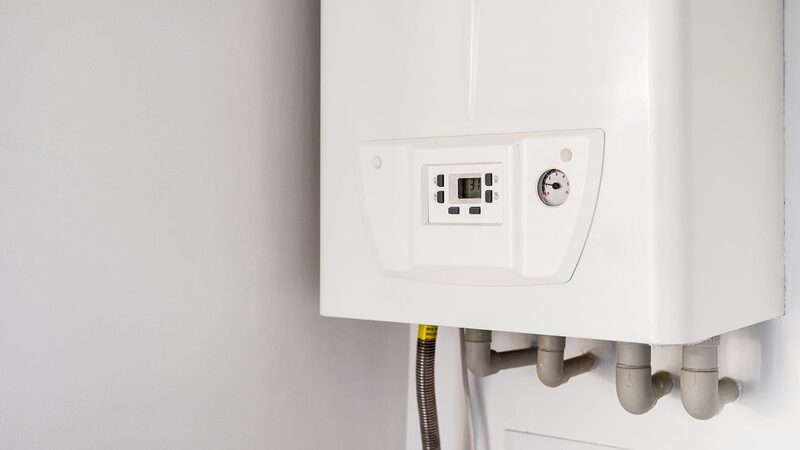
A working boiler is not something the rules require you to remove. The policy position is to replace existing functioning gas boilers with a low carbon alternative when they naturally need to be12, which places the timing with the household and the condition of the appliance rather than with a fixed date.
Consumer advice draws the same line. Replacement is described as worth it if a non-condensing boiler was bought before 2005, while an old condensing boiler need not be replaced unless it is broken, functioning poorly or condemned13. That distinction matters: the condensing requirement means most boilers fitted since 2005 are already condensing, so the pre-2005 test catches the older, less efficient stock.
There is a safety dimension that runs independently of efficiency. A gas boiler works even when the heating is off, and faulty appliances can release carbon monoxide14. That is an argument for annual servicing and a working alarm, not for replacement on age alone.
Cover products also accommodate older appliances. One cover provider will cover boilers that are not brand new, as long as they are in good working order, fuelled by natural gas and have a total power input of less than 70kW15. Repair cover is available without existing cover with at least one provider16.
What to weigh before you commit to a new gas boiler
Cost is the first practical consideration. A replacement gas boiler typically costs between £2,000 and £3,0006. That figure is installer-quoted rather than published as a national price, and it moves with the model, the property and any additional work. The old boiler can often be taken away by the engineer at no extra cost, and old boilers or their parts can sometimes be recycled17.
Efficiency is the second. A condensing replacement captures heat that a non-condensing unit sends out of the flue, which is why the building regulations push replacements towards condensing in the first place3. The gain is largest when a pre-2005 non-condensing boiler is being swapped out13.
The third consideration is whether gas is the right fuel to stay on. Independent guidance notes that switching away from mains gas may not reduce bills if you are already on mains gas with a newer boiler18. That is a statement about running costs, not about carbon or about future price risk, and it cuts against treating a heat pump as an automatic saving.
Where a household does want to move, the Boiler Upgrade Scheme requires that any existing fossil fuel heating system, such as a gas or oil boiler, must be fully replaced19. Hybrid arrangements are possible under other scheme rules, but only where the existing gas boiler has an energy-related products rating of A or above and is in good working order20.
| Option | What the rules require | Independence it gives |
|---|---|---|
| Like-for-like gas replacement | Condensing boiler, Gas Safe installer3 | Reliability, not fuel independence |
| Heat pump, Boiler Upgrade Scheme | Existing fossil fuel system fully replaced19 | Off gas, still on electricity |
| Hybrid retrofit | Existing boiler rated A or above, in good working order20 | Partial, gas still needed |
| Biomass | May not replace heating in a property with a gas supply22 | Off gas where eligible |
Can I replace my gas boiler with the same type?
In most cases, yes. The replacement will probably have to be a condensing boiler unless there is sufficient reason why one cannot be installed3. For LPG households the position is equally clear: there is currently no ban on installing or replacing your LPG boiler23. Renewable liquid gases can be used with existing infrastructure, including tanks, boilers, fires, cylinders, hobs and ovens, in fact any LPG appliance24.
Biomass is the exception worth knowing about. Biomass boilers can directly replace your gas or oil boiler, but stoves will only heat a single room25. Under Boiler Upgrade Scheme rules, biomass boilers may replace fossil fuel heating systems fuelled by oil, LPG and coal, but may not replace the heating system in a property with a gas supply, including where the gas supply has been capped or clamped22. A household on mains gas therefore cannot use that route.
The type of replacement also determines who may fit it. Only a Gas Safe registered engineer or installer can install a new boiler4. That applies whether the replacement is the same model as before or a different one.

Who is the maker of my existing boiler and does it matter?
The maker matters for warranty terms, parts availability and servicing, not for whether a replacement is permitted. Gas boiler warranties usually last several years, with some manufacturers offering warranties that last for 10 years or more26, and gas boiler manufacturers can offer ones that last up to 10 years or more27. Warranty conditions are strict: common mistakes can invalidate a boiler warranty26.
Brand evidence exists in reasonable depth. A consumer body's boiler brand survey drew on 7,000 gas boiler owners, 1,791 electric boiler owners and 225 Trusted Trader engineers who installed, repaired or serviced gas or electric boilers in the past six years28. That is enough to say something about reliability across the market, and it is the kind of evidence a household can weigh when choosing a replacement.
What the rules do not do is favour any maker. The condensing requirement, the Gas Safe requirement and the 2035 target apply to all manufacturers equally. For a household's independence, the maker's identity changes little: the boiler still runs on gas from a supplier, and the warranty is a contract with a company whose terms and continued trading matter as much as the badge on the case.
Sources29 cited
- Gas central heating, Which?, 2025-09-22
- Building regulations discussion document, Northern Ireland Department of Finance, 2023-10-11
- Boilers and heating: building regulations, Planning Portal, 2026
- Baxi boilers review, Which?, 2025-09-17
- Heat pumps investment roadmap, Department for Energy Security and Net Zero
- New boiler cost, Uswitch, 2025-08
- How long does a boiler last?, Uswitch, 2024-11-13
- Upgrading and replacing your boiler, Centre for Sustainable Energy, 2026-06
- Heating checks for oil households, OFTEC, 2026-08-13
- Heat pumps vs boilers, The CPA, 2025-02-18
- A new plan for phasing out boilers, Nesta, 2025-01-21
- What the UK needs from the Warm Homes Plan, Energy Saving Trust, 2025-04-17
- Boiler energy efficiency, Which?, 2025-09-19
- Summer carbon monoxide awareness, Cadent Gas, 2026-09-20
- HomeServe boiler cover, Uswitch, 2026-09-17
- Boiler repair, Uswitch, 2024-11-05
- How long does it take to fit a boiler?, Uswitch, 2026-09-16
- Heat pump guide: air source vs ground source, The IAA, 2026-09-20
- Boiler Upgrade Scheme guidance for property owners, Ofgem, 2026-04-28
- Warm Homes Local Grant policy guidance, Department for Energy Security and Net Zero, 2026-07
- Warm Homes Social Housing Fund wave 3 addendum, Department for Energy Security and Net Zero, 2026-06
- Boiler Upgrade Scheme guidance, Ofgem, 2023-09-25
- BioLPG, Liquid Gas UK, 2026-09-20
- Biomass strategy, Liquid Gas UK, 2026-09-20
- Biomass, MCS Certified, 2026-08-17
- Common mistakes that can invalidate your boiler warranty, Which?, 2025-10-22
- Electric boilers: what you need to know, Which?, 2025-09-17
- Vokera boilers review, Which?, 2025-09-17
- Ariston boilers review, Which?, 2025-05
 Will Gas Boilers Be Banned?What has actually been legislated, proposed or dropped on gas and oil boiler phase-out across the four UK nations, and the difference between new build rules and replacement in existing homes.
 Heating Controls Building RulesWhat heating controls must you fit by law when you replace a boiler?
 New Boiler Cost in the UKWhat a replacement boiler costs in the UK by type and fuel, and what drives the installation element: conversions, relocations, flue work and system upgrades.
 Gas Boilers GuideMains gas boilers heat around 23 million UK homes.
 The Full Boilers and Heating GuideWhich boiler suits your home, and when is it worth swapping the old one?
 Building RegulationsReplacing a boiler or heating system usually needs building regulations approval, and the rules differ across England, Scotland, Wales and Northern Ireland.