
In this guide
A boiler service is an annual inspection and test of a boiler and its safety devices, carried out by a registered engineer, and it is the single cheapest thing a household can do to keep a heating system working, efficient and inside its warranty. Independent guidance puts the average cost at around £90 to £100, with a figure of £100 including VAT as of March 20261. A gas boiler service is typically quoted at £80 to £120 including VAT, and an oil boiler service at around £90 to £951.
The interval is 12 months. It is recommended that a boiler is serviced at least once a year, in other words every 12 months, and the boiler and system should be serviced and checked annually to keep them running in tip-top condition2. For owner occupiers this is a recommendation rather than a legal duty, but for landlords it is a legal requirement, and for anyone with a conditional warranty it is a condition of cover4.
What servicing buys a household is not independence from the grid or from gas, because a serviced boiler still burns the same fuel from the same supplier. What it buys is a longer working life, fewer midwinter breakdowns, a valid guarantee and a documented safety record. The dependence that remains is on a registered engineer, on the fuel supply, and on the manufacturer whose warranty terms set the servicing condition.
What a boiler service involves and why it matters
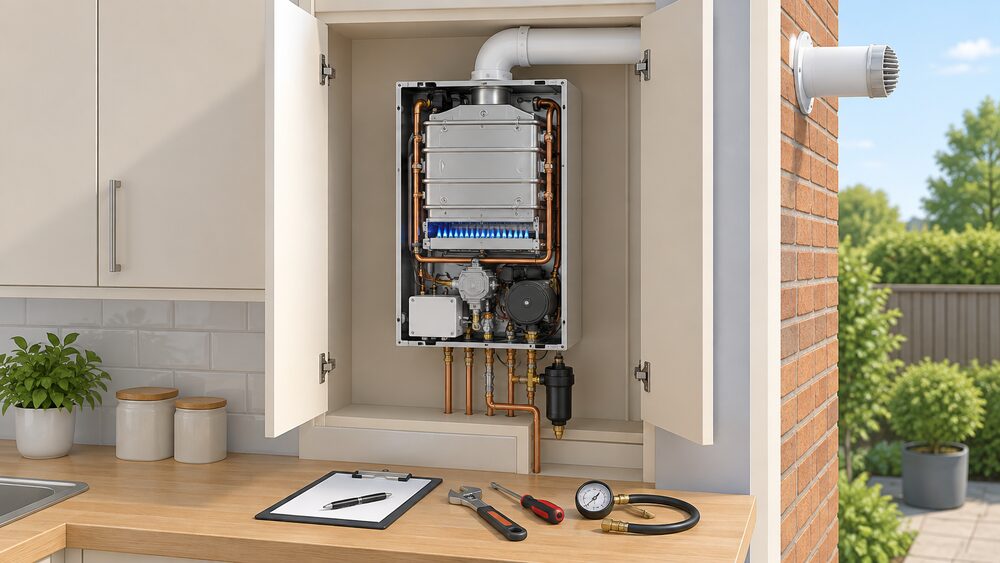
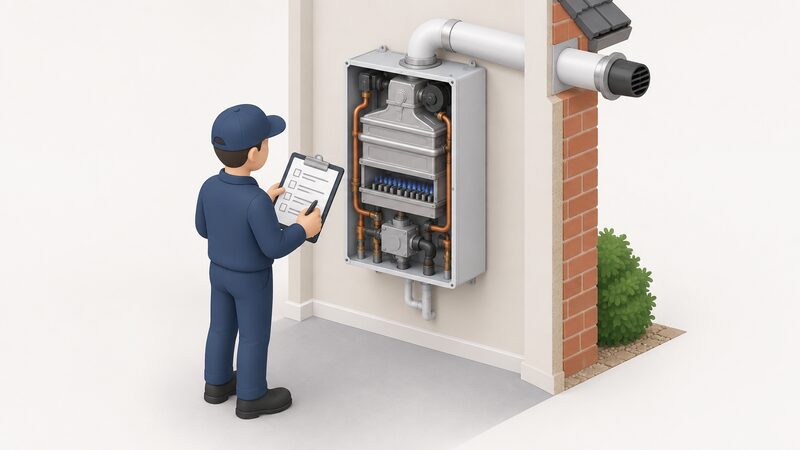
A service is a structured inspection rather than a repair visit. The engineer carries out a visual inspection of the boiler and flame, checks the flue internally and externally, tests operating pressure and input heat, examines case seals and safety devices, removes the case to inspect components including the heat exchanger, burner and main injector, and fires the boiler to spot faults2. Flue checks inside and outside confirm that no unsafe emissions are leaving the appliance4.
Why it matters is partly mechanical and partly financial. Regular maintenance improves efficiency, extends the lifespan of the system and helps catch small issues before they become big ones6. An annual service can keep a boiler running smoothly and extend its life, delaying an expensive replacement by years7. The current lifespan of a boiler is around 15 years, so a service regime is effectively what decides whether a household gets the full life out of the appliance or replaces it early5.
There is a safety dimension that sits above efficiency. A boiler that is burning incorrectly can produce carbon monoxide, which is why flue integrity and combustion checks are part of the routine rather than optional extras. For oil households the same logic applies through a different registration route, and the advice is to use an OFTEC registered engineer8.
For a household's energy independence, servicing is a maintenance of the status quo rather than a step towards self-sufficiency. It keeps a gas or oil appliance safe and efficient, and it preserves the option to repair rather than replace. It does not reduce the volume of fuel bought, and it does not remove the reliance on a mains gas connection, a heating oil delivery or an LPG supply.
How often to service: annual, and why the interval is 12 months

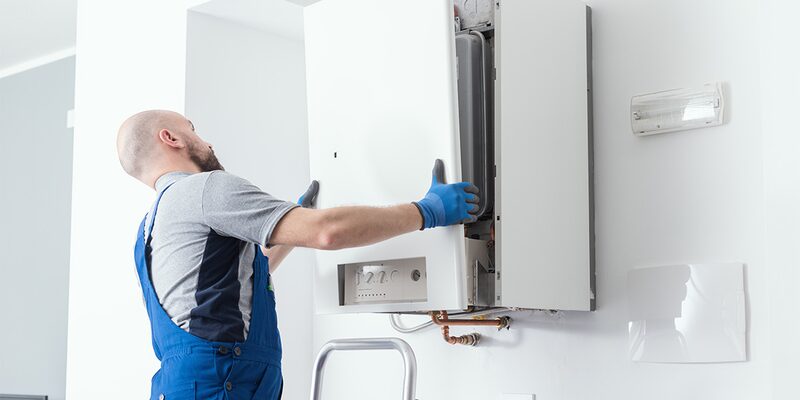
The interval is annual across every source that addresses it. It is recommended that a boiler is serviced at least once a year, in other words every 12 months2. The boiler and system should be serviced and checked annually to ensure they are running in tip-top condition, and any system filter is typically cleaned at the time of the annual boiler service3. Energy Saving Trust recommends getting a boiler or heat pump serviced every year to make sure it is running properly9.
Twelve months is not an arbitrary number. A heating system accumulates wear, debris and water chemistry changes over a heating season, and the annual visit is the point at which those are caught. The system filter, which traps magnetic debris and sludge, is serviced on the same cycle, which is why the two are usually booked together3.
The interval also aligns with the warranty cycle. Many boiler warranties require regular servicing to remain valid, and many manufacturers require an annual service in order to keep the warranty valid1. A guarantee may require the boiler to be serviced at least once a year, otherwise the guarantee is invalidated2. Because the warranty term is usually measured in years from installation, the service record and the warranty clock run on the same 12 month rhythm.
In practice, a household that services on time every year builds a continuous record. A household that skips a year creates a gap that a manufacturer can point to if a claim is made. The cost of the service is small against the cost of a refused claim or an early replacement.
Cost: £60 to £160, and what drives the price
Published figures cluster around £90 to £100 for an average service, with a Checkatrade figure of £100 including VAT as of March 20261. The spread by fuel and boiler type is narrow but real: a gas boiler service is typically around £90 to £100, quoted at £80 to £120 including VAT, and an oil boiler service is typically around £90 to £951. A gas boiler service is put at around £100 according to Checkatrade2.
| Item | Figure | Source |
|---|---|---|
| Average boiler service | around £90 to £100 | 1 |
| Average service, March 2026 | £100 including VAT | 1 |
| Gas boiler service | £80 to £120 including VAT | 1 |
| Oil boiler service | around £90 to £95 | 1 |
| Repair if issues found during service | £120 to £750 | 1 |
What drives the price is the type of boiler, its age, where you live and the company chosen4. An oil boiler takes longer and involves different checks, which is reflected in the range. A service that uncovers a fault can turn into a repair bill averaging £120 to £750, which is the main reason a service is cheaper than a breakdown1.
Where no published price exists, servicing is installer quoted. Cover products price the work differently: one maker product page lists Boiler, Radiator and Service Care from £7.00 a month for three months then £14.00 a month, and a HomeServe boiler cover plan is listed from £6.99 a month11. Those are subscription prices for cover, not the price of a one-off service, and the terms differ between providers.
What the engineer actually checks during a service
The check list is consistent between sources. A service covers controls and the boiler itself, inspection of internal components, a corrosion or leak check, flue checks inside and outside, water and gas pipework, and gas and pressure-flow tests4. The more detailed list adds a visual inspection of the boiler and flame, the flue internal and external, operating pressure and input heat, case seals, safety devices, removal of the case to inspect the heat exchanger, burner and main injector, and firing the boiler to spot faults2.
For biomass appliances the pattern is similar in shape: the maintenance engineer carries out a general inspection and safety checks among other technical checks13.
What a service is not is a full system clean. Bleeding radiators is a separate task, defined as releasing trapped air so hot water can circulate properly and heat the radiator evenly, taking a few minutes per radiator and generally done about once a year, ideally before winter14. Boiler pressure should be checked afterwards and topped up following the boiler manual14. Normal boiler pressure sits between 1 and 2 bar2.
A service also confirms the installation itself is sound. A boiler housed in a cupboard should have at least 60 mm clearance2. That kind of check is why a service can catch an installation problem that has nothing to do with wear.
Who can service a boiler: Gas Safe registration and ID checks
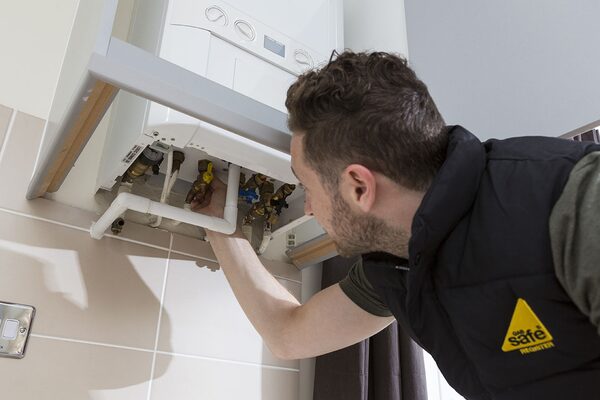
Only Gas Safe Register engineers are legally permitted to work on boilers in the UK, so the registration card should be asked for1. A service is carried out by a Gas Safe registered engineer who performs maintenance checks on all the key parts of the boiler4. For mains gas the technician should be Gas Safe registered, and for oil or solid fuel the equivalent is OFTEC registration15.
Verification is straightforward. Gas Safe Register can be rung on 0800 408 5500 or checked on its website to confirm an engineer is registered16. If there is any doubt, the Gas Safe website can be checked or the engineer asked to show their registration card17. All new gas boilers and appliances should be installed and serviced by an accredited Gas Safe engineer, and the boiler should receive an annual service from one17.
For oil households the registration route is different and the advice is to use an OFTEC registered engineer8. Landlords should arrange for heating equipment to be regularly serviced, which in practice means using a registered technician for the fuel type18.
"Only they are legally permitted to work on boilers in the UK, so always ask to see your boiler engineer's Gas Safe ID card."
Where work is carried out by someone who is not registered, the installer cannot self-certify, and the firm or the householder must give notice to the local authority of the intention to carry out the boiler work in advance and pay a notification fee19. That is a building regulations route, not a substitute for competence, and it leaves the household carrying the compliance risk.
Warranty, Benchmark and the service record
The warranty link is the strongest practical reason to keep servicing on schedule. Many boiler warranties require regular servicing to remain valid, and many manufacturers require an annual service in order to keep the warranty valid1. It is not uncommon for certain boilers to have a conditional warranty, the condition being that the boiler is serviced once a year4. A guarantee may require the boiler to be serviced at least once a year, otherwise the guarantee is invalidated2.
The Benchmark Scheme is the document that ties the installation, commissioning and servicing together. Its purpose is to ensure customers are provided with the correct domestic heating and hot water products for their needs, and that the product is installed, commissioned and serviced in accordance with the manufacturer's instructions by competent persons, in a way that is safe, performs with optimum efficiency and meets the requirements of the appropriate Building Regulations20. Benchmark covers all aspects of installation, not simply those directly covered by Building Regulations, and its scope includes gas-fired space heating and hot water systems, hot water storage cylinders, water treatment products, solar thermal systems, heat pumps, oil and gas cooker boilers, warm air heating systems and micro CHP20.
In England and Wales the installer is legally required to complete a commissioning checklist as a means of complying with the appropriate Building Regulations20. That checklist is the record a manufacturer will ask for if a warranty claim is challenged, and the annual service entries are what keep it current.
Landlords and rented homes: who arranges and pays

For rented homes the duty sits with the landlord. A landlord should arrange and pay for the service9. A landlord is legally required to service a boiler on an annual basis in all of their properties, and is responsible for servicing boilers and appliances annually and for providing an up-to-date gas safety record, which is a legal requirement4. Landlords should arrange for heating equipment to be regularly serviced18.
Tenants have a parallel set of rights. In private rented homes in England the landlord must make sure plumbing and heating work properly22. Where a boiler needs repair or replacement, the landlord is responsible for repairing or replacing it23. For council and housing association tenants, the landlord is responsible for damp if it means the home is not safe to live in, or if it is an ongoing serious problem affecting physical or mental health24.
There is one route where the complaints body changes. Where heat charges are service charges under the Landlord and Tenant Act 1985, the complaints body is the Housing Ombudsman rather than the Energy Ombudsman25. Where individual metering comes into effect for networks covered by that Act which charge through service charges or rent, suppliers would be expected to charge for heat separately and unbundle the heat charge from service charges or rent26.
In Northern Ireland, where a boiler has been installed under the Northern Ireland Sustainable Energy Programme, the homeowner or landlord is responsible for arranging and paying for the annual service after installation27.
When to book: timing your service before winter
The end of summer is a good time to book a service4. Summer is generally the best season for a boiler service10. The logic is that faults are found while the heating is still off, and engineers are less stretched than in the first cold snap.
Heat pumps follow the same pattern: just like a gas boiler, they should be serviced once a year, preferably before winter28. Oil households have an additional set of pre-winter tasks, and the winter heating checklist covers everything from ordering heating oil in advance to checking oil tanks, booking a boiler service and exploring flexible payment options29.
There is a wider timing consideration for households on time of use tariffs. Running appliances at cheaper times is part of demand flexibility, and the Demand Flexibility Service runs this winter30. That does not change the service interval, but it does mean a household's heating and hot water schedule may be shifting at the same time as the service is due.
Booking early also protects against the practical problem that a boiler tends to fail at the moment of first heavy use. A service in late summer leaves time to order parts or book a repair before the heating season starts.
How long a service takes, and what can extend it

A gas boiler service takes between 30 minutes and two hours, and may take longer depending on the boiler's type, location, age and condition2. Average figures by type are 30 minutes for a combi boiler, one hour for a system boiler, 1.5 hours for a regular boiler and one to two hours for an oil boiler1.
| Boiler type | Average service duration |
|---|---|
| Combi boiler | 30 minutes1 |
| System boiler | 1 hour1 |
| Regular boiler | 1.5 hours1 |
| Oil boiler | 1 to 2 hours1 |
What extends a visit is access and condition. A boiler in a tight cupboard, an older appliance, or one showing corrosion or a leak will take longer, and the published range explicitly allows for type, location, age and condition2. If the engineer finds a fault, the visit can turn into a repair, and the additional bill can average £120 to £7501.
For a household, the practical point is to allow the full window rather than the shortest figure. A combi in an accessible position may genuinely be done in half an hour, but the same combi in a difficult location with a dirty system filter will not be.
Servicing an ageing boiler: when repair gives way to replacement
Servicing an older boiler is still worthwhile, but the decision about repair versus replacement starts to matter. One source asks directly whether a boiler is more than 10 years old, framing that as the point to consider replacement31. Another suggests considering a new boiler if it is 10 to 15 years old, frequently has issues or breaks down a lot32. A further source suggests replacement at over 15 years old15, and another puts the threshold at over 15 years old as the point at which it may be worth replacing33. A separate source suggests thinking about replacement as a boiler approaches the 10 year mark10.
| Source position | Age threshold |
|---|---|
| Consider replacement | more than 10 years old31 |
| Consider replacement | 10 to 15 years old, or frequent breakdowns32 |
| Worth replacing | over 15 years old33 |
| Time to replace | over 15 years old15 |
| Think about replacing | approaching 10 years10 |
On repair specifically, if a boiler is newer, under eight years old, repairing it is likely a more sensible idea than replacing it33. The current lifespan of a boiler is around 15 years, which is the frame these thresholds sit inside5.
For energy independence the calculation is about control. A well serviced older boiler keeps running on the existing fuel and the existing flue, with no new connection, no new controls and no installer visit beyond the annual one. Replacement resets the warranty clock and the efficiency, but it also ties the household to a new appliance and, if the fuel changes, to a new supply arrangement. Servicing is what keeps the first option open for as long as the appliance is sound.
Sources33 cited
- How much does a boiler service cost?, Uswitch, 2026-09-03
- Boiler maintenance guide, Uswitch, 2026-09-03
- HHIC guidance document, HHIC, 2026-09-17
- Boiler servicing guide, Confused.com, 2025-07-23
- Heating and hot water, Planning Portal, 2026
- Spring into home care, APHC, 2025-05-07
- Keeping warm in winter, CIPHE, 2022-12-19
- Home heating oil, Consumer Council, 2026
- Take control of your heating at home, Energy Saving Trust, 2026-09-11
- How long does a boiler last?, Uswitch, 2024-11-13
- Home services, ScottishPower, 2026-09-17
- HomeServe boiler cover, Uswitch, 2026-09-17
- Biomass maintenance, HETAS, 2026
- How to bleed a radiator, Smart Energy GB, 2026-08-17
- Five important heating checks for oil households, OFTEC, 2026-08-13
- Gas safety for owner occupiers, Health and Safety Executive, 2026
- Gas leaks and safety, Uswitch, 2026-06-01
- Guide to carbon monoxide safety, OFTEC, 2026-09-17
- Building regulations for boilers and heating, Planning Portal, 2026
- Benchmark Scheme guidance, HHIC, 2026-09-17
- Gas safety and carbon monoxide, nidirect, 2025-11-24
- Make sure your home is energy efficient, Citizens Advice, 2026-09-19
- Getting your broken boiler repaired or replaced, Citizens Advice, 2024-08-16
- Who is responsible for repairs, Citizens Advice, 2026-09-20
- Heat networks consumer protection guidance decision, Ofgem, 2026-01-13
- Heat networks consumer protections draft guidance, Ofgem, 2025-09-05
- Northern Ireland Sustainable Energy Programme, Energy Saving Trust, 2026-09-07
- Heat pump fact check, Energy Saving Trust, 2026-07-01
- UKIFDA launches winter heating checklist 2025, UKIFDA, 2025-10-29
- Demand flexibility and running appliances at cheaper times, Electrical Safety First, 2026-09-19
- Upgrading and replacing your boiler, Centre for Sustainable Energy, 2026-06
- New boiler cost, Uswitch, 2024-11-06
- Boiler repair guide, Uswitch, 2024-11-05
 Boiler WarrantiesHow long does a boiler warranty actually last, and what do you have to do to keep it?
 Cover and Service PlansHow manufacturer maintenance plans, insurer boiler cover and independent contracts differ in what they repair, exclude and charge.
 Air Conditioning MaintenanceExplains routine householder tasks such as filter cleaning and drain checks, and what a professional service covers.
 Registering a WarrantyGetting a new boiler covered for longer usually means registering it quickly, often within a month of installation, or the long guarantee drops to a year.
 Servicing and MaintenanceHow often does a heat pump need servicing, and what actually happens during the visit?
 Boiler Manufacturers in the UKCovers the manufacturers supplying gas, oil, LPG and electric boilers to UK homes, their main ranges and where they are made.