
In this guide
Carbon monoxide is the one combustion risk a household cannot see, smell or taste, and the only way to detect it is with an alarm1. It is produced when gas, oil, LPG or solid fuel burns incompletely, and it can kill without warning in just a few hours2. At very high levels, death may occur within minutes3.
The scale is small but stubborn. In England and Wales, approximately 40 deaths are reported each year due to carbon monoxide poisoning4. Northern Ireland guidance puts the UK figure at about 30 deaths a year from gas systems that have not been properly installed or maintained2, while the Health and Safety Executive records around 7 deaths a year from gas related carbon monoxide poisoning5. One utility's awareness campaign states that around 40 people die and over 4,000 are injured each year, and separately that poisoning kills 50 people a year in England and Wales1.
For a household, the practical position is straightforward. An audible alarm, correctly sited and within its working life, is the detection layer. An annual service by a Gas Safe registered engineer is the prevention layer. The rules that make alarms compulsory vary by nation and by tenure, and they are narrower than most people assume.
How many deaths and injuries carbon monoxide causes in the UK
The headline figures come from different bodies counting different things, and the gap between them is worth understanding rather than averaging.
The Department for Business and Trade consultation on the product safety framework records approximately 40 deaths reported each year due to carbon monoxide poisoning in England and Wales4. Northern Ireland's domestic gas guidance gives a UK figure of about 30 deaths a year from carbon monoxide poisoning caused by gas systems which have not been properly installed or maintained2. The Health and Safety Executive's narrower measure, gas related carbon monoxide poisoning, is around 7 deaths a year5. A utility awareness campaign states that around 40 people die and over 4,000 people are injured each year, and in a separate page that poisoning kills 50 people a year in England and Wales and hospitalises many more1.
The variation has three causes. First, scope: the HSE figure covers gas only, while the wider figures include oil, LPG and solid fuel. Second, geography: England and Wales, the UK, and Great Britain are not the same population. Third, reporting: deaths are recorded through different routes, and the consultation figure is described as reported deaths rather than modelled ones.
What does not vary is the mechanism. Carbon monoxide binds to haemoglobin far more readily than oxygen, and the general information published by government describes it as invisible, with the only detection route being an alarm1. The Northern Ireland guidance is blunt about the speed: "CO can kill without warning in just a few hours."2 At very high exposure, death may occur within minutes3.
For a household's energy independence, this is the counterweight to every argument for self-sufficiency. A home that runs its own boiler, stove or range carries its own combustion risk, and no amount of fuel autonomy removes it. The detection and servicing regime is what makes independent heating safe to operate.
Carbon monoxide alarm regulations: what the rules require
The regulations are narrower than the risk. The Smoke and Carbon Monoxide Alarm Regulations (England) 2015 currently cover carbon monoxide alarm requirements only for solid fuel heating10. That is the baseline, and it has been extended in stages rather than replaced.
In England, the position changed on 1 October 2022. From that date all relevant landlords must provide a carbon monoxide alarm in any room used as living accommodation which contains a fixed combustion appliance, excluding gas cookers9. The Smoke and Carbon Monoxide Alarm (Amendment) Regulations 2022 put the same duty in the same terms1. A consultation has since proposed making carbon monoxide alarms mandatory in rental properties with heating of any fuel type, and requiring alarms on the installation of a fixed heating appliance of any fuel type in any home10.
In Wales, the Fitness for Human Habitation Regulations require a landlord to ensure that a carbon monoxide alarm is present in any room which has a gas, oil or solid fuel burning appliance installed11. That requirement does not replace duties under existing legislation, including the Management of Houses in Multiple Occupation (Wales) Regulations 2006 and the Gas Safety (Installation and Use) Regulations 199811.
In Northern Ireland, the private tenancy rules require each smoke, heat or carbon monoxide alarm to be in proper working order at the beginning of every new tenancy12.
Scotland takes a different route entirely, through the Tolerable Standard rather than a tenancy regulation, and that is covered below.
The standards an alarm must meet: BS EN 50291 and battery or mains power
An alarm is only worth fitting if it is the right device. The consistent standard across the sources is BS EN 50291.
Approved Document J states that carbon monoxide alarms should comply with BS EN 50291:200113, and the 2010 edition incorporating 2010 and 2024 amendments gives BS EN 50291-1:201814. Northern Ireland guidance refers to British or European standards, BS Kitemark or EN 502918. The Met Office seasonal advice refers to European Standards EN 502915. The Health and Safety Executive's homeowner guidance is simpler: ensure it meets current safety standards (BS EN 50291) and carries the Kitemark7.
Consumer facing guidance adds the marks to look for: the EN50291 standard, which may be written as BSEN 50291 or EN50291, with the CE mark, and a Kitemark or Loss Prevention Certification Board logo1. Scotland's Tolerable Standard guidance states that CO detectors should comply with BS EN 5029116.
Two further requirements matter in practice. The alarm should include an integral sounder14, and it should incorporate a warning device to alert users when the working life of the alarm is due to pass14. That end of life warning is the reason the expiry date on the device is not decorative. Welsh landlord guidance puts it plainly: the guidance accompanying carbon monoxide alarms should always be followed carefully, including noting the expiry date11.
On power, the Northern Ireland stove guidance describes an alarm to BS EN 50291 powered by a battery designed to operate for the working life of the alarm, positioned in a suitable location17. That is the sealed long life battery model rather than a replaceable annual cell.
Where alarms must be fitted, and whether they need interlinking
Placement follows the appliance, not the room count. The Met Office advice is that a carbon monoxide alarm should be fitted in any room that contains a gas fuel burning appliance, like a boiler and gas fire, and a solid fuel burning appliance15.
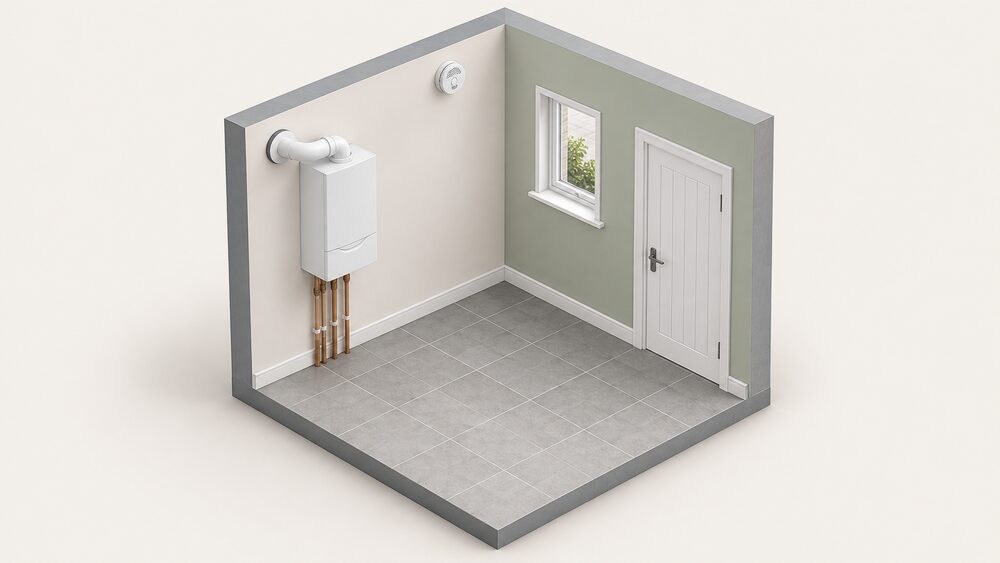
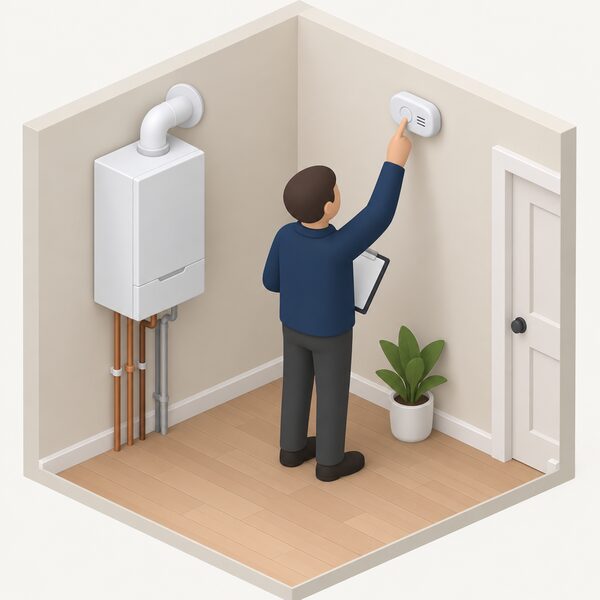
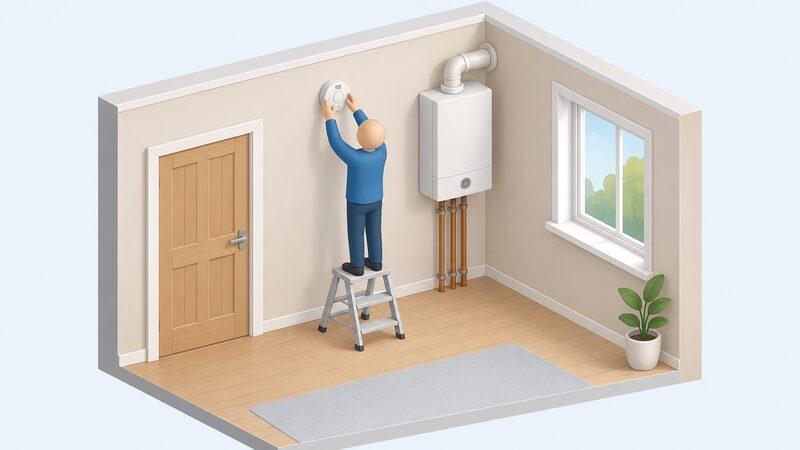
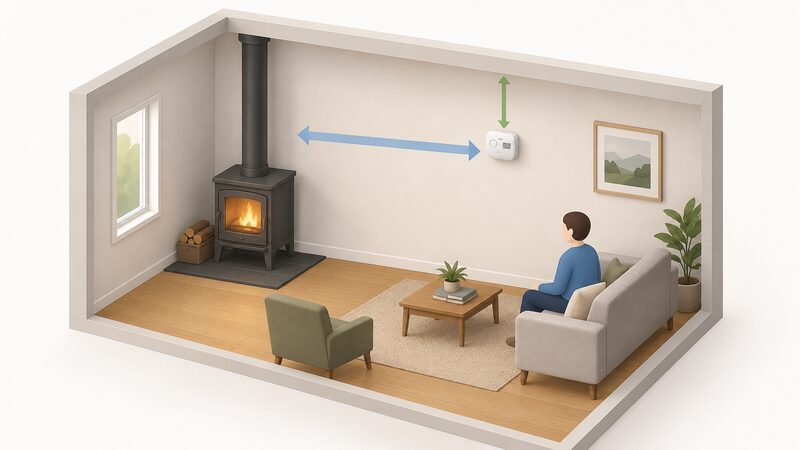
Approved Document J sets out the detailed rule for a room containing the appliance: on the ceiling at least 300mm from any wall, or if on a wall, as high up as possible, above any doors and windows, but not within 150mm of the ceiling, and between 1m and 3m horizontally from the appliance18. Welsh landlord guidance notes that as a general guide, carbon monoxide alarms are usually installed lower than smoke alarms11.
The Welsh Approved Document J guidance goes further than a single room. Alarms should be provided in every space, including connected spaces such as attached garages and loft spaces, containing a fixed combustion appliance, including a fixed flued combustion appliance used for cooking. In high risk accommodation, that extends to a bedroom or principal habitable room such as a living room where a flue serving a combustion appliance passes through14.
Interlinking is not required. Northern Ireland legislation states that carbon monoxide alarms do not need to be interlinked12. Scotland's Tolerable Standard does not require carbon monoxide detectors to be interlinked, or to be interlinked with fire alarms16. Welsh guidance confirms that the Fitness for Human Habitation regulations do not require additional battery powered alarms to be inter-linked11.
Where telecare is in use, Scotland's guidance takes a different line: effective CO alarms should be installed which are compatible with any telecare alarms, and connected to the telecare system, ensuring a single system approach16.
Scotland's Tolerable Standard: the minimum for CO detection
Scotland regulates carbon monoxide detection through the condition of the house rather than the terms of a tenancy. The Tolerable Standard is the minimum standard for all housing in Scotland19, and a house meets it only if it complies with the relevant requirements in relation to satisfactory carbon monoxide alarms16.
The legal basis is the Housing (Scotland) Act 1987 (Tolerable Standard) (Extension of Criteria) Order 2019, which introduced new requirements for fire and carbon monoxide detection and warning equipment20. The Act itself requires that a house has satisfactory equipment installed for detecting, and for giving warning of, carbon monoxide present in a concentration that is hazardous to health21. The parallel fire requirement sits in the same section21.
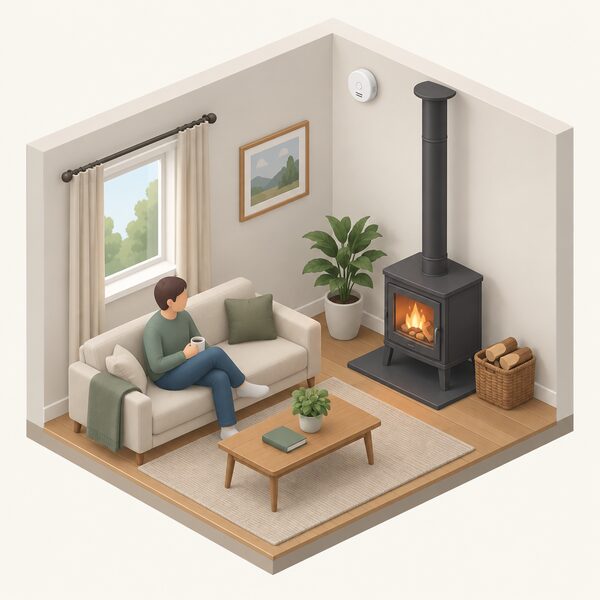
Coverage is broader than the English landlord duty. CO detectors must be fitted in all rooms where there is a fixed combustion appliance or a flue, excluding an appliance used solely for cooking16. A house does not fail the standard if there is no detector in a part of the house that is not used as, or has not been converted for use as, living accommodation, such as cellars, attics and garages16. The standard is a minimum and does not preclude additional detectors16.
The effect on the housing stock has been substantial. The Scottish House Condition Survey recorded a sharp increase in the proportion of below tolerable standard dwellings, from 2% in 2019 to 29% in 2022, following the introduction of two new criteria for smoke, heat and carbon monoxide alarms; without those criteria the proportion would have been 2%22. The 2024 survey found 28% of all dwellings, around 702,000, fell below the tolerable standard23. Within that group, 55% of below tolerable standard dwellings, around 383,000, did not have satisfactory equipment for warning against high levels of carbon monoxide23.
The pattern is not evenly spread. In 2024, 32% of private sector dwellings fell below the standard against 12% in the social sector, and the private rented sector rate was lower at 25%23. Owned outright and mortgaged dwellings failed at similar rates, 33% and 35%23.
For households, the Tolerable Standard is the clearest statement in the UK that carbon monoxide detection is part of what makes a home fit to live in, not an optional accessory.
Approved Document J: combustion appliances, ventilation and warning of CO
Approved Document J deals with combustion appliances and fuel storage systems in the Building Regulations 2010 as amended13. Its purpose is to provide practical guidance on ways of complying with Requirements J1 to J7 and regulation 7 of the Building Regulations 2010 for England and Wales13. The current Welsh edition is the 2010 edition incorporating further 2010 amendments, and it takes effect on 1 October 201013.
The central requirement is J3: where a fixed combustion appliance is provided, appropriate provision shall be made to detect and give warning of the release of carbon monoxide13. The document was amended in 2022 to extend the provisions and update the guidance for carbon monoxide alarms in support of that requirement24.
The Welsh amendments go further. Approved Document J has been amended to include guidance that where a new or replacement fixed flued combustion appliance of any fuel, oil, gas including LPG, and solid fuel, is installed in a dwelling, including fixed flued cookers, a carbon monoxide alarm should be provided14. For solid fuel specifically, where a new or replacement fixed solid fuel appliance is installed in a dwelling, a carbon monoxide alarm should be provided in the room where the appliance is located13. Section 2 of the document covers solid fuel installations of up to 45kW rated output13.
Ventilation is part of the same requirement, because an appliance starved of air burns badly. Where a kitchen contains an open-flued appliance, the extract rate of the kitchen extract fan should not exceed 20 litres per second, or 72 cubic metres per hour13.
Compliance works by presumption rather than prescription. If guidance in an Approved Document is followed there will be a presumption of compliance with the requirements covered by the guidance, but there is no obligation to adopt any particular solution if the requirement is met another way13. Anyone carrying out building work should check with their Building Control Body, either the local authority or an approved inspector, that their proposals comply13.
A consultation has proposed renaming the document Approved Document J (Non-gas fired Combustion appliances and fuel storage systems), on the grounds that gas appliances are adequately regulated by the Gas Safety regime25. That reflects the split in how the two regimes operate.
Servicing and Gas Safe registration: the annual check that keeps appliances safe
Detection catches a problem once it exists. Servicing stops it developing. The Health and Safety Executive strongly advises that all gas appliances, flues and pipework should be installed, regularly maintained and serviced at least annually by a Gas Safe registered engineer9. Independent guidance repeats the twelve month interval and extends it to gas boilers, gas cookers and gas water heaters6, and states that an annual service by a Gas Safe registered engineer can help prevent carbon monoxide poisoning26.
The engineer requirement is not a formality. Always use a Gas Safe registered engineer to fit, fix and check your appliances26. Installation of gas appliances is regulated under the Gas Safety Regulations25.
For households, the annual service is the point where the safety regime and the warranty regime meet. A service record is also the evidence that the appliance has been maintained, which matters if a fault later becomes a claim. The wider servicing picture, including what a service covers and how it interacts with cover plans, is set out in boiler servicing and maintenance and boiler cover and service plans.
The independence argument cuts both ways here. A household that maintains its own appliance and keeps its own records depends less on a landlord or a letting agent to keep it safe. It still depends on a registered engineer, on the gas network, and on the manufacturer for parts. That is the residual dependence in every gas heated home, and it does not go away with ownership.
Warning signs of a faulty appliance, from a lazy yellow flame to sooty staining
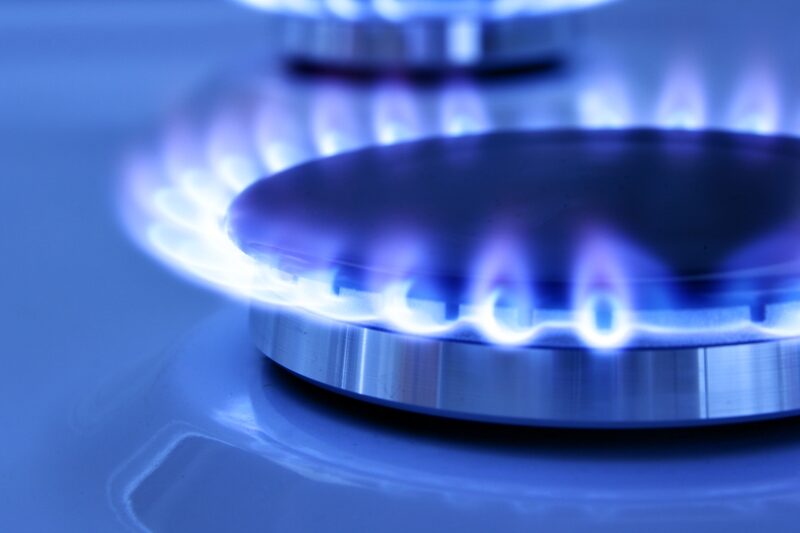
Incomplete combustion leaves traces, and the sources list them consistently. The Health and Safety Executive records yellow or orange rather than blue flames, except fuel effect fires or flueless appliances which display this colour by design; soot or yellow or brown staining around or on appliances; pilot lights that frequently blow out; and increased condensation inside windows27.
Independent guidance gives the same set in plainer terms: lazy yellow or orange flames instead of crisp blue ones, black marks on or around the appliance, a pilot light that keeps going out, and too much condensation in the room26. A healthy flame should be crisp and blue26.
"Flames look lazy and are yellow or orange rather than blue. (Except fuel-effect fires or fuel-less appliances that display this colour flame by design.)"
Two of these signs are easy to misread. Condensation on windows is normally a ventilation or insulation issue, and a pilot light that blows out is often put down to draughts. Both appear on the combustion warning list because they can indicate an appliance that is not burning cleanly. The exception for fuel effect and flueless appliances matters, because those are designed to show a yellow flame and their appearance is not a fault signal.
The symptoms in people follow a similar pattern of being mistaken for something else. Northern Ireland health guidance notes that other people in the same house, flat or workplace falling ill with similar symptoms is itself a warning sign3. That clustering is what separates carbon monoxide from a cold or a headache that one person has.
Where to get help: CO-Gas Safety and the gas emergency service
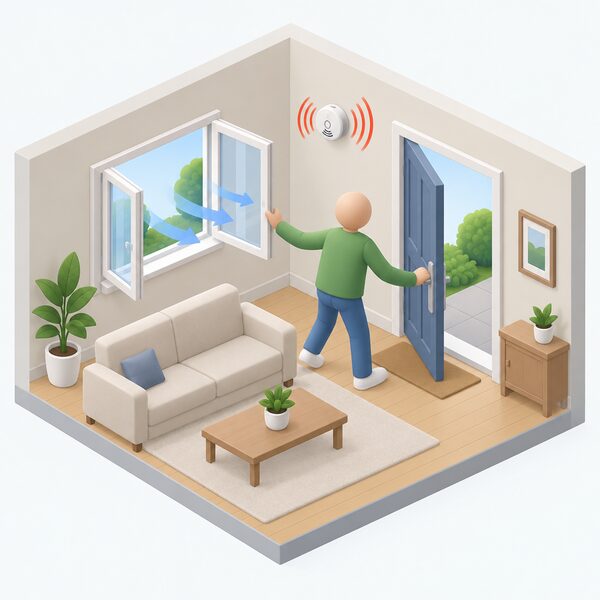
If an alarm sounds, the instruction is unambiguous: stop using all appliances and evacuate the property immediately14. The Health and Safety Executive adds the sequence for a suspected release: switch off the appliance and shut off the gas supply at the meter control valve, open all doors and windows to ventilate the room, and visit a GP to say that you believe you may have been exposed to carbon monoxide27.
For the gas supply itself, call the National Gas Emergency Service on 0800 111 9991. The same number appears in independent safety guidance, alongside the immediate steps of opening all doors and windows, moving everyone into the fresh air, and then calling29.
On the medical side, the advice is to seek medical help from a qualified healthcare professional3. If you or your family experience symptoms and believe you may have been exposed, seek urgent medical advice from either your GP or an A&E department27. If you think you or someone with you has been exposed to carbon monoxide with symptoms suggesting high levels, go immediately to your local emergency department3.
In Northern Ireland, the routes differ slightly: you can ring your heating engineer or the Northern Ireland Fire and Rescue Service8.
Alarms themselves are widely available. They can be bought from DIY stores and some supermarkets, or directly from energy suppliers, and tenants may be able to get alarms from a landlord or local council1. Northern Ireland guidance gives a price point of from as little as £20 for an audible alarm meeting British or European standards8. Prices elsewhere are not published in the same way and are quoted by the seller at the time of purchase.
The wider context for gas safety in the home, including the annual check and the landlord duties that sit alongside carbon monoxide rules, is covered in gas safety in the home. Households weighing a change of appliance can also read boiler servicing and maintenance for how the annual visit fits the rest of the heating year.
Sources29 cited
- Carbon monoxide, WW Utilities, 2026-09-20
- Domestic gas installation and health and safety, nidirect, 2025-10-28
- Carbon monoxide poisoning, nidirect, 2026-09-17
- The UK's new product safety framework, GOV.UK, 2026-03-31
- Gas safety in the home: frequently asked questions for owner occupiers, Health and Safety Executive, 2026
- Be aware, or it could be game over, WW Utilities, 2026-09-20
- Carbon monoxide: general information, GOV.UK, 2022-05-24
- Gas safety and carbon monoxide, nidirect, 2025-11-24
- Gas safety in the home: frequently asked questions, Health and Safety Executive, 2026
- Domestic smoke and carbon monoxide alarms consultation, CIBSE, 2026-09-17
- Fitness for human habitation: guidance for landlords, Welsh Government, 2022-01-13
- The Private Tenancies (Northern Ireland) Order 2024, legislation.gov.uk, 2024-05-30
- Approved Document J: Combustion appliances and fuel storage systems, Welsh Government, 2026-09-17
- Approved Document J: Combustion appliances and fuel storage systems, 2010 edition incorporating 2010 and 2024 amendments, Welsh Government, 2024-10-04
- Keeping your home warm in winter, Met Office, 2026-09-20
- Satisfactory fire and carbon monoxide detection: tolerable standard guidance, Scottish Government, 2023-06-20
- Stove guidance for householders, Building Control Northern Ireland, 2015-11
- Building Regulations guidance Part J: heat producing appliances, Welsh Government, 2010
- Regulations to modify the repairing standard: summary, Scottish Government, 2022-02-01
- The Housing (Scotland) Act 1987 (Tolerable Standard) (Extension of Criteria) Order 2019, legislation.gov.uk, 2021-01-27
- The Housing (Scotland) Act 1987 (Tolerable Standard) (Extension of Criteria) Order 2019, legislation.gov.uk, 2019-01-16
- Scottish House Condition Survey 2022: key findings, Scottish Government, 2022
- Scottish House Condition Survey 2024: key findings, Scottish Government, 2026-02
- Approved Document J, Planning Portal, 2022
- Proposals for amending Approved Document J, CIBSE, 2026-09-17
- Gas safety advice, Cadent Gas, 2026
- Carbon monoxide, Health and Safety Executive, 2026
- Carbon monoxide, SGN, 2026-09-20
- Carbon monoxide advice, Cadent Gas, 2026
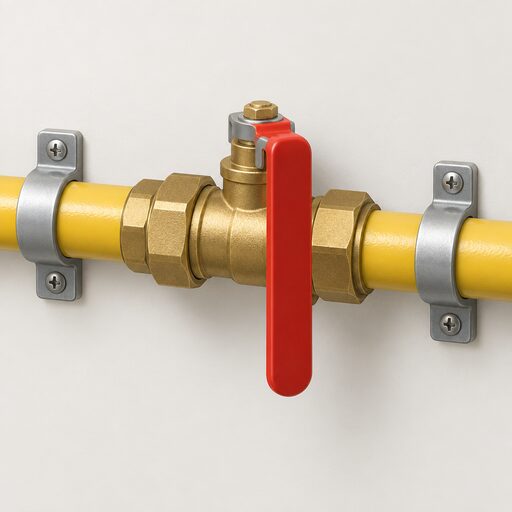 Smell Gas or Suspect COThe emergency steps for a suspected gas escape or carbon monoxide alarm, including ventilation, ignition sources and turning the supply off at the emergency control valve.
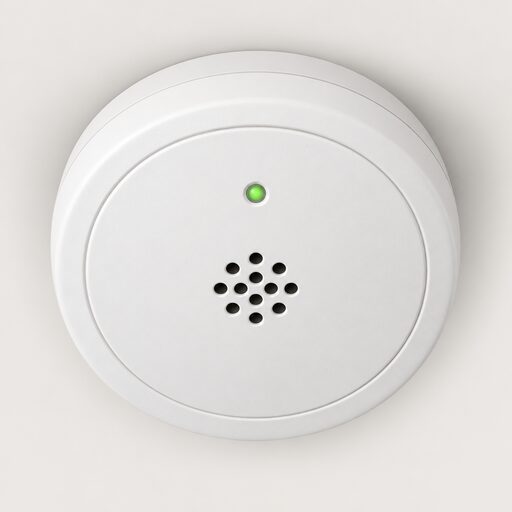 Generator SafetyCovers the main hazards of running a generator at a home: exhaust fumes and carbon monoxide, hot surfaces and refuelling fires, electric shock and earthing.
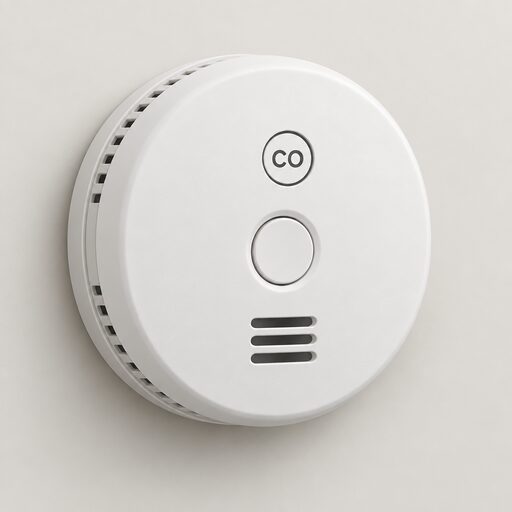 Alarm Rules in Rented HomesHow many smoke and carbon monoxide alarms a rented home must have, where they must be sited, and how the rules differ across England, Scotland, Wales and Northern Ireland, including the standards alarms must meet and who tests them.
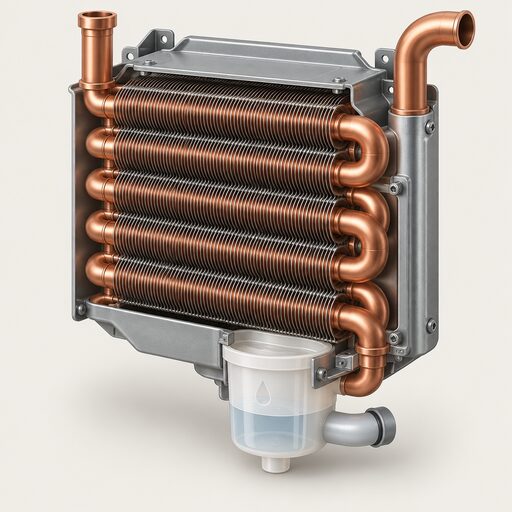 Gas Boilers GuideMains gas boilers heat around 23 million UK homes.
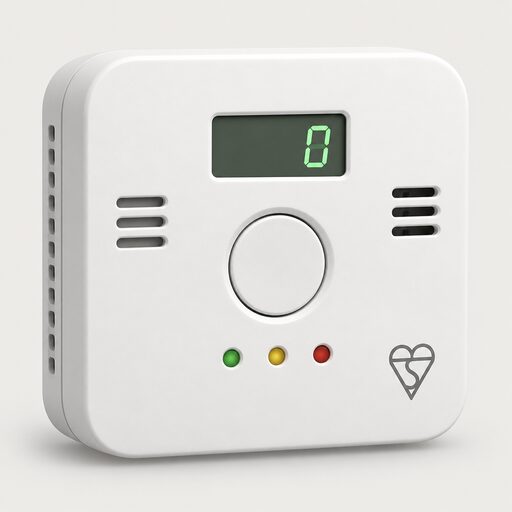 Test Smoke and Heat AlarmsHow often alarms should be tested, what the different beeps mean and when a unit has reached the end of its life.
 Air Conditioning SafetyA safety guide to home cooling appliances: plug and circuit loading, flammable refrigerants in portable units, condensate and water damage, venting, window sealing and product recalls, with the markings to look for.