
In this guide
The Clean Heat Market Mechanism (CHMM) is the government's market-based scheme that obliges boiler manufacturers and other heating supply chain actors to support a rising share of heat pump installations relative to their boiler sales. It began on 1 April 2025, with a Year 1 target of 6% of relevant boiler sales, and the government has confirmed a Year 2 target of 8%1.
The mechanism is not a tax on households. It places an obligation on manufacturers, who must either deliver heat pump installations or pay a buy-out charge for any shortfall. That design is why the scheme was labelled a "boiler tax" in public debate, and why some manufacturers warned the cost could be passed on to boiler buyers. The government's consultation response records responses from fossil fuel heating appliance manufacturers, energy suppliers, heat pump manufacturers and other organisations, but the obligation itself sits with the supply chain, not the consumer1.
For a household, the CHMM matters indirectly. It shapes the price and availability of gas boilers, and it sits alongside the Boiler Upgrade Scheme (BUS), which provides the upfront capital grants that make a heat pump installation cheaper. The BUS standard grant is £7,500 off the cost and installation of an air source heat pump, with an uplifted £9,000 for eligible off-gas grid properties replacing oil or liquefied petroleum gas, and £2,500 for air-to-air heat pumps4.
What the Clean Heat Market Mechanism does
The CHMM is a market-based mechanism for heat pumps, first signalled in the Heat and Buildings Strategy and launched from 2024 in early policy documents before commencing on 1 April 20252. Its purpose is to build a market for low carbon heating by requiring obligated parties, principally boiler manufacturers, to achieve the installation of a certain number of heat pumps up to 45 kWth in existing UK properties7.
The mechanism works by setting a target expressed as a percentage of relevant boiler sales. In Year 1, covering 2025 to 2027, that target is 6%. The government consulted on revisions ahead of Scheme Year 2 and confirmed a target of 8% of relevant boiler sales, having consulted on a range of 8% to 10%1. The consultation opened on 7 May 2025 and closed on 2 July 20251.
The obligation is on the supply side, not the household. Manufacturers who meet their quota through heat pump installations avoid the buy-out; those who do not face a charge. The government's own assessment of the mechanism put the estimated benefit at £3.6bn, in 2020 prices and 2022 present value terms, rounded to the nearest £100 million8.
The consultation response shows who engaged with the design:
- 8 energy suppliers and related trade associations
- 30 other organisations, including individuals and NGOs
- 6 other heating supply chain actors
- 6 specialist heat pump manufacturers
- 7 fossil fuel heating appliance manufacturers1
That spread matters: the mechanism was contested by the firms whose boiler sales set the baseline, and supported by the heat pump side of the industry.
For a household's energy independence, the CHMM is a structural lever rather than a direct benefit. It does not pay a grant or change a tariff. What it does is push the supply chain towards heat pumps, which run on electricity rather than gas. A home that switches to a heat pump reduces its dependence on the gas grid, though it remains dependent on the electricity grid and on a supplier. The mechanism does not remove that dependence; it shifts where it sits.
The planned phase-out of new natural gas boilers

The CHMM sits inside a wider policy direction: the phase-out of new natural gas boiler installations. The Heat and Buildings Strategy set the ambition of phasing out the installation of new natural gas boilers from 2035, using natural trigger points such as when a boiler is replaced9. The Heat Pump Investment Roadmap restated the aim to phase out the installation of new and replacement natural gas boilers by 2035 at the latest2.
That date is an ambition, not a legal ban. The strategy language is careful: the government "aims" to begin phasing out new natural gas boiler installations from 2035, and no legally binding regulatory decision has been made. The distinction matters for anyone weighing a boiler replacement now. A boiler installed today is not unlawful, and there is no rule requiring its removal in 2035.
The CHMM is the mechanism intended to make that transition happen through the market rather than through a prohibition. By requiring manufacturers to sell a rising proportion of heat pumps against their boiler sales, it aims to grow the heat pump market ahead of any regulatory cutoff. The 6% Year 1 and 8% Year 2 targets are the first steps on that path1.
Scotland has moved on a separate track. The Heat in Buildings programme sets out a pathway for buildings to use zero emissions heating and cooling systems by 2045, with a proposed backstop date of 2045 for low or zero emissions heating in existing buildings11. The New Build Heat Standard Direction, dated September 2024, enables applicants to install a bioenergy or peat heating system or appliance in defined circumstances12. Scotland's proposed Heat in Buildings Bill would ask people buying new homes and buildings before 2045 to move to a clean heating system within a set period after the sale11.
For a household, the practical reading is this: the direction of travel is towards electrified heat, the CHMM is the supply-side lever, and the BUS is the demand-side grant. Neither removes a home's reliance on the grid, and neither makes a gas boiler illegal today.
Boiler Upgrade Scheme: upfront grants of up to £7,500
The Boiler Upgrade Scheme is the grant scheme that sits alongside the CHMM. It provides upfront capital grants towards the cost of installing approved heat pumps and biomass boilers in homes and non-domestic buildings in England and Wales13. It opened on 23 May 2022 and is administered by Ofgem5.
The scheme is installer-led. The property owner's chosen installer applies for the grant on their behalf, and the installer must be certified by the Microgeneration Certification Scheme (MCS)5. The installer discounts the grant from the invoice, applies to Ofgem for a grant voucher, and redeems the voucher after installation and commissioning5. The full BUS grant value must be deducted from the quote before any payment is made by the property owner6.
The application has two stages: a Voucher Application and a Voucher Redemption Application6. The application must be properly made within 120 days of the commissioning date6. That timing rule is the reason a retrospective claim is not possible: the voucher has to be issued before the work is done, and redeemed after.
The scheme was extended to 2030 as of 28 April 2026, and applications close on 30 December 20295. The initial budget was £150m per financial year for 2022 to 20256. Unspent budget is not carried over to the next scheme year15.
For energy independence, the BUS is the most direct lever a household has. It reduces the upfront cost of a heat pump, which is the technology that moves a home off gas. It does not cover the running cost, the electricity supply, or the grid connection, and it does not make a home self-sufficient. A heat pump household still buys electricity from a supplier.
Grant amounts: £7,500 standard, £9,000 off-gas grid, £2,500 air-to-air

Grant values depend on the technology and, for off-gas grid properties, on the fuel being replaced. The standard grant is £7,500 for air-to-water heat pumps and ground source heat pumps6. Air-to-air heat pumps attract £2,5006. From 21 July 2026, eligible off-gas grid properties replacing an oil or liquefied petroleum gas heating system can receive an uplifted grant of £9,000 for air-to-water or ground source heat pumps6.
| Technology | Grant value | Conditions |
|---|---|---|
| Air-to-water heat pump | £7,500 | Standard rate6 |
| Air-to-water heat pump, off-gas grid | £9,000 | Replacing oil or LPG, from 21 July 20266 |
| Ground source heat pump | £7,500 | Standard rate6 |
| Ground source heat pump, off-gas grid | £9,000 | Replacing oil or LPG, from 21 July 20266 |
| Air-to-air heat pump | £2,500 | Residential properties only6 |
| Biomass boiler | £5,000 | Rural areas only6 |
The uplifted off-gas grid value is in place until 31 March 20276. After that date, the standard rate applies unless the scheme rules change. The uplift is specifically tied to replacing oil or liquefied petroleum gas, so a property on mains gas does not qualify for the higher figure even if it is in a rural area.
One official scheme-rules page gives the BUS grant as up to £7,500, while another official guidance page gives £5,000. The £7,500 figure is the one carried in the current scheme rules and the grant categories notice, and the £9,000 uplift is confirmed in Ofgem guidance dated 21 July 20264. Where the figures differ, the newer and more specific scheme documentation gives the higher values.
For a household, the grant is a capital contribution, not a running-cost subsidy. It reduces the installation bill. It does not change the unit price of electricity, and it does not remove the standing charge or the grid connection.
Who qualifies: property type, previous system and technology rules
Eligibility turns on the property, the system being replaced, and the technology being installed. Only properties in England and Wales are eligible6. The previous heating system must have been a fossil fuel system such as gas, oil or LPG, or an electric heating system that does not include a heat pump18. Funding is not available for the replacement of existing low carbon heat systems19.
Properties classed as social housing are not eligible for BUS funding, and this includes shared ownership properties18. Updated guidance confirms that Right to Buy properties may become eligible once privately owned20. Social housing landlords are supported instead through separate capital grant funding to install clean heating systems and energy efficiency measures21.
Air-to-water heat pumps, ground source heat pumps including water source heat pumps and shared ground loops, and biomass boilers are eligible for residential and non-residential properties. Air-to-air heat pumps are eligible for residential properties only6. Self-build properties are eligible for heat pumps only6.
Capacity limits apply:
- An individual heat pump system is capped at 45 kWth
- A multi heat pump system is capped at 70 kWth
- A shared ground loop system is capped at 300 kWth total, with each connected heat pump not exceeding 45 kWth6
Air-to-water and ground source heat pumps must achieve an in situ seasonal coefficient of performance (SCOP) of at least 2.86. Biomass boilers may only be installed in rural areas, are capped at 45 kWth, and must meet emissions limits: particulate matter not exceeding 30g/GJ net heat input and NOx not exceeding 150 g/GJ net heat input6.
From 28 April 2026, properties are no longer required to have a valid EPC to apply for BUS6. That is a change from the earlier position, where a valid energy performance certificate was required5. From the same date, BUS heat pumps can be installed alongside supplementary heating appliances, provided those appliances are not fossil fuel based6.
What the scheme funds and what it excludes
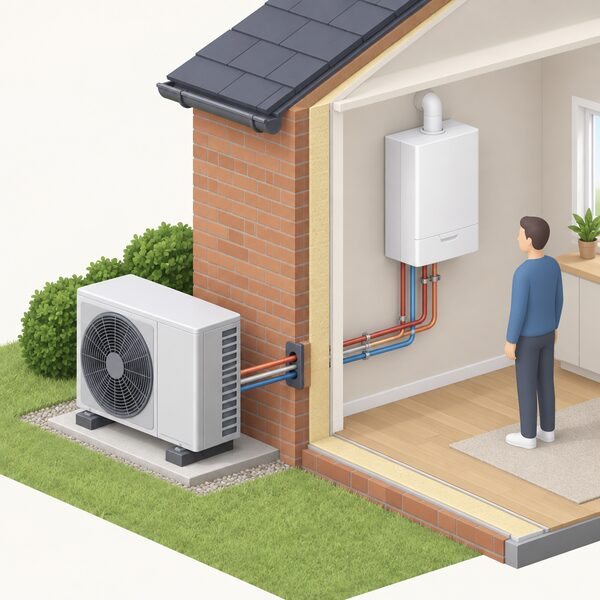
The BUS funds the installation of eligible low carbon heating systems. It does not fund hybrid systems. The scheme rules state plainly:
"You cannot get a grant for a hybrid heat pump system (for example a combination of gas boiler and air source heat pump)."
That exclusion is the sharpest limit in the scheme. A household wanting to keep a gas boiler as a backup alongside a heat pump cannot use BUS funding for the pairing. The supplementary heating rule from 28 April 2026 allows a BUS heat pump to sit alongside another appliance, but only if that appliance is not fossil fuel based6. A gas boiler backup therefore falls outside the scheme.
The scheme also excludes replacement of existing low carbon systems19. A home that already has a heat pump cannot claim a grant to replace it with another one. The grant is for moving from fossil fuel or non-heat-pump electric heating to a low carbon system, not for upgrading between low carbon systems.
Biomass is funded but tightly bounded. It is available only in rural areas, only for properties meeting the emissions limits, and only for boilers up to 45 kWth6. The scheme's own statistics show that grants have been paid for replacing gas, oil, direct electric, LPG, coal and other heating systems, plus grants for eligible self-build properties where no heating system was replaced22.
What the scheme does not do is cover the wider cost of making a home heat-pump ready. Insulation, radiator upgrades, pipework changes and electrical supply improvements are outside the grant. Those costs sit with the household, and they are often the difference between a straightforward installation and a difficult one.
For energy independence, the exclusion of hybrids is significant. A hybrid keeps a home on gas for part of its heating, so it does not move the household off the gas grid. The BUS rules push towards a full switch, which is the position that reduces gas dependence most, but also the position that requires the home to be ready for it.
How the installer-led application and voucher process works
The application is installer-led, with the installer applying for the grant on the property owner's behalf5. The installer must be MCS certified5. The process runs in order:
- The installer submits a voucher application to Ofgem.
- Ofgem issues a voucher.
- The installer completes the installation and commissioning.
- The installer submits a voucher redemption application.
- The installer receives the grant payment15.
The property owner does not apply directly. The installer discounts the grant from the invoice, applies to Ofgem for the voucher, and redeems it once the work is complete5. The full grant value must be deducted from the quote before any payment is made by the property owner6.
Voucher validity depends on the technology:
| Technology | Voucher validity |
|---|---|
| Air-to-water heat pump | 3 months23 |
| Air-to-air heat pump | 3 months23 |
| Biomass boiler | 3 months23 |
| Ground source heat pump | 6 months23 |
The installation must be completed and the voucher redeemed within that window. The application must be properly made within 120 days of the commissioning date6. That rule is why a retrospective claim is not possible: the voucher has to be in place before the installation, and the redemption follows the commissioning. A household that has already had a heat pump installed outside that window cannot bring it into the scheme.
Installers are required to keep all documentation relied upon in voucher applications and voucher redemption applications for six years from the date the application was properly made6. That retention period supports the audit process and is a condition of participation.
For a household, the installer-led model means the grant is only accessible through a certified installer. A household cannot self-apply, and cannot claim the grant after the fact. The practical consequence is that the installer has to be chosen and engaged before the work starts, and the voucher clock has to be managed alongside the installation schedule.
Budget, funding and how long the scheme runs
The BUS had an initial budget of £150m per financial year for 2022 to 20256. The scheme was extended to 2030 as of 28 April 2026, and applications close on 30 December 20295. Unspent budget is not carried over to the next scheme year15.
One official statistics source gives £295 million for 2025/26, with 2024/25 funding increased by £30 million, while another gives £400 million for 2026/27. Both figures are official, and the difference reflects different reporting periods and announcements rather than a contradiction in the scheme rules.
The scheme's quarterly reporting runs on a fixed cycle. The most recent quarterly report covers the period from 1 May 2026 to 31 July 202624. The annual report covers April 2025 to March 202614. The scheme's own statistics are published by Ofgem17.
The uplifted off-gas grid grant value runs until 31 March 20276. That is a fixed end date for the higher rate, and it is the single most time-sensitive element of the scheme for a household on oil or LPG. After that date, the standard rate applies unless the rules change.
For energy independence, the budget position matters because the grant is capped by annual funding. A scheme that is extended to 2030 but funded year by year, with no carryover, means the grant is available while the budget lasts in each year. The scheme does not guarantee a grant at any particular date, and the off-gas grid uplift has a defined end.
Audits, compliance and how to complain
Ofgem administers the scheme and handles complaints about its administration. Complaints about Ofgem's administration of the scheme can be sent to feedback@ofgem.gov.uk25. Suspected fraud or misuse can be reported to counterfraud@ofgem.gov.uk18.
Installers are required to keep all documentation relied upon in voucher applications and voucher redemption applications for six years from the date the application was properly made6. That documentation supports the audit process, and it is the record that Ofgem can check if a claim is questioned.
The scheme's compliance framework sits alongside the CHMM's own consultation process. The CHMM consultation drew responses from 8 energy suppliers, 30 other organisations, 6 other heating supply chain actors, 6 specialist heat pump manufacturers, and 7 fossil fuel heating appliance manufacturers1. Those responses shaped the revisions ahead of Scheme Year 2.
If an application is rejected, the property owner can ask for a review through Ofgem's complaints route. The scheme guidance directs administration complaints to the feedback address, and fraud concerns to the counterfraud address18. The installer-led model means the installer is the first point of contact for application issues, and Ofgem is the route for administration complaints.
For a household, the audit and compliance rules are the reason the paperwork matters. The grant is paid to the installer, not the household, and the installer holds the documentation. A household that wants to check the grant was claimed correctly has to rely on the installer's records, which are retained for six years.
How the CHMM and BUS fit together
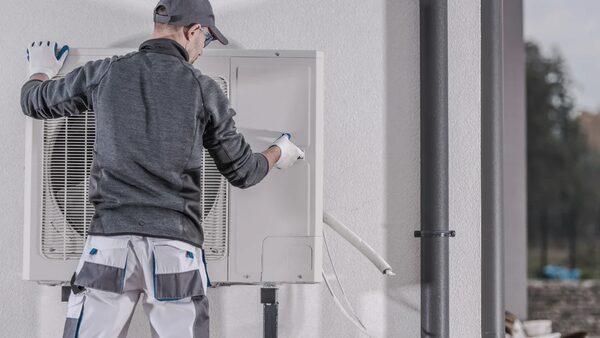
The two schemes work on opposite sides of the market. The CHMM obliges manufacturers to support a rising share of heat pump installations against their boiler sales, with a Year 1 target of 6% and a Year 2 target of 8%1. The BUS reduces the upfront cost for the household, with grants of £7,500, £9,000 off-gas grid, and £2,500 for air-to-air6.
| Clean Heat Market Mechanism | Boiler Upgrade Scheme | |
|---|---|---|
| Side of the market | Supply: manufacturers and supply chain1 | Demand: the household5 |
| Mechanism | Heat pump quota against boiler sales, with a buy-out for shortfall1 | Upfront capital grant, installer-led5 |
| Headline figure | 6% Year 1, 8% Year 21 | £7,500 standard, £9,000 off-gas grid, £2,500 air-to-air6 |
| Ends | Scheme Year 2 revisions confirmed1 | Applications close 30 December 20295 |
The CHMM is the supply-side push. It does not pay a household anything. The BUS is the demand-side pull. It does not oblige a manufacturer to do anything. Together they are the government's two main levers on domestic heating, and they sit under the 2035 ambition to phase out new natural gas boiler installations2.
For a household's energy independence, the pair changes the economics of a heat pump but not the structure of dependence. A heat pump home still draws electricity from the grid and buys it from a supplier. The gas connection may go, but the electricity connection remains, and the running cost depends on the tariff and the unit price. The CHMM and BUS make the switch more likely and cheaper at the point of installation; they do not make a home self-sufficient.
The limits are worth stating plainly. The BUS excludes hybrid systems, so a household cannot use the grant to keep a gas boiler as backup16. Social housing and shared ownership properties are not eligible18. Only one grant is available per property, and a previous BUS grant at the same address blocks a second claim6. The off-gas grid uplift ends on 31 March 20276. The scheme closes to applications on 30 December 20295.
Where a household wants to reduce dependence further, the routes sit outside these two schemes: insulation, heating controls, and in some cases a different heat source. The Boiler Upgrade Scheme grants in England page covers the England-specific grant landscape, and the heat pumps compared with boilers page sets out how the technologies differ in practice. For the wider picture of how heating choices affect a home's independence, the home heating and energy independence page is the starting point.
Sources25 cited
- Clean Heat Market Mechanism: Revisions ahead of Scheme Year 2 (2026 to 2027) government response, GOV.UK, 2026-09-18
- Heat pumps investment roadmap, GOV.UK
- Accelerating to net zero: responding to the CCC progress report, GOV.UK, 2024-12-17
- Notice of approved grant categories and values for the Boiler Upgrade Scheme, GOV.UK, 2026-07-21
- Boiler Upgrade Scheme, GOV.UK, 2026-09-18
- Boiler Upgrade Scheme guidance for installers v5.1, Ofgem, 2026-07-02
- Heat Market Mechanism consultation, Parliament, 2021-10
- Heat Market Mechanism consultation final, Parliament, 2022-07
- Heat and Building Strategy, GOV.UK
- Equality impact assessment for the Heat and Buildings Strategy, GOV.UK, 2023-03-01
- The Heat in Buildings programme, Scottish Government, 2026-09-17
- Heat and Buildings progress report 2025, Scottish Government, 2025-10-02
- ECO4 summary updates document, Ofgem, 2026-09-17
- Boiler Upgrade Scheme annual report April 2025 to March 2026, Ofgem, 2026-07-31
- Boiler Upgrade Scheme quarterly report issue 14, Ofgem, 2025-11-26
- What you can get, GOV.UK, 2026-09-17
- Boiler Upgrade Scheme statistics July 2026, GOV.UK, 2026-08-27
- Boiler Upgrade Scheme guidance for property owners V5, Ofgem, 2026-04-28
- Boiler Upgrade Scheme leaflet, GOV.UK, 2022-05
- Summary of updates to BUS guidance for installers V5, Ofgem, 2026-04
- New Warm Homes Programme policy statement, Welsh Government, 2023-06-15
- Boiler Upgrade Scheme quarterly report issue 3, Ofgem, 2023-02-28
- BUS guidance for property owners v5 draft, Ofgem, 2026-03-25
- Boiler Upgrade Scheme quarterly report issue 17, Ofgem, 2026-08-31
- Boiler Upgrade Scheme guidance for property owners v5.1, Ofgem, 2026-07
 Policy, Targets and Coming RulesHeat pumps are central to the government's plans for greener home heating.
 Heat Pump Electricity TariffsA heat pump tariff gives you cheaper electricity for part of the day, so running your heating costs less than on a standard rate.
 Replacing a Gas or Oil BoilerSwapping a gas, oil or LPG boiler for a heat pump changes how your home is heated and how much it costs.
 Heat Pump Running CostsWhat does a heat pump cost to run each year, and is it cheaper than a gas boiler?
 The Full Boilers and Heating GuideWhich boiler suits your home, and when is it worth swapping the old one?
 Financing an InstallationPaying monthly for a boiler, solar panels, battery or heat pump sounds simple, but who actually lends you the money and what happens if the work goes wrong?