

In this guide
The Boiler Upgrade Scheme (BUS) is a UK Government grant scheme that pays a fixed, upfront capital sum towards replacing a fossil fuel or electric heating system with a heat pump, or in limited circumstances a biomass boiler, in England and Wales. It is set out in the Boiler Upgrade Scheme (England and Wales) Regulations 2022, with grant categories and values approved by the Secretary of State under Regulation 131. It opened for applications on 23 May 20222 and, as of 28 April 2026, has been extended to 20303.
The headline values are £7,500 off the cost and installation of air-to-water heat pumps, ground source heat pumps and water source heat pumps4, £2,500 for air-to-air heat pumps and £5,000 for a biomass boiler5. From 21 July 2026 an uplifted grant of £9,000 is available for air-to-water or ground source heat pumps in eligible off-gas grid properties previously heated by oil or liquefied petroleum gas (LPG); that uplift is in place until 31 March 20273. The grant is not means-tested6, and one grant is available per property7.
Critically, householders cannot apply themselves. The scheme is installer-led: an installer certified by the Microgeneration Certification Scheme (MCS) applies to Ofgem for a voucher, deducts the grant value from the quote, and redeems the voucher after commissioning2. Ofgem administers the scheme on behalf of the Gas and Electricity Markets Authority8.
What the scheme is and what it pays for
The scheme provides upfront capital grants to support the installation of heat pumps and, in limited circumstances, biomass boilers in homes and small and medium non-domestic buildings10. It is not a loan, a tariff or a payment made over time: the money is a single sum against the capital cost of the installation, paid to the installer.
The design target is fuel switching rather than efficiency improvement. To qualify, a retrofit property must be replacing an existing heating system that operates on either fossil fuels or electricity, and properties that have already had public funding for a heat pump or biomass boiler are not eligible9. The systems that can be replaced are described as a fossil fuel heating system such as gas, oil or LPG, or an electric heating system excluding existing heat pumps11.
Budget has moved considerably over the scheme's life. It began as a £450 million, three year scheme12 with an initial budget of £150 million per financial year for 2022 to 20253. Take-up in the first year was well below that: £50,999,000 was allocated from the original £150 million Year 1 budget between launch on 23 May 2022 and 31 March 202313. Funding for 2024/25 was later increased by £30 million and a much higher figure of £295 million set for 2025/2614. A 2026 government consultation describes the scheme as a £2.7 billion investment in grants of up to £7,50015. These figures measure different things (the original envelope, annual allocations and a forward programme), so they cannot be added together into a single lifetime total.
For a household, the practical meaning is narrow but real: the grant removes a fixed slice of the capital cost of moving off gas, oil or LPG. It does not cover running costs, insulation, or the electrical work and radiator changes a heat pump may require. No published typical installation price sits behind these grants, so the balance of the bill is installer-quoted.
Grant values: £7,500, £9,000 off gas grid and £5,000 for biomass
| Technology | Grant value | Voucher validity | Key restriction |
|---|---|---|---|
| Air-to-water heat pump | £7,5004 | Must replace fossil fuel or electric heating16 | |
| Ground source heat pump (incl. water source, shared ground loops) | £7,5003 | 6 months3 | Capacity limits apply3 |
| Air-to-water or ground source, eligible off-gas grid | £9,000 from 21 July 2026 to 31 March 20273 | Previous fuel must be oil or LPG; property not fuelled by mains gas16 | |
| Air-to-air heat pump | £2,5005 | Residential properties only3 | |
| Biomass boiler | £5,0005 | 3 months3 | Rural properties only3 |
The £9,000 uplift is the newest change and the most time-limited. It applies to applications properly made on or after 21 July 20263, and to qualify the property must not be fuelled by mains gas and the heating system being replaced must be fuelled by either oil or LPG16. Properties that do not meet the uplift conditions may still be eligible for a grant of £7,5003. Official statistics describe the uplift in the same terms: £9,000 towards an air-to-water or ground source heat pump for eligible off-grid properties heated by LPG or oil17.
One point of confusion in the published material is worth flagging. Guidance dated 21 July 2026 states a ground source heat pump grant value of £7,500, while the same date is associated with a £9,000 figure for ground source installations. The two values do not reconcile as competing standard rates; the difference is best read as the standard value set against the off-gas grid uplifted value3.
Grant values are flat, not proportional. A £7,500 grant is worth the same against a modest air-to-water retrofit as against a far more expensive ground array, so the proportion of the bill it covers varies widely between homes. There is no published typical installation price from an official or independent body to set against these grants, so the remaining cost is installer-quoted and specific to the property.

Which technologies qualify, and which do not

Eligible technologies are air-to-water heat pumps, air-to-air heat pumps, ground source heat pumps (including water source heat pumps and shared ground loops) and biomass boilers3. Official statistics use the same list, describing air source heat pumps, ground source heat pumps, ground source heat pumps with shared ground loops and, in some circumstances, biomass boilers17.
All heating systems installed under the scheme must meet the relevant MCS standards approved and published by the Secretary of State3, and all installations must be MCS certified to be eligible17.
Technical limits set out in installer guidance include3:
- 45 kWth for an individual heat pump system
- 70 kWth for a multi heat pump system
- 300 kWth total for shared ground loop systems, with each connected heat pump not exceeding 45 kWth
- 45 kWth for an individual biomass boiler system
- An in situ seasonal coefficient of performance (SCOP) of at least 2.8 for air-to-water and ground source heat pumps
Biomass carries extra conditions. Biomass boilers may only be installed in properties in rural areas, and the emissions certificate must show particulate matter not exceeding 30g/GJ net heat input and NOx not exceeding 150 g/GJ net heat input3.
Air-to-air heat pumps sit apart from the rest: only residential properties are eligible for them3, and they attract the lower £2,500 value5. Residential and non-residential properties are both eligible for air-to-water heat pumps, ground source heat pumps (including water source heat pumps) and biomass boilers3.
Eligibility: who can apply and which properties count
The scheme is targeted at domestic and non-domestic properties in England and Wales18; only properties located in England and Wales are eligible for funding8. Scotland and Northern Ireland have separate arrangements, and the home energy grants in Scotland and Northern Ireland run to different rules entirely. Householders in Wales apply under exactly the same BUS rules as those in England19.
For retrofit installations, the property must be replacing an existing fossil-fuel or electric heating system16, and the installation must fully replace that system except where supplementary heating appliances are permitted8.
Exclusions and special cases:
- Social housing is not eligible, and that includes shared ownership properties11. Guidance from April 2026 confirmed Right to Buy properties may become eligible once privately owned20.
- New builds which the developer is still building are not eligible; someone who moves into a finished new build with a fossil fuel boiler may be able to get a grant for a heat pump21.
- Self-builds are eligible18, where the property has been built mainly using the labour or resources of the first owner16, but they are only eligible for heat pumps, not biomass3.
- Previously funded properties are excluded: a property is not eligible if a previous BUS grant has already been received for installing a heat pump or biomass boiler at the same address3.
The EPC position has changed. From 28 April 2026, properties are no longer required to have a valid EPC to apply3; earlier guidance had required a certificate no more than ten years old8, and where a property does hold a valid EPC the certificate number must be provided16. Government had signalled this in November 2025, stating an intention to relax the EPC requirement from 2026/27 onwards using a hybrid model22. Older guidance still requires properties exempt from insulation requirements to submit a valid EPC at voucher application stage23. Fuller detail sits on the Boiler Upgrade Scheme eligibility page.
How the installer-led application works, from voucher to redemption

The application is installer-led, with the installer applying for the grant on the property owner's behalf2. Ofgem states the position plainly:
"the Boiler Upgrade Scheme is installer-led and you cannot apply yourself"
Installers who are MCS certified can apply for and redeem vouchers on behalf of property owners19. The process runs in two stages24:
- The installer submits a voucher application. Ofgem considers it properly made only once it has all the necessary information to assess eligibility, and the property owner has provided consent and identity verification8.
- Ofgem issues the voucher.
- Following commissioning, the installer submits a voucher redemption application (stage 2a)25.
- Once Ofgem has established that the remaining eligibility requirements have been met, the grant payment is made to the installer (stage 2b)25.
The property owner's role is consent and confirmation. They must confirm their full name, key project details, ownership, consent to the application, that they will own the system on completion, that the property is not social housing, and that they have not received other support from public funds or government schemes such as the Energy Company Obligation for the system costs23.
Retrospective applications are possible but carry risk. Installers may apply for a voucher after the installation has been commissioned, provided the application is properly made within 120 days of the commissioning date3. Guidance is explicit that where a system is installed and commissioned before applying, the property owner and the installer do so at additional risk23, because eligibility has not been confirmed in advance. Ofgem may grant an extension to the 120-day commissioning rule where the time taken to reach certain administrative decisions results, or is likely to result, in the period being exceeded for a re-application8.
Behind the scenes, installers must keep all documentation relied upon in voucher applications and redemption applications for six years from the date the application was properly made3, and Ofgem can conduct site or desk audits at any point after an application, including after grant payment16. The mechanics are set out further on the page covering how the Boiler Upgrade Scheme application works.
The grant arrives as a discount, not a cheque
The money never passes through the householder's bank account.
"The grant is applied upfront as a discount to the cost of your installation. You do not receive the grant directly, it is paid to your installer"
Installers must deduct the full BUS grant value from the quote before any payment is made by the property owner3. Earlier guidance framed this as an expectation that installers discount the value of the grant from the total cost paid by the property owner and include this in their quote23.
The practical consequence is that the quote a household sees should already be net of the grant. A quote that does not show the deduction, or that asks for the full sum with a promise of a later refund, is not how the scheme is designed to operate. The grant is not means-tested6, so household income does not affect the value, only the property and the technology do.
This also means the household's exposure is to the installer, not to Ofgem: the installer carries the cash flow between doing the work and receiving payment at redemption. Where an installer fails to redeem within the voucher validity period, the discount they have already given is at their own risk, not the householder's grant to reclaim.
Budget, quarterly caps and one grant per property
Budget is allocated by scheme year and released in quarters. Voucher caps operate for each quarter beginning 1 April, 1 July, 1 October and 1 January8. Vouchers are issued on a first come, first served basis to applicants who meet the eligibility requirements, until the budget cap for the financial year is reached17. Unspent budget is not carried over to the next scheme year24.
| Scheme year | Budget | Committed | Remaining |
|---|---|---|---|
| Year 4 (Apr 2025 to Mar 2026), as at 26 November 2025 | £295,000,000 | £185,500,000 | £109,500,00024 |
Year 1 shows the other end of the pattern: £50,999,000 was allocated from the original £150 million Year 1 budget between launch and 31 March 202313. The gap between allocation and budget in the early years, and the much larger 2025/26 envelope14, reflect a scheme that was initially underspent and later scaled up.
Only one voucher can be redeemed per property3, and a property is ineligible where a previous grant has already been received for a heat pump or biomass boiler at the same address3. The limit is per property, not per household, so a later owner cannot reuse it.
Where a voucher expires, validity periods cannot be extended under any circumstances8; a new application may be submitted if a voucher expires before work is complete23. This matters in volume terms: 3,638 vouchers expired before they were redeemed in Scheme Year 326. Ground source vouchers run six months and biomass vouchers three months3, and Ofgem retains the power to revoke a voucher3.
Ofgem is required to publish quarterly and annual reports, and aims to publish monthly operational updates3. Annual reports are published on 31 July each year covering the preceding 12-month period ending 31 March23.
Supplementary heating and what can stay in the house
Until 2026 the scheme required a clean replacement. From 28 April 2026, heat pumps funded by the scheme can be installed alongside supplementary heating appliances, provided those appliances are not fossil fuel based3. Guidance updated at the same time emphasises that the heat pump must be sized to meet full space heating demand, either standalone or in combination with a supplementary appliance, with the constraint that the funded heat pump must still be sufficient on its own for space heating20.
Biomass sits on both sides of this rule. A biomass boiler may be retained or installed alongside a funded heat pump as supplementary heating, but cannot be used to meet the heating demand requirement20. In the other direction, biomass boilers funded through the scheme cannot be installed alongside supplementary heating appliances at all8. The effect is that a household keeping a wood-fuelled appliance can still take a heat pump grant, but the heat pump must be sized to carry the demand on its own.
For independence, this is a meaningful loosening. A household can keep a wood stove or another low-carbon appliance for resilience without losing the grant, provided the heat pump alone is sized for the heat loss. What cannot stay is the fossil fuel boiler: the funded system must fully replace the existing fossil fuel or electric heating system, except where supplementary appliances are permitted8.
Where the scheme ends and what sits around it

Dates in the published material differ because the scheme has been extended more than once. It was extended by three years to 2028 in October 202327; as of 28 April 2026 it has been extended to 20303; and the grant listing gives a closing date of 30 December 2029 at 11:59pm2. Older descriptions still say the scheme runs from 2022 to 202528. Government has said changes will be introduced via scheme regulations when parliamentary time allows22, so terms can shift again within that window. Reported scheme activity currently covers the period from 23 May 2022 to 31 August 202629.
Funding cannot be stacked. Funding from BUS and ECO cannot be blended for the same measure or be included within an ECO4 project30, and ECO4 guidance states that funding for measures delivered under ECO4 must not be blended with funding from other government schemes or grants, including but not limited to the Warm Home Discount, the Boiler Upgrade Scheme, the Social Housing Decarbonisation Fund and the Home Upgrade Grant31. Households weighing the two routes will find the comparison on Boiler Upgrade Scheme vs ECO4, and the wider landscape on the grants and schemes pillar.
For social housing, the route is different rather than absent: support for decarbonisation is available through the Social Housing Decarbonisation Fund in England and the Optimised Retrofit Programme in Wales23.
What it means for household energy independence
The grant removes a fixed sum from the capital cost of leaving gas, oil or LPG behind, and for off-grid oil and LPG homes the £9,000 uplift until 31 March 2027 is the largest value the scheme has offered3. A household that completes the switch stops buying a delivered or metered fossil fuel and moves its heat demand onto electricity.
The dependencies that remain should be stated as firmly. The home still draws from the grid and still buys from an electricity supplier, so heating cost tracks the electricity price rather than the gas or oil price. The grant itself depends on a manufacturer's product meeting MCS standards3, on an MCS certified installer2, and on that installer's willingness and capacity to apply and redeem: a household cannot apply on its own behalf11. Budget is capped, quarterly, and first come first served17, so eligibility on paper is not the same as a grant in hand. And the scheme funds heat generation only: insulation, fabric work and electrical upgrades fall outside it, and those costs are installer-quoted.
Sources31 cited
- Notice of approved grant categories and values for the Boiler Upgrade Scheme, GOV.UK, 21 July 2026
- Boiler Upgrade Scheme grant listing, Find a Government Grant, 18 September 2026
- Boiler Upgrade Scheme guidance for installers v5.1, Ofgem, 2 July 2026
- Boiler Upgrade Scheme scheme page, Ofgem, 17 September 2026
- Carbon Budget and Growth Delivery Plan: heat and buildings factsheet, GOV.UK, 23 June 2026
- What the Heat and Buildings Strategy means for MCS certified installers, MCS, 21 October 2021
- Boiler Upgrade Scheme: what you can get, GOV.UK, 17 September 2026
- Boiler Upgrade Scheme guidance for installers V5, Ofgem, 28 April 2026
- Boiler Upgrade Scheme annual report 2024 to 2025, Ofgem, July 2025
- Boiler Upgrade Scheme annual report April 2025 to March 2026, Ofgem, 31 July 2026
- Boiler Upgrade Scheme guidance for property owners V5, Ofgem, 28 April 2026
- Carbon Budget Delivery Plan, GOV.UK, 30 March 2023
- Boiler Upgrade Scheme quarterly report issue 4, Ofgem, 31 May 2023
- Boiler Upgrade Scheme research briefing, House of Commons Library, 17 September 2026
- Reforming consumer protection for home upgrade schemes, GOV.UK, 17 June 2026
- Boiler Upgrade Scheme: information for installers, Ofgem, 17 September 2026
- Boiler Upgrade Scheme statistics, July 2026, Department for Energy Security and Net Zero, 27 August 2026
- Heat pump deployment quarterly statistics, UK 2026 Q1, Department for Energy Security and Net Zero, 11 June 2026
- Boiler Upgrade Scheme (Welsh language page), Ofgem, 17 September 2026
- Summary of updates to BUS guidance for installers V5, Ofgem, April 2026
- Boiler Upgrade Scheme: check if you're eligible, GOV.UK, 17 September 2026
- Amendments to the Boiler Upgrade Scheme: government response, Department for Energy Security and Net Zero, November 2025
- Boiler Upgrade Scheme property owner guidance V2.3, Ofgem, 25 September 2023
- Boiler Upgrade Scheme quarterly report issue 14, Ofgem, 26 November 2025
- Boiler Upgrade Scheme quarterly report issue 13, Ofgem, 29 August 2025
- Boiler Upgrade Scheme annual report April 2024 to March 2025, Ofgem, 31 July 2025
- Heat pump grants increased by 50 per cent, GOV.UK, 23 October 2023
- Boiler Upgrade Scheme guidance for property owners v5 draft, Ofgem, 25 March 2026
- Boiler Upgrade Scheme quarterly report issue 17, Ofgem, 31 August 2026
- ECO4 delivery guidance v3.2, Ofgem, 8 December 2025
- Energy Company Obligation: homeowners and tenants, Ofgem, 17 September 2026
 Replacing a Gas or Oil BoilerSwapping a gas, oil or LPG boiler for a heat pump changes how your home is heated and how much it costs.
 Hybrid Heat PumpsHow hybrid systems pair a heat pump with a gas, oil or LPG boiler, what decides which appliance runs, what they cost, how much gas they displace, and why the Boiler Upgrade Scheme will not fund them.
 Ground Source Heat Pump CostWhat a ground source heat pump costs in the UK, splitting groundworks and drilling from the heat pump and internal works, and how the £7,500 Boiler Upgrade Scheme grant and the £9,000 off-gas-grid uplift change the figure.
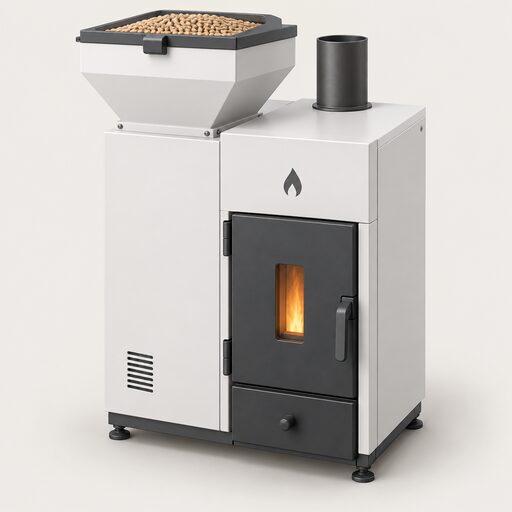 Biomass Boilers and StovesHow pellet and log biomass boilers and room stoves work in UK homes: the £5,000 Boiler Upgrade Scheme grant and its rural, off-gas-grid conditions, emissions limits, smoke control area law, fuel sourcing and the practical demands of storage and maintenance.
 How Much Does a Heat Pump CostA heat pump usually costs around eleven thousand pounds installed, though quotes vary a lot depending on your home.
 Financing an InstallationPaying monthly for a boiler, solar panels, battery or heat pump sounds simple, but who actually lends you the money and what happens if the work goes wrong?