In this guide
There is no UK-wide grant that exists solely for home battery storage. A household searching for a battery storage grant in the UK will not find a standalone pot of money reserved for batteries in the way the Boiler Upgrade Scheme reserves funding for heat pumps. What exists instead is a patchwork: a Scottish grant and loan scheme that names battery storage among the renewable measures it will support, a VAT zero rate that removes 20% from the installed cost of a qualifying battery, and an export framework that lets a household earn from electricity it stores and later sells.
The VAT position is the single largest and most widely available saving. A rate of 0% applies to both certain products supplied by an installer and the cost of all work to install those products in a home, and electrical storage batteries are on the list of qualifying energy-saving materials1. That relief runs until 31 March 2027, after which the reduced rate replaces it across the whole of the United Kingdom unless further legislation extends the end date3.
North of the border, the Home Energy Scotland Grant and Loan can provide interest-free loan funding for energy efficiency measures or to install renewable measures such as heat pumps or battery storage, and grant funding may also be available4. The scheme is run by the Energy Saving Trust on behalf of the Scottish Government5. For a household weighing up a battery, the practical question is therefore not which grant to claim but which combination of VAT relief, Scottish support and export income applies to their circumstances.
No UK-wide grant exists solely for battery storage
The funding landscape for batteries is defined as much by what is excluded as by what is offered. The Boiler Upgrade Scheme, the government's main domestic heating grant, is built around heat pumps and biomass boilers. Its published grant values run to £7,500 for a ground source heat pump from 28 April 2026 and £5,000 for biomass boilers in limited circumstances9. Battery storage does not appear among those supported measures. A household cannot use the Boiler Upgrade Scheme to fund a battery, and the scheme's eligibility rules are framed around the heating system rather than around electricity storage.
The same pattern holds elsewhere. The Electric vehicle charging device grant scheme statistics are published as official statistics in development on the number of grants awarded for the installation of electric vehicle charging devices, covering the UK11. That is a transport measure, not a storage one. The government's heat pump deployment statistics note that the schemes they cover include installations in the UK, but that some devolved administration schemes in Scotland and Northern Ireland are currently not included12. Coverage gaps of that kind matter when a household is trying to work out whether a figure it has seen applies to its own nation.
Where batteries do appear in a grant context, they appear as one measure within a broader package rather than as the purpose of the scheme. The Home Energy Scotland Grant and Loan is the clearest example, offering interest-free loan funding for energy efficiency measures or to install renewable measures such as heat pumps or battery storage, with grant funding possibly available alongside4. That is a different structure from a dedicated battery grant: the household applies to a general retrofit scheme, and the battery is one of the measures that scheme will support.
| Scheme | What it funds | Battery storage included? |
|---|---|---|
| Boiler Upgrade Scheme | Heat pumps and biomass boilers9 | No |
| Electric vehicle charging device grant | EV chargepoint installation11 | No |
| Home Energy Scotland Grant and Loan | Energy efficiency and renewable measures4 | Yes, as one eligible measure |
For most households in England, Wales and Northern Ireland, then, the realistic funding route is not a grant application at all. It is the VAT treatment of the installation, combined with whatever the household can earn by exporting stored electricity. The sections below set out how each of those works, where the boundaries fall, and what changes on 31 March 2027.
Zero-rate VAT on installation: the main saving for battery households
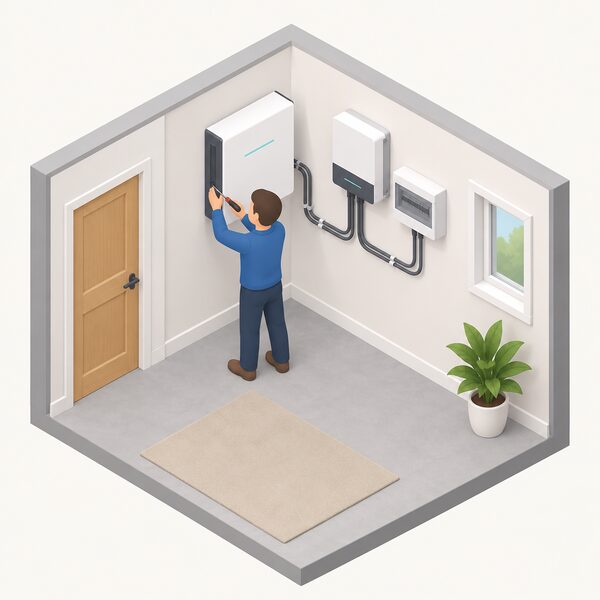
The zero rate is the most significant and most broadly available financial support for a domestic battery. A household pays a rate of 0% VAT on both certain products supplied by an installer and the cost of all work to install those products in a home1. Because the relief covers the labour as well as the hardware, its value scales with the total installed cost rather than with the price of the battery alone. On a typical installation the saving is therefore larger than a simple percentage of the unit price would suggest.
Electrical storage batteries sit within the list of energy-saving materials that qualify. The legislation adds electrical batteries that store electricity generated by certain energy-saving materials and from the National Grid6. The published list of materials subject to relief at 0% until 31 March 2027 includes electrical storage batteries alongside air source heat pumps, ground source heat pumps, water source heat pumps, solar panels, insulation, central heating and hot water controls, draught stripping, micro combined heat and power units, wood fuelled boilers, water and wind turbines, and smart diverters2.
The relief is not limited to owner-occupiers in the way a means-tested grant would be. It applies to the installation of qualifying energy-saving materials in buildings used solely for a relevant charitable purpose as well as in residential accommodation13. The instrument itself is framed around residential installations of qualifying energy-saving materials, and the government's own assessment states that it will only impact residential installations14.
"You'll pay a rate of 0% VAT on both:"
Two conditions are worth understanding because they shape what an installer can put on an invoice. A single supply of energy-saving materials is eligible for relief where standard-rated elements are ancillary to, or an integral part of, the installation of energy-saving materials15. That matters where a battery is installed alongside other work: the question is whether the additional elements form part of the qualifying installation or stand apart from it. Where they stand apart, the standard rate can apply to that portion.
The relief is also a reversal of an earlier restriction rather than a new invention. The 2022 Order was intended to reverse legislation introduced in 2019 that narrowed the scope of the previous VAT relief for energy-saving materials, and to introduce a temporary zero rate for the installation of energy-saving materials from 1 April 2022 to 31 March 2027 in Great Britain14. Before that reversal, reduced rating of installations was limited to supplies that met certain social conditions or where the cost of the materials did not exceed 60% of the total value of the supply14. The 60% test is the reason older guidance on this subject reads differently from current guidance: it applied to supplies made in Great Britain between 1 October 2019 and 31 March 2022, and to supplies made in Northern Ireland from 1 October 201915.
For a household, the practical consequence is that a battery installed as part of a qualifying package before 31 March 2027 should carry no VAT on the qualifying elements. The saving is real but it is time-limited, and the deadline is the one figure in this area that a household should hold on to.
VAT relief period and what happens after it ends
The temporary zero rate ends on 31 March 2027. That date appears consistently across the official documents: the changes qualify for the temporary zero rate until 31 March 202713, the relief is described as a temporary VAT zero rate until 31 March 202716, and the consultation outcome confirms that qualifying installations would benefit from a temporary VAT zero rate17. The relief remains in force for the period from 1 April 2022 until 31 March 202718.
What happens next is set out in legislation rather than left to speculation. The zero rate will be replaced with the reduced rate after 31 March 2027 across the whole of the United Kingdom unless further legislation extends the end date3. The reduced rate is 5%, so an installation completed after that date would carry VAT at that level rather than at 0%. The Order also widens the scope of the zero rate from 1 April 2022 to 31 March 2027 and the reduced rate from 1 April 2027 for installations in England and Wales and Scotland18.
The mechanism behind the change is a sunset clause. A sunset clause in the legislation will result in the automatic reversion to the reduced rate after five years unless the government introduces further legislation to extend the end date14. The zero rate will be replaced with the reduced rate once the five-year period ends, unless the government lays further legislation to extend the end date14. The reversion is therefore automatic in the absence of action, not conditional on a decision to remove the relief.
There is a distinction worth drawing between the temporary element and the permanent one. The reforms are described as permanent, meaning that when the zero rate aspect of the relief sunsets on 31 March 2027, the underlying relief continues in a different form17. The 2022 Order permanently reverses, in Great Britain, the legislative changes the United Kingdom was required to make in 2019 following the CJEU ruling in European Commission v United Kingdom C-161/1414. What ends in 2027 is the zero rate, not the relief itself.
For a household planning a battery, the timing question is straightforward to state and difficult to predict: an installation completed before 31 March 2027 falls under the zero rate, and one completed afterwards falls under the reduced rate unless the government acts. The documents do not indicate whether an extension is planned. The relief has no known outstanding effects recorded against it, and no known changes or effects made by subsequent legislation have been applied to its text19.
What qualifies as an energy-saving material and where the relief applies
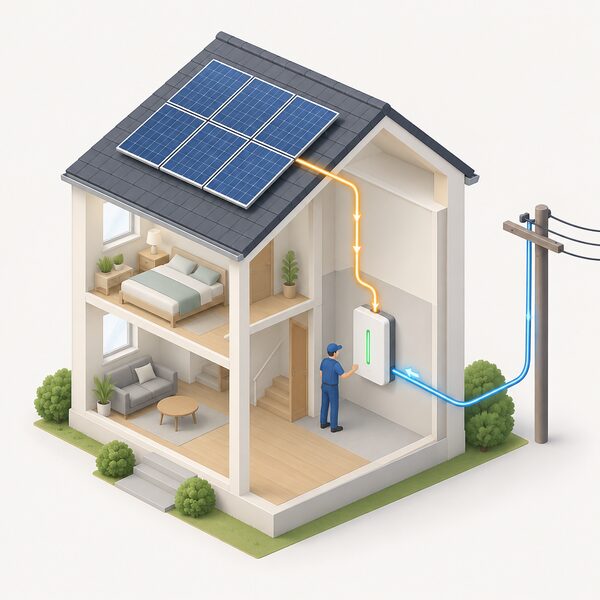
The list of qualifying materials has been widened twice in recent years, and batteries are among the additions. The 2022 Order added water source heat pumps, certain electrical batteries, and certain smart diverters to the list of energy-saving materials that can qualify for the reduced rate of VAT21. A later instrument added electrical batteries that store electricity generated by certain energy-saving materials and from the National Grid6. The published list of materials subject to relief at 0% until 31 March 2027 confirms electrical storage batteries among them2.
The statutory language is specific about what a battery must store. The legislation refers to electrical storage batteries within sub-paragraph (2)22. The accompanying note describes the addition as covering electrical batteries that store electricity generated by certain energy-saving materials and from the National Grid6. A battery charged from a solar array and from grid electricity therefore falls within the description; the relief is not confined to batteries charged only from renewable generation.
The relief applies to installations in residential accommodation and in buildings used solely for a relevant charitable purpose13. It is not a general relief on the purchase of a battery as a standalone product. The structure of the relief is built around installation: the zero rate applies to certain products supplied by an installer and to the cost of all work to install those products in a home1. A household buying a battery as a bare product, without an installation supply, is not within that structure.
Where a supply mixes qualifying and non-qualifying elements, the treatment depends on how the parts relate. A single supply of energy-saving materials is eligible for relief where standard-rated elements are ancillary to, or an integral part of, the installation of energy-saving materials15. The test is one of integration rather than of proportion. Where the standard-rated elements are integral to the qualifying installation, the relief can cover the single supply; where they are not, the standard rate applies to them.
The territorial position has converged. The Order's territorial extent and territorial application are both the United Kingdom14. The reduced rate applied to Great Britain supplies made between 1 October 2019 and 31 March 2022, and to supplies made in Northern Ireland from 1 October 201915. The installation of energy saving materials in residential accommodation was reduced rated in Great Britain between 1 October 2019 and 31 March 2022, and in Northern Ireland from 1 October 2019 to 30 April 202323. From 1 May 2023, Northern Ireland has been within the same zero-rate relief as the rest of the United Kingdom6.
| Nation | Reduced rate period | Zero rate from |
|---|---|---|
| Great Britain | 1 October 2019 to 31 March 202215 | 1 April 202214 |
| Northern Ireland | 1 October 2019 to 30 April 202323 | 1 May 20236 |
Smart Export Guarantee: earning from stored and surplus electricity
A battery does not only reduce what a household buys; it can also change what a household sells. Surplus solar electricity can be sold back to an energy supplier through a Smart Export Guarantee tariff when the battery is full7. The Smart Export Guarantee enables small-scale generators to receive payments from electricity suppliers for electricity which they export back to the National Grid, providing certain criteria are met24. The scheme launched on 1 January 202025.
The interaction between a battery and export income is not straightforward, because a battery changes when electricity is available to export. Without storage, exports happen when generation exceeds immediate household demand. With a battery, the household can hold that electricity and either use it later or export it when the battery is full. The Energy Saving Trust describes the export route as available once the battery is full, which places the battery ahead of the export in the order of operations7.
The payment basis is set out in official guidance. Generators are entitled to payments based upon actual meter readings, even if some suppliers offer deals with alternative payment models24. That matters for a battery household because it means the payment should follow measured export rather than an estimate or a deemed figure. Where a supplier offers an alternative model, the entitlement to metered payment remains.
The scale of small-scale storage in the wider system is modest but growing. National Grid's Future Energy Scenarios forecast 1.5GW of small battery storage, domestic and commercial, by 2040, around a third of total battery storage deployment capacity26. At grid scale, UK battery storage power capacity reached 7.5GW by the end of 2025, with a record new 2.3GW energised in 2025 alone27. Those figures describe the system rather than the household, but they indicate the direction of travel: storage is being built at every level, and domestic batteries are part of that picture.
For a household, the export route is the mechanism by which a battery can generate income rather than only reduce consumption. The rate paid is a matter for the supplier, and the scheme does not set a single national price. What the scheme does set is the framework: a qualifying installation, a qualifying meter, and payment based on what is actually exported.
How a battery affects your SEG payments and metering
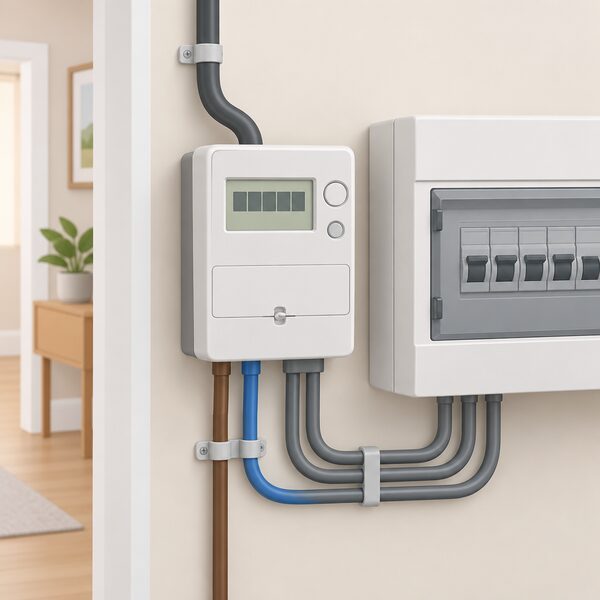
The metering requirements are the practical gate on export income. Generators must have a smart meter to monitor exports in order to qualify for the Smart Export Guarantee8. The meter must be an export or smart meter capable of taking measurements at half-hourly intervals25. A household without a compliant meter cannot be paid for exports, however much electricity it sends to the grid.
A battery changes the pattern of what is exported, and the effect on self-consumption is substantial. Great British Energy states that adding a battery to a solar installation increases self-consumption from 30 to 40% to 70 to 80%8. That shift has a direct consequence for export income: electricity used in the home is electricity not exported, so a battery that raises self-consumption reduces the volume available for export while increasing the value the household takes from its own generation. The two effects pull in opposite directions, and which dominates depends on the relative value of avoided import against the export tariff on offer.
Where a household already receives payments under an older scheme, the rules on combining support are specific. A household can receive Smart Export Guarantee payments for an installation when it already receives Feed-in Tariff export payments for a different installation, as long as the installations are completely separate with distinct import and export meters and different import and export MPANs28. The Feed-in Tariff scheme is closed to new applicants and will wind down by 203928. The separation requirement is the operative condition: two installations on the same meter do not qualify, and a battery added to an existing solar array is normally part of that same installation rather than a separate one.
The practical position for a battery household is therefore that export income is available but conditional. It requires a compliant meter, a supplier offering a Smart Export Guarantee tariff, and, where older payments are already in place, a clear separation between installations. A battery does not automatically increase export earnings; it changes the timing and the volume of what is exported, and the household's own consumption sits between the two.
Home Energy Scotland Grant and Loan: support north of the border
Scotland operates the clearest route by which a household can obtain funded support for a battery. The Home Energy Scotland Grant and Loan can provide interest-free loan funding for energy efficiency measures or to install renewable measures such as heat pumps or battery storage, and grant funding may also be available4. The scheme offers eligible homeowners support, and it is administered by the Energy Saving Trust on behalf of the Scottish Government5.
The structure is a loan first, with grant funding as a possible addition. Loans have also been available to cover additional costs30. That combination means a household may be able to borrow interest-free for the renewable measure and receive grant support towards part of the work, depending on the measures and the property. The scheme has been extended into new territory: grant support for homeowners to enable connections to heat networks has been introduced through the long-running Home Energy Scotland scheme, and applications opened in December 202531.
The Scottish policy context is distinct from the rest of the United Kingdom. The Scottish Government has consulted on prohibiting the use of polluting heating systems in all buildings after 204532. That is a longer horizon than the 2035 date that applies to the phase-out of new gas boiler installations elsewhere, and it shapes the case for measures such as batteries and heat pumps in Scottish homes. A household in Scotland considering a battery is therefore operating under a different policy timetable as well as a different funding route.
For a household in Scotland, the practical sequence is to establish which measures the scheme will support, whether the support takes the form of a loan, a grant or both, and how the battery fits alongside any heating measures being installed at the same time. The scheme is not a battery grant in isolation; it is a general retrofit funding route in which battery storage is one eligible measure among several. Households elsewhere in the United Kingdom do not have an equivalent route and rely on the VAT relief and export arrangements described above.
Heat batteries: the £2,500 grant

Heat batteries are a different technology from electrical storage batteries, and the funding position differs accordingly. A heat battery stores heat rather than electricity, typically charged from a heat pump or another heat source, and it is treated as part of a heating system rather than as an electricity storage device. The £2,500 figure that circulates in connection with heat batteries relates to the Boiler Upgrade Scheme's air source heat pump grant value rather than to a standalone heat battery grant.
The Boiler Upgrade Scheme's published values are specific. A ground source heat pump carries a grant value of £7,500 from 28 April 20269. Biomass boilers attract £5,000 in limited circumstances10. Air source heat pumps are supported at the scheme's standard rate. The scheme is administered through Ofgem guidance for installers, which sets out the grant values and the conditions attached to each technology9.
| Technology | Boiler Upgrade Scheme grant value |
|---|---|
| Ground source heat pump | £7,500 from 28 April 20269 |
| Biomass boiler | £5,000 in limited circumstances10 |
| Electrical storage battery | Not a supported measure9 |
Heat pump deployment figures give a sense of how the scheme sits within the wider picture. The government publishes quarterly heat pump deployment statistics for the United Kingdom, and notes that the schemes they cover include installations in the UK, though some devolved administration schemes in Scotland and Northern Ireland are currently not included12. The Heat Pump Ready Programme has funded projects at various grant totals, including £773,156.36 for The Flexible Heat Pump, £465,763.11 for a natural refrigerant based heat pump, and £293,830 for a Pricing Engine for Heat Pump Subscriptions33. Those are innovation programme awards rather than household grants, and they illustrate the range of public funding that touches heating technology without being available to individual homes.
For a household, the distinction matters because a heat battery is not an electrical storage battery and does not qualify for the VAT relief on electrical storage batteries in the same way. A household considering a heat battery should establish which scheme, if any, supports the specific technology being installed, and should not assume that the £2,500 figure applies to it. The Boiler Upgrade Scheme's values are published by technology, and the technology determines the amount.
How battery storage fits the UK's wider energy policy timeline
Battery storage sits within a policy landscape that is being reshaped around electrification. The UK grid-scale battery storage power capacity reached 7.5GW by the end of 2025, with a record new 2.3GW energised in 2025 alone27. National Grid's Future Energy Scenarios forecast 1.5GW of small battery storage, domestic and commercial, by 2040, around a third of total battery storage deployment capacity26. Those projections place domestic batteries within a system that is itself becoming more storage-heavy.
The direction of travel for heating is set out in the Heat and Buildings Strategy, which set a target for phasing out gas boilers from 2035 in favour of low-carbon alternatives. The strategy states the phase-out will run in line with replacement cycle timelines so that almost all heating systems in 2050 are low-carbon. The ban on new fossil fuel boilers extends to all homes by 2035. The UK Government has committed to fully decarbonising the electricity grid by 2035.
For a household, the significance of those dates is that they describe a system in which electricity becomes the dominant energy carrier for heating and transport, and in which storage becomes more valuable as a result. A battery installed today operates within a framework that is expected to change: the VAT relief ends in 2027, the gas boiler phase-out runs to 2035, and the electricity grid is targeted for decarbonisation by the same year. The Clean Flexibility Roadmap sets out the government's approach to flexibility, and the grid-scale figures show that storage is being built at scale27.
The dependence that remains is worth stating plainly. A domestic battery does not make a household independent of the grid. It stores electricity that has usually come from the grid or from a solar array, and it requires a supplier, a meter and an export tariff to realise the value of what it holds. Where a battery is paired with solar, the household reduces its reliance on imported electricity during daylight and evening hours, but it remains connected, metered and dependent on the network for the balance of its supply. The independence a battery offers is measured in reduced import and increased self-consumption, not in disconnection.
Sources33 cited
- VAT on energy-saving products, GOV.UK, 2026-09-17
- VAT rates on different goods and services, GOV.UK, 2026-07-10
- The Value Added Tax (Installation of Energy-Saving Materials) Order 2023: explanatory memorandum, legislation.gov.uk, 2026-09-17
- Home energy efficiency advice, Argyll and Bute Council, 2026-09-17
- Home Energy Scotland Grant and Loan Scheme awards, Scottish Government, 2025-05-12
- The Value Added Tax (Installation of Energy-Saving Materials) Order 2024: explanatory memorandum, legislation.gov.uk, 2026-09-17
- Battery storage, Energy Saving Trust, 2026-08-19
- POSTnote 771: Small-scale low-carbon generation, Parliament, 2026-06-25
- Boiler Upgrade Scheme guidance for installers V5, Ofgem, 2026-04-28
- Boiler Upgrade Scheme guidance for installers V5.1, Ofgem, 2026-07-02
- Electric vehicle charging device grant scheme statistics: October 2025, GOV.UK, 2025-11-26
- Heat pump deployment quarterly statistics, United Kingdom 2025 Q3, GOV.UK, 2025-12-04
- VAT energy-saving materials and grant-funded heating supplies: VENSAV2082, GOV.UK, 2026-09-17
- The Value Added Tax (Installation of Energy-Saving Materials) Order 2022: explanatory memorandum, legislation.gov.uk, 2026-09-17
- VAT energy-saving materials and grant-funded heating supplies: VENSAV3210, GOV.UK, 2026-09-17
- Extension of VAT energy-saving materials relief, GOV.UK, 2024-01-11
- Summary of responses: VAT energy-saving materials relief, GOV.UK, 2023-12-11
- The Value Added Tax (Installation of Energy-Saving Materials) Order 2022: note, legislation.gov.uk, 2026-09-17
- The Value Added Tax (Installation of Energy-Saving Materials) Order 2022: introduction, legislation.gov.uk, 2026-09-17
- The Value Added Tax (Installation of Energy-Saving Materials) Order 2022: contents, legislation.gov.uk, 2026-09-17
- The Value Added Tax (Installation of Energy-Saving Materials) Order 2024: made data, legislation.gov.uk, 2026-09-17
- Value Added Tax Act 1994, Schedule 7A, Part 2, Chapter 2, legislation.gov.uk, 2026-09-17
- VAT energy-saving materials and grant-funded heating supplies: VENSAV3110, GOV.UK, 2026-09-17
- Smart Export Guarantee: generators, Ofgem, 2026-09-17
- Feed-in Tariffs: scheme closure, Ofgem, 2026-09-17
- The future for small-scale low-carbon generation: SEG, GOV.UK, 2040
- Clean Flexibility Roadmap: July 2026 update, GOV.UK, 2025-12
- Guidance for FIT Generators V18, Ofgem, 2026-04-01
- Home Energy Scotland Grant and Loan Scheme: application and claim processing times, Scottish Government, 2026-03-12
- Heat in Buildings progress report 2024, Scottish Government, 2024-10-10
- Heat in Buildings Bill update from the Cabinet Secretary, Scottish Parliament, 2025-11-18
- Heat networks delivery plan review report 2026, Scottish Government, 2025-12
- Heat Pump Ready Programme: Stream 2 Wave 2 projects, GOV.UK, 2026-05-28
 Planning Permission in ScotlandDo you need planning permission for a home battery in Scotland?
 The Full Home Batteries GuideA home battery stores cheap or solar power for later, but will it really cut your bills enough to be worth it?
 Planning Permission in EnglandWhen a domestic battery or its enclosure falls within permitted development in England, when an application is needed, and how the position differs for outbuildings, listed buildings and conservation areas.
 Solid-State BatteriesAre solid-state batteries on sale yet, and should you wait for one?
 Grants and Energy IndependenceCan you get a grant for solar panels or a battery?
 Planning Permission in WalesDo you need planning permission for a home battery in Wales?