

In this guide
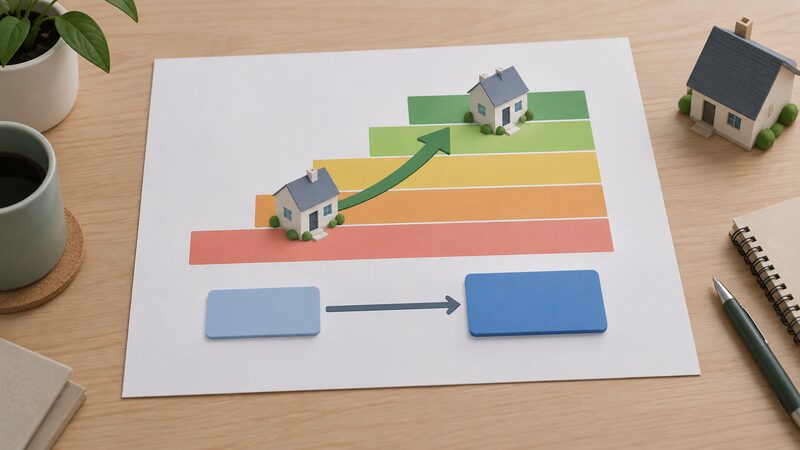
ECO4 does not pay a fixed grant per measure. It pays energy suppliers a score, and the score decides what a household is offered. Ofgem's scoring decision sets out the core rule: full project scores are based on the starting and finishing intermediate SAP bands of the property, and they must be based on the difference in average annual bill expenditure between the starting and finishing SAP ratings1. A project that moves a home a long way up the scale is worth a great deal to a supplier; one that nudges it is worth little, and may not be funded at all.
Underneath the full project score sits the partial project score, the value attached to an individual measure. Ofgem implemented pre-calculated, deemed partial project scores based on the floor area and the intermediate SAP band, split into four floor area segments, with the final set of scores including a correction factor of 10 per cent1. Every partial project score is then reduced by a deflator, which Ofgem applied so that the incentive remains on industry to complete confirmed projects and reach the minimum requirement rather than to stop after one easy measure2. That single design choice explains most of what householders experience: packages rather than single products, insulation before heating, and offers that change after a survey.
ECO4 is a Great Britain scheme, delivering insulation and heating qualifying actions to low-income, vulnerable and fuel-poor households3. Ofgem states it runs until 31 December 2026, following a nine-month extension4. Northern Ireland is not covered.
The short answer: score first, measures second
A supplier looks at a property and asks a single commercial question: what score will this project generate, and what will it cost to install? The answer comes from Ofgem's scoring matrix, not from an installer's judgement. Because partial project scores are deemed and pre-calculated by floor area and intermediate SAP band1, two identical boilers in two different homes can be worth very different amounts.
The worked example Ofgem published during consultation shows the mechanics. A premises with a starting SAP rating of 25 and a total floor area of 80m², improved by a qualifying package, produced a full project score of 1079.8 for a project meeting the minimum requirement2. The same document illustrates deflation on an individual measure: an internal wall insulation score of 318.3 becomes 191.1 once deflated2. The gap between those two numbers is the whole argument for doing a project rather than a measure.
For householders, this means the ECO4 scheme rarely offers a menu. It offers a package assembled to reach a band threshold, and the composition of that package is driven by arithmetic the household never sees.
Full project scores, partial project scores and the deflator
The two score types serve different purposes.
| Term | What it is | Source of the figure |
|---|---|---|
| Full project score (FPS) | Based on starting and finishing intermediate SAP bands; must reflect the difference in average annual bill expenditure between starting and finishing SAP ratings1 | Ofgem scoring decision, April 2022 |
| Partial project score (PPS) | Pre-calculated and deemed, based on floor area and intermediate SAP band; required to represent the measure's average annual energy bill savings1 | Ofgem scoring decision, April 2022 |
| Deflator | Applied to all partial project scores to maintain the incentive to complete confirmed projects and reach the minimum requirement2 | Ofgem scoring consultation, December 2021 |
| Correction factor | The final set of partial project scores includes a correction factor of 10%1 | Ofgem scoring decision, April 2022 |
Ofgem was explicit about the limits of its own discretion over the deflator, stating that "this will be part of the scheme legislation and we will not have any discretion in this area"1. The correction factor has a separate history: testing against the ten example measures developed for the first consultation suggested a correction factor of 6.8 per cent, and the final set of scores landed on 10 per cent1.
The National Insulation Association, an independent trade body, described the mechanism in its commentary on the successor insulation scheme, referring to the 10 per cent score correction deflator used in ECO4 to account for measure interaction, and calling for measures under ECO+ to receive ECO4 partial project scores without the 20 per cent deflator8. The documents use the language of deflator and correction factor in overlapping ways, and the published figures differ; what is consistent across them is that a measure's headline score is not the score that is banked.
Partial project scores also travel outside ECO4. Government confirmed that ECO4 partial project scores are used in the Great British Insulation Scheme to calculate the bill savings a measure achieves9.
Floor area: four segments, and why big homes score more

Floor area is one of the two inputs to a deemed partial project score. Ofgem segregated the scores into four floor area segments and noted that scores for the largest floor area segment, over 200m², are significantly larger than those for the smaller segments1.
The logic is physical: a larger heated envelope loses more energy, so the modelled bill saving from insulating or reheating it is larger. The consequence is commercial. A supplier weighing two eligible households will find the larger, colder property produces more score for a comparable installation cost. Small flats, mid-terraces and homes already part-treated generate thinner scores, and applications from them are more often declined even where the household clearly qualifies on benefits or through ECO4 Flex.
Where only part of a property is treated, the arithmetic tightens further. Ofgem's decision requires that the partial project score must be multiplied by the percentage of property treated, known as POPT1. Insulating three walls of four does not earn three quarters of a notional score by informal estimate; it earns a defined proportion under the rules.
For an intelligent reading of a quote, the two questions that matter are what intermediate SAP band the assessment has recorded and which of the four floor area segments the property falls into. Both are set at assessment, and both determine the value of the work before any installer visits.
What drives the package a household is offered
ECO4 is targeted at households with low Energy Performance Certificate ratings10. Independent industry commentary describes the scheme as applying to properties with an EPC of E, F or G, split between private low-income households and social housing11. Elmhurst Energy, an accreditation body, summarises the funding logic plainly: ECO4 grants are awarded based on how big the difference is between the energy performance ratings12.
Three forces then shape what appears in the offer:
- Band movement is the currency. Because full project scores depend on starting and finishing intermediate bands, measures are selected to cross a threshold, not to give a household what it would most like.
- Insulation tends to come first. Insulation and heating qualifying actions are the two families of measure the obligation covers3, and insulation changes the modelled band in a way that makes a heating measure score better afterwards.
- Deflation punishes isolated work. A single measure carries a deflated score; a completed project that reaches the minimum requirement carries a full project score2.
The measures that can be installed at all are listed in Ofgem's ECO4 Measures Table, which provides information on the energy efficiency measures which can be installed under the fourth Energy Company Obligation scheme13, and which suppliers use to meet their obligations14. Version 4.0 of that table carries a version date of 26 June 202515, and Ofgem's ECO4 Delivery Guidance reached version 4.0 on 26 March 202616.
Uplifts: innovation, new measures and rural off-gas premises

The base matrix is not the whole story. ECO4 includes mechanisms designed to support the delivery of innovative measures where benefits and improvements may not otherwise be captured through current partial project and full project scores17. Ofgem's guidance on new measures and products states that either a 25 per cent or 45 per cent uplift can be awarded5, and the scoring decision sets out that the innovation measure uplift is calculated using the partial project score for the innovation measure1.
Two routes exist for a new measure to enter the scheme: a standard alternative methodology route and a "data light" route1. Products seeking entry must show real effect: smart technologies and flexible heating systems are eligible to apply for a new ECO4 measure type and score, but all smart technologies must provide evidence of space heating cost savings5. The scheme legislation set out that the published methodology for scoring smart thermostats has effect from 14 November 20246.
A separate uplift applies geographically. Under the ECO4 Order as amended, the factor R is 0.2 where a qualifying action is a low-income qualifying action installed at off-gas premises in a rural area in Scotland or Wales, and otherwise 06. That is the clearest point at which the scoring rules treat the nations differently.
Not everything attracts score. Ofgem stated that batteries installed with solar PV will not contribute to any ECO scoring18. Solar appears in what councils list as fundable under the scheme, alongside insulation and boilers and central heating19, but the scoring treatment of storage is settled: no score. Households considering panels under the obligation should read that alongside ECO4 and solar panels and battery storage grants.
How the four nations sit differently
ECO4 is an energy efficiency scheme for Great Britain3, delivering measures to homes in Great Britain20. Northern Ireland is outside the obligation altogether. One supplier of solar equipment states flatly that free panels under the scheme exclude Northern Ireland21. Northern Irish households are served by separate arrangements covered in home energy grants in Northern Ireland.
| Nation | Position under ECO4 scoring |
|---|---|
| England | Covered; no nation-specific uplift in the scoring factor R6 |
| Scotland | Covered; R is 0.2 for low-income qualifying actions at rural off-gas premises6 |
| Wales | Covered; same rural off-gas uplift factor of 0.26 |
| Northern Ireland | Outside the Great Britain scheme3 |
Delivery has historically been uneven. Under the previous scheme, ECO3, Scotland received 10.1 per cent of measures and Wales 4.5 per cent22. Local authority routes give some counterweight: ECO4 allows local authorities to identify the most vulnerable households who could benefit from energy efficiency improvements23, and an authority proposing its own statement of intent methodology under Flex Route 4 must demonstrate, underpinned by evidence, that the proposed methodology is more effective at identifying low income households than the criteria offered under Routes 1 and 224. Eligibility, rather than scoring, is what the nations and councils vary; the matrix itself is common across Great Britain. See ECO4 eligibility and home energy grants in Scotland.
The market test for new products is also framed at Great Britain level: comparable measures, for the purposes of the improvement assessment, are those that would otherwise be promoted on ECO4 by the participant and are commonly available on the market in Great Britain20.
The rules behind the arithmetic

ECO4 is enacted by the Electricity and Gas (Energy Company Obligation) Order 2022, as amended25. The obligation period runs from the commencement of the ECO4 Order on 27 July 2022 to 31 December 202626, and the scheme was launched in 202227. Government valued it at £4 billion at consultation28, while Ofgem's scoring decision warned that, without a correction to the scores, the £1 billion spending envelope for the scheme could be breached1.
The modelling basis is fixed by law rather than by Ofgem's preference. Ofgem's understanding was that ECO4 legislation would instruct it to calculate scores with reference to SAP 2012, and that scores remain based on SAP 2012 unless the legislation is changed1. Ofgem's summary of guidance updates records the use of SAP 2012 v9.92 and SAP 10, and the use of RdSAP 2012 v9.9429. When the industry was asked whether the scoring methodology should be reworked after the move from SAP 2012 to SAP 10.2, the National Insulation Association agreed it should not, on the grounds that updating the methodology at that stage would create extra administrative complexity30.
Thresholds matter at the margin, and Ofgem committed to continue to express the thresholds to one decimal place1, which is why published scores carry a decimal rather than being rounded to whole numbers.
"Full project scores (FPS) will be based on starting and finishing intermediate SAP bands."
Timing is the live constraint. Ofgem's delivery guidance states that work of the relevant kind must be completed in full no later than 31 March 202625; the original scheme end date was 31 March 20267; and Ofgem's scheme page now gives 31 December 2026 following the nine-month extension4. Mid-scheme changes to ECO4 and the insulation scheme were consulted on in 202518. Households mid-application should expect installers to be working to the earlier date for the works themselves.
What ECO4 scoring means for household independence
Scoring makes ECO4 a fabric-and-heating scheme rather than a generation scheme, and that shapes what independence it buys. The obligation funds insulation and heating qualifying actions3, described by councils as heating improvements and insulation31. Insulation reduces the quantity of energy a home needs at all, which is the most durable form of independence available: it does not degrade with tariff changes, it does not depend on an app, and it survives a supplier's collapse. A project designed to move a property up intermediate SAP bands is, by construction, a project that shrinks demand.
What it does not buy is autonomy from the grid or the gas network. Batteries alongside solar PV earn no ECO score18, so the obligation is not a route to storage. Heating measures replace one supplied fuel with another or improve its efficiency; the meter stays. And the funding itself is supplier money, not household money: the scheme requires medium and large energy suppliers to support energy efficiency improvements for eligible households19, and government has set out the ending of funding for the scheme on the path to its close7. A household that qualifies is dependent on a supplier's appetite for score in the months remaining, and on whether its floor area segment and starting band make the sums work.
The practical reading is that scoring rewards the homes with most to gain and passes over the homes already part-improved. That is deliberate: the scheme is described as government-backed and designed to tackle fuel poverty, focused on low-income, vulnerable and fuel-poor households20. For a household outside the scoring sweet spot, the alternatives sit elsewhere in home energy grants and schemes, including the Boiler Upgrade Scheme compared with ECO4 and the Great British Insulation Scheme compared with ECO4.
Sources31 cited
- ECO4 scoring methodology part 1 and 2 decision, Ofgem, 12 April 2022
- ECO4 scoring consultation part 2, Ofgem, 13 December 2021
- ECO4 supplier administration guidance, Ofgem, 6 July 2026
- Energy Company Obligation scheme page, Ofgem, 17 September 2026
- ECO4 New Measures and Products Guidance v3.0, Ofgem, 26 March 2026
- Electricity and Gas (Energy Company Obligation) (Amendment) Order, legislation.gov.uk, 24 July 2023
- Extending the ECO4 end date, GOV.UK, 29 August 2025
- Energy Company Obligation commentary, National Insulation Association, 3 January 2023
- Great British Insulation Scheme government response, DESNZ, March 2023
- ECO4 consumer guidance, MCS, 7 September 2026
- ECO funding for solid wall insulation, SWIGA, 20 September 2026
- ECO4 overview, Elmhurst Energy, 20 September 2026
- ECO4 Measures Table v4.0, Ofgem, 29 July 2025
- ECO4 Measures Table v2.0, Ofgem, 9 August 2023
- Summary of updates to ECO4 delivery guidance and measures table, Ofgem, 26 June 2025
- ECO4 delivery guidance version 4.0, Ofgem, 26 March 2026
- ECO4 innovation, new measures and products, Ofgem, 17 September 2026
- Summary of guidance updates: mid-scheme changes to ECO4 and GBIS, Ofgem, 7 April 2025
- ECO4 scheme information, West Lindsey District Council, July 2025
- ECO4 guidance: new measures and products, draft for comment, Ofgem, 4 July 2022
- Solar panel costs in the UK, Jackery, 2022
- ECO3 final determination report, Ofgem, February 2023
- ECO4 and ECO flexible eligibility, Breckland Council, 17 September 2026
- ECO4 Delivery Guidance v1.1, Ofgem, 3 February 2023
- ECO4 delivery guidance v3.2, Ofgem, 8 December 2025
- ECO public reports and data, Ofgem, 17 September 2026
- ECO4 Flex and GBIS Flex information document, Ceredigion County Council, November 2025
- Design of the Energy Company Obligation ECO4 2022-2026, GOV.UK, 20 July 2021
- ECO4 summary of updates from draft, Ofgem, 17 September 2026
- ECO schemes: SAP and RdSAP amendments, National Insulation Association, 18 September 2023
- Home energy efficiency, Bridgend County Borough Council, 17 September 2026
 Grants and Energy IndependenceCan you get a grant for solar panels or a battery?
 Fabric First ApproachWhy insulate before replacing the boiler or fitting a heat pump?
 Energy Checks Before BuyingHow energy efficient is the house, and what will it cost to heat?
 Energy Performance CertificatesAn Energy Performance Certificate rates how energy efficient your home is, from A down to G.
 Measured vs Modelled PerformanceWhy does a home use more energy than its rating predicts, and what does that mean for your bills?
 The Full Where to Start GuideWhich home improvements actually cut your bills, and which should you do first?