
In this guide
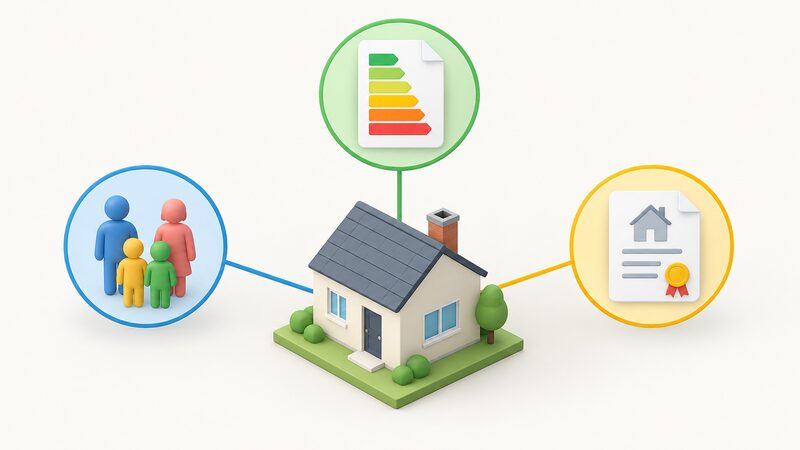
ECO4 eligibility rests on three tests taken together: who lives in the home, what the property's energy rating is, and who owns it. A household qualifies either because someone receives one of the named means-tested benefits, which places it in the Help to Heat Group, or because a local authority refers it under ECO4 Flex, most commonly on a combined gross annual household income of less than £31,000. The property must then be in the right band: properties with a starting SAP band of C or above are not eligible, owner-occupied homes qualify from band D to G, and private rented homes are targeted at bands E, F and G.
The scheme is closed to new funding. The announcement is unambiguous that no new applications can be funded1, and central guidance for suppliers describes the ending of funding for the scheme. That matters more than any eligibility rule: a household reading this in late 2026 should treat ECO4 as a scheme whose criteria explain existing and completed work rather than a route to new measures. Documents disagree on the closing date. The original end date was 31 March 2026, and Ofgem's scheme page states it will run until 31 December 2026 following a nine-month extension2.
ECO4 is the fourth iteration of the Energy Company Obligation, administered by Ofgem3 and enacted by the Electricity and Gas (Energy Company Obligation) Order 2022, as amended4. It obliges medium and large energy suppliers to fund insulation and heating improvements in the least efficient homes occupied by low income, vulnerable and fuel poor households. For a household's energy independence the effect is real but partial: the fabric and heating improvements are permanent and reduce demand for good, while the funding itself comes from a supplier obligation recovered through bills, and the decision to proceed always rested with a supplier or installer, never with the householder.
What ECO4 is and who administers it
The Energy Company Obligation places a duty on medium and large energy suppliers to support energy efficiency improvements for eligible households8. ECO4 launched in 20229 and applies to measures installed from 1 April 20222. Its stated main objective is to reduce fuel poverty by improving the least energy efficient housing stock occupied by low income, vulnerable and fuel poor households9.
Ofgem is the scheme administrator, meaning it writes the delivery guidance, runs the ECO4 Register, and audits what suppliers claim. ECO4 requires medium and large energy suppliers to support energy efficiency improvements for eligible households5, so the obligation sits with the supplier rather than with the installer who knocks on the door or the household that accepts the work. The supplier must be able to evidence every measure it claims, which is why the paperwork trail behind an installation matters as much as the installation itself.
Delivery is split between two eligibility mechanisms. The Help to Heat Group is the benefit-linked route, checked against benefit receipt. ECO4 Flex is a household referral mechanism within the wider scheme for households not in receipt of a means tested benefit7, operated by local authorities, which publish a statement of intent naming the routes they use. The declaration form used at pre-installation lists the full set of eligibility routes as Help to Heat Group, Social Housing, LA Flex, In-Fill and Supplier Flex10. Suppliers may provide evidence only for certain Flex routes, not all of them11.
Qualifying benefits and the £31,000 income route

The means-tested benefits named for access to an ECO scheme are Child Benefit subject to income thresholds, Pension Credit Guarantee Credit and Pension Credit Savings Credit, income-related Employment and Support Allowance, income-based Jobseeker's Allowance, Income Support, Child Tax Credit and Working Tax Credit, Universal Credit, and Housing Benefit6. Receipt of one or more of these by a member of the household is what places it in the Help to Heat Group. Further detail on how these benefits interact with other schemes sits on the page covering which benefits qualify you for energy grants.
Where no qualifying benefit is claimed, the income route applies. Route 1 of ECO4 Flex covers owner-occupied and private rented sector households with a total combined gross annual income from all sources of less than £31,0007. The cap applies irrespective of property size, composition or region12, so a large household in an expensive area faces the same threshold as a single occupant elsewhere. The figure is also written into legislation, which defines the relevant qualifying condition as premises occupied by a household living on a gross income of less than £31,000 per year, certified by a relevant authority declaration13.
Some local authorities combine the income test with a health condition. Councils describe eligibility where a household has a combined income below £31,000 or someone in the home has a qualifying medical condition3, and a combined annual household income under £31,000 with someone at the property having a qualifying long-term health condition is a commonly published pairing14. Because each authority sets its own combination within the national routes, the same household can qualify in one area and not in the next. The detail of the routes is covered under ECO4 Flex, and the comparison of the two paths under ECO4 Flex vs the Help to Heat route.
The EPC condition: starting band decides everything
The certificate rating does two jobs in ECO4. It decides whether the property is in scope at all, and it sets the target the work must reach. Properties with a starting SAP band of C or above are not eligible under ECO46. Only properties in band D to G can be treated15, which in householder terms means an owner-occupied home needs a certificate rated D, E, F or G before an installer can bring it forward.
The improvement requirement is then fixed by where the property starts. Properties with starting bands F and G must be improved to a D, while properties with starting bands E and D must be improved to a C7. Ofgem's delivery guidance states the same requirement in SAP terms.
"Any starting SAP band D or E property treated must be improved to at least a band C."
| Starting band | Minimum outcome required | Tenure generally in scope |
|---|---|---|
| D | Band C5 | Owner occupied5 |
| E | Band C5 | Owner occupied, private rented, social housing6 |
| F | Band D7 | Owner occupied, private rented, social housing6 |
| G | Band D7 | Owner occupied, private rented, social housing6 |
| C or above | Not eligible6 | Not applicable |
The funding a property attracts depends on the improvement made to its original certificate6, which is why a single measure rarely suffices in the worst homes and why projects are assembled as packages. How those packages are scored is set out under ECO4 scoring and minimum requirements. The dwelling must also be a pre-existing building erected before 1 April 20226. Houses in multiple occupation can be treated as part of ECO4 if at least one household occupying the HMO is eligible to receive ECO support5.
The reliance on certificates carries a known weakness. An EPC assessment is non-invasive, so no holes are drilled and no cavities are opened up for inspection, and the software records more than 140 pieces of data while only a simple summary appears on the certificate16. The rating is based on cost factors such as the type of fuel used for heating, hot water, lighting and ventilation17, so a property on mains gas scores higher than an equivalent property on electricity because gas is cheaper per kWh. A pre-installation assessment is carried out regardless, and the declaration form records the starting band as one of twelve values, from High B and Low B down to High G and Low G10.
Low income, fuel poverty and the flexible routes
ECO4 Flex allows local authorities to identify and refer consumers who live in private tenure properties and are considered low-income, fuel poor, or vulnerable to the effects of living in a cold home18. There are four separate qualifying routes to identify low income and vulnerable households, and in ECO4 suppliers may provide evidence only for routes 2 and 411.
- Route 1, income: gross annual household income of less than £31,0005.
- Route 2, proxies: households in bands E to G meeting at least two published proxy criteria7. One such proxy is a householder receiving free school meals due to low income12.
- Route 3, health referral: households identified and referred by a GP, a health board or an NHS trust7.
- Route 4, bespoke targeting: applicable to ECO4 Flex only, where suppliers and local authorities apply centrally having identified new methods of finding low-income and vulnerable households19.
Route 4 carries an evidential burden. Applicants must demonstrate, underpinned by evidence, that the proposed methodology is more effective at identifying low income households than the criteria offered under Routes 1 and 211. That is a test of the method, not of the individual household, and it is why bespoke routes appear in only some areas.
Local authorities also carry the governance. A statement of intent names a senior officer who will oversee the process of identifying eligible households under ECO4 Flex. Applications and declarations may be subject to Ofgem audits during the time that ECO4 is in effect and up to three years after the scheme ends7, and evidence of eligibility is expected to be retained for up to three years following the end of the scheme5. Council-run variants of this work are described under council and local authority energy grants.
Tenure: owner-occupier, private rented and social housing

Tenure is recorded on the eligibility form as one of three categories: Owner Occupied, Private Rented or Social Housing20. Measures delivered to occupants of the Help to Heat Group or identified through ECO4 Flex must go to private domestic premises, meaning premises not owned or let by a social landlord11. Flex is therefore restricted to private tenure homes, that is owner-occupied or private rented sector households5.
For a private tenant the band rule is tighter than for an owner-occupier. A privately rented house must have an energy efficiency rating of E, F or G to be eligible, and the owner's permission is required21. Local authority schemes state the same condition plainly: to benefit from ECO4 Flex a household must own its home or have the permission of its landlord7. Landlords may themselves be applicants: council schemes describe eligible applicants as a homeowner, private tenant or landlord22. Where a landlord is replacing heating, guidance notes that private landlords can only access ECO to replace an old heating system with a renewable heating system where the existing certificate is an E, F or G6.
| Tenure | Starting band in scope | Who applies |
|---|---|---|
| Owner occupied | SAP band D to G5 | Householder, via supplier or council23 |
| Private rented | Band E, F or G21 | Tenant with landlord permission, or landlord22 |
| Social housing | Band E, F or G6 | Registered provider, outside Flex11 |
Social housing sits on its own route and is not reached through Flex. One exception is recorded: where social housing is let at or above the market rate, the property can be treated as a private domestic premises, where the occupant meets the eligibility requirements24. Suppliers were also given a floor for private tenure delivery, having to upgrade a minimum equivalent of 150,000 private tenure band E, F and G homes under ECO46. One industry description of the split in scope reports properties with a certificate of E, F or G as 72% private low income and 28% social housing20; that is a trade body's characterisation rather than an official statistic. Social tenants are also served by the separate Warm Homes: Social Housing Fund.
What ECO4 pays for
Funding covers energy efficiency measures such as heating improvements and insulation3, and the obligation is framed around insulation and heating work rather than one-off fixes. The measures table sets out the full scope: upgrades to non-renewable and renewable heating systems, repair of a broken heating system, replacement of a broken efficient heating system, first time central heating, electric storage heating upgrades and repairs, connection to a district heating system, heating controls, solar PV, wall, roof, floor and loft insulation, draught proofing, window glazing and higher performance external doors6.
Commonly delivered examples include solid wall insulation, cavity wall insulation, room in roof insulation, loft insulation, flat roof insulation, electric storage heater upgrades, first time central heating to an air source heat pump, boiler upgrades from oil, LPG and solid fuel to an air source heat pump, and solar photovoltaic panels7.
Solar is conditional. ECO4 was the first iteration of the obligation to include solar PV, but only if it was installed alongside an electric heating system25. Battery storage was brought into scope by a guidance paragraph added in August 202526. Smart technologies and flexible heating systems are eligible to apply for a new measure type and score, but all smart technologies must provide evidence of space heating cost savings27. The detail sits under solar panels through ECO4 and battery storage grants.
For the household, the independence gained is fabric and heat: insulation and a heat pump or first-time central heating cut demand permanently and can move a home off oil, LPG or solid fuel. What remains is dependence on the grid, on a supplier for electricity, and, where solar was installed without storage, on imports after dark.
Applying, evidence and what happens when a case is unclear

Two contact points existed. For the benefit-linked route, applications were made through an energy supplier, many of which published dedicated pages with the steps to follow14, or by approaching an approved supplier to express interest23. For flexible eligibility, households applied to the local authority or to one of its approved ECO4 Flex providers and agents7. Where a case sat near a threshold, the council was the body able to make the declaration, because Flex declarations are certified by a relevant authority13.
- Check the starting band; a property already at band C or above is out of scope6.
- Establish the route: qualifying benefit, income under £31,000, a published proxy, or health referral5.
- Obtain the landlord's written permission if the home is privately rented7.
- A pre-installation survey records the starting band and the eligibility route on the declaration10.
- The obligated supplier notifies the completed measure and holds the evidence behind it5.
Timings are set by administration rather than by the household. The required Register update to enable an installation measure number notification takes approximately four to six weeks27. Where a project runs on, the supplier manages the notification deadlines with the administrator rather than the household doing so. Afterwards, records stay live: declarations may be audited by Ofgem for up to three years after the scheme ends7.
Finding the certificate is usually the first practical step. Current or expired certificates for homes in England, Wales and Northern Ireland are on the government EPC Register, and Scottish certificates on the Scottish EPC Register run by the Energy Saving Trust28. A property is likely to have one if it has been marketed for sale or rent since 200816. A certificate is valid for ten years or until a newer one is produced for the same property17, and there is no requirement to get a new one unless the owner wants to sell or let16. Where an assessor has made a mistake, they should correct it and issue a new certificate at no extra cost16. New certificates are produced by an accredited Domestic Energy Assessor for existing flats, bungalows and houses17; accreditation schemes are required to audit at least 2% of all certificates lodged16. Certificates are displayed online in England, Wales and Northern Ireland and distributed as PDFs in Scotland, where each feature is scored out of five stars rather than on the very good to very poor scale used elsewhere17.
Where ECO4 ends and what follows
The obligation period runs from the commencement of the ECO4 Order on 27 July 20225. Consultation material and local scheme notes state the scheme was due to end on 31 March 202629, while Ofgem's scheme page gives 31 December 2026 following a nine-month extension2. Local statements of intent record that the scheme was due to end on 31 March 2026 with no subsequent ECO5 replacement7. Whichever date applies to a given supplier's obligation, the operative fact for households is the announcement that no new applications can be funded1 and the central guidance describing the ending of funding for the scheme30.
Households still searching for help are directed towards the other live routes rather than ECO4: the Great British Insulation Scheme, the Warm Homes: Local Grant, and the Boiler Upgrade Scheme for heat pumps and biomass. Where devolved provision differs, the national pages for Scotland, Wales and Northern Ireland set out what each administration runs. The full picture of what is open and what has closed sits on the grants and schemes guide.
The closure does not erase the obligations already created. Evidence retention and Ofgem audit powers for up to three years after the scheme ends5 continue to bind suppliers and installers for work already notified, as do the notification deadlines attached to each project. For a household with an ECO4 installation in progress or recently completed, the eligibility rules described here remain the ones against which that work will be judged.
Sources30 cited
- End of ECO announcement, Birmingham City Council, 2026-09-20
- Energy Company Obligation (ECO), Ofgem, 2026-09-17
- Home energy efficiency, Bridgend County Borough Council, 2026-09-17
- ECO4 delivery guidance version 4.0, Ofgem, 2026-03-26
- ECO4 delivery guidance v3.2, Ofgem, 2025-12-08
- Energy Company Obligation ECO4 scheme, Derbyshire County Council, 2026-09-17
- ECO flexibility funding, Ceredigion County Council, 2026-09-17
- ECO4 scheme, West Lindsey District Council, 2025-07
- ECO4 Flex and GBIS Flex information document, Ceredigion County Council, 2025-11
- ECO4 and GBIS eligibility and pre-installation declaration v1.1, Ofgem, 2026-01
- ECO4 delivery guidance v1.1, Ofgem, 2023-02-03
- Bristol ECO Flex statement of intent v2, Bristol City Council, 2023-06-06
- The Electricity and Gas (Energy Company Obligation) (Amendment) Order 2023, legislation.gov.uk, 2023-07-24
- How to make a Victorian house more energy efficient, Uswitch, 2025-09-25
- Grants and funding for energy saving, Tameside Metropolitan Borough Council, 2026-09-17
- How to get an energy performance certificate, Which?, 2025-10-22
- EPCs explained, Elmhurst Energy, 2026-09-20
- ECO4 LA Flex audit report, Ofgem, 2025-06-20
- GBIS and ECO4 Flex statement of intent, Telford and Wrekin Council, 2025-05-12
- ECO and funding for solid wall insulation, SWIGA, 2026-09-20
- ECO4 and ECO flexible eligibility, Breckland Council, 2026-09-17
- Energy Company Obligation ECO4 and Flex, Essex County Council, 2026-09-17
- ECO4 consumer guidance, MCS, 2026-09-07
- Energy Company Obligation ECO4 delivery guidance v1, Ofgem, 2022-10-14
- Retrofitting homes for energy efficiency, UK Parliament POST, 2026-06-25
- Summary of updates to ECO4 delivery guidance and measures table, Ofgem, 2025-08-07
- ECO4 new measures and products guidance v3.0, Ofgem, 2026-03-26
- How to make your home more energy efficient, Which?, 2026-05-05
- Extending the ECO4 end date, GOV.UK, 2025-08-29
- Domestic energy tariff reductions 2026: guidance for energy suppliers, GOV.UK, 2026-03-18
 EPC Regulations and ReformSelling or renting out a home means you need an Energy Performance Certificate.
 The Full Your Type of Home GuideLiving in a flat, an old listed house or somewhere off the gas grid changes what energy help you can get and what you are allowed to install.
 Check Which Energy Grants ApplyWhich energy grants can you actually get right now, and which have closed?
 Energy Performance CertificatesAn Energy Performance Certificate rates how energy efficient your home is, from A down to G.
 Get an EPC for Your HomeSelling or renting out a home means you need an Energy Performance Certificate.
 Renting and Home EnergyThe position of a tenant in a privately rented home: which measures need no permission, which are fixtures the landlord controls, and what the law says about heating, insulation, certificates and bills across the four UK nations.