

In this guide
An Energy Performance Certificate is a legal document, not a voluntary badge. It is required when a home is built, converted, sold or let, and it is lodged on a national register where anyone can look it up1. If a certificate already exists for your address, you can find it in minutes and download it free. If none exists, you commission an accredited assessor, who visits the property and produces the rating.
The certificate itself is short: a rating band from G, the lowest, to A, the highest, plus a report of cost effective measures that would improve the score3. It stays valid for 10 years, or until a newer certificate is produced for the same building, whichever comes first5. It can be used more than once in that period, so a sale and a later letting can rely on the same document6.
What follows covers when a certificate is needed, how to find one that is already lodged, how a new assessment works, what the rating measures, the regulations behind it, and where minimum standards are heading. It also sets out what an EPC does and does not do for a household's energy independence.
When a home needs an EPC
The trigger is an event, not the calendar. An EPC is required when selling or letting an existing building, and whenever a property is built or marketed for sale or rent2. Official statistics put it plainly: certificates are only required when a dwelling is constructed, converted, sold or let5. A household that stays in place and never markets the property has no legal duty to hold one.
That event based rule explains a common frustration. The register does not hold records for all dwellings in England and Wales, precisely because not every dwelling has ever needed a certificate9. A home bought in the 1990s and never sold or let since may have no record at all, and no amount of searching will produce one.
Where a certificate is needed, the duty sits with the owner or landlord, who must have an EPC, make it available to potential buyers or tenants, and hand a copy to the new owner on sale6. The certificate should be provided at no cost to the buyer or prospective tenant, and a buyer receives a copy from the seller that can be reused within its period of validity6. In Northern Ireland, the owner or estate agent must show the EPC when a buyer or renter first asks about a property10.
Some cases are more granular than the headline rule suggests. An EPC is required for each self contained dwelling, including HMO licensed properties let under a joint tenancy agreement, and bedsits or similar units let as a whole11. For shared ownership, responsibility for obtaining an EPC sits with whichever party is initiating the sale or letting, and no EPC is required where a housing association sells an additional share to an existing shared owner11.
How to find an existing EPC online
A copy of every certificate is lodged on a national register and can be accessed through the EPC search facility2. The government's Find an energy certificate service covers three document types: an energy performance certificate for a home, a display energy certificate for a public building, and an air conditioning inspection certificate and report1. For a household, the first is the one that matters.
The search is public by design. Certificates are lodged on the register website where single EPCs can be viewed through a public search facility8, and there is majority support for historical EPCs to remain publicly accessible there12. That means a previous owner's certificate is normally visible to you, and your own certificate will be visible to whoever buys or rents the property next.

The register is not one database for the whole UK. Certificates issued in Scotland are lodged on the Energy Saving Trust Scotland's Home Energy Efficiency Database, and the Scottish register is at scottishepcregister.org.uk13. In Northern Ireland, the check service for all other properties is at ebpniregisternd.com14, and public search of EPCs there opened in November 201314. England and Wales use the gov.uk service1.
Two practical points. First, the register is incomplete by nature, so a blank result does not mean a certificate was lost; it usually means none was ever required9. Second, the underlying data is being modernised. User research noted that the API used to access the data would soon have a UPRN search capability15, which would let a search run from the unique property reference number rather than a fuzzy address match.
How to get a new EPC: the assessment process
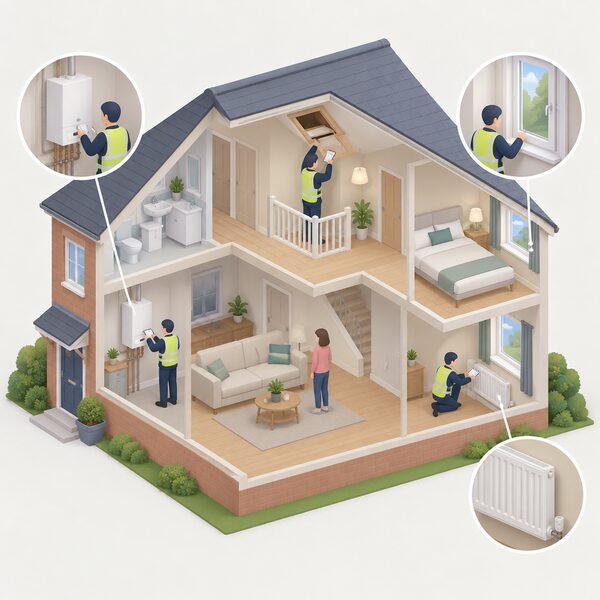
An EPC can only be produced by an accredited energy assessor who visits the property to carry out an assessment6. Qualified assessors can be found on the EPC register2. There is no route to a valid certificate without a site visit, and no self assessment option.
The assessor inspects the property and uses information such as the type of construction, the heating system and the lighting10. In practice that means access to the loft, the boiler, the cylinder cupboard, radiators, windows and any extensions, because the calculation depends on the fabric and services of the whole dwelling. A case study published by the government describes a householder, Adam, who was asked to investigate how he might improve his Energy Performance Certificate16, which is the usual starting point: the certificate is a diagnosis, and the report attached to it lists the measures that would raise the score.
The cost is not fixed. Official guidance states that the cost of the EPC will vary from one company to another and that households will have to shop around for the best price, with size, location and age of the building all affecting the figure7. No published national price exists, so any figure quoted is installer or assessor quoted rather than a regulated rate.
Quality assurance is tightening. The Scottish Government has introduced strengthened operational governance arrangements for EPC assessors and Approved Organisations to enhance quality assurance for consumers17, and is working with the other UK governments to agree a common approach to accreditation, skills and quality assurance18. Research commissioned on EPC accuracy is intended to develop insights to improve modelling algorithms and enable dynamic updates to EPCs when building changes occur19.
What the certificate shows and how the rating works
An EPC explains how energy efficient a building is and how it could be improved20. It is issued by a registered assessor and gives a rating band from G, the lowest, to A, the highest3. Certificates are produced using standard information about buildings, which is what allows buyers and tenants to compare energy efficiency and likely heating and lighting costs before entering a contract6.
With each EPC comes a report setting out the cost effective measures that homeowners or businesses can take to improve energy efficiency and the energy rating, such as low energy bulbs or upgrading insulation6. That report is often more useful than the headline band, because it names the specific interventions the calculation rewards.
The Scottish Government has set out what a reformed rating will cover for domestic buildings: the fabric energy efficiency of a property, the emissions, efficiency and running costs of its heating system, and the cost of energy to run the home to standardised conditions17. That is a broader set of measures than the current single band, and it reflects a criticism that a letter grade hides the difference between a leaky home with a good boiler and a well insulated home with an old one.
| Element | What it shows | Source |
|---|---|---|
| Rating band | G (lowest) to A (highest) | 3 |
| Purpose | How energy efficient the building is and how it could be improved | 20 |
| Comparability | Standard information, so homes can be compared before a contract | 6 |
| Improvement report | Cost effective measures such as low energy bulbs or insulation | 6 |
| Validity | 10 years, or until a newer EPC is registered | 5 |
The UK regulations behind the certificate
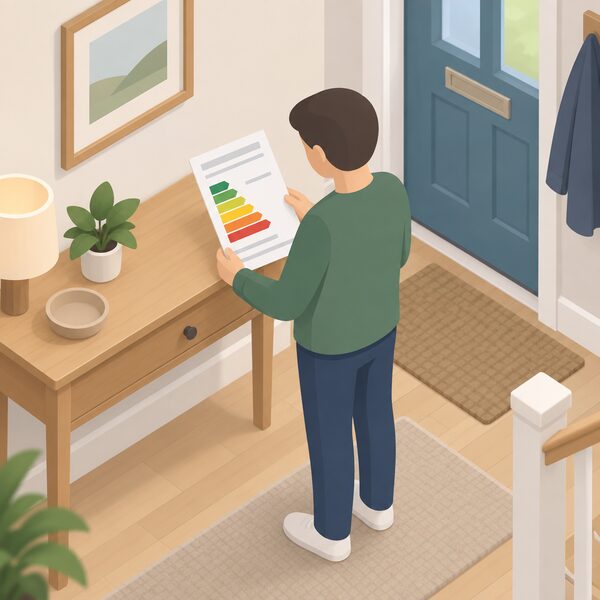
Legislation covering EPCs was introduced across the UK in 2008, transposing the EU Energy Performance of Buildings Directive, and was retained in UK law following EU Exit21. In Scotland, dwelling owners are legally required under the Energy Performance of Buildings (Scotland) Regulations 2008 to provide an EPC on construction, sale or rental of a building to a new tenant8.
The duty is enforced differently in each nation, and the differences matter to a household. In England and Wales, it is a legal requirement for all new build domestic dwellings to have an EPC when completed9. In Northern Ireland, the assessor's inspection and the certificate's contents are set out in building control guidance10. In Scotland, EPCs remain a source of information only, unlike in other parts of the UK where they are linked to minimum energy efficiency standards17.
That last point is the sharpest national difference. A Scottish EPC informs; an English or Welsh EPC can also bind, because it underpins the minimum standards applied to privately rented homes. The Scottish Government is nonetheless reforming its own system, with new ratings, redesigned certificates and improvements to the operational infrastructure23, and a new technical infrastructure to replace the current Standard Assessment Procedure with the UK Home Energy Model calculation methodology, together with a new EPC Register shared in significant part with the UK Government17.
The certificate also carries weight beyond the transaction. EPCs are described in official research as the basis of many energy efficiency policies in the domestic built environment19, which is why the rating on a certificate can determine access to funding as well as inform a buyer.
The European directive that set the requirement
The Energy Performance of Buildings Directive was first adopted in 200221. Its Article 7 required that when buildings are constructed, sold or rented out, energy performance certificates are made available13. That single obligation is the origin of the certificate a UK household sees today, and it explains why the trigger is a transaction rather than a periodic inspection.
The directive has moved on since. A recast was adopted in April 202421, with targets including reducing greenhouse gas emissions by at least 60 per cent in the building sector by 2030 compared with 2015, and achieving a highly energy efficient, zero emission building stock by 205021. The original directive also pushed member states to consider low or zero carbon technologies such as photovoltaics, micro wind turbines, combined heat and power, community heating and heat pumps13, which is the policy lineage behind much of the current grant landscape.
For a UK household the directive's direct effect is historical rather than current, since the 2008 regulations were retained in UK law after EU Exit21. Its practical legacy is the register, the rating scale and the transaction trigger, all of which remain in force.
Where the rules are heading: minimum standards and the worst-performing homes

The direction of travel is from information towards obligation, and the worst performing homes are the target.
For privately rented property in England and Wales, the current baseline is the 2018 Minimum Level of Energy Efficiency standard at EPC band E. Landlords letting a property rated F or G must improve it to a minimum of E or register an exemption where applicable24. The 2025 consultation proposes raising that minimum to the equivalent of EPC C by 2030, and would allow properties with a current EPC C to be recognised as compliant under the future standard until the EPC expires25.
For owner occupiers, the ambition is softer. The UK Government's stated aspiration is that as many homes as possible are improved to EPC band C by 2035, where practical, affordable and cost effective26. Where it is not technically feasible or cost effective to reach the equivalent of EPC C, the proposal is a minimum fabric energy performance for walls, roof, floor and windows as recommended in the EPC27.
Scotland has consulted on reducing the validity period of EPCs from 10 to five years to ensure consumers have more up to date information18, and on a new rating system for non domestic buildings17. The introduction of a redesigned certificate will coincide with the regulations bringing the new rating system into force22.
| Nation | Current position | Direction |
|---|---|---|
| England and Wales | Private rented minimum band E; F and G must improve or register an exemption24 | Consultation proposes EPC C equivalent by 2030 for private rented homes25 |
| Scotland | EPC is a source of information only, not linked to minimum standards17 | Reform of ratings, certificates and infrastructure; consultation on five year validity17 |
| Northern Ireland | Certificate required on construction, sale or letting, with public search since November 201314 | No minimum standard change recorded in the material reviewed |
What an EPC means for household energy independence
An EPC is a map, not a supply. It tells a household where heat is escaping and which measures the calculation rewards, and it does so in a standardised way that can be compared with any other home6. That is genuine independence of a kind: the assessment is paid for once, the certificate is lodged publicly, and the improvement report is yours to act on without reference to a supplier or a tariff.
What it does not do is reduce dependence on the grid, on gas, or on a supplier. The certificate measures the dwelling and its services; it does not generate a unit of energy or store one. A home can hold a band C certificate and still buy every kilowatt hour it uses from the same network as before. The independence it offers is informational and, through grant eligibility, financial.
That financial link is real and worth stating precisely. The Warm Homes: Local Grant requires owner occupied properties to be rated band D, E, F or G, and privately rented properties to be band D or E28. Nest in Wales requires a rating of 54 (E) or less29. The London Warm Homes programme likewise uses an EPC of D to G as an eligibility condition30. From 28 April 2026, properties are no longer required to have a valid EPC for the Boiler Upgrade Scheme, but where an EPC exists the certificate number must be provided31.
The dependence that remains is on the assessor and the register. A household cannot produce its own certificate, cannot amend it, and cannot improve the rating without a new assessment. The register is a national database, not a household's own record, and the data is held by government rather than by the occupant. For a household pursuing energy independence, the EPC is best understood as the entry ticket to the schemes and the standards that follow, and as a to do list for the fabric of the home, rather than as a step towards self sufficiency in itself.
Sources31 cited
- Find an energy certificate, GOV.UK, 2026-09-17
- When is an Energy Performance Certificate required?, Planning Portal, 2026
- Feed-in Tariffs: frequently asked questions, Ofgem, 2018-12
- Feed-in Tariffs factsheet, Ofgem, 2017-04
- Energy efficiency of housing in England and Wales, Office for National Statistics, 2025-10-28
- Energy Performance Certificates, nidirect, 2026-02-26
- Energy Performance Certificates: a guide, Scottish Government, 2026-08-24
- EPC reform consultation analysis, Scottish Government, 2025-01-23
- Energy Performance of Buildings Certificates statistical release, January to March 2023, GOV.UK, 2023-04-27
- Energy Performance Certificate leaflet, Building Control Northern Ireland, 2014
- Energy Performance Certificates: buildings for let, Scottish Government, 2023-11-29
- Domestic EPC reform consultation, Scottish Government, 2021-07-23
- Energy Performance of Buildings (Scotland) Regulations 2008, legislation.gov.uk, 2008
- Energy Performance of Buildings, Building Control Northern Ireland, 2013-11
- Energy Performance of Buildings Certificates user research, GOV.UK, 2021-10
- Home Energy Information, advice and guidance: case studies, GOV.UK, 2026-03-11
- Reforming energy performance certificates, Scottish Government, 2025-01-21
- EPC reform consultation: government response, Scottish Government, 2025-01-21
- Energy Performance Certificate accuracy research, GOV.UK, 2026-05-26
- Energy Performance of Buildings Certificates change note, GOV.UK, 2025-07-31
- EPC reform consultation: government response, section 8, Scottish Government, 2025-01-21
- Energy Performance Certificate reform consultation: government response, Scottish Government, 2025-01
- Energy Performance of Buildings (Scotland) Regulations 2025 update, Scottish Government, 2025-10-10
- Minimum Energy Efficiency Standards, Carmarthenshire County Council, 2026-09-20
- Improving the energy performance of privately rented homes: 2025 update, GOV.UK, 2025-02-07
- Improving the energy performance of privately rented homes, Environmental Audit Committee, 2021-04-30
- Heat in Buildings Strategy, Scottish Government, 2021-10-07
- Warm Homes: Local Grant, Greater Manchester Combined Authority, 2026-09-17
- Nest eligibility, Welsh Government, 2026-09-17
- Warmer Homes, Greater London Authority, 2026-09-17
- Summary of updates to BUS guidance for installers, Ofgem, 2026-04
 EPC Regulations and ReformSelling or renting out a home means you need an Energy Performance Certificate.
 Energy Performance CertificatesAn Energy Performance Certificate rates how energy efficient your home is, from A down to G.
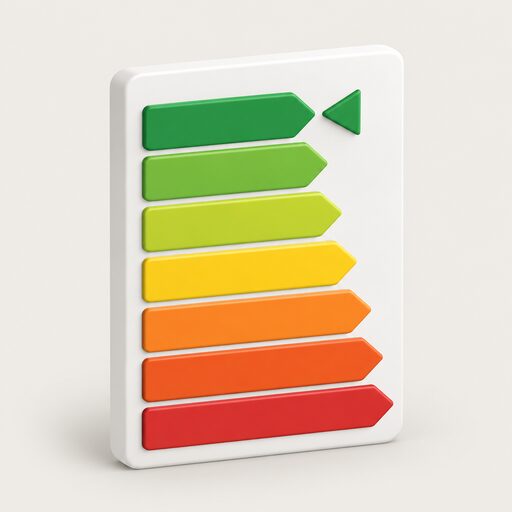 Energy Checks Before BuyingHow energy efficient is the house, and what will it cost to heat?
 EPC StatisticsHow energy efficient are UK homes, and is it getting better?
 Read an EPCA walk through each part of an EPC: the A to G rating and potential rating, the estimated costs, the fabric and heating assumptions and the recommendation table, plus what the assessor did and did not inspect and how the rules differ across the UK.
 Home Energy AssessmentsWhich home energy check do you actually need?