
In this guide
Electricity causes half of accidental domestic fires in the UK every year, and that share is not falling1. The same evidence base puts white goods such as tumble dryers, washing machines and dishwashers behind over five fires a day in England alone1. Disposal sits at the centre of that picture, because the two most common mistakes, putting a battery in the bin and leaving a faulty appliance in service, are both avoidable.
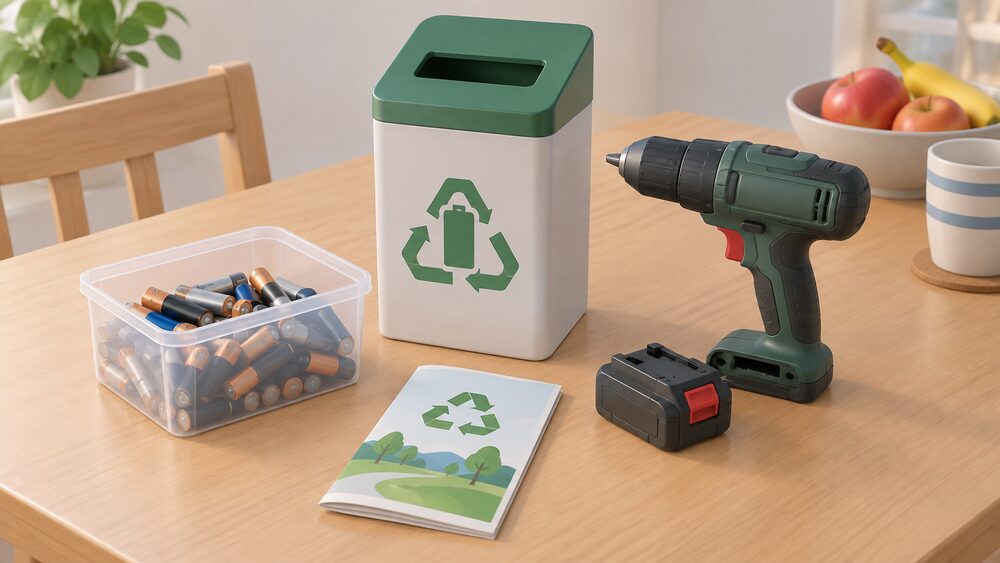
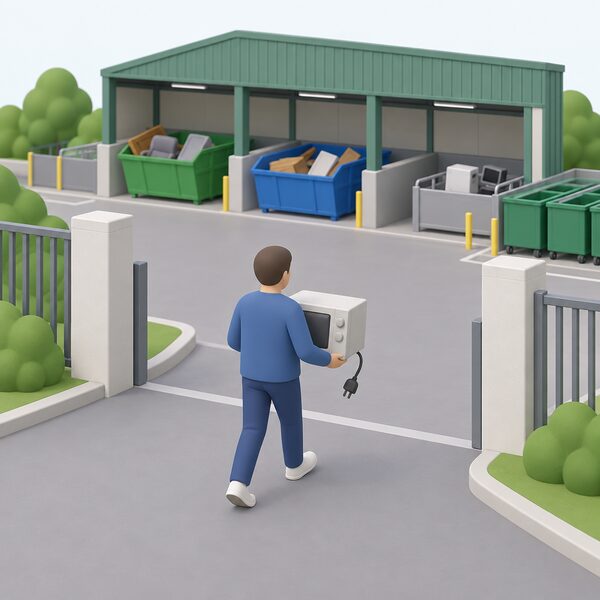
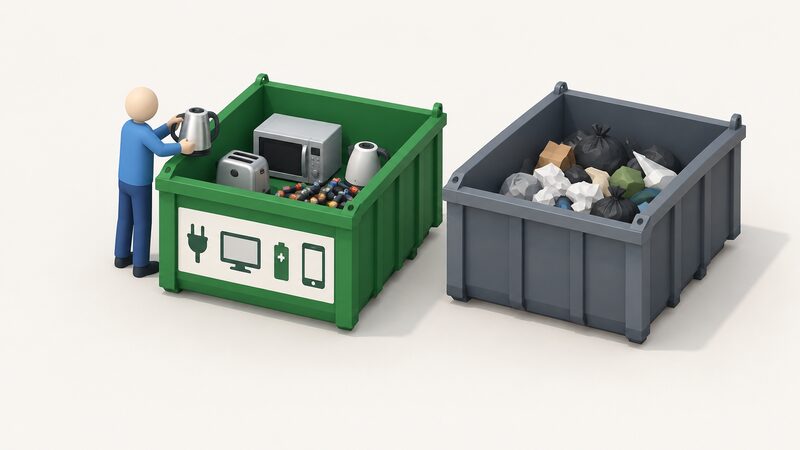
The rules are simple to state. Batteries, appliances and appliances with batteries fitted, even AA or AAA cells, must not go into general waste or normal recycling2. Recycling is the safest and most responsible route for anything faulty, old or beyond repair2. Rechargeable batteries and cordless appliances go to a local recycling centre or a council scheme, and most large stores that sell batteries keep in-store collection bins for ordinary household cells2.
For a household, disposal is part of energy independence in a modest but real way. Clearing an old heater, cylinder or storage heater safely removes a fire risk, frees the space and the circuit for equipment that is actually wanted, and keeps the materials in circulation rather than in landfill. What remains outside the household's control is the collection network itself: council schemes, retailer take-back and recycling centres vary by nation and by area, and the household depends on them.
Why disposal matters: electricity causes half of accidental domestic fires
The case for taking disposal seriously rests on a fire statistic that has proved stubborn. Every year, half of accidental domestic fires in the UK are caused by electricity, and this figure is not changing1. A separate Electrical Safety First press release puts the same problem slightly differently, describing electricity as the cause of almost half of all fires in UK homes5. The two formulations differ by a hair and both come from the same charity; the practical reading is that electricity is implicated in roughly half of domestic fires, and that the proportion has been stable.
The stated causes are misuse of appliances, poor regulation of electrical safety checks, particularly in the private rented sector, and faulty appliances1. Disposal touches all three. An appliance kept in service past the point where it is safe, a heater run from an overloaded extension lead, or a battery left charging overnight are all failures that a household can prevent without spending anything.
The charity's policy demand follows from the same evidence: it is calling on the government to introduce mandatory five-yearly electrical checks in rented homes1. That is a campaign position rather than a rule in force, and it matters to renters because the inspection duty currently rests on the landlord rather than on a fixed statutory cycle.
There is a quieter cost alongside the safety one. The Energy Saving Trust estimates that households in the UK waste around eight per cent of their electricity bill on standby power3. That figure is about consumption rather than disposal, but it points the same way: equipment that is no longer wanted, still plugged in and still drawing, is worth removing rather than storing in a spare room.
Batteries in general waste: the fire risk from wrong disposal
The single clearest rule in this area is that batteries do not go in the bin. Electrical Safety First states that batteries, appliances, or appliances with batteries, even AA or AAA ones, do not belong in the general waste or normal recycling2. The reason is mechanical as much as chemical: a battery that is punctured, crushed or shorted in a collection vehicle or a waste facility can ignite, and lithium cells in particular can enter thermal runaway.
North Wales Fire and Rescue Service sets out the household picture plainly. The average UK household has many rechargeable items containing lithium ion batteries, including laptops, mobile phones, e-scooters, e-cigarettes and mobility vehicles, and each of these items has the potential to cause a serious fire in the home7. The same service notes that non-compliant or incompatible battery components, and the use of batteries outside their safe design parameters, can lead to thermal runaway and fire8.
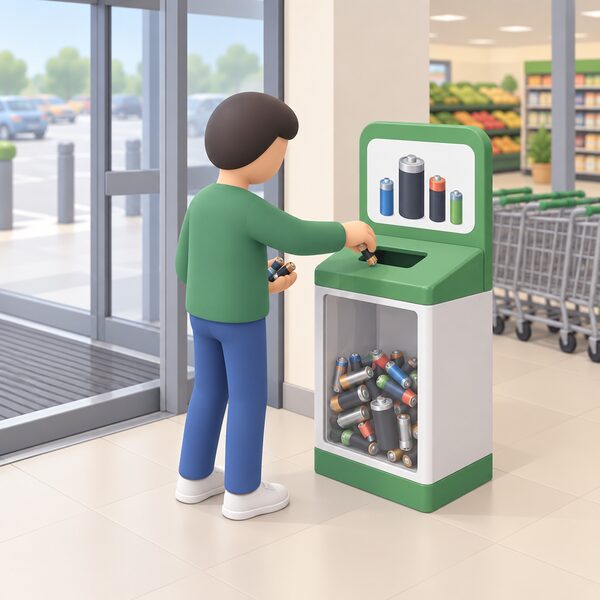
The routes that work are well established. Rechargeable batteries, or cordless appliances with rechargeable batteries, go to a local recycling centre or a check of the local council's website2. Many councils run schemes to collect batteries and appliances fitted with batteries separately from normal recycling, and some offer special collection bags to leave out with the regular bins, or small item collections that can be booked2. For ordinary household cells, most large stores that sell batteries, such as supermarkets and hardware stores, have in-store collection bins for AA, AAA, C and D batteries2.
"Recycling is the safest and most responsible way to dispose of batteries and electrical items that are faulty, old, or beyond repair."
Recalled electrical items: stop using until checked by the manufacturer
A recall is not a suggestion. Where a product has been recalled, the instruction is to stop using it until it has been checked by the manufacturer9. The Tesco Electric Heater recall illustrates how the process works in practice: the unit is returned to the nearest Tesco Extra or Superstore, where a full refund is given9.
The reason recalls matter to disposal is that a recalled appliance is exactly the item that should not be passed on, stored in a garage or left in a spare room for a future owner to find. It should go back through the recall route, which is the only path that both removes the hazard and returns the money.
Registration is the mechanism that makes recalls reach people. Electrical Safety First recommends registering all electrical appliances so that, in the event of a problem, the manufacturer can contact you2. The same principle applies to e-scooters, where registration exists so the buyer can be contacted easily if there is a safety recall4.
Not every dangerous product reaches the market through a mainstream retailer. The Government's product safety report on a device sold as a 2Pcs Electricity Saving Box Power Saving Device Smart Energy Saver UK records a risk level of Serious, dated 28 April 202210. Devices of that kind, sold as plug-in savings gadgets, are a reminder that the recall and alert system covers online marketplace listings as well as shop shelves.
E-bike and e-scooter batteries: why they need special handling
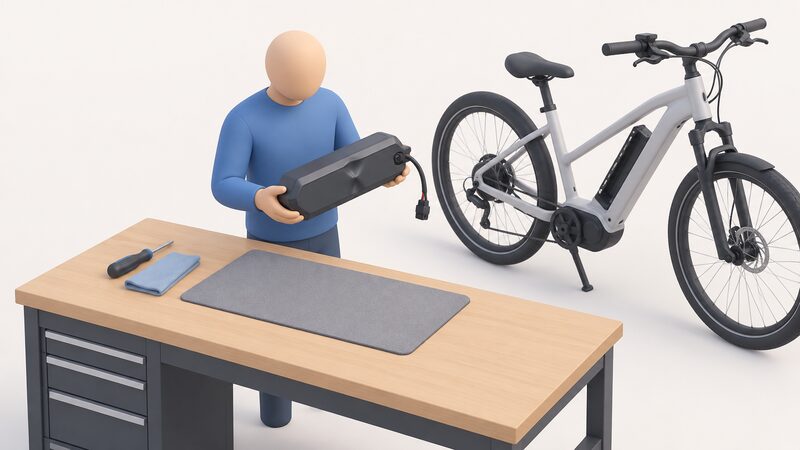
Lithium batteries on two wheels have produced a distinct fire problem, and the guidance is more prescriptive than for ordinary cells. E-bike batteries can be a severe fire risk if used, charged or sourced incorrectly, and fires can occur from poor design, incorrect charging, or from damage to the battery11. Overcharging, over-discharging, or charging the battery too quickly are among the main causes of fires from lithium-ion batteries11. Leaving items on charge continuously or overnight is a fire risk11.
Sourcing is the second half of the problem. Second-hand e-bike batteries and chargers can be a serious fire risk, and it is vitally important that a battery and charger have been tested to conform to UK safety standards, because counterfeit and substandard items can be deadly11. The same testing requirement applies to e-scooter batteries and chargers4. In the UK, e-scooters are classified as Personal Light Electric Vehicles (PLEVs)4.
Damage is the trigger to act at once. If any damage is noticed, the guidance is to stop using and charging the battery immediately and replace it, and to check the battery regularly for dents, deformities and signs of overheating11.
One model has been singled out by government. Certain UPP e-bike batteries, models U004 and U004-1, are deemed to pose a serious fire risk according to the Government, and have been linked to serious fires, risking explosion and the release of toxic gases13. Affected batteries risk entering thermal runaway, a rapid and extreme chemical reaction that can cause ferocious fires almost impossible to extinguish13. Despite the Government withdrawal notice, dangerous UPP e-bike batteries have been identified still being sold privately across the UK13. The disposal instruction for these units is explicit: do not dispose of the battery in the general waste or normal recycling, because that could put other people at risk; find a suitable local recycling point or seek advice on how to safely dispose of the battery13. Where redress is sought, the guidance is to contact the seller13.
The regulatory response is in progress. A fast-track Publicly Available Specification is being developed addressing the technical requirements for battery systems used in e-bikes, e-scooters and conversion kits8.
Buying and disposing safely: what Electrical Safety First recommends
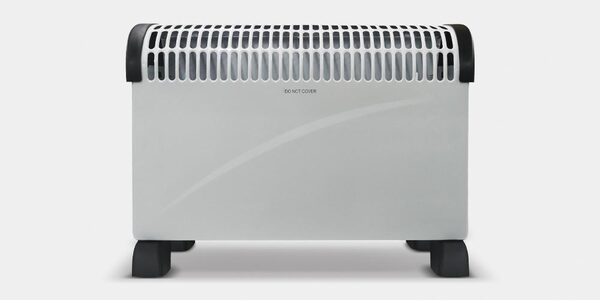
The charity's buying advice is short and applies directly to the second-hand market that disposal feeds. Buy from manufacturers or retailers that you know and trust, and avoid second-hand heaters, but if one is bought anyway, ask what safety checks are carried out5. The same press release carries a set of operating rules that bear on when an appliance should be retired rather than repaired: put a heater on a level surface, well away from anything or anyone that could knock it over; keep it well away from combustible materials such as paper, furniture or curtains; never power a heater from an extension lead, because they can easily be overloaded and cause fires; and regularly inspect the heater for damage and deterioration, and if it is not in good condition, do not use it5. The instruction never to use a heater to dry clothes is stated in the same terms5.
Two further points complete the picture. Ensure there is a working smoke alarm on every floor and test it regularly5. And do not bring home electrical products purchased from outside the UK, because plugs, voltages and safety approvals differ2.
The charity launched a new campaign video to mark Electrical Fire Safety Week, with members of the Fire and Rescue Services recounting devastating fires they have attended that were caused by electric heaters5. The campaign sits alongside its wider work with the Electrical Contractors Association, which found through freedom of information requests that 66 per cent of local authorities who responded had no EV charging infrastructure strategy at all14. That figure is about charging rather than disposal, but it shows the same pattern: the equipment arrives in homes faster than the supporting infrastructure and oversight.
For a household, the practical test of whether something can be recycled at all is straightforward. An item can be recycled if it has a plug, uses a charger, uses batteries, or carries the WEEE logo2.
Old energy equipment: heaters, white goods and large appliances
Large items follow a different route from small ones. Electrical products go to a local recycling centre2. In Northern Ireland, the nearest recycling centre can be found by contacting the local council, and in most parts of Northern Ireland light bulbs can be recycled at a household waste recycling centre13. The WEEE Directive exists to govern how manufacturers and retailers in European countries should behave with regards to recycling, which is the basis of the take-back duties that apply to retailers selling large electrical goods2.
The scale of the gap is worth stating. Currently less than one-third of new electrical items purchased in the UK each year are recycled when they come to the end of their lifecycle2. That is the number that disposal policy is trying to move.
For households replacing rather than simply removing equipment, there is support in some cases. The EDF Customer Support Fund provides large energy-efficient appliances including cookers, fridges and washing machines, to enable replacement of old or broken models and reduce energy bills15. That is a supplier scheme with its own eligibility rules, not a universal entitlement.
VAT treatment is worth knowing when equipment is being installed rather than removed. Heating equipment and connection of a gas supply attract a reduced rate of 5 per cent to the extent they are grant-funded by certain funders to people aged over 60 or who are in receipt of certain benefits, covering items including closed solid fuel fire cassettes, electric dual immersion water heaters with factory-insulated hot water tanks, electric storage heaters, gas-fired boilers, gas room heaters with thermostatic controls, oil-fired boilers and radiators, along with the installation, repair and maintenance of a boiler, radiators, pipework and controls forming a central heating system, the installation, repair and maintenance of renewable source heating systems, and connection or reconnection to the mains gas supply16. The qualifying energy products list separately covers central heating and hot water controls, draught stripping, insulation on walls, floors, ceilings and lofts, solar panels, ground-source heat pumps, air-source heat pumps, micro combined heat and power units, wood-fuelled boilers, and wind and water turbines in Great Britain only17. Funded work under the energy-saving products rules covers installation of heating appliances, installation, repair and maintenance of central heating systems, and installation, repair and maintenance of renewable source heating systems18.
Where recycling regulation stands and what is being called for
The regulatory framework around electrical goods is being actively rewritten, and the direction of travel matters for anyone disposing of equipment now. The UK Government has introduced new ecodesign and labelling requirements for specified electrical products sold in Great Britain, under the Ecodesign for Energy-Related Products and Energy Information Regulations 2021, SI 2021 No. 74520. Currently CE marked products can be sold in Great Britain if they are compliant with GB ecodesign standards, without the need to also affix a UKCA marking21.
On tumble dryers specifically, the government will proceed with new Ecodesign and Energy Labelling regulations for household tumble dryers in Great Britain, broadly as consulted upon, with a small number of refinements based on stakeholder feedback22. That matters to disposal because dryer design, lint handling and fire risk are connected, and because a change in standards shifts what is worth repairing and what is worth replacing.
Devolution complicates the picture. Legislation relating to the energy performance of buildings is devolved in Scotland and Northern Ireland, while competition law and consumer protection law are reserved to the UK Government23. Building regulation for the installation of electric vehicle charge points or cable routes in England sits in Approved Document S24. The Electric Vehicles (Smart Charge Points) Regulations 2021 apply to the sale of private charge points sold in Great Britain after 30 June 2022, and cover charge points sold in Great Britain only25.
Wider energy policy is being reshaped at the same time. The government confirmed its decision to retain a single UK wide wholesale market and proceed with Reformed National Pricing26. The Climate Change Committee has recommended making electricity cheaper through rebalancing prices to remove policy levies from electricity bills, as a key recommendation to the UK Government27, and has separately stated that England needs a comprehensive home energy retrofit scheme28. Scotland's carbon budgets work runs on a separate track27.
For a household, the practical consequence is that the rules on what can be sold, what must be labelled and what a retailer must take back are moving, and the safe assumption is that the take-back duty is here to stay.
If an item is unsafe to sell on: second-hand, online marketplaces and your options
Second-hand selling is lawful and useful, but it carries a safety duty that sits with the seller. Under the proposed product safety framework, only safe products will be able to be sold online to UK buyers, whether the seller is based in the UK or overseas8. The framework also proposes exclusions from scope for antiques and collectibles, artworks, and products needing to be repaired, reconditioned or refurbished before use if the consumer is explicitly informed of this8.
Where a product turns out to be unsafe, the route is defined. Contact the manufacturer first, then report it to the local Trading Standards Office if the manufacturer does not deal with it satisfactorily2. Regulation 12 provides for the recall of electrical equipment in England, Wales and Scotland14.
For energy-specific complaints, the escalation path runs through the supplier first. Citizens Advice consumer service may refer a household to the Extra Help Unit if support is needed with a difficult or urgent complaint, if the household cannot deal with its energy supplier alone due to personal circumstances, if it is considered vulnerable, or if it is at risk of being disconnected from an energy supply29. Ofgem's counter fraud team can be contacted about suspected fraud by emailing counterfraud@ofgem.gov.uk or by calling 0207 901 737330, and the Boiler Upgrade Scheme guidance gives the same email address for reporting suspected fraud or misuse19.
On the electrical side, fixed wiring work is not a DIY matter. In England only, an electrician registered with a third-party certification scheme, a registered third-party certifier, can certify notifiable work31. In Wales, the equivalent requirement is that the electrician is registered by an organisation authorised by the Secretary of State and is able to certify the work as safe without notifying Building Control32. Examples of electrical equipment covered by the rented sector electrical safety standards guidance include cookers, fridges or microwaves33.
Sources33 cited
- 10 ways to avoid electrical fires in your home, Electrical Safety First, 2026-09-19
- Recycling electricals and batteries, Electrical Safety First, 2026-09-17
- Energy efficiency tips, nidirect, 2026-09-17
- E-scooters, Electrical Safety First, 2026-09-17
- Potential risk to households this winter as millions worried about energy bills will use electrical heaters, Electrical Safety First, 2026-09-19
- Comment on reports of off-peak energy pricing, Electrical Safety First, 2026-09-19
- Lithium-ion batteries, North Wales Fire and Rescue Service, 2026
- The UK's new product safety framework, GOV.UK, 2026-03-31
- Tesco Electric Heater, Electrical Safety First, 2026-09-17
- Product safety report: 2Pcs 90V-250V Electricity Saving Box, GOV.UK, 2022-04-28
- Is your e-bike battery safe, Electrical Safety First, 2026-09-17
- E-bikes, Electrical Safety First, 2026-09-17
- Choosing energy efficient products, nidirect, 2025-04-09
- Regulation 12, legislation.gov.uk, 2026-09-17
- EDF Customer Support Fund, Charis Grants, 2026-09-17
- VAT rates on different goods and services, GOV.UK, 2026-07-10
- Qualifying energy products list, HM Revenue and Customs, 2026-09-20
- VAT on energy-saving products, GOV.UK, 2026-09-17
- Boiler Upgrade Scheme guidance for property owners, Ofgem, 2026-04
- Ecodesign and labelling requirements for electrical products, House of Commons Library, 2026-09-17
- Extended CE marking recognition for ecodesign regulations, GOV.UK, 2026-07-06
- Raising product standards for household tumble dryers, GOV.UK, 2025-07-17
- EPC reform consultation: government response, Scottish Government, 2025-01-21
- Infrastructure for charging electric vehicles: Approved Document S, GOV.UK, 2021-12-15
- Guide to EVSCP regulations 2021, GOV.UK, 2026-09-18
- DESNZ annual report and accounts 2025 to 2026: performance report, GOV.UK, 2026-09-17
- Scotland's carbon budgets, Climate Change Committee, 2025-05-21
- Climate policy that cuts costs, Climate Change Committee, 2026-09-19
- Complain about your energy supplier or network operator, Ofgem, 2026
- Guidance for FIT generators, Ofgem, 2026-04-01
- Building regulations: general information, Planning Portal, 2026
- Building regulations: electrics, Welsh Government, 2026-09-17
- Electrical safety standards in the private and social rented sectors: guidance, GOV.UK, 2025-11-01
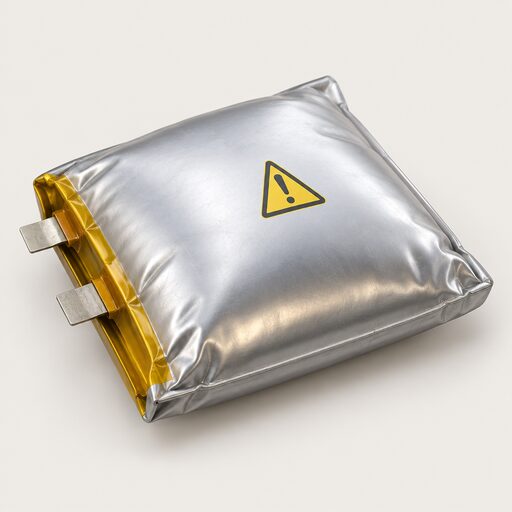 Lithium Battery SafetyLithium batteries power phones, e-bikes, scooters and home storage, and any of them can catch fire.
 Recycling and DisposalWhat happens to a domestic storage battery at end of life, who takes it back, the transport and handling rules for damaged lithium units, and the difference between recycling, refurbishment and second-life reuse.
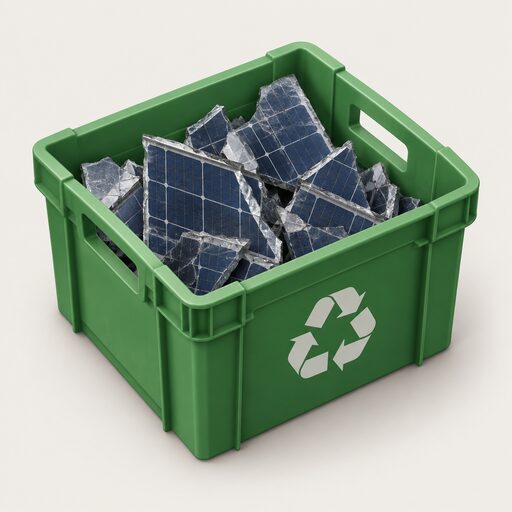 Panel RecyclingWhat actually happens to a solar panel when it stops working, and what can a household do with one?
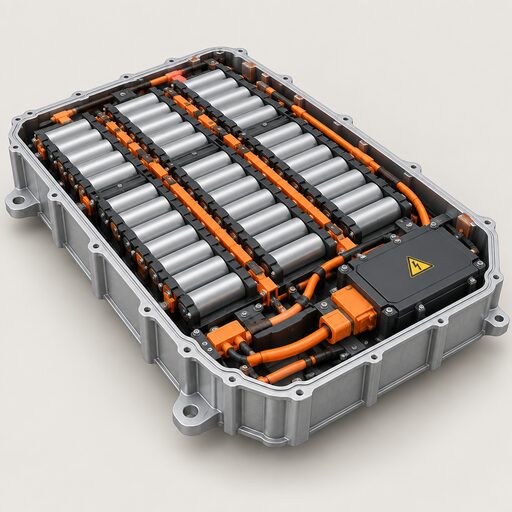 Second-Life EV BatteriesUsed electric car batteries can store solar power at home, but can you actually buy one in the UK?
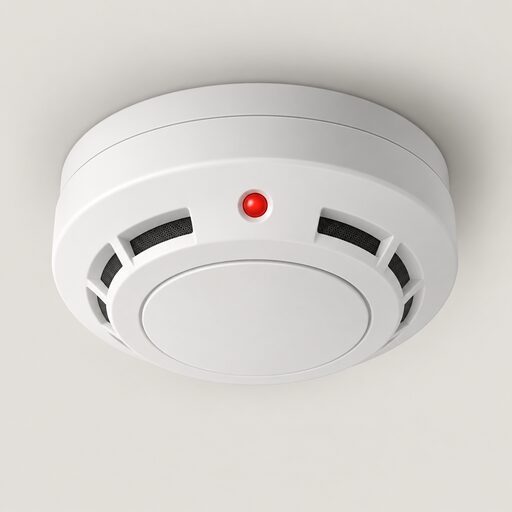 Siting and LocationWhere can a home battery actually go?
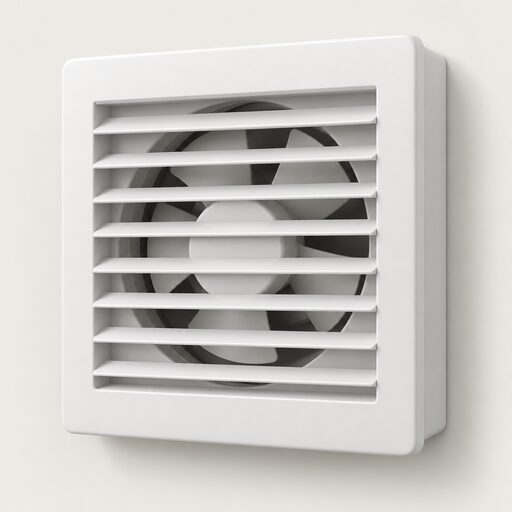 Ventilation and TemperatureWhere can you put a home battery so it stays warm enough in winter and cool enough in summer?