

In this guide
An Energy Performance Certificate that misstates a home's fabric, heating or glazing is not a permanent verdict. The certificate is a lodged record produced by an accredited assessor, and there is a defined route for disputing it: speak to the assessor first, then take the complaint to the certification body that accredited them1. Neither step requires a new survey, and neither requires payment.
The starting point is the EPC Register entry for the property. It carries the assessor's contact details and, listed below them as scheme details, the certification body they belong to1. That single page gives a householder both the person who produced the certificate and the body that oversees their competence, which is the whole escalation chain in one place.
What a challenge cannot do is change the certificate by argument alone. A correction has to rest on something the assessor or their scheme can verify: a building element that was recorded wrongly, a default applied where real data existed, or work carried out since the assessment. The government's own accuracy research compared modelled energy use with monitoring data specifically to identify inaccuracies in EPCs and propose improvements, and it names defaults and assessor practices among the weaknesses examined2. That is the official acknowledgement that errors happen and where they come from.
What an EPC is and when one is required
An EPC is a statutory document. Provision of one is a statutory requirement whenever a property is bought, sold or rented, and the requirement was introduced in 20075. The practical trigger is broader than a transaction: certificates are needed whenever a property is built or marketed for sale or rent4. In England and Wales it is a legal requirement for all new build domestic dwellings to have an EPC when completed6.
The certificate exists to be compared. EPCs are produced using standard information about buildings, which allows buyers and tenants to compare energy efficiency and likely heating and lighting costs before entering a contract4. That comparability is the point, and it is also why an error matters: a wrong rating does not just sit on a file, it feeds a decision someone else is making about the property.
The duty sits with the owner. It is the owner's or landlord's responsibility to make sure there is an EPC, to make it available to potential buyers or tenants, and to give a copy to the new owner when selling4. In Scotland, the EPC must be provided to the purchaser free of charge, and that is a legal requirement7. Certificates must be provided when a building is advertised for sale or for let to a new tenant, and also on completion of construction of a new building8.
There is a direction of travel worth knowing about. Government has stated an intention to update regulations so that an EPC is required at the point of marketing a property rather than the point of sale or rent9. For a householder challenging a certificate, that shift matters because it moves the moment at which an accurate record becomes unavoidable earlier in the process.
The legal basis: from the EU directive to UK regulations
The regime did not begin in the UK. The Energy Performance of Buildings Directive was first adopted in 2002, and a recast directive was adopted in April 202411. Legislation covering EPCs was introduced across the UK in 2008, transposing the EU directive, and was retained in UK law following EU Exit11. The Scottish regulations trace the same lineage, established as a legal requirement of the EU Energy Performance of Buildings Directive8.
The current governing instrument in England and Wales is the Energy Performance of Buildings (England and Wales) Regulations 2012, derived from EU law12. That instrument has been amended repeatedly: in 2014, 2020, 2021, 2022 and again in 202413. The 2024 amendment regulations amend the 2012 regulations directly14. The 2021 amendments were made in exercise of the powers conferred by paragraph 7(2) of Schedule 4 to the European Union (Withdrawal) Act 2018, which is how retained EU law was kept operable15.
The detail that matters most to a challenge sits in the regulations themselves. Regulation 9 requires that a certificate be issued by an energy assessor who is accredited to produce energy performance certificates for the category of building to which the certificate relates18. That is the hook for a complaint: if the assessor was not accredited for that building category, the certificate was not properly issued.
Schedule B1 sets out the data items from which a residential EPC may be produced, and the list is long: the address including postcode, the energy rating and potential energy rating, building type and built form, inspection date, local authority area, constituency and county, the date data were entered onto the register, transaction type, current and potential environmental impact ratings, primary energy use, CO2 emissions and emissions per floor area, lighting, heating and hot water costs, total floor area, energy tariff, gas network connection, floor level, glazing, extensions, rooms, fuel type, heating systems and controls, insulation, lighting, wind turbines, ventilation, solar water heating, unique property reference number, construction age band, tenure type, air permeability, and further building and heating detail items9.
That list is the practical map of where an error can hide. Every one of those fields is an input, and a wrong input produces a wrong rating.
Who produces the certificate and how the assessment works
An EPC can only be produced by an accredited energy assessor who will visit the property to carry out an assessment4. In the Planning Portal's wording, it must be produced by a qualified domestic energy assessor19. Qualified assessors can be found on the EPC register19.
The accreditation requirement is not a formality. Regulation 9 ties the validity of the certificate to the assessor's accreditation for that category of building18. Accreditation is also the mechanism that gives a householder somewhere to go when the assessor's work is disputed, because the certification body is the body that stands behind the assessor's competence.
Where a building is under construction, responsibility for the EPC rests with the person who carries out the construction3. That is a different responsible party from the eventual owner, and it matters in a dispute about a new build: the challenge goes to the party that commissioned the assessment, not to the buyer who receives the certificate.
Accreditation policy is being coordinated across the UK. The Scottish Government states that it is working with other governments across the UK to agree a common approach to issues around accreditation, skills and quality assurance20. For a householder, that points to a system in which the standards an assessor is held to are intended to be consistent wherever in the UK the property sits.

Common reasons an EPC comes out wrong
The official position is that inaccuracy is a known problem, not a rare one. The EPC accuracy research project compared modelled energy use with monitoring data to identify inaccuracies in EPCs and propose improvements2. Its stated aim was to identify weaknesses in current EPC assumptions and processes, including defaults and assessor practices2.
Two mechanisms follow from that. The first is defaults: where a surveyor cannot establish a building element, the model falls back on an assumed value, and an assumption can be wrong in either direction. The second is assessor practice: what gets recorded on the visit, and how it is entered.
The research also set out where the system is intended to go. It aimed to develop insights to improve modelling algorithms and enable dynamic updates to EPCs when building changes occur2. Dynamic updating would address the most common practical complaint of all, which is that a certificate describes a house as it was years ago rather than as it is now.
There is a wider criticism of the metric itself. The Climate Change Committee has said that the ratings on EPCs are an important policy tool, used to define standards and targets for reducing emissions from homes, but are poorly suited to this role17. That is a statement about the fitness of the rating for policy purposes rather than about any individual certificate, and it is worth separating from a challenge about a specific error.
How to challenge a wrong EPC: the steps in order
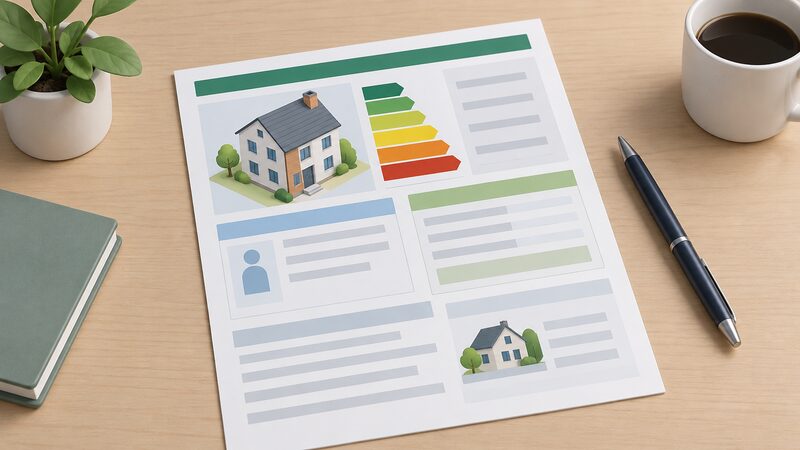
The escalation route is short and sequential. The first step is to speak directly to the assessor. If the householder is still unhappy after that, the next step is to contact the assessor's certification body1. The certification body for a given assessor can be found on the Department for Communities and Local Government EPC register, listed as scheme details below the assessor's contact details1.
- Find the property's entry on the EPC Register and note the assessor's contact details and the certification body listed as scheme details1.
- Contact the assessor directly and set out the specific field or fields believed to be wrong1.
- If unresolved, contact the certification body that accredited the assessor1.
- Where the problem is that no EPC has been made available at all, contact the local district council building control for advice, in Northern Ireland4.
The principle behind that order is the same one that governs other consumer disputes: the company or practitioner gets the opportunity to fix the issue before an outside body takes it on. The Energy Ombudsman states the requirement plainly for its own remit, that a consumer needs to follow the company's dispute process to give them an opportunity to fix any issue16. The EPC route applies the same logic through the assessor and then the scheme.
For complaints about a heating installation rather than a certificate, the routes diverge. Ofgem publishes a complaints process page for complaints about an installation under the Energy Company Obligation21. Where a complaint relates to installation quality, workmanship or the behaviour of an installer, it should be raised with the installer in the first instance, then with the installer's consumer code, HIES or RECC, or through MCS installation quality complaints22.
What evidence strengthens a challenge
A challenge is only as good as the discrepancy it identifies. The most useful evidence is a specific field on the certificate that can be shown to be wrong against something the assessor or scheme can check. Schedule B1's data item list is the checklist: glazing, extensions, insulation, heating systems and controls, fuel type, floor area, construction age band and air permeability are all recorded inputs9.
Photographs of the element in question, dated, are the plainest form of that evidence. So are documents that postdate the assessment: a boiler installation record, an insulation installation certificate, a glazing specification. Where work has been done since the assessment, the certificate is describing a building that no longer exists in that respect, and the official research explicitly looked towards enabling dynamic updates to EPCs when building changes occur2.
The wider policy context supports the case for correction. The accuracy research was intended to support the EPC Reform and ensure future models better reflect real-world energy performance2. The Climate Change Committee has noted that EPCs could also be expanded to provide information on risks posed by climate change and ways to reduce these17. Both point to a system that is expected to become more, not less, accurate over time.

When a new assessment is the better route than a complaint
A complaint corrects a record. It does not re-survey a building. Where the certificate is broadly right but the building has changed, or where the assessor is no longer contactable, a fresh assessment is the practical answer, and it produces a new lodged record rather than an amendment to the old one.
The validity rules explain why this matters. An EPC is valid if it was entered on the register no more than 10 years before the date it is made available, or until a newer EPC is produced and registered, whichever is earlier3. A new assessment therefore does two things at once: it replaces the disputed rating and it resets the clock.
Existing certificates are not being swept away by reform. Government has stated that existing EPCs will retain their ten-year validity until they expire9. That means a householder weighing a complaint against a new assessment is not racing a deadline imposed by the reform programme.
There is also a structural reason a new assessment can be the cleaner route. The certificate is a snapshot of a visit, and the data items behind it are extensive9. Where several fields are disputed rather than one, a re-survey resolves them together, whereas a complaint resolves the specific points raised.
What a corrected rating means for your household's energy position

A corrected EPC changes more than a letter. Each EPC comes with a report setting out the cost effective measures that homeowners or businesses can take to improve energy efficiency and energy rating, such as low energy bulbs or upgrading insulation4. A rating that understates the building's performance can obscure measures that would genuinely help, and a rating that overstates it can point a household towards work that has already been done.
The rating also sits inside a policy framework that is tightening. The recast Energy Performance of Buildings Directive sets a target of reducing greenhouse gas emissions by at least 60% in the building sector by 2030 compared to 2015, and a long term objective of achieving a highly energy efficient, zero-emission building stock by 205011. The directive sets zero-emission buildings as the standard for new public buildings from 1 January 2028, and for all new buildings from 1 January 203011.
For a household, the independence question is straightforward. An accurate EPC is the document that describes how much of a home's comfort depends on bought energy and how much is already provided by the fabric, the glazing and the heating system. A wrong rating misstates that position to a buyer, a tenant, a lender or a grant scheme. Correcting it does not reduce dependence on the grid or on a supplier, and it does not by itself improve the building. What it does is make the record honest, which is the precondition for any decision about improving the home's energy position.
"The ratings on EPCs are an important policy tool, used to define standards and targets for reducing emissions from homes but poorly suited to this role."
Sources22 cited
- Who to contact, Ofgem, 2026-09-17
- Energy Performance Certificate (EPC) accuracy research, GOV.UK, 2026-05-26
- Energy Performance Certificate validity, Isle of Anglesey County Council, 2025-09
- Energy Performance Certificates, nidirect, 2026-02-26
- Energy Performance Certificates, Public Accounts Committee, 2026-09-20
- Energy performance of buildings certificates change note, GOV.UK, 2025-07-31
- Energy Performance Certificates guide: buildings for sale, Scottish Government, 2026-08-24
- Energy Performance of Buildings (Scotland) Regulations 2025, Scottish Government, 2025-10-10
- Schedule B1, Paragraph 2, legislation.gov.uk, 2024-04-25
- Energy Performance Certificates guide: buildings for let, Scottish Government, 2023-11-29
- EPC reform consultation: government response, Scottish Government, 2025-10-10
- Energy performance of buildings regime, House of Commons Library, 2026-09-20
- Regulation 37, legislation.gov.uk, 2026-09-17
- The Energy Performance of Buildings (England and Wales) (Amendment) Regulations 2024, legislation.gov.uk, 2024-05-14
- The Energy Performance of Buildings (England and Wales) (Amendment) Regulations 2021, legislation.gov.uk, 2021-03-31
- Understanding your rights, Energy Ombudsman, 2026-09-20
- Letter: reform of domestic EPC rating metrics, Climate Change Committee, 2026-09-19
- Regulation 9, legislation.gov.uk, 2026-09-17
- When is an Energy Performance Certificate required?, Planning Portal, 2026
- EPC reform consultation: government response, Scottish Government, 2025-01-21
- Energy Company Obligation contacts, guidance and resources, Ofgem, 2026-09-17
- Boiler Upgrade Scheme guidance for property owners, Ofgem, 2026-03-25
 Report a Faulty MeterWhat to do when a meter over-records, stops recording or produces impossible readings: the evidence to gather, how to raise it with the supplier, the 5 working day and 8 week deadlines, and how the Energy Ombudsman handles meter disputes.
 Read an EPCA walk through each part of an EPC: the A to G rating and potential rating, the estimated costs, the fabric and heating assumptions and the recommendation table, plus what the assessor did and did not inspect and how the rules differ across the UK.
 Complaining About an InstallerMaps the escalation path from the installer's own complaints procedure to the scheme provider, consumer code, ombudsman or ADR body and finally the courts.
 Submit Meter ReadingsThe routes for sending readings, by app, online account, phone and automated line, and the timing that gets them onto the right bill.
 EPC Regulations and ReformSelling or renting out a home means you need an Energy Performance Certificate.
 Complain About Energy SupplierThe order of a complaint: the supplier's own procedure, the eight-week point or deadlock, and referral to the Energy Ombudsman in Great Britain or the Consumer Council in Northern Ireland.