

In this guide
An Electrical Installation Condition Report, usually shortened to EICR, is the document a qualified person produces after inspecting and testing the fixed wiring, accessories and protective devices in a property. It is not a certificate of approval and it is not a guarantee: it is a condition report setting out the results of an electrical safety inspection carried out by a qualified person1. The report must give the results of the inspection and test and the date by which the next inspection and test is required2. That date, not a fixed number of years, is what governs when the next one falls due.
For an owner-occupier in England, Scotland, Wales or Northern Ireland there is no statutory duty to hold an EICR. The five-yearly inspection and testing duty sits on landlords: all landlords must have the electrical installations in their properties inspected and tested by a qualified person at least every 5 years1. Where a property has been newly built or completely rewired, the landlord is not required to carry out further checks or provide a report for 5 years after the Electrical Installation Certificate has been issued1. Owner-occupiers arrange an EICR voluntarily, typically at a change of occupancy, after a major alteration, or on the recommendation of an insurer or a buyer's surveyor.
The practical sequence is short. Find an electrician registered with an approved self certification organisation, check that registration on the Competent Persons Register, book the visit, read the observation codes on the report, and act on anything coded C1 or C2 before treating the installation as sound3. The rest of this page sets out each step, the codes, the remedial route and the legal backdrop.
What an EICR is and what the inspection covers
An EICR is a condition report, and the phrase matters. It records the state of an installation at a moment in time. It is not a warranty, not a design certificate and not a statement that the installation will remain safe. The legislation that governs the private rented sector describes it exactly that way: a condition report setting out the results of an electrical safety inspection carried out by a qualified person7.
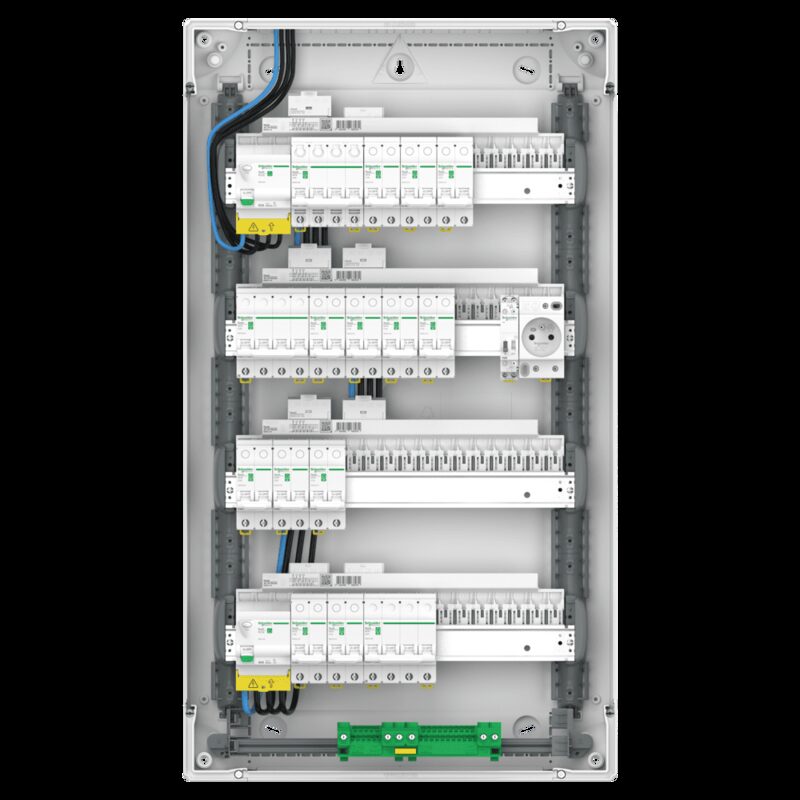
The inspection covers the fixed installation: the consumer unit and its protective devices, the circuits, the earthing and bonding arrangements, socket outlets, switches and the wiring that connects them. It does not cover appliances plugged into the installation, and it does not cover the electricity supply cable or meter, which belong to the network operator and the supplier. Testing involves instrument readings at outlets and at the consumer unit, and a visual survey of accessible parts of the installation.
The output has two halves. The first is the schedule of test results and the schedule of inspections, which record what was measured and seen circuit by circuit. The second is the summary of observations, where each defect is given a classification code. The report must also state the date by which the next inspection and test is required, which is the inspector's professional judgement of how quickly the installation should be revisited2.
For a household thinking about energy independence, the EICR is the safety counterpart to the metering and tariff work. It does not reduce dependence on the grid, a supplier or imported gas, and it generates no power. What it does is establish whether the fixed wiring can safely carry the loads a household wants to add, whether that is a heat pump, an electric vehicle chargepoint or a home battery. A domestic energy assessor working to PAS 2035 standards must be certified and registered by an assessor body, or working towards that certification through a recognised route, or be a RICS registered surveyor8. The electrical inspection is a separate discipline with its own register.
How often you need one: owners, landlords and businesses
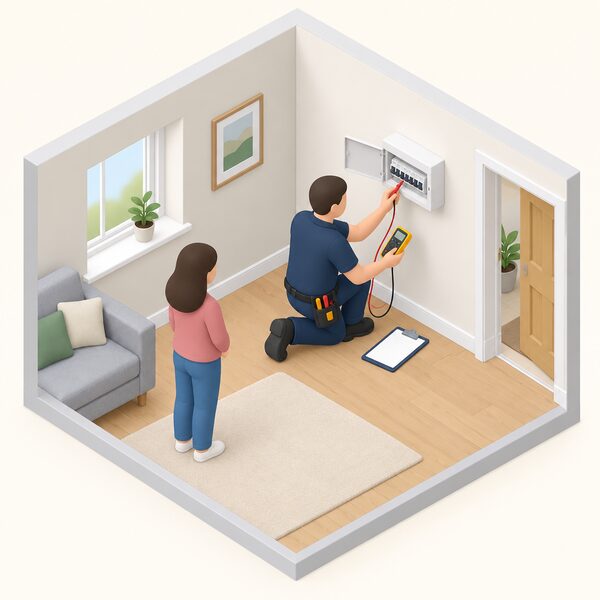
The interval depends entirely on who occupies the property and what the law requires of them.
For landlords in the private rented sector, the duty is explicit: all landlords must have the electrical installations in their properties inspected and tested by a qualified person at least every 5 years1. The same guidance confirms the new-build and rewire exemption: the landlord will then not be required to carry out further checks or provide a report for 5 years after the EIC has been issued1. That exemption applies where a full Electrical Installation Certificate already exists for newly built or completely rewired premises.
For owner-occupiers there is no equivalent statutory interval. The inspection is voluntary, and the sensible trigger points are a purchase, a major alteration, a change in the loads the installation carries, or an insurer's condition. Where a report has been produced, the date it gives for the next inspection and test is the operative one, and where the most recent report requires inspection and testing to take place by an earlier date, that earlier date applies2.
For businesses, the position follows the same logic as the rented sector: the duty arises from the occupation and the risk, not from the building type. A small commercial premises linked to domestic accommodation falls within the same building regulations framework as a dwelling for the purposes of new electrical work9.
| Occupier | Statutory interval | Notes |
|---|---|---|
| Private landlord | At least every 5 years1 | New build or full rewire: 5 years from the EIC1 |
| Owner-occupier | None in statute | Report's own next-test date governs2 |
| Business premises | Follows occupation and risk | New work caught by Part P where linked to a dwelling9 |
The pattern to hold on to is that the five-year figure is a landlord's floor, not a universal rule. An owner-occupier who has an EICR is bound by whatever date the inspector writes into it, and by any earlier date a previous report specified.
Finding a qualified electrician: registered schemes and certification
The route to a competent electrician runs through the Competent Persons Self Certification Scheme, under which electricians become registered with an approved self certification organisation3. Registration is what allows a contractor to self-certify notifiable work rather than referring it to building control.
Checking that registration is a separate, deliberate step. The Competent Persons Register exists for exactly this purpose: checking whether an electrician is registered4. It is the register to consult before booking, and it is free to use.
In England only, an electrician registered with a third-party certification scheme, described in official guidance as a registered third-party certifier, can certify notifiable work6. That route does not exist in Scotland, Wales or Northern Ireland, where the competent person scheme registration is the relevant credential.
The wider lesson from comparable certification regimes is that registration bodies maintain their own registers and that households are expected to use them. The EPC register works the same way: qualified assessors can be found on the EPC register10. For electrical work the equivalent is the Competent Persons Register, and for gas work it is a separate register entirely, covered in how to check an engineer is Gas Safe registered.
How to arrange the inspection and what happens on the day
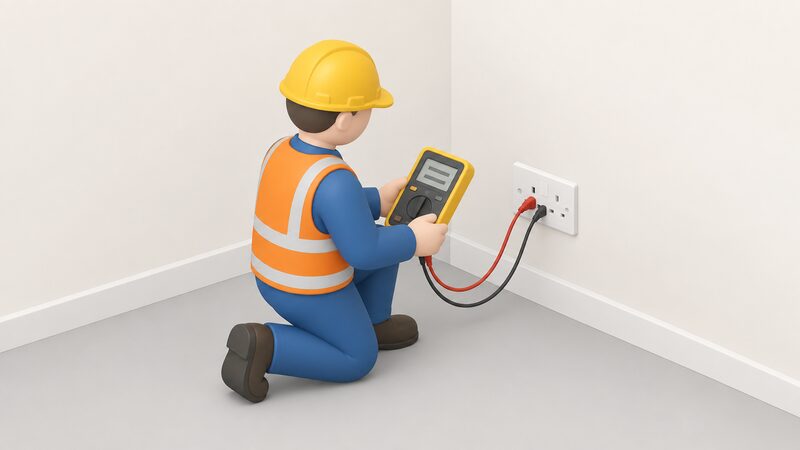
Arranging the visit is a short process, and knowing the sequence helps a household plan around it.
- Identify contractors registered with an approved self certification organisation and confirm each one on the Competent Persons Register3.
- Ask what the inspection covers, whether the report will include the schedule of test results and the schedule of inspections, and what the next-test date will be based on.
- Book the visit and clear access to the consumer unit, the meter position and any outbuildings or garages on separate circuits.
- On the day, expect the supply to be isolated at points during testing, so any equipment that must stay powered needs planning around.
- Receive the report, which must give the results of the inspection and test and the date by which the next inspection and test is required2.
The report itself is the deliverable, and the legislation is specific about what it must contain. A private landlord must obtain a report from the person conducting the inspection and test which gives the results of the inspection and test and the date of the next inspection and test11. The same structure applies to a voluntary EICR for an owner-occupier.
Where a landlord has tenants, the report has to be passed on: the landlord must supply a copy of that report to each existing tenant of the dwelling-house within 28 days beginning with the day on which the inspection and test is carried out5. That deadline is a useful marker for owner-occupiers too, because it shows the expected turnaround between the visit and the paperwork.
Scheduling expectations vary by body. The Northern Ireland Housing Executive, which inspects work under its grant process, aims to give no less than 10 working days' notice of a property inspection, and it may take up to two weeks to schedule a visit to a work site from when it receives a request for an inspection12. Those are administrative timings for a grant programme rather than for a commercial EICR, but they illustrate the order of magnitude for a site visit once a request is in.

Reading the report: observation codes and what 'satisfactory' means
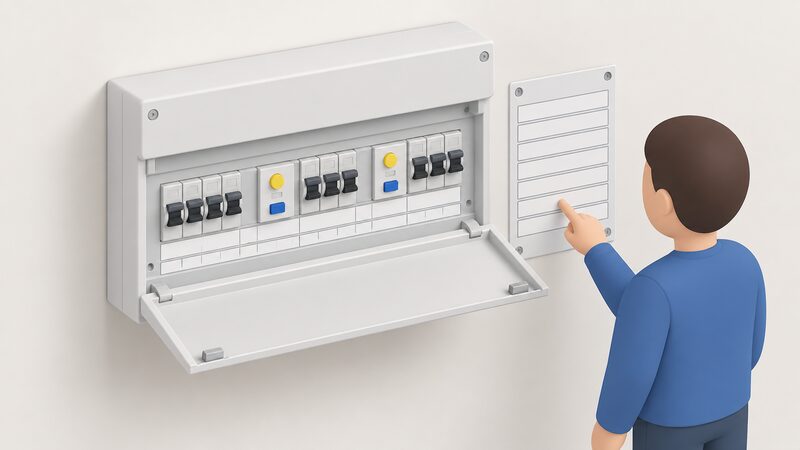
The classification codes are the heart of the report, and they are not interchangeable.
- C1 marks a danger present. The condition requires immediate attention.
- C2 marks a potentially dangerous condition, requiring urgent remedial work.
- C3 means improvement recommended: further remedial work is not required for the report to be deemed satisfactory1.
- FI means further investigation is required before the condition can be classified.
The single most important sentence in the guidance is the one attached to C3: improvement recommended, and further remedial work is not required for the report to be deemed satisfactory1. That is what separates a satisfactory report with recommendations from an unsatisfactory one. A report is unsatisfactory when it carries C1 or C2 observations, because those are the codes that indicate danger or potential danger.
The word satisfactory therefore has a narrow, technical meaning. It does not mean the installation is new, modern or efficient. It means no C1 or C2 observations were recorded. An installation can be decades old, carry several C3 recommendations and still be satisfactory.
"Code 3 (C3): Improvement recommended. Further remedial work is not required for the report to be deemed satisfactory."
Reading a report well means reading the schedule of test results alongside the summary. The codes tell a householder what must be done; the schedules tell the electrician why. Where a report is unsatisfactory, the next step is remedial work and a written confirmation that it has been carried out.
Remedial work and certification after an unsatisfactory report

An unsatisfactory report is not the end of the process. It is the trigger for a defined sequence.
The person conducting the inspection and test must produce a report stating either that the electrical safety standards are met, or that further investigative or remedial work is required11. Where further work is required, the landlord must obtain written confirmation from a qualified person that the further investigative or remedial work has been carried out, and whether the electrical safety standards are met or further investigative or remedial work is required2. The private rented sector legislation in Northern Ireland uses the same structure: where a report indicates an actual or potential breach and requires further work, the landlord must obtain written confirmation from a qualified person that the further investigative or remedial work has been carried out5.
The practical effect is that a household ends up with two documents: the original report and the confirmation that the work has been done. The confirmation is the one that matters to a buyer, a lender or an insurer, because it closes the loop.
Where work is carried out by someone who is not registered to self-certify, a different route applies. Approval can be sought from the relevant Building Control Body, either at the local authority or a registered building control approver, who will check compliance and issue a certificate of compliance if satisfied13. Where work has already been done without approval, the equivalent route is a regularisation certificate14.
Costs, validity and when to renew early
There is no published national price for an EICR. Official guidance on the closest comparable certificate, the EPC, states that the cost will vary from one company to another and that households will have to shop around for the best price15. The same applies here: prices are installer-quoted, and no range should be assumed.
Validity works differently from an EPC. An EPC is valid for a maximum of ten years or until another EPC is commissioned for the same building, whichever is sooner15. In Northern Ireland each EPC is valid for 10 years and can be used multiple times during that period16. In Scotland, a new EPC does not need to be produced when the previous certificate's 10-year validity period expires, unless the property is being sold or let to a new tenant17. Those are EPC rules, and they are set out here only because households often conflate the two documents.
An EICR has no equivalent fixed term. The report must state the date by which the next inspection and test is required2, and where the most recent report requires inspection and testing to take place by an earlier date, that earlier date applies2. Renewing early is therefore a matter of judgement rather than rule. The circumstances that justify bringing the date forward are a change of occupancy, a significant addition to the load, damage to the installation, or a lender's or insurer's requirement.
| Document | Validity | Source |
|---|---|---|
| EICR | Next-test date stated in the report2 | Legislation |
| EPC (England and Wales) | Maximum of ten years, or until a newer EPC is commissioned15 | Official guidance |
| EPC (Northern Ireland) | 10 years, reusable within that period16 | Official guidance |
| EPC (Scotland, buildings for let) | 10 years unless sold or let to a new tenant17 | Official guidance |
For a household, the practical point is that the EICR's own next-test date is the only date that binds. Diarise it, and treat any earlier date specified in a previous report as the operative one.
Part P and the law: what applies to your electrical work

Part P of the Building Regulations is the legal framework that catches electrical work in dwellings, and it applies whether or not an EICR has ever been produced.
All new electrical work in a dwelling must be designed and installed to account for Part P of the Building Regulations9. The scope covers a house, a flat or a small commercial premises linked to domestic accommodation9. The purpose is stated plainly in official guidance: these rules have been introduced to help reduce the number of deaths, injuries and fires caused by faulty installations6.
Where work is notifiable, the person doing it must either be registered to self-certify or the work must go through building control. A copy of the Installer's Electrical Installation Test Certificate compliant with BS7671 must be obtained and supplied to the local authority4. That requirement is what ties the completed work back to the building regulations record.
The four nations differ in how the competent person route is administered. In England only, an electrician registered with a third-party certification scheme, a registered third-party certifier, can certify notifiable work6. Scotland, Wales and Northern Ireland operate their own building standards and building regulations regimes, and the competent person scheme registration remains the relevant credential in each.
For households planning work that adds load, such as a chargepoint, the building regulations route and the grant rules are separate questions. The electric vehicle chargepoint grant for renters or flat owners, for example, is not available where there must by law be a chargepoint or charging infrastructure, for instance because the home is a new build18. Grant eligibility and building control approval are distinct tests, and both are covered elsewhere on this site in how to check which energy grants you qualify for.
Why it matters: electrical fires, injuries and the safety case
The case for inspection rests on a stated official purpose rather than on a statistic. The building regulations for electrics exist to help reduce the number of deaths, injuries and fires caused by faulty installations6. That is the whole of the safety argument as the guidance frames it, and it is enough: fixed wiring is concealed, rarely examined and carries the full load of the home.
The limits of the evidence are worth stating. There is no figure in the official material for how many domestic fires an EICR prevents, and no published rate of defects found per inspection. What exists is the classification framework itself, which sorts findings into danger present, potentially dangerous, improvement recommended and further investigation required1. That framework is the mechanism by which a hidden condition becomes a documented one.
For a household pursuing energy independence, the inspection is the gate that most load-adding measures pass through. A heat pump, a chargepoint, a battery or a large electric heating load all draw on the same fixed wiring, and the EICR is how a household establishes what that wiring can carry. It does not remove dependence on the grid, a supplier or imported gas, and it produces nothing. It establishes whether the installation is safe to build on.
The wider pattern across comparable regimes is that certification and registration are how households verify competence. The EPC regime relies on qualified assessors found on a register10. The electrical regime relies on the Competent Persons Register4. In both cases the register, not the contractor's own assurance, is the check that counts.
Sources18 cited
- Electrical safety standards in the private and social rented sectors: guidance, GOV.UK, 2025-11-01
- The Electrical Safety Standards in the Private Rented Sector (England) Regulations 2020, regulation 3, legislation.gov.uk, 2026-09-17
- Electrical safety, Cumberland Council, 2026-09-17
- Building control application guidance notes, London Borough of Bromley, 2026-09-17
- Electrical Safety Standards in the Private Rented Sector (Northern Ireland) Regulations 2024, legislation.gov.uk, 2024-11-27
- Building regulations: general information, Planning Portal, 2026
- Renting Homes (Wales) Act 2016, regulation 6, legislation.gov.uk, 2022
- Heat Energy Efficiency Technical Suitability Assessment (HEETSA) scoping consultation, Scottish Government, 2025-06-06
- Building regulations and electrical works, London Borough of Richmond upon Thames, 2026-06-02
- When is an Energy Performance Certificate required?, Planning Portal, 2026
- The Electrical Safety Standards in the Private Rented Sector (England) Regulations 2020, regulation 3 (made), legislation.gov.uk, 2026-09-17
- How long will the whole process take?, Northern Ireland Housing Executive, 2026-09-17
- Building regulations, Planning Portal, 2026
- Retrospective approval for electric vehicle charging, Planning Portal, 2026
- Trading standards guidance: other consumer problems, Isle of Anglesey County Council, 2025-09
- Energy Performance Certificates, nidirect, 2026-02-26
- Energy Performance Certificates: buildings for let, Scottish Government, 2023-11-29
- Electric vehicle chargepoint grant for renters or flat owners: eligibility, GOV.UK, 2026-09-17
 Landlord Electrical ChecksWho is responsible for checking the electrics are safe in your rented home, and how often should it happen?
 Finding an Insulation InstallerHow to find, verify and check an insulation, glazing or ventilation installer in the UK: the registration schemes, trade bodies and guarantee arrangements that cover the work, how to compare quotes, what a written specification should state, and how complaints and disputes are handled.
 Prepare a Home for WinterA seasonal checklist covering heating and hot water checks, controls and timers, alarms, draughts, outside pipework and stocking up on off-grid fuel.
 The Full Installers GuideHow do you find an installer you can trust, and what should you check before signing anything?
 Checking an InstallerBefore you sign anything, how do you know your installer is genuine?
 Reading an Energy BillA line-by-line walk through a domestic gas and electricity bill: unit rate, standing charge, kWh consumption, meter readings, tariff name and balance, plus the 12-month back billing limit and the guaranteed standards payments that apply when a supplier or network operator gets it wrong.