

In this answer
Short answer
Checking an engineer is Gas Safe registered takes a few minutes and can be done three ways: search the register online by postcode, business name or licence number, text the word Gas plus the registration number to 85080, or ask to see the engineer's Gas Safe ID card before any work starts1. The register is the official hallmark for gas safety, and by law all gas engineers must be on it and hold current qualifications to install, repair or maintain domestic gas appliances1.
The check matters because the consequences of unregistered work are not confined to a botched repair. Gas work done by someone outside the register is illegal, and the risks it creates, from leaks to carbon monoxide, are the reason the register exists. Gas Safe Register replaced CORGI as the gas registration body in Great Britain and the Isle of Man on 1 April 2009, and in Northern Ireland and Guernsey on 1 April 2010, so any CORGI branding on a van or a card is more than a decade out of date3.
For a household, this is one of the few energy checks that is entirely within your own control. It does not depend on a supplier, a tariff or a smart meter, and it costs nothing. What it cannot do is remove the underlying dependence: a gas appliance still needs gas from the network, and a registered engineer is still a business you have to book, wait for and pay.
What the Gas Safe Register is and why checking matters
Gas Safe Register is the official hallmark for gas safety, and in Northern Ireland it is the official registration for all gas engineers1. It is not a trade association or a voluntary scheme: it is the registration body that sits behind the legal requirement, and its remit covers finding a registered gas engineer, reporting illegal gas work (work undertaken by a person not registered with Gas Safe) and handling customer complaints about unsatisfactory gas work7.
The scale of the register is worth knowing when you are told that "everyone round here is registered". There were 76,630 Gas Safe registered businesses in 2023/244. That is a large population, which is precisely why a verbal assurance is not a check. Registration is held by a business and by individual engineers within it, and the two are checked in slightly different ways.
Checking also protects against the specific failure mode that gas safety campaigns keep returning to. Gas Safety Week, organised by Gas Safe Register, exists to provide information about the importance of gas safety, and the 2026 edition ran from 14 to 20 September under a Take No Chances theme with advice on servicing, carbon monoxide and gas emergencies8. The message is consistent across the industry: the check is quick, and skipping it is the mistake.
For energy independence, the register is a form of consumer infrastructure rather than a source of supply. It gives a household a verifiable way to control who touches the gas installation, which is the part of the system you can actually govern. It does not change the fact that the gas itself arrives through a network you do not own, or that a boiler needs an annual service by someone you have to find and book.
Check the register online: postcode, business name or licence number

The online register is the primary route and accepts three kinds of search: by postcode, by business name or by licence number2. The postcode search is the one to use when you are looking for someone local; the business name and licence number searches are the ones to use when someone has already been recommended or has quoted for a job.
The same search doubles as a finder. Using your postcode finds Gas Safe registered engineers in your area, and an advisor can be reached on the freephone number if the online route is not workable6. Anyone can verify a Gas Safe ID online at the register's website, which means the check does not require an account, a login or a phone call10.
When a business registers, it supplies its company name, its trading name if different, its company address and its phone number5. Those are the details that appear against a listing, so a householder comparing a quote against the register can see whether the trading name on the paperwork matches the name on the register. A mismatch is not proof of anything on its own, but it is the point at which to ask a direct question.
| What you have | How to check it |
|---|---|
| A postcode and no name | Search the register by postcode to list local engineers6 |
| A business name from a quote | Search the register by business name2 |
| A licence number from a card | Search the register by licence number2 |
| A mobile phone and a registration number | Text Gas plus the number to 850802 |
The register is also the route for reporting illegal gas work and for complaints about unsatisfactory work, which is worth noting before a job starts rather than after7. If a search returns nothing for a business that has quoted, that is the moment to stop and ask for the registration details in writing.
The Gas Safe ID card: what to look at before any work starts
Registration on a database is not the same as the right qualification for the job in front of you, and the ID card is where that distinction is visible. All Gas Safe Register engineers carry an ID card showing the type of work they are qualified to do, so it is worth asking to see it11. Before any work starts in your property, ask to see the engineer's Gas Safe ID card and check that they are qualified for the specific appliance or job2.
The card has two sides and both carry information. On the front, check the engineer's photograph, the start and expiry dates, the licence number, the security hologram, and that the engineer is from the business you contacted6. On the back, check the engineer's qualification to do the gas work you asked them to do, and that the engineer's qualifications are current6.
"Ask to see the engineer's Gas Safe ID card"
Each installer must carry an ID card, which lists the gas work they are qualified to do13. That wording matters: a card is not a general licence to work on anything gas. An engineer qualified on boilers is not automatically qualified on a gas fire or a commercial appliance, and the back of the card is where the scope is set out.
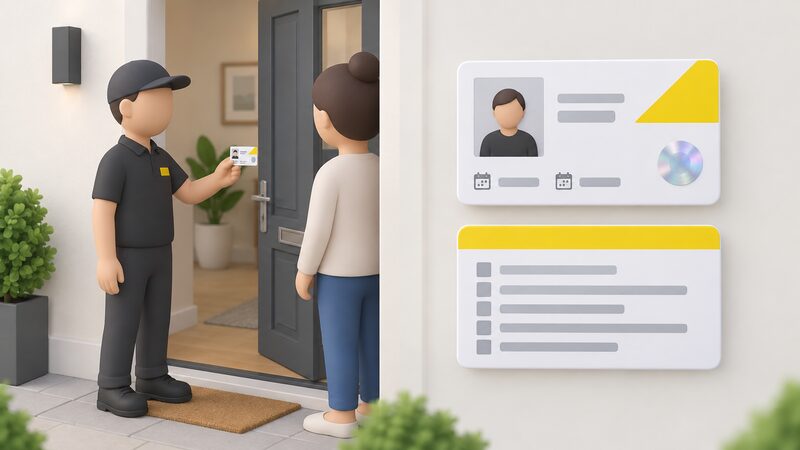
The practical sequence is short. Ask for the card at the door, before tools come out. Check the photograph against the person. Check the expiry date is current. Check the back for the appliance in question. If any of those four fails, the work should not start, and the register search can be repeated while the engineer is still on the doorstep.
What the law requires of anyone working on your gas appliances
The legal position is unambiguous. By law, all gas engineers must be on the register and hold current qualifications to install, repair or maintain domestic gas appliances6. All people working with gas have to be Gas Safe registered by law, and all gas engineers are required by law to be on the Gas Safe Register9. The law states that anyone working on a gas boiler must be on the Gas Safe Register7.
That requirement extends to maintenance as well as installation. A gas appliance should be properly installed and maintained at regular intervals by an engineer who is on the Gas Safe Register8. For rented homes, the duty is sharper still: an annual gas safety check must be carried out within 12 months of the installation of each appliance, by a Gas Safe registered engineer3.
Registration itself carries obligations that support the check. Registration is renewed every year, new registrations are placed on probation for three months, and records of all gas work must be kept during that probation5. Engineers must supply National Insurance numbers when they are registered, which is part of how the register ties a licence to a person rather than a trading name5.
The limits of the law are worth stating plainly. It governs who may work on gas, not how quickly they attend, what they charge or whether parts are available. A registered engineer is a necessary condition for safe gas work, not a guarantee of a good outcome, and the register's complaint route exists because registered work can still be unsatisfactory7.
How to check by text, and the numbers that matter

The text service is the fastest check when you are standing in a hallway with a phone. Consumers can check a business is registered by texting Gas and the business registration number to 85080, and can check an engineer is registered by texting Gas and the engineer's seven digit licence number to the same number2. The seven digit licence number is the one printed on the ID card, so the card and the text check work together.
The telephone routes are split by purpose, which is where most confusion arises. The freephone number for checking an engineer and finding one locally is 0800 408 55006. Technical enquiries and registration renewals use 0800 408 5577, with option 2 for renewal, and the renewal line runs a 24-hour service5. The register's address is 200 Cedarwood, Crockford Lane, Basingstoke, RG24 8WD, and its customer services email is register@gassaferegister.co.uk3.
| Purpose | Contact |
|---|---|
| Check an engineer or find one locally | 0800 408 5500 freephone6 |
| Technical enquiries | 0800 408 55775 |
| Registration renewal | 0800 408 5577, option 25 |
| Text check | Gas plus the number to 850802 |
| Customer services email | register@gassaferegister.co.uk5 |
Registration and renewal can be handled online, by post using an application form, or by phone, and payment is by credit or debit card5. That is the engineer's side of the process rather than the householder's, but it explains why a registration can lapse quietly: it is an annual transaction, and a business that has not renewed will drop off the register even though its vans still carry the logo.
Where the check sits in a wider safety routine
The registration check is one step in a sequence, and it works best when the other steps are in place. A boiler service is the annual event at which most households encounter a gas engineer, and the law requires anyone working on a gas boiler to be on the register7. Booking a service is therefore also an opportunity to run the check, and the boiler service frequency page sets out how often that should happen.
For rented homes, the responsibilities are split. A tenant should check that any engineer who visits to carry out work is Gas Safe registered12. The landlord is responsible for arranging the annual gas safety check on all gas appliances and flues, so a tenant who rents needs to contact the landlord to arrange it rather than booking it directly17. The boiler service when renting page covers that division in more detail.
Two related checks are worth knowing about because they are often confused with this one. If you are unsure whether an engineer is accredited, check the Gas Safe website or ask them to show their registration card19. And if the problem turns out to be a gas leak rather than a registration question, the response is different: the reporting a gas emergency page covers what to do, and the smell gas who to call page gives the number.

The wider point for a household is that this check is the one part of gas safety that requires nothing from anyone else. It does not depend on a supplier's response time, a manufacturer's warranty department or a network operator. It is a verification you perform, and it is the reason the register publishes a search tool, a text number and a freephone line rather than relying on trust.
Sources19 cited
- Gas Safe Register, nidirect, 2025
- Take No Chances With Gas Safety, Northern Gas Networks, 2026
- Gas Safety FAQs, Health and Safety Executive, 2026
- Projecting the Future Domestic Heat Pump Workforce, Heat Pump Association, 2026
- Registration to Carry Out Gas Work, GOV.UK, 2026
- Domestic Gas Installation and Health and Safety, nidirect, 2025
- Know or Suspect You Have a Gas Emergency, Institution of Gas Engineers and Managers, 2026
- Gas Safety and Carbon Monoxide, nidirect, 2025
- Carbon Monoxide, Chartered Institute of Plumbing and Heating Engineering, 2026
- Gas Safety Week 2023, Chartered Institute of Plumbing and Heating Engineering, 2023
- Why You Need a Boiler Service and What to Ask About, Which?, 2025
- Why It's Vital to Use a Qualified Gas Engineer, Home Improvement and Heating Council, 2025
- Boiler Prices: How Much Does a New Boiler Cost, Which?, 2025
- Everything You Need to Know About Choosing an Electrician, NICEIC, 2025
- Make the Right Call, Cadent Gas, 2026
- Gas Leaks Safety, Uswitch, 2026
- Repair and Replacement, Cadent Gas, 2026
- Know Your Rights and Responsibilities in Rented Properties, Home Improvement and Heating Council, 2025
- 6 Mistakes to Avoid When Looking for Boiler Cover or Boiler Servicing, Which?, 2026
 Gas Safety RulesAnyone working on gas in your home has to be on the Gas Safe Register, whether they are installing, fixing or servicing an appliance.
 Gas Safety in the HomeYour landlord has to arrange a yearly gas safety check by a Gas Safe registered engineer and give you the record if you rent.
 Checking an InstallerBefore you sign anything, how do you know your installer is genuine?
 F-Gas RulesWho is legally allowed to work on the gas in your home air conditioning?
 Arrange an Electrical InspectionHow to find and check a registered electrician, what an Electrical Installation Condition Report covers and the intervals usually recommended for owner-occupied homes.
 Finding an Insulation InstallerHow to find, verify and check an insulation, glazing or ventilation installer in the UK: the registration schemes, trade bodies and guarantee arrangements that cover the work, how to compare quotes, what a written specification should state, and how complaints and disputes are handled.