

In this answer
Short answer
Verifying an electrician's registration comes down to one check: the business name should appear on the Competent Persons Register at electricalcompetentperson.co.uk, the official list of electricians registered with approved self-certification organisations1. Registration is what allows an installer to self-certify notifiable work as compliant with the Building Regulations, rather than the householder making a Building Regulations application to the local authority's Building Control body2.
The register is the starting point, not the whole answer. Registration attaches to a business, not to the person standing in your kitchen, and the two main certification bodies, NICEIC and NAPIT, run separate schemes with separate complaint processes. NICEIC states that it certifies businesses, not individuals, unless the business is a sole trader3. That single sentence explains most of the confusion householders run into when they ask whether "the electrician" is registered.
What follows sets out what registration certifies, how often it is checked, how the schemes differ, and what happens when work goes wrong. It also sets out the limits plainly: a scheme can require remedial work, but it will not pay you compensation.
Why registration matters: self-certification against the Building Regulations
Notifiable electrical work in a dwelling has to satisfy Part P of the Building Regulations, and there are two routes to that. The work can be reported to the local authority building control body, or it can be carried out by a registered electrician who is a member of a Government-approved scheme, with the exception of some minor tasks1. Registration is what unlocks the second route, and it is why the question of whether an electrician is registered is not a matter of preference but of which paperwork the job generates.
A registered electrician is deemed competent to self-certify their work as compliant with the Building Regulations4. In practice that means the householder receives an Electrical Installation Certificate or Minor Work Certificate confirming the work meets BS 7671, plus a Building Regulations Compliance Certificate confirming it meets the Building Regulations1. Where the electrician is not registered as a competent person, or where the householder does the work, a Building Regulations application to Building Control is required instead2.
The Welsh government's guidance sets out the same principle: the electrician must be registered by an organisation authorised by the Secretary of State and be able to certify the work as safe without notifying Building Control2. Safety can be checked in either of two ways, through a competent person scheme or by notifying the local authority's building control section2.
For a household, the practical consequence is about who carries the compliance burden. Using a registered business moves notification, certification and the risk of a Building Control query onto the installer. Using an unregistered one leaves the householder to make the application, pay any fee and hold the paperwork. That is the independence question in miniature: registration is not about the quality of the workmanship, it is about who is accountable for the compliance record.

The Competent Persons Register: the official place to check

The Competent Persons Register exists for one purpose: checking whether an electrician is registered8. Electricians become registered with an approved self-certification organisation, and those organisations feed the register9. The register is the single official destination, and it is the check that matters most because it is the one the schemes themselves populate.
The register is not the only route. Electrical Safety First advises contacting the scheme directly if you want to check the individual's registration10. That distinction is worth holding onto: the register confirms the business, while the scheme can confirm whether a named individual is registered under it. The schemes are regulated by the UK Government10.
There is a third route in England only. An electrician registered with a third-party certification scheme, a registered third-party certifier, can certify work as an alternative to using a building control body11. Approved Document P records that installers who are not a registered competent person may use a registered third-party certifier to certify work12. The Planning Portal notes that this route applies in England only13.
Registration also carries a listing benefit. All technicians who register with the OFTEC electrical (Part P) registration scheme are automatically listed on the Registered Competent Person Electrical website for England and Wales14. For households in Wales, the same register serves the same purpose, and the Welsh government's guidance on building regulations and electrics applies2.
Where a household is looking for someone to assess the property and identify suitable measures, rather than simply certify electrical work, a competent person register such as TrustMark is the government-endorsed route15. That is a different function from Part P certification, and the two are often conflated.
NICEIC and NAPIT: the two main certification bodies
NICEIC and NAPIT are separate organisations, and neither is a synonym for the other. NICEIC describes itself as the UK's largest certification body for electrical businesses3, and separately as the UK's leading certification body for the electrical industry16. It assesses, certifies and trains electricians, plumbers, renewable energy installers, and gas and heating engineers3.
NAPIT operates its own schemes across a wider trade base. NAPIT registered scheme members can certificate their own work in the areas of electrical, heating, plumbing, ventilation and air-conditioning, microgeneration and building fabric trades in England and Wales17. That breadth matters for households installing renewable heating or solar alongside electrical work, because one registered business may cover several notifiable trades.
For electrical work generally, the recommended bodies are NICEIC, NAPIT, ECA, SELECT or BLUE Flame18. The Energy Saving Trust recommends finding an installer registered with a trade association such as the Electrical Contractors' Association, NAPIT, or in Scotland SELECT19. Scotland's separate mention reflects its different building standards regime.
| Body | Scope described | Notes |
|---|---|---|
| NICEIC | Electrical businesses; also plumbers, renewable energy installers, gas and heating engineers3 | Describes itself as the UK's largest certification body for electrical businesses3 |
| NAPIT | Electrical, heating, plumbing, ventilation and air-conditioning, microgeneration, building fabric, in England and Wales17 | Runs its own complaints process for members6 |
| ECA, SELECT, BLUE Flame | Listed alongside NICEIC and NAPIT for all types of electrical work18 | SELECT is named for Scotland19 |
Belonging to a certification body like NICEIC is purely voluntary20. What is not voluntary is the consequence: without registration under a government-approved scheme, notifiable work cannot be self-certified, and a Building Control application follows2. Registration with NAPIT or NICEIC is required for Part P electrical compliance, and registered installers can self-certify electrical work without building control notification21.

What registration actually certifies: businesses, not individuals
This is the point most householders get wrong. NICEIC certifies businesses, not individuals, unless they are a sole trader3. A NAPIT member is defined as a business or tradesperson who has demonstrated their competence, holds the necessary insurances and has the right processes and procedures in place to assure compliance22. Both definitions describe an organisation and its systems, not a named person's qualifications.
The practical test is who signs the certificate. An Electrical Installation Certificate must be signed by a competent person9. Where the business is registered, the certificate is issued under that registration, and the individual who signs may be an employee working under the business's certification. Asking who will sign, and under which scheme, is a more useful question than asking whether "the electrician" is registered.
Registration also carries insurance expectations. NICEIC-registered electricians have comprehensive insurance to protect the customer and their property in the event of accidental damage or injury20. That is a condition of registration rather than a guarantee of outcome, but it is one of the things the annual assessment is checking.
For households, this shapes what independence looks like. A registered business carries the certification, the insurance and the notification duty. A household that contracts an unregistered individual carries the Building Control application and the compliance risk itself. Neither route changes the physics of the installation, but they place the accountability in very different hands.
How often an electrician is assessed: annual checks
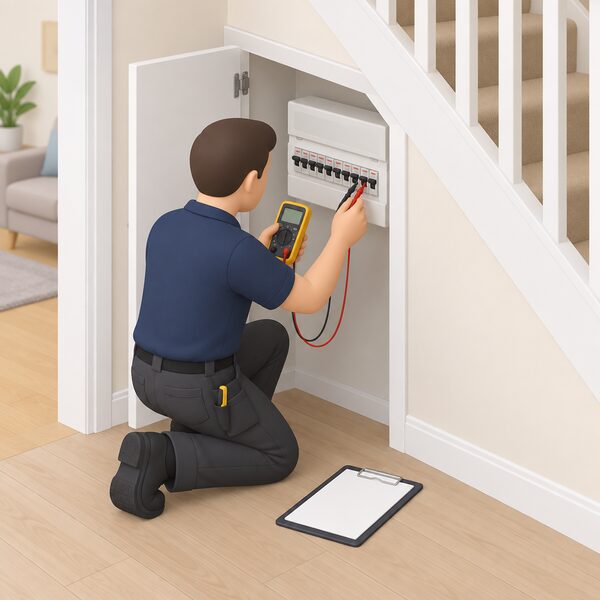
NICEIC-registered electricians are assessed on an annual basis4. The assessment is of the business: their business is assessed annually by an experienced NICEIC assessor to ensure they meet stringent quality and technical requirements20. NICEIC also states that registered electricians' work is regularly assessed10.
The annual cycle is the mechanism that keeps a registration meaningful between jobs. It is not an inspection of every installation, and it does not mean each job is checked. It means the business's competence, processes and insurance are reviewed on a fixed cycle, and continued registration depends on passing.
For landlords, the assessment cycle sits alongside separate legal duties. The government guidance requires all landlords to have the electrical installations in their properties inspected and tested by a qualified person at least every 5 years23. Electrical Safety First recommends landlords arrange periodic inspection and testing by a registered electrician at the relevant intervals24. An electrical safety check will typically need to be carried out once every five years assuming no remedial work is needed, and takes about half a day to complete25.
| Check | Frequency | Who it applies to |
|---|---|---|
| Business assessment by the certification body | Annually4 | NICEIC-registered electricians |
| Periodic inspection and testing | At least every 5 years23 | All landlords, rented properties |
| Building Regulations Compliance Certificate | Within 30 days of completion7 | Notifiable work in England and Wales |
The distinction between the annual business assessment and the five-yearly installation inspection is worth keeping clear. One is a check on the firm; the other is a check on the wiring. A household commissioning work is buying into the first, and receiving the paperwork that supports the second.
If something goes wrong: complaints to NAPIT and what they will and will not do
NAPIT can investigate complaints made against NAPIT Registered Businesses and/or NAPIT Registered Tradesperson where a lack of technical competence is a concern6. The complaint process applies when a company certificated by NAPIT has been contracted or subcontracted to carry out work covered by the scope of their certification5. Complaints must be submitted using the complaints form found on the NAPIT website5.
There are conditions before NAPIT will take a complaint up. A complaint may be made by any person who has had work completed by a member who is certified for the relevant scope of work at the time5. The consumer or their representative must have formally contacted the member directly and allowed a minimum of 14 days for the member to acknowledge the complaint5. Once received, NAPIT acknowledges receipt within 5 working days5.
The scope of what NAPIT will investigate is defined. It covers work that does not comply with Building Regulations, British Standards, MCS published standards, or has resulted in an unsafe situation, and the issue must first be raised directly with the installer6. If rectification work is not done satisfactorily or no resolution was agreed, the installer may jeopardise their NAPIT certification6.
There is a further limit. NAPIT can only require the scheme member to make an installation compliant at their expense; if the householder will not allow them back, NAPIT's involvement can go no further except action over safety or non-compliance with regulations6. Where an installer is no longer trading and the guarantee is missing, fraudulent or cancelled, other routes exist, including the National Energy Foundation in cases of that kind26.
On data, NAPIT shares information with partners including government departments, enforcement authorities, consumer protection organisations, technical experts, manufacturers, scheme owners, legal counsel and other certification or registration bodies5. NAPIT cannot remove personal data while the complaint is ongoing, or if a guarantee related to the complaint has not yet expired5.
For households, the honest summary is that registration buys a route to enforced remediation and a route to certification, not a route to money. That is the dependence that remains even with a fully registered business: the scheme's leverage is over the member's certification, and the householder's financial remedy sits with the business itself.
Sources26 cited
- Part P of the Building Regulations, Electrical Safety First
- Building regulations: electrics, Welsh Government
- Householders and landlords help hub, NICEIC
- Wiring a shed: a guide for homeowners, NICEIC
- Complaints against members policy, NAPIT
- FAQs, NAPIT
- Consumer advice, NAPIT
- Application guidance notes, London Borough of Bromley
- Electrical safety, Cumberland Council
- 5 questions to ask your electrician, Electrical Safety First
- Approved Document P, Planning Portal
- Part P electrical safety, Planning Portal
- Building regulations general information, Planning Portal
- Electrical Part P registration, OFTEC
- Energy Company Obligation (ECO) scheme, Leeds City Council
- How to prepare for (and stay safe during) a power cut-a-power-cut), NICEIC
- Consumer advice for households, NAPIT
- Rogue trader hotspots revealed, Electrical Safety First
- Electric heating, Energy Saving Trust
- Everything you need to know about choosing an electrician, NICEIC
- How to choose the best solar panel installer, Boiler Central
- Glossary of terms, NAPIT
- Electrical safety standards in the private and social rented sectors, Ministry of Housing, Communities and Local Government
- Plug-in solar panels, Electrical Safety First
- Electrical checks in privately rented homes, Electrical Safety First
- Energy Market Consumer Protection, Hansard
 Competent Person SchemesIf a tradesperson says they can sign off their own work, how do you know they are genuinely registered?
 Gas Safety RulesAnyone working on gas in your home has to be on the Gas Safe Register, whether they are installing, fixing or servicing an appliance.
 Using an Installer in EnglandHow do you check an installer is registered to sign off their own work, and what happens if they are not?
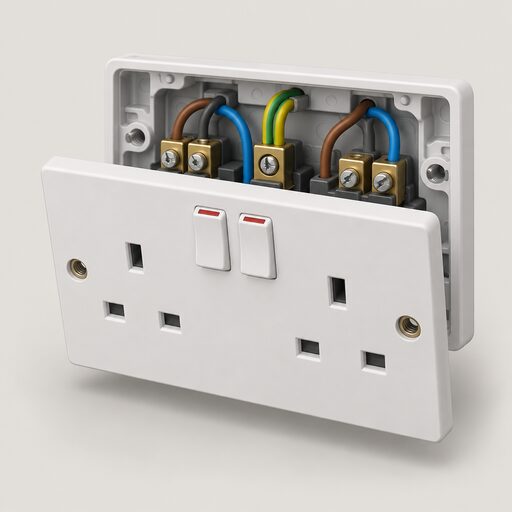 Arrange an Electrical InspectionHow to find and check a registered electrician, what an Electrical Installation Condition Report covers and the intervals usually recommended for owner-occupied homes.
 Installer in Northern IrelandHow do you check an installer in Northern Ireland is properly registered, and who do you complain to if the work goes wrong?
 Electrical Safety RegulationElectrical work at home raises real questions about who can do it, what needs signing off, and what paperwork you should keep.