


In this guide
TrustMark is the Government Endorsed Quality Scheme, covering work a consumer chooses to have carried out in their home1. It is not a warranty provider, an installer and not a regulator. It is a registration and quality assurance framework: firms that join are vetted, assessed and monitored, and their work on grant-funded retrofit is lodged in a central data warehouse so that the scheme can see what was installed and where.
The scheme matters to households because it is the gatekeeper for most public money spent on home energy efficiency. Businesses including installers, Retrofit Assessors and Retrofit Coordinators must be registered with TrustMark to access ECO and other taxpayer funded, UK government led energy efficiency schemes2. The Energy Company Obligation, the GB wide obligation on suppliers, requires suppliers to be TrustMark approved in order to access the funding3. For a household pursuing a grant, the practical effect is that the installer list is not a free market: it is a filtered one.
The scheme is operated by TrustMark (2005) Limited, a company registered in England and Wales with company number 054801444. It runs under licence from the Government's Department for Business and Trade and is overseen by an independent Board5. It is a not-for-profit social enterprise, receiving a small fee from Scheme Providers for each Registered Firm that joins5.
What TrustMark offers a UK household
The scheme's own description of the benefits is a list of protections rather than a product: Government Endorsed Quality, robust consumer protection, a TrustMark Online Directory, competent and quality work backed by guarantees, a Customer Charter, Trading Standards integration, free advice and information, and verified consumer reviews1. The origin is worth knowing. Following the Each Homes Count review the TrustMark scheme was chosen as the route to provide homeowners with reassurance and protection from rogue traders1.
What that means in practice is a vetting and surveillance regime. Registered Businesses are thoroughly vetted to meet required standards and committed to good customer service, technical competence and trading practices, and members are subject to initial and ongoing assessment and surveillance visits to check that they continue to meet all of the requirements1. TrustMark audits the Scheme Providers every year to ensure continued compliance with the Framework Operating Requirements5. The scheme also has the right to suspend or remove Registered Businesses from the scheme5.
The screening is not limited to the firm's own paperwork. Any supplier approved under the TrustMark scheme and/or MCS will be subjected to a thorough screening process including checks against Trading Standards systems, with monitoring and possible sanctions including suspending or removing the company from the scheme9. That is the mechanism that gives the register its value: a household searching it is relying on a check that has already been run, and on a sanction that can be applied afterwards.
TrustMark covers domestic only9. There is currently no approval mechanism for these standards in the commercial sector, so the register is not a route to a non-domestic contractor. Local authorities treat it as a competent person register for finding an installer that will assess your circumstances and property to identify suitable measures10.

Specifications: PAS 2035, PAS 2030 and the framework behind registration

The technical content of TrustMark is not written by TrustMark. TrustMark's Framework requires compliance and certification with PAS 2035:2019 and PAS 2030:2019 standards, for all relevant ECO measures11. Those are the British Standards Institution publicly available specifications for retrofit: PAS 2035 governs how a whole-dwelling retrofit is assessed, designed and coordinated, and PAS 2030 governs how individual measures are installed.
The scheme is underpinned by the Framework Operating Requirements, a robust Customer Charter and Code of Conduct that member companies must follow1. It also carries a robust framework of operating requirements, including dispute management12. The Scottish quality assurance scheme is built on the same foundation, operating in accordance with the principles of the British Standards Institution (BSI) Publicly Available Specification (PAS) 2035/30 standards3.
The route by which this became mandatory is a Green Deal inheritance. Following a review of the Green Deal, the new standards (both PAS 2035 and PAS 2030) were subsequently integrated into the UK government endorsed TrustMark quality assurance scheme, with Green Deal Approved installers transitioning over2. Work and financial protection also needs to be lodged into the TrustMark Data Warehouse to allow oversight of retrofit activities2. A certificate of lodgement is a document entitled "TrustMark Certificate of Lodgement" which sets out the address at which a measure has been installed or repaired and the type of measure12. TrustMark will issue a Certificate of Lodgement once the project Retrofit Co-ordinator has signed off the project and submits a lodgement13.
| Requirement | What it applies to | Source |
|---|---|---|
| PAS 2035:2019 and PAS 2030:2019 certification | All relevant ECO measures | 11 |
| TrustMark or equivalent registration | All innovation measures | 14 |
| TrustMark or equivalent registration | DHC measures excluding shared ground loop GSHP | 15 |
| TrustMark registration | Installers, Retrofit Assessors and Retrofit Coordinators accessing ECO and other schemes | 2 |
| Data Warehouse lodgement | Work and financial protection | 2 |
The standards themselves are covered in more detail in PAS 2035 and PAS 2030: The Retrofit Standards Explained, and the wider landscape of certification bodies sits in Installer Schemes and Consumer Codes.
What the warranty covers, and what it does not
TrustMark's framework sets a floor rather than a product. It requires a minimum two-year warranty for work, and a minimum 25-year guarantee for certain measures installed under the ECO6. The 25-year term applies to specified measures, not to every job, and the guarantee is provided by the installer or the scheme provider rather than by TrustMark itself.
The distinction between a guarantee and a warranty matters here. A warranty (or extended warranty) is a form of insurance policy, which provides cover for the unexpected failure or breakdown of goods, usually after the trader or manufacturer's guarantee has run out16. A guarantee is the trader's own promise on the work. TrustMark registration does not convert one into the other.
There is a separate payment protection product, Trusted Payments, which is not the same as TrustMark registration. It holds money in escrow and provides an insurance backed warranty on the work, underwritten by a fully authorised, A-rated insurer, covering three months while the job is running and twenty four months after it is finished17. TrustMark's own escrow option allows a householder to protect an investment for as little as £6 per party5.
Where a dispute arises, the framework includes dispute management12. Complaints can be raised by calling TrustMark on 0333 555 1234, by emailing disputes@trustmark.org.uk, or through an online form18. For energy supply disputes rather than retrofit work, the Energy Ombudsman is independent of the energy company and free of charge19, and Ombudsman Services: Energy is a free independent scheme20.
What TrustMark costs
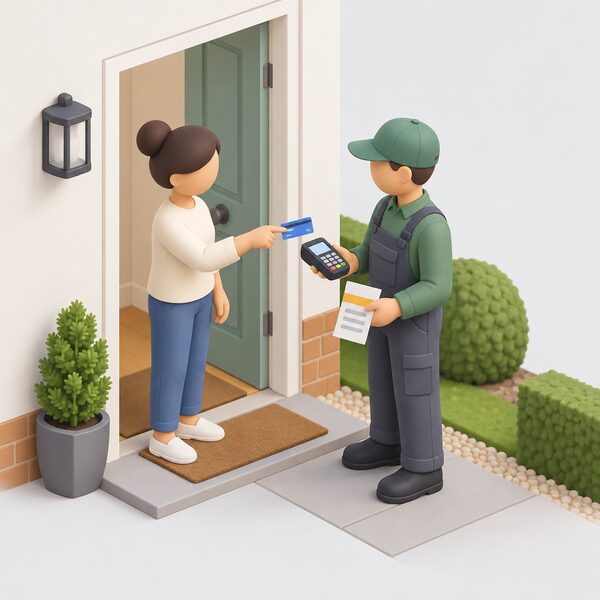
For a householder, the scheme's stated position is that there should be no premium for using a TrustMark Registered Business5. The cost sits with the supply side. The additional costs associated with becoming TrustMark approved is estimated to be approximately £140 a year, made up of a £40 TrustMark registration fee and £100 in administration costs7. Scheme Providers who approve these suppliers pay TrustMark a one-off joining fee of £2,0007.
Those figures come from a 2023 Scottish Government consultation on the domestic quality assurance programme for heat buildings, so they are estimates of supplier cost rather than a published price list, and they are now several years old7. They are useful mainly as an indication of scale: the registration cost is small relative to the value of a typical retrofit job, which is why the scheme can be described as carrying no household premium.
The separate Trusted Payments product is priced at between £25 and £85 depending on the project size, less than 1% of project spend17. That is a payment protection fee, not a TrustMark registration fee, and it is optional.
Company status and oversight
TrustMark is not a government body. It is operated by TrustMark (2005) Limited, a company registered in England and Wales with company number 054801444. The same company number and description appear in the 2022 regulations that define the scheme for ECO purposes12 and in the 2026 regulations21, so the operating entity has been stable across the period in which the scheme became mandatory for grant work.
It operates under licence from the Government's Department for Business and Trade and is overseen by an independent Board5. It is a not-for-profit social enterprise, receiving a small fee from Scheme Providers for each Registered Firm that joins the scheme5. Ministers have advised using builders registered with TrustMark, describing it as a trusted scheme, to ensure that work is done properly22.
Oversight has not been without friction. Neither TrustMark nor DESNZ have been able to provide minutes of meetings which took place between 2022 and 202423. As of November 2025, 22 installers had been fully reinstated after meeting requirements on TrustMark's "robust six-point plan", including full remediation of the problems identified23. Routine checks carried out by TrustMark, the independent body which oversees tradespeople working in homes, have uncovered substandard solid wall insulation24. The scheme is therefore both the body that finds poor work and the body that decides when a firm can return.
What it means for energy independence
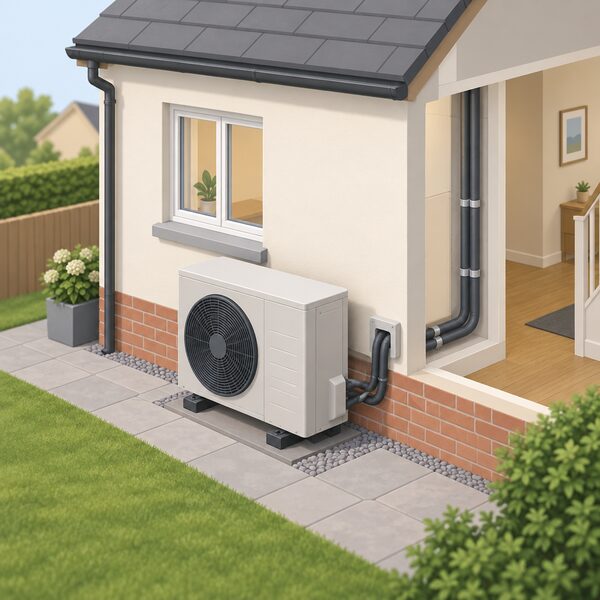
TrustMark does not generate a single kilowatt hour and does not reduce a household's dependence on the grid, a supplier or a fuel. What it does is govern the quality of the work that changes that dependence. A heat pump, insulation measure or solar installation funded through a government scheme has to be delivered by a TrustMark registered business and lodged in the TrustMark Data Warehouse2. The register is the mechanism by which a household can find an installer who will assess the property and identify suitable measures10.
The dependence it creates is a dependence on a scheme. Access to grant funding runs through registration, so a household that wants public money for retrofit is choosing from a filtered list rather than an open market. The quality assurance that comes with it is real: vetting, surveillance visits, annual audits of Scheme Providers, Trading Standards checks and the power to suspend or remove a firm1. The limits are equally real. TrustMark covers domestic only9, the warranty floor is a minimum rather than a promise of a specific term6, and the scheme's own oversight has been the subject of parliamentary scrutiny over missing meeting minutes and installer reinstatements23.
For a household, the practical position is that TrustMark registration is a necessary condition for grant-funded work and a reasonable signal of vetting, but it is not a guarantee of any individual job. The scheme's own advice is to get a minimum of three quotes for any work you are planning to get done5. The wider regulatory picture, including how these schemes interact with building regulations and consumer protection, is set out in UK Home Energy Regulation and Policy.
Sources24 cited
- TrustMark scheme overview, CIGA, 2026
- Heat in Buildings Quality Assurance Statement, page 3, Scottish Government, 2022
- Heat in Buildings Quality Assurance Statement, Scottish Government, 2022
- The Electricity and Gas (Energy Company Obligation) Order 2018, legislation.gov.uk, 2018
- TrustMark homeowner FAQs, TrustMark, 2026
- Research briefing CBP-9585, House of Commons Library, 2026
- Domestic Quality Assurance Heat Buildings Programme BRIA, Scottish Government, 2023
- Warm Homes Local Grant statistics, August 2026, GOV.UK, 2026
- Heat in Buildings Quality Assurance Statement, page 4, Scottish Government, 2022
- Energy Company Obligation scheme and home energy efficiency, Leeds City Council, 2026
- ECO4 Guidance: New Measures and Products, Ofgem, 2022
- The Electricity and Gas (Energy Company Obligation) Order 2022, legislation.gov.uk, 2022
- Summary of Guidance Updates: Mid-scheme Changes to ECO4 and GBIS, Ofgem, 2025
- ECO4 Innovation: Approved Innovation Measures, Ofgem, 2026
- ECO4 New Measures and Products Guidance v3.0, Ofgem, 2026
- Remedies and redress: an overview of your key consumer rights, Trading Standards Wales, 2025
- Trusted Payments: paying for home improvements, Trading Standards, 2026
- Support for customers of CES, Welsh Government, 2026
- Energy Ombudsman guidance, Ofgem, 2020
- How to leaflet, Ofgem, 2014
- The Electricity and Gas (Energy Company Obligation) Order 2026, legislation.gov.uk, 2026
- Government advice on builders registered with TrustMark, House of Commons Library, 2024
- Public Accounts Committee report, House of Commons Public Accounts Committee, 2025
- Action taken to protect households with poor quality insulation, GOV.UK, 2025