

In this guide
Checking an installer is legitimate means checking three separate things, because no single register covers everything. The first is whether the business is registered with a scheme that covers the specific work: a competent person scheme for building regulations work, MCS for microgeneration, TrustMark for the general quality framework. The second is whether the company itself is real, solvent and traceable. The third is what sits behind the certificate if the work goes wrong, which is a consumer code, an insurance-backed guarantee or nothing at all.
The starting point is free and takes minutes. Official guidance advises checking that your installer is a member of a scheme covering the work they will be undertaking1. An installer registered with a competent person scheme can self-certify that their work complies with building standards, which removes the need for local authority building control involvement, and a certificate is issued on completion2. For renewables, the government-endorsed Microgeneration Certification Scheme is the register to search, and official guidance recommends getting at least three quotes from reputable installers4.
What follows is what each scheme actually vouches for, how to verify a registration yourself, and where the protection stops. The distinction matters for household energy independence: a certified installation is the paperwork that lets a household claim a grant, notify building control and enforce a warranty, and none of that survives an installer who was never registered in the first place.
What 'legitimate' means: the schemes that vouch for an installer
There is no single licence to install energy equipment in a UK home. Instead there is a patchwork of schemes, each covering a defined type of work, and an installer may hold one, several or none. Official guidance is direct about the householder's part in this: you are advised to check your installer is a member of a scheme covering the work they will be undertaking1.
The competent person scheme route is the oldest and broadest. An installer registered with a scheme can self-certify that their work complies with building standards, and when the work is complete the household receives a certificate showing it was done by a registered installer2. The practical effect is that a registered installer is approved to carry out the work to comply with building regulations without involving local authority building control6. Building control bodies may accept certification under independent schemes of certification and accreditation as evidence of compliance with a relevant standard, which is the legal basis on which self-certification rests5.
For electrical work the same logic applies. It is recommended to hire an installer who is registered with a competent person scheme, a registered competent person, who can self-certify that the work meets the required standards3. Installers who are not a registered competent person may use a registered third-party certifier to certify electrical installation work, so an unregistered electrician is not automatically working illegally, but the certification route is different and the household should know which one applies8.
For renewables, MCS is the scheme that matters. MCS is an independent certification scheme for microgeneration installation companies and products, and it certifies, quality assures and provides consumer protection for microgeneration installations and installers, covering small-scale renewable electricity technologies such as solar photovoltaic panels, biomass, wind, heat pumps and heat products9. Its roles include setting and maintaining technical standards, certifying installers and products against those standards, issuing MCS certificates for completed eligible installations, and assisting certification bodies to review and address cases and consumer issues10.
TrustMark sits above these as the Government Endorsed Quality Scheme for work in and around the home. Official scheme rules point householders to a competent person register such as TrustMark when looking for an installer that will assess circumstances and property to identify suitable measures11. The three schemes overlap but are not interchangeable, and a household funding work through a grant will usually find that more than one is required at once.

TrustMark: the Government Endorsed Quality Scheme

TrustMark is the framework that funded work is built on. Under the Warm Homes Social Housing Fund, all installers are required to be TrustMark registered, or equivalent, and compliant with the corresponding requirements set out on TrustMark's website12. Under the Green Homes Wales loan terms, the installer must be registered with TrustMark and the relevant body for the relevant type of eligible measure, must comply with relevant PAS certification, and must not be the borrower, a member of the borrower's household or immediate family13. That last condition is a reminder that scheme rules are written to close specific loopholes, not to be decorative.
Registration is not a one-off. Under the same Welsh terms, the installer must remain registered until the installation work has been completed13. Under the Energy Company Obligation delivery guidance, measures should be installed by or under the responsibility of a TrustMark registered installer and have a relevant certificate of lodgement for measures covered by PAS and projects containing such measures, including MCS14. ECO4 and GBIS Flex providers, agents, installers and contractors should be TrustMark registered9.
TrustMark also carries a support role after schemes close. The Department for Energy Security and Net Zero confirmed that it nominated TrustMark to directly support customers of the closed Energy Company Obligation scheme, reachable on 0333 555 1234, by email at disputes@trustmark.org.uk, or through an online form6.
The scale of the register is visible in the statistics. There were around 14,700 Warm Homes Local Grant measures lodged in the TrustMark data warehouse up to the end of July 2026, covering around 6,700 households15. That lodgement record is what a household's grant claim rests on, and it is why the registration status of the installer at the time of installation matters more than the status at the time of the quote.
TrustMark has also had to correct its own register. As of November 2025, 22 installers had been fully reinstated after meeting requirements on TrustMark's "robust six-point plan", including full remediation of the problems identified16. A parliamentary committee found that neither TrustMark nor the Department for Energy Security and Net Zero have been able to provide minutes of meetings which took place between 2022 and 202416. Registration is a meaningful signal, but it is a signal about a moment in time, and it is worth checking the current entry rather than a certificate shown at the door.
MCS: the quality mark for renewables, and what it does not cover
MCS is the certification scheme for microgeneration installation companies and products, aiming to ensure consistent standards and provide confidence to consumers17. It is a certification scheme for microgeneration installation companies and products, and it includes certification for products and installer companies, and a code of practice based on The Office of Fair Trading Consumer Code18. For a household installing solar, a heat pump or biomass, MCS certification is usually the difference between being able to claim a grant and not.
Its limits are as important as its scope, and they are set out in official analysis. MCS requires installers to provide a design-stage prediction of system efficiency, not verify actual performance19. MCS does not require remediation of systems that are underperforming relative to their design19. Weather compensation is not mandatory under current requirements of the Microgeneration Certification Scheme, and third party non-modulating controls are not prohibited19. MCS specifies handover documentation but not the quality of verbal explanation, household understanding, structured follow-up or ongoing support19.
Read together, those findings describe a scheme that guarantees a standard of installation and documentation, not a standard of measured outcome. A household can hold an MCS certificate and still have a system that performs below its design prediction, with no route through MCS to compel remediation. That is not a reason to avoid certified installers, but it is a reason to keep the design-stage prediction, the handover pack and the commissioning record, because they are the evidence a household would need in any later dispute.
MCS certification also carries obligations on the installer side. Installers working with consumers must be MCS-certified and members of a consumer code approved by the Secretary of State20. That dual requirement is the hinge between the technical scheme and the redress scheme, and it is the reason a certificate alone is not the whole protection.
NICEIC, NAPIT and the other certification bodies
Certification bodies are the organisations that actually audit installers and issue the certificates. Official guidance describes a certification body as the body that oversees the work of your installer21. They are not household-facing brands, but their names appear on the paperwork and they are the first place a complaint about technical standards lands.
The bodies recognised for MCS work are named in scheme specifications. Under the Barcud Solar Panel Installation Scheme Specification, installers must carry a current and valid MCS Certificate issued by Certsure LLP trading as NICEIC, Napit Certification Ltd, Simply Certification, The IAA (Installation Assurance Authority), or Amtivo Group trading as British Assessment Bureau22. That list is the practical answer to the question of who stands behind an MCS certificate.
For electrical work, the certification body also handles the building regulations notification. Solar installers should provide a certificate for the electrical installation and make the notification to Building Control via their certification body such as NAPIT23. Installers accredited by bodies such as NAPIT can submit a building regulations application on the householder's behalf23. The competent person should also provide a completed Electrical Installation Certificate which shows that the work was tested for safety24.
The bodies are also changing. NICEIC began transitioning existing businesses across to the redeveloped MCS installer scheme from 9 March 2026, and has assessed all new applicants to that scheme since its launch on the same date25. NICEIC no longer offers certification for PAS 2030 from 31 March 202626. NAPIT states it is accepting applications for the MCS Redeveloped Installer Scheme, with updated standards and pricing effective from April 202627. For a household, the practical consequence is that the scheme name on an older certificate may no longer be the scheme the installer is currently assessed under, and the register entry is the current position.
| Body | What it certifies | Household relevance |
|---|---|---|
| Certsure LLP t/a NICEIC | MCS certificates; electrical certification | Named issuer of valid MCS certificates22 |
| Napit Certification Ltd | MCS certificates; electrical; building regulations applications | Can submit a building regulations application on the householder's behalf22 |
| Simply Certification | MCS certificates | Named issuer of valid MCS certificates22 |
| The IAA (Installation Assurance Authority) | MCS certificates | Named issuer of valid MCS certificates22 |
| Amtivo Group t/a British Assessment Bureau | MCS certificates | Named issuer of valid MCS certificates22 |
How to check a registration yourself, for free

Every scheme named above publishes a searchable register, and the check costs nothing. The sequence that catches most problems is short.
- Search the relevant register for the company name, not the trading name on the quote, and confirm the entry is current.
- Confirm the entry covers the specific technology or work type, since a company certified for one measure is not certified for all of them.
- Check the certification body named on the entry against the list recognised for that scheme22.
- Ask which consumer code the installer belongs to, since MCS-certified installers working with consumers must be members of a code approved by the Secretary of State20.
- Check the company record at Companies House for filing history and status, and confirm the address on the quote matches.
- Ask for the insurance position in writing before signing, and read the certificate rather than the summary.
Two verification routes exist for work that is not self-certified. Installers who are not a registered competent person may use a registered third-party certifier to certify electrical installation work8. And installers can still use local council or private inspectors if they prefer not to use a scheme route28. Neither is a mark of a bad installer, but both mean the household should expect a separate inspection step rather than a completion certificate issued by the installer.
Where a scheme audits work after the event, the timelines are fixed. Where an installer is found non-compliant, the installer is required to provide evidence of correction within 8 weeks, and if not remediated by that point certification bodies should inform the installer of the implications of not having done so by 12 weeks from the audit5. Those deadlines apply to the installer and the certification body, not to the household's own complaint, but they set the pace at which a scheme will act.
Consumer codes, guarantees and the paperwork behind the certificate
The certificate is the technical record. The protection is separate, and it comes from a consumer code, an insurance-backed guarantee or a warranty. Installers working with consumers must be MCS-certified and members of a consumer code approved by the Secretary of State20. MCS itself includes a code of practice based on The Office of Fair Trading Consumer Code18.
Householders should collect the guarantee documents rather than assume them. Under ECO4 Flex, grant recipients are advised that if they offer guarantees or warranties, they should make sure they get these documents after the installation29. The same discipline applies to any funded work: the guarantee is a document, and an undocumented guarantee is a conversation.
The completion paperwork has a defined content. The competent person should provide a completed Electrical Installation Certificate which shows that the work was tested for safety24. Under competent person schemes, when work is complete the household receives a certificate showing the work was done by a registered installer6. Under the Green Homes Wales terms, the installer must be registered with TrustMark and the relevant body for the measure type and must comply with relevant PAS certification13.
For funded measures, the lodgement record is the link between the certificate and the money. Measures installed must adhere to requirements within PAS 2035 and be installed by an appropriately certified PAS 2030 or MCS installer which is TrustMark registered, or equivalent12. Warm Homes Local Grant installers on the Surrey County Council network are TrustMark Registered and MCS accredited for renewable technologies, and certified to PAS2035:202330.
What this means for independence is straightforward. A household that holds the certificate, the lodgement record, the electrical certificate and the guarantee documents can enforce its position against a certification body, a consumer code or an insurer. A household that holds only a receipt depends entirely on the installer remaining willing and able to honour the work.
What each scheme will and will not do if something goes wrong
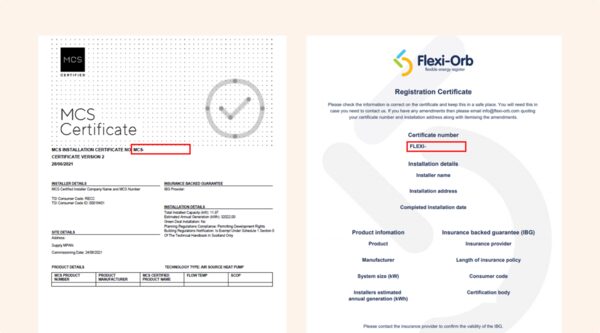
The schemes divide into three functions: technical standards, registration and redress. MCS sets and maintains technical standards, certifies installers and products, issues certificates for completed eligible installations, and assists certification bodies to review and address cases and consumer issues relating to installers or products10. It does not guarantee measured performance, and it does not require remediation of systems underperforming against their design19.
MCS will consider complaints about system performance and design, quality of work, incomplete installation, delayed installation, commissioning and handover, installer conduct, damage to property, mis-selling, contractual issues, issues with product, and breach of the customer commitment31. That is a broad list, and it is wider than most householders expect from a technical certification scheme.
Where an installer is not willing or able to install to a high standard in compliance with MCS requirements, the ultimate sanction of MCS is to withdraw the installer's MCS certification31. Withdrawal removes the installer's ability to work on funded schemes, which is the sanction that carries commercial weight.
Competent person schemes operate differently. Approved installers face ongoing inspections28. Installers who do not join a scheme, or who do not use one, can still use local council or private inspectors28. The scheme's leverage is the ability to remove self-certification rights, which forces the installer back through building control on every job.
TrustMark's role after a scheme closes is support rather than enforcement. It was nominated to directly support customers of the closed Energy Company Obligation scheme, and it maintains a three-stage complaints process with published eligibility criteria and time limits6. Its register has been corrected where installers failed: 22 installers were fully reinstated as of November 2025 after meeting the requirements of its six-point plan, including full remediation of the problems identified16.
Getting quotes and comparing installers before you sign
Official guidance on heat pumps recommends getting at least 3 installers to quote, so that costs and design can be compared4. The same advice appears in local authority guidance for solar, which directs householders to use the government-endorsed Microgeneration Certification Scheme to find certified installers and to get at least three quotes from reputable installers33.
Three quotes serve a purpose beyond price. They expose differences in design assumptions, in the measures proposed, and in which scheme the installer is registered under. A quote that cannot name the certification body, the consumer code and the guarantee provider is incomplete regardless of its total.
The verification steps that belong before signing are these:
- Confirm the register entry is current and covers the specific measure1.
- Confirm the installer is TrustMark registered where the work is funded, and will remain so until completion12.
- Confirm the consumer code membership, since MCS-certified installers working with consumers must be members of an approved code20.
- Ask for the insurance position in writing, and read the certificate rather than a summary.
- Ask what happens to the guarantee if the business stops trading, and get the answer in the contract.
- Check the company record and the trading address against the quote.
For funded work, the installer requirements are stricter and worth stating plainly. Under the Boiler Upgrade Scheme, installers working with consumers must be MCS-certified and members of a consumer code approved by the Secretary of State20. Under the Warm Homes Social Housing Fund, all installers are required to be TrustMark registered, or equivalent12. Under Green Homes Wales, the installer must be registered with TrustMark and the relevant body for the measure type, and must not be the borrower or immediate family13.
The comparison itself is covered in more detail in getting quotes for a home energy installation and comparing installation quotes, including what a quote must show and how performance estimates are presented.
Spotting the warning signs: cold calls, pressure selling and fake credentials

The warning signs cluster around contact that the household did not initiate and credentials that cannot be checked. Independent guidance on unexpected calls or visits about smart meter appointments is to make sure you ask for official ID34. The same rule applies to any unsolicited approach about energy work.
MCS does make contact, and householders should know the difference. MCS may contact you for a short, routine verification on behalf of Ofgem either via email or phone on 0333 103 8198, and property owners should aim to respond within seven days7. That is a verification of an installation already carried out, not a sales approach, and MCS does not sell warranties. General MCS enquiries go through 0333 103 81307.
The specific risks to watch for are these:
- A credential that cannot be found on the register it claims to belong to1.
- A certification body name that is not on the recognised list for the scheme22.
- A guarantee offered verbally with no document to follow29.
- Pressure to sign before the register entry has been checked.
- A company name on the quote that does not match the company record or the trading address.
- An approach about a scheme the household has not applied to.
Where an installer is no longer MCS certified or has stopped trading, MCS states that it can still review your complaint and let you know what options are available31. That is a genuine route, but it is a review rather than a remedy, and it is why the guarantee documents and the payment method matter. The escalation routes are set out in complaining about an installer and when your installer goes bust.
For the wider picture of how registration, notification and redress fit together across the UK, the pillar page is Home Energy Installers and Retailers. Scheme-specific detail sits in MCS certified installers, TrustMark registered businesses, NICEIC registration, NAPIT registration and competent person schemes.
Sources34 cited
- Use a competent person scheme, GOV.UK, 2026-09-17
- Building regulations: doors and windows, Welsh Government, 2026-09-17
- Do I need building regulations approval for electrical work, Planning Portal, 2026
- Heat pumps explained: experts answer your questions, GOV.UK, 2024-03-28
- Solid wall insulation installed under ECO4 and GBIS: statistical audit results, GOV.UK, 2026-09-17
- Written statement: support for householders impacted by closure of the Energy Company Obligation scheme, Welsh Government, 2026-03-13
- Boiler Upgrade Scheme guidance for property owners, Ofgem, 2026-04
- Approved Document P: electrical safety, Planning Portal, 2013-01
- ECO4 Flex and GBIS Flex information document, Ceredigion County Council, 2025-11
- Boiler Upgrade Scheme, Ofgem, 2026-09-17
- Energy Company Obligation scheme and home energy efficiency, Leeds City Council, 2026-09-20
- Warm Homes Social Housing Fund wave 3 scheme guidance addendum, GOV.UK, 2026-06
- Green Homes Wales loan standard terms and conditions, Development Bank of Wales, 2026-09-17
- ECO4 delivery guidance version 4.0, Ofgem, 2026-03
- Warm Homes Local Grant statistics: August 2026, GOV.UK, 2026
- Public Accounts Committee report on the Energy Company Obligation, UK Parliament, 2026-01-23
- Who to contact, Ofgem, 2026-09-17
- Planning permission: wind turbines, Welsh Government, 2026-09-17
- Carbon footprint report: heat pump transition, GOV.UK, 2026-05
- Boiler Upgrade Scheme guidance for installers, Ofgem, 2026-04
- What to do if you have poor quality wall insulation, GOV.UK, 2025-01-23
- Barcud Solar Panel Installation Scheme Specification, Sell2Wales, 2026-06-15
- Building regulations: renewables guidance, Bedford Borough Council, 2026-09-17
- Building regulations: electrics, Welsh Government, 2026-09-17
- Redeveloped MCS installer scheme: key changes and benefits, NICEIC, 2026-03-09
- PAS 2030 scheme, NICEIC, 2026-03-31
- MCS scheme, NAPIT, 2026-04
- Building regulations: competent person schemes, GOV.UK, 2026-09-17
- ECO4 Flex open, South Cambridgeshire District Council, 2026-09-17
- Warm Homes Local Grant, Surrey County Council, 2026-09-17
- Consumer complaints, MCS, 2026-09-07
- TrustMark complaints process, TrustMark, 2026-04-07
- Solar panels, London Borough of Hammersmith and Fulham, 2026-09-17
- Do I have to accept a smart meter, Which?, 2026-05-12
 Using an Installer in EnglandHow do you check an installer is registered to sign off their own work, and what happens if they are not?
 Installer ReviewsCheck whether an installer is signed up to a scheme like MCS or TrustMark before you trust their star rating.
 Finding an Insulation InstallerHow to find, verify and check an insulation, glazing or ventilation installer in the UK: the registration schemes, trade bodies and guarantee arrangements that cover the work, how to compare quotes, what a written specification should state, and how complaints and disputes are handled.
 Installer in Northern IrelandHow do you check an installer in Northern Ireland is properly registered, and who do you complain to if the work goes wrong?
 The Full Installers GuideHow do you find an installer you can trust, and what should you check before signing anything?
 Insulation StandardsHow do you know your insulation was fitted to a proper standard, and who backs the guarantee if the installer disappears?