

In this guide
The Microgeneration Certification Scheme is a certification scheme for microgeneration installation companies and products, aiming to ensure consistent standards and provide confidence to consumers1. The documents that carry that intention into practice are the MCS Product and Installation Standards, which define how small-scale renewable technologies, such as solar PV and heat pumps, are tested, designed and installed2. The Installation Standards in particular define how those technologies should be designed and installed using MCS certified products, and all installers must follow the strict criteria set out in them2.
There is no single document. Each technology has its own installation standard, with separate standards for planning and for the pre-sale information a customer receives. Solar PV work sits under MIS 3002, small wind turbines under MIS 3003, and domestic battery storage under the MCS battery installation standard cited in government scheme guidance as MCS 3012. Planning matters are handled by MCS 020, which legislation names down to the issue number. That last point matters more than it sounds: standards are amended, sometimes substantially, so the version in force at the date of the work defines what the installer was actually required to do.
The scale is large. There are over 2 million MCS certified installations across the UK, including over 34,000 across Northern Ireland4. MCS has set new rules under which every installer will have to operate by 31 March 20276, although the technical requirements are not changing from what the Installation Standards contain today.
What the Installation Standards are, and who owns them
The Product and Installation Standards are produced by MCS and owned by the MCS Foundation10. They set standards that allow for the certification of products, installers and their installations11, and MCS itself is described as a standards organisation that certifies low-carbon energy technology products, installers and their installations, providing a mark of quality, competence and compliance for customers12.
The Installation Standards do a narrower job than the scheme as a whole. They define how small-scale renewable technologies should be designed and installed using MCS certified products, and compliance with them helps to ensure installers adhere to industry-recognised safety practices and deliver quality installations for consumers2. Taken together with the product standards, they define and maintain quality, performance and consumer protection requirements for small-scale renewable energy technologies, covering products, installers and certification processes in the UK2.
That structure explains why a householder rarely reads one. The standards are technical documents aimed at the installing business: design calculation, commissioning, testing and handover are specified there, and the evidence that they were followed reaches the household as a certificate and a handover pack rather than as the standard itself. What the household can check is that the business holds certification for the technology being fitted, which is the subject covered on MCS certified installers, and that the paperwork described on your MCS certificate and handover pack arrives.

Which standard covers which technology
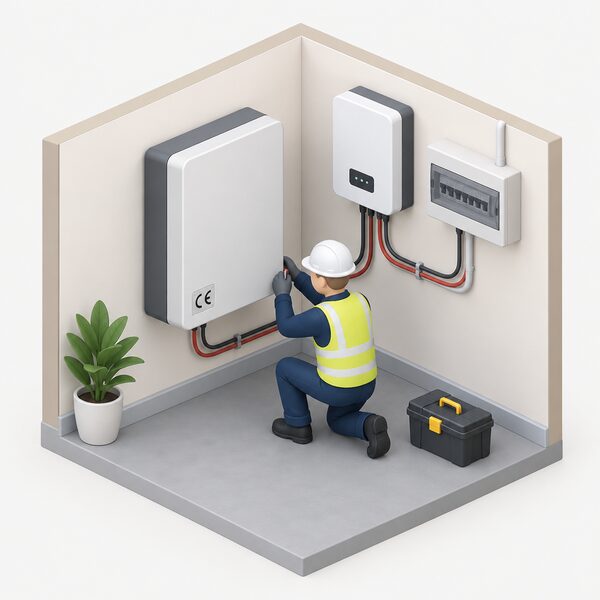
The table below names the standards identified in scheme rules, legislation and MCS publications, with the technology each governs.
| Standard | Technology or subject | What the sources record |
|---|---|---|
| MIS 3002 | Solar PV | An update requires written confirmation from the installer that the final installation is in accordance with the manufacturer's instructions, for installations covered by clause 5.5.513 |
| MIS 3003 | Small wind turbines | Version 4.0 published 6 December 202414 |
| MCS 033 | Published alongside the wind turbine standard update | Version 1.0 published 6 December 202414 |
| MCS 3012 | Battery storage | Domestic batteries must be installed by an MCS certified installer to the relevant MCS installation standard, and must carry UKCA or CE marking, which that standard requires15 |
| MCS 020 | Planning standards | Named in legislation as the product and installation standards specified in MCS 020, Issue 1.316 |
| MCS 034 | Biomass pre-sale information and system performance estimate | Consulted on as part of the simplification of MCS installation standards17 |
Battery storage is the newest of these: MCS introduced the battery storage installation standard at the end of 20219. A battery system fitted by a certified business will be designed and installed in accordance with MCS Standards, and certification is presented as ensuring installers work to the best possible quality while adhering to industry-recognised safety practices18. The same design-and-install formula applies to micro CHP and to other certified technologies19.
Issue numbers: why the version on the paperwork matters
MCS 020 is the clearest illustration. Scottish planning legislation defines "MCS Planning Standards" as the product and installation standards specified in MCS 020, Issue 1.37. A second account of the same legislative material cites MCS 020 without an issue number and limits it to air source heat pumps; that discrepancy is unresolved, and both readings are set out here rather than one being chosen. Either way, permitted development rights are tied to a named standard, so the standard is not merely a trade document: it carries statutory weight.
Standards also accumulate amendments. The wind turbine standard's own amendment history records a change to Consumer Code of Practice wording in February 2008, the addition of Gemserv as Licensee with references to BERR updated to DECC in December 2008, a quality review in January 2009, an updated MCS Mark in February 2009, additional contracting options added to clause 3.3, and the addition of metering requirements under section 4.4 and handover text on MCS Certificates and the MID in August 201020. Issue 3.0, dated 11 March 2011, was a substantial revision including windspeed adjustment for turbine height, an acoustic performance estimate, updated wind resource correction factors, a change to size limits, a dedicated fuseway change, commissioning, responsible siting guidelines and shadow and flicker guidance20. That standard also sets out underpinning knowledge areas for the installer, including mechanical engineering with an understanding of the static and dynamic stresses and loads involved with wind turbines20. Version 4.0 followed in December 202414.
For a household, the practical consequence is simple: a certificate issued in one year does not evidence compliance with a later issue of a standard, and a retrofit or alteration years later may fall under different requirements. The related questions are covered on can an MCS installation be certified retrospectively?.
The numbers behind the scheme
More than 1.7 million certified systems had gone into UK homes by December 2023 since MCS began recording installations21, and by August 2026 the figure was reported as over 2 million across the UK4. Northern Ireland accounts for over 34,000 of them5.
Battery installations are now tracked as a separate official series. The government publishes data monitoring the installation of domestic batteries recorded on the Microgeneration Certification Scheme, including capacity and cost statistics, first published on 29 May 202522. Those figures are published as official statistics in development, because they are a new statistics series and are still being developed22. The most recent dataset, dated 28 May 2026, covers retrofitting electric batteries into domestic properties in the United Kingdom and carries the same development status23.
The data exists because the standards require it to be captured at the point of certification. When registering an installation, installers are required to enter address and MPAN details, and in doing so they make a declaration that the information is accurate, true and adheres to MCS standards24. The MCS Data Dashboard then gives a real-time snapshot of certified installations and installers24. Certification is not universal, however, so these totals describe certified work rather than all microgeneration in UK homes.
What drives the standards: grants, licences and industry drafting
The standards are load-bearing because public money is attached to them. Under the Boiler Upgrade Scheme, installation must meet MCS standards approved by the Secretary of State25, all BUS installations must be carried out by MCS-certified installers26, and an installer must be MCS certified to deliver work under the scheme27. The MCS standards required by BUS are approved by the Secretary of State as set out under the BUS regulations28, which is what turns a voluntary industry document into a condition of grant funding. Ofgem's own account of the scheme lists the MCS roles as setting and maintaining technical standards for installations and products, certifying installers and products against those standards, issuing MCS certificates for completed eligible installations, and assisting certification bodies to review and address cases and consumer issues relating to installers or products29.
Other funded routes point the same way. Under ECO4 guidance, measures within the scope of MCS must be installed in accordance with the applicable MCS standard as well as PAS 2035, and for a product with an MCS installation standard, MCS product certification is mandatory30. Under the Warm Homes: Social Housing Fund, domestic batteries must be installed by an MCS certified installer to MCS 301215. The broader picture is set out on installer requirements for grants and funded schemes.
The drafting itself is not governmental. MCS states that its standards are written by industry, for industry, and that it maintains design and installation standards across the spectrum of technologies31. That is a strength in technical realism and a limit in independence: the same trade that must meet the standard helps to write it, and the checks that follow, rather than the drafting, are where independence has to come from.
How it differs across the four nations

MCS is a UK-wide scheme, and certified work is recorded in every nation: over 34,000 installations in Northern Ireland5, with the battery statistics covering the United Kingdom as a whole23. What differs is where certification is compulsory and how it plugs into each nation's planning and grant systems.
| Point of difference | What the sources record |
|---|---|
| Where certification is mandatory | Certification is only required for installations under the Boiler Upgrade Scheme and the Home Energy Scotland Grant32 |
| Planning in England | Full requirements for installations in England are found at the Planning Portal, and requirements in other countries may differ33 |
| Planning in Scotland | Legislation defines MCS Planning Standards as those specified in MCS 020, Issue 1.316, and provides that a turbine is to be installed in accordance with MCS planning standards applicable to domestic wind turbines or an equivalent standard34 |
| Historic Feed-in Tariff rules | Eligible installations within Great Britain had to be either MCS-certified (or equivalent) or ROO-FIT accredited35 |
The Boiler Upgrade Scheme operates in England and Wales, while the Home Energy Scotland Grant is the Scottish route; Northern Ireland households sit outside both, which is why certification there is driven by consumer confidence and product eligibility rather than by grant conditions. Nation-specific detail on notification and redress is set out on using an installer in Scotland, using an installer in Wales and using an installer in Northern Ireland.
The rules a certified installer works under
Certification is more than a technical test. Under the MCS Installer Standards, certification means a business has the ability and expertise to fit, test and commission an energy generator or battery storage unit, in compliance with ISO 1706536. MCS certified installers must follow the Customer Commitment and all relevant MCS Standards, with MCS regularly checking compliance, financial stability, resourcing and customer protection37. The scheme is also described as ensuring that installers adhere to a strict code of conduct38.
"MCS certified Installers must follow this Customer Commitment and all relevant MCS Standards."
A programme of change is under way. MCS has set new rules under which every installer will have to operate by 31 March 2027, including a legally binding commitment to adhere to consumer protection law6. The installation standards have been restructured and streamlined to be more focussed as "technical truths", and the technical requirements are not changing from what is contained in the MCS Installation Standards today40. Separately, the standards are being simplified17, and MCS is strengthening post-installation checks41. The direction is described by installers as a fundamental shift for the sector intended to drive quality, consumer protection and confidence in home-grown energy42.
The onward routes if the work is defective are covered on complaining about an installer, and the code that sits alongside MCS for many firms is described on the Renewable Energy Consumer Code.
What the standards do, and do not, do for energy independence
The standards govern the quality of the kit that makes a home less dependent on bought-in energy. MCS certifies products, installers and their installations as a mark of quality, competence and compliance12, and the Product and Installation Standards are presented as an industry-recognised benchmark for quality, giving everyone confidence in home-grown energy2. A battery, a solar array or a heat pump installed to those standards is more likely to work as designed, and that is the foundation of any self-supply.
They do not, however, guarantee output. MCS requires installers to provide a design-stage prediction of system efficiency, not verify actual performance43. A householder reading a quote is therefore reading a modelled figure, not a measurement, a point developed on performance estimates and savings claims.
There are scope limits too. Product certification applies up to 50kW for electrical technologies8, and schemes historically defined an MCS-FIT installation as solar PV or wind with a declared net capacity of 50kW or less44. Licence conditions required installations of 50 kilowatts or less generating from combined heat and power, solar photovoltaic or wind to be certified under MCS or an equivalent scheme and installed by an MCS or equivalent installer45. Eligibility deadlines have also bitten in the past: installations up to and including 50kW without preliminary accreditation or pre-registration, with an MCS certificate issue date on or before 31 March 2019, had to apply on or before 31 March 202046.
The dependencies that remain are worth naming plainly. A certified installation still leaves a household reliant on the grid connection and an electricity supplier, on a manufacturer for parts and product warranties, on the continued existence of the certifying body and its certification bodies, and on whichever grant scheme the certification requirement was attached to. MCS itself is an independent certification scheme for microgeneration installation companies and products29, not a guarantor of supply or of savings. What it does provide is a documented, checkable record that the work met a named standard at a named issue, which is what makes an installation transferable on sale, insurable, and arguable when it goes wrong. For new build, the MCS Foundation's position is that housebuilders should ensure every installation is delivered by an MCS certified installer, to MCS standards47.

Sources47 cited
- MCS: who to contact, domestic RHI guidance, Ofgem, 2026-09-17
- MCS Standards, MCS, 2026-06-17
- Why MCS certification matters, MCS, 2026-08-17
- Tomlinson Longstaff: powering the rooftop revolution, MCS, 2026-08-20
- Surging renewables forward in Northern Ireland, MCS, 2024-11-08
- Low Carbon Landscape 2026, MCS, 2026-09-17
- Town and Country Planning order, 2024 revision, legislation.gov.uk, 2026-09-17
- Certifying your product, MCS, 2026-05-18
- UK on track for best year ever for renewable energy and heat installations, MCS, 2023-08-14
- Scheme governance, MCS, 2026-07-06
- The brains behind MCS standards and their development, MCS, 2024-10-21
- Home energy efficiency key terms explained, Development Bank of Wales, 2024-10-17
- MCS publishes update to MIS 3002, MCS, 2026-03-18
- MCS publishes updates to small wind turbine standards, MCS, 2024-12-06
- Warm Homes: Social Housing Fund wave 3 guidance addendum, GOV.UK, 2026-06
- The Town and Country Planning (Scotland) Amendment Order 2024, legislation.gov.uk, 2024-05-24
- Consultation: MCS 034 biomass pre-sale information, MCS, 2023-12-11
- Battery storage for consumers, MCS, 2026-09-17
- Micro CHP for consumers, MCS, 2026-08-17
- MIS 3003 Issue 3.0: installer requirements for wind turbines, MCS, 2011-03-11
- UK sees best year ever for renewable energy and heating installation, MCS, 2023-12-13
- MCS certified domestic battery installation statistics, GOV.UK, 2025-05-29
- MCS domestic retrofit battery installations 2025 to 2026, GOV.UK, 2026-05-28
- MCS certificates: why data matters, MCS, 2025-03-11
- Boiler Upgrade Scheme guidance for installers, version 5, Ofgem, 2026-04-28
- Boiler Upgrade Scheme guidance for property owners, version 5, Ofgem, 2026-04-28
- Boiler Upgrade Scheme for installers, MCS, 2026-07-21
- Boiler Upgrade Scheme product eligibility, Ofgem, 2023-03-28
- Boiler Upgrade Scheme, Ofgem, 2026-09-17
- ECO4 guidance: new measures and products, Ofgem, 2022-07-04
- MCS responds to DESNZ consultation on the Clean Heat Market Mechanism, MCS, 2025-07-07
- How can I find a trustworthy installer, Nesta, 2025-01-21
- MCS 020 Planning Standards, MCS, 2015-05-01
- Policy note to the 2024 Scottish planning amendment order, legislation.gov.uk, 2024-03
- Feed-in Tariff guidance for suppliers, version 14, Ofgem, 2021-08
- RECC consumer code, RECC, 2026-07-01
- MCS Customer Commitment, issue 1.0, MCS, 2025-01
- Solar panels: energy improvement options, London Borough of Hammersmith and Fulham, 2026-09-17
- Record number of UK households combining renewables, MCS, 2026-08-20
- Update on the redevelopment of MCS, MCS, 2024-11-27
- Making heat pumps mainstream in the UK, Low Carbon Hub, 2025-09-18
- Stron Renewables: the next generation of heat pump installers, MCS, 2026-08-20
- Climate and Finance Partnership report on the heat pump transition, GOV.UK, 2026-05
- Feed-in Tariffs: key terms explained, Ofgem, 2026-09-17
- Draft licence conditions, GOV.UK, 2026-09-17
- Feed-in Tariff guide to closure, Ofgem, 2020
- Future Homes campaign, MCS Foundation, 2026-09-20
 MCS ExplainedMCS is the quality mark for solar panels, heat pumps and other home renewables.
 MCS CertificationWhy do so many installers and tariff schemes ask about MCS certification when you get solar panels?
 Installer QualificationsWhat training and qualifications should a heat pump installer actually have?
 MCS Installation StatisticsHow many homes have had solar panels, heat pumps or batteries fitted by certified installers, and is that number still rising?
 Certification and ApprovalsWhich certificates actually matter when you are choosing solar panels or a heat pump?
 Installation StandardsWhich rules must an installer follow when fitting a home battery?