
In this guide
A fixed price boiler installation online is a price agreed from a questionnaire, before anyone has stood in your kitchen. The seller asks what fuel you use, what kind of boiler you have now, how many bedrooms and bathrooms the house has, and where the flue leaves the wall. From those answers it produces a total that covers the boiler and the fitting, and that total is what appears on the order.
The figures that come back sit in a wide band. Independent guidance puts a conventional boiler at £1,600 to £5,000 including installation, and a system boiler at £1,580 to £5,0001. Labour alone is quoted at £1,000 to £2,000, with more complex jobs such as upgrading from a conventional to a combi system or relocating the boiler at £3,000 to £5,0002. The spread is not noise: it reflects how much of the job is a straight swap and how much is new pipework, a new flue route and a cylinder coming out.
What the online route buys is certainty about the headline number and speed in getting it. What it does not buy is a survey before you commit. The assessment still happens, usually on the day, and it is the point at which the price can move. Understanding which conditions move it, and which certificates and notifications follow the work, is what separates a fixed price that holds from one that grows.
What a fixed-price online quote actually is
A fixed price is a total agreed for a defined scope of work, not a daily rate. Consumer guidance on what a quote should contain is specific: a fixed total price rather than a daily rate, a breakdown of all the work to be done and the materials, separate costs for each material and each part of the work, how long the price is valid for, whether the price includes VAT, and the circumstances in which the price can go up6. An online fixed price that arrives as a single number without those elements is a headline, not a quote.
The word "fixed" is used loosely across the energy market and it is worth separating the senses. A fixed-rate energy tariff sets the price you pay per unit for a period, usually between one and three years, and the rate cannot be changed by the supplier before the plan's end date7. Even there, the guarantee is on the unit price, not on the bill: your unit price is fixed, not your energy bill7. A fixed-price installation is a different thing again, a price for a piece of work rather than a rate for a supply.
What makes the online version distinctive is the sequence. The price is produced before any visit, from the householder's own description of the property. That is workable because most boiler replacements are like-for-like swaps in the same position, using the same flue and the same pipework. It becomes unreliable exactly where the job stops being like-for-like, which is why the conditions in the next sections matter more than the headline figure.
For a household's energy independence, a fixed price changes nothing about where the heat comes from. The gas still arrives through the grid, the boiler still depends on a supplier and on mains pressure, and the warranty depends on a manufacturer's company remaining solvent. What the fixed price does is remove one source of uncertainty, the cost of the work, from a decision that is otherwise about fuel and equipment.
How quote-without-a-survey selling works, step by step

The process is short and largely automated, and the same shape applies to boilers and to heat pumps.
- You answer an online questionnaire: fuel type, current boiler type, property size, number of bedrooms and bathrooms, and where the flue exits.
- The seller returns a fixed price for a defined package, usually with a choice of boiler models at different points in the range.
- You place the order, often with a deposit, and a date is set.
- An engineer attends, assesses the property and confirms or amends the scope.
- The installation is carried out and commissioned.
- Certificates and notifications follow, and the manufacturer's warranty is registered.
The grant-funded version of this route is well documented, because the Boiler Upgrade Scheme runs through installers rather than through households. Installers carry out a simple application procedure on behalf of property owners, with the up-front funding taken off their quote9. The grant is applied upfront as a discount to the cost of your installation; you do not receive the grant directly, it is paid to your installer5. Payments to installers are usually made within five working days of approval10.
Householders who have been through it describe the administrative side as lighter than expected. One case study records the experience as "Much easier than I thought it would be. I thought that it was going to be very bureaucratic and very lengthy."11. The same account describes the installer sending a link to the scheme website for verification, and the process running smoothly over a couple of emails11.
The independence question here is about who holds the money and the paperwork. On the grant route the installer holds both, and the household's protection comes from the scheme rules and the installer's certification rather than from a direct relationship with the funding body.
What a fixed price typically covers: £1,500 to £5,000 including the boiler and fitting
The band that most online quotes fall into covers the boiler itself, the labour to fit it, and the standard sundries: flue, filter, controls where specified, and commissioning. Independent pricing puts a conventional boiler at £1,600 to £5,000 including installation and a system boiler at £1,580 to £5,0001. Labour is separately estimated at £1,000 to £2,0002.
| Item | Typical figure | Notes |
|---|---|---|
| Conventional boiler, installed | £1,600 to £5,000 | Includes the boiler and fitting1 |
| System boiler, installed | £1,580 to £5,000 | Includes a cylinder in the scope1 |
| Labour only | £1,000 to £2,000 | The fitting element of the job2 |
| Conversion to combi or relocation | £3,000 to £5,000 | More complex jobs2 |
VAT treatment matters to the total. On heat pump installations supported through the grant route, consumers can receive a zero VAT rate on installations13. For gas boiler work the VAT position is not stated in the same terms, and a quote should say whether the price includes VAT, which is one of the items consumer guidance expects a quote to state6.
What a fixed price is really buying is a defined scope. The number is only as firm as the list of work behind it. A quote that names the boiler model, the flue, the controls and the making good, and states how long the price is valid for and when it can go up, is doing the job properly6. A quote that gives a single figure and a model name is not.
What makes the price move: conversion, relocation, flue position and where you live
Four conditions account for most of the movement between the online figure and the final invoice.
Conversion. Moving from a conventional or system boiler to a combi removes the cylinder and the tanks, and reroutes the pipework. More complex jobs, such as upgrading from a conventional to a combi system, could cost between £3,000 and £5,0002.
Relocation. Putting the boiler somewhere else is priced in the same bracket, between £3,000 and £5,000 for relocating the boiler2. Moving a combi to a different location can take one to two days depending on how far it is moved3.
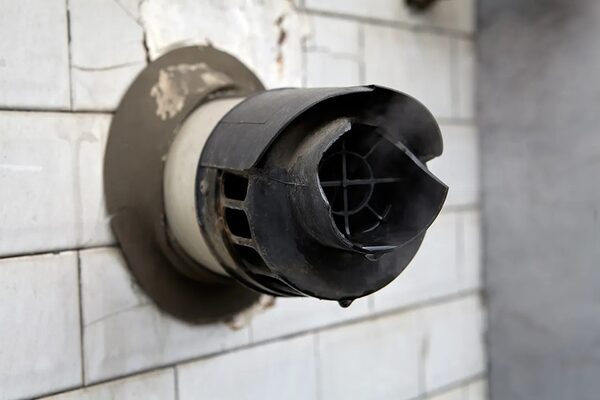
Flue position. The flue route governs where the boiler can go and what the installation involves. Installers must follow the guidelines set out in Approved Document J, which shows what is necessary for air supplies, hearths, flue linings and chimney labelling where the flue outlet can be positioned7.
Where you live. The four nations differ in how the work is notified and regulated. In Wales, building regulations for boilers and heating are published separately by the Welsh Government8, and electrical work has its own Welsh guidance14. Northern Ireland's scheme landscape is set out separately again15. These differences affect the paperwork and the notification route more than the headline price, but they are part of what a fixed price has to cover.
Why a home assessment and heat loss survey still matter before you commit
The assessment is not a formality, and it is where the fixed price meets the building. Even on a straightforward controls upgrade, the engineer will still need to check if your boiler is compatible, and you will have to pay to have it fitted16. The same logic applies to the boiler itself: compatibility with existing pipework, the cylinder, the controls and the flue is a physical question.
Heat loss matters because it sets the size of the appliance. A boiler that is undersized for the property will not heat it adequately, and one that is oversized cycles inefficiently. The assessment is also where the installer checks the things a questionnaire cannot capture: the condition of the roof space if a route runs through it, the position of the condensate discharge, and whether the existing gas supply is adequate.
The flow temperature setting is a related point that affects running costs rather than the installation price. How much you save from adjusting it will depend on several factors including what your boiler was set to before you made the change, whether your home was too warm before, and how much you are prepared to experiment with your boiler's flow temperature16. None of that is visible from a questionnaire.
For a household, the assessment is the moment when the fixed price becomes a real scope. It is also the moment to check the installer's registration, because the person who assesses the property is usually the person who does the work.
Installation day: one to three days depending on the job
Fitting times vary more than the headline prices suggest, and the variation follows the type of job rather than the brand.
| Job type | Fitting time |
|---|---|
| Like-for-like combi replacement | Around 4 to 6 hours3 |
| Combi replacement, upper end | Up to six hours3 |
| Conversion from system or conventional to combi | Up to two days3 |
| System boiler installation | 2 to 3 days3 |
| Conventional boiler installation | 1 to 3 days3 |
| Conventional to system boiler | 2 to 3 days3 |
| Combi relocation | 1 to 2 days3 |
| Biomass boiler | Around 2 to 3 days3 |
Across all types, installation can take anywhere from 4 to 6 hours to 3 to 4 days, depending on whether the work is a like-for-like replacement or a switch to a new type of boiler or heating system3. A new boiler with new pipework around the house, removal of floorboards and other system upgrades can take a few days depending on property size3.
Access is part of the arrangement. The engineer needs access to the boiler, radiators and possibly the loft while the work is happening3. That access requirement is what makes the assessment and the installation day the same visit in many online sales.
Who can legally do the work: Gas Safe registration, notification and certification

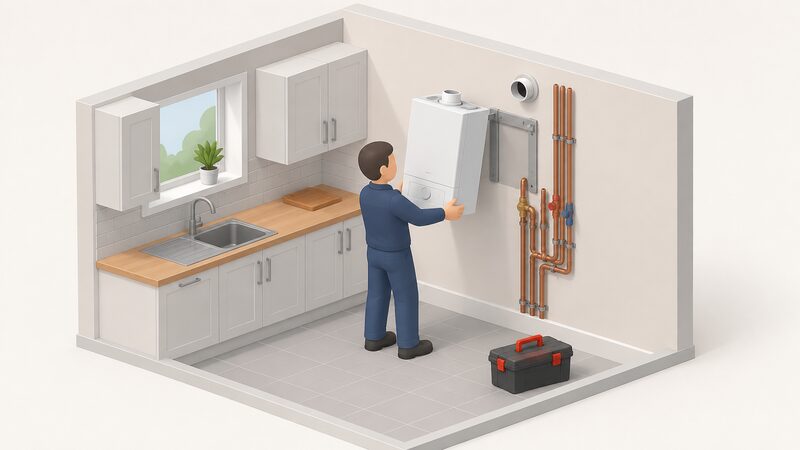
Only Gas Safe-registered engineers are legally allowed to install boilers3. For gas boilers, the registration to check is the Gas Safe Register4. As a bare minimum, the engineer should be Gas Safe registered, and reviews should be checked online before hiring a trader17.
Notification depends on the installer's scheme membership. If the installer is registered with a relevant Competent Person Scheme, a building control body does not need to be notified for certain services or fittings, including fuel-burning appliances18. If the installer is not in an approved Competent Person scheme, the firm or the householder will need to give notice to the local authority of the intention to carry out the boiler work in advance8. Where the installer cannot self-certify, the firm or the householder must give notice to the local authority in advance and pay a notification fee7.
Certification follows the work. When works have been completed, the installer should produce a commissioning certificate such as a Benchmark certificate and notify the local authority building control department either directly, or, if a member of a Competent Person Scheme, via the scheme operator8. The local authority should supply a building regulations completion certificate7. Where electrical work forms part of the job, the competent person should also provide a completed Electrical Installation Certificate showing that the work was tested for safety14.
Solid fuel fired boiler installation has its own requirement: the installer should be registered with one of the relevant Competent Person Schemes7. On the grant route for heat pumps, the installer must be certified by the Microgeneration Certification Scheme19.
"When works have been completed the installer should then produce for you a commissioning certificate such as a Benchmark certificate and notify the local authority building control department either directly, or, if a member of a Competent Person Scheme, via the scheme operator."
Fixed price or three quotes: how the two buying routes compare
The two routes answer different questions. A fixed online price answers "what will this cost me, roughly, and how soon can it be done". Three quotes answer "what does this job actually involve, and who is treating it seriously".
Independent guidance is to get at least three quotes from qualified heating engineers4. That advice exists because the same property can produce materially different scopes: one quote includes a filter, another does not; one allows for a new flue, another assumes the existing one; one prices the making good, another leaves it. Comparing quotes is how those differences surface before the work starts rather than after.
The fixed-price route has real advantages. It is fast, it is transparent about the headline number, and on the grant-funded version the administration is handled by the installer, with the funding taken off the quote9. Householders report the process as smoother than expected11. The trade-off is that the price is built on your description of the property, and the assessment is where that description is tested.
| Online fixed price | Three quotes | |
|---|---|---|
| When the price is set | Before any visit6 | After each installer has seen the property |
| Basis | Your answers to a questionnaire | Each installer's own assessment |
| Speed | Immediate | Days to weeks |
| Scope detail | Varies by seller | Comparable across quotes |
| Grant handling | Installer applies, discount taken off the quote9 | Installer applies |
| Main risk | Price moves at assessment | Slower, more visits |
A household that wants both can use the online figure as a benchmark and still take two further quotes. The comparison is only meaningful if each quote states the same items: a fixed total price, a breakdown of work and materials, separate costs, validity period, VAT position, and when the price can go up6.
What a fixed-price quote does not cover, and where extra charges appear

The exclusions are where the final invoice diverges from the online figure, and they are consistent enough to list.
- Conversion from a conventional or system boiler to a combi. Priced as a more complex job, between £3,000 and £5,0002.
- Relocating the boiler. Also in the £3,000 to £5,000 bracket2, and taking one to two days for a combi depending on distance3.
- New pipework, floorboard removal and system upgrades. These can take a few days depending on property size3.
- Making good and decoration after the flue and pipework are run.
- Controls beyond the standard set. The requirement for a full set of heating controls in the property following a boiler installation was removed under ECO4 delivery guidance version 3.020, so what is included is a matter for the quote rather than a scheme rule.
- Condensate routing. An external condensate pipe carries a freezing risk: freezing can occur if the temperature outside drops below freezing, causing the boiler to stop working or display an error21.
- Ongoing cover. Boiler cover is sold separately, and one plan is priced at a £10 monthly fee plus £100 excess22.
The independence picture is unchanged by any of this. A fixed price buys certainty about the cost of one piece of work. It does not change the fact that the boiler runs on gas from the grid, that the warranty rests with a manufacturer, or that the household remains dependent on a supplier and on mains pressure. What it does is remove the cost uncertainty from a decision that a household will live with for a decade or more.
Sources22 cited
- New boiler prices, Uswitch, 2025-03-21
- Boiler replacement, Fuse Energy, 2026-05-06
- How long does it take to fit a boiler?, Uswitch, 2026-09-16
- Upgrading and replacing your boiler, Centre for Sustainable Energy, 2026-06
- Boiler Upgrade Scheme guidance for property owners, Ofgem, 2026-04-28
- Before you get building work done, Citizens Advice, 2026-09-20
- Building regulations: boilers and heating, Planning Portal, 2026
- Building regulations: boilers and heating, Welsh Government, 2026-09-17
- Ditching costly gas and oil is cheaper thanks to heat pump scheme, GOV.UK, 2022-05-23
- Boiler Upgrade Scheme guidance for installers, Ofgem, 2026-04-28
- Matthew Bell OBE heat pump case study, Energy Saving Trust, 2026-04-28
- Boiler Upgrade Scheme guidance for property owners v5.1, Ofgem, 2026-07
- Varied heat pump grants to improve access to low carbon heating, EPVS, 2023-08-31
- Building regulations: electrics, Welsh Government, 2026-09-17
- NISEP list of schemes 2026-27, Utility Regulator Northern Ireland, 2026-04
- Should I turn my boiler's flow temperature down?, Energy Saving Trust, 2026-05-20
- What to do if your boiler breaks down at Christmas, Which?, 2025-12-12
- Approved Document L, Volume 1: Dwellings, HM Government, 2021
- Boiler Upgrade Scheme, GOV.UK, 2026-09-18
- ECO4 delivery guidance v3.2, Ofgem, 2025-08-07
- Boiler maintenance, Uswitch, 2026-09-03
- HomeServe boiler cover, Uswitch, 2026-09-17
 Getting Installation QuotesHow householders obtain quotes for boilers, heat pumps and solar PV, how many quotes are usually recommended, what a survey should involve, and the difference between an estimate, a quotation and a fixed price.
 Fixed-Rate Energy TariffsWhat a fixed energy tariff fixes and what it does not, the contract lengths sold in the UK, exit fees and the 49-day window, how fixed rates compare with the price cap, and what happens when the term ends.
 Fixed and Variable TariffsCompares capped standard variable tariffs with fixed deals, including exit fees, contract end and rollover.
 How Tracker Tariffs WorkTracker tariffs move your unit rate with wholesale prices or the Ofgem price cap, so what you pay can change daily.
 Free Solar Panels vs Rent-a-RoofOffers of free panels usually mean a company owns the system and keeps the generation income or charges a monthly fee.
 Direct Debit and CreditExplains how fixed monthly direct debits are set and reviewed, why balances build over the year, and the rules on refunding credit.