

In this guide
Northern Ireland runs its own building control system, and that single fact changes how a householder there finds, checks and complains about an installer. Building regulations set standards for the design and construction of buildings to ensure the safety and health for people in or around those buildings, and they also include requirements to ensure that fuel and power is conserved1. Where work does not follow them, the consequence is stated plainly: "You may have to correct the work or pay a fine if building regulations are not followed"2. That is a notification and inspection model, not the self-certification model that operates across England and Wales.
The quality marks that matter are UK-wide rather than regional. MCS is "a certification scheme for microgeneration installation companies and products" that aims to ensure consistent standards and give consumers confidence1, and TrustMark is "a government endorsed quality scheme"2. Both directories work in Northern Ireland, and both carry complaint routes with published time limits.
The figures a householder needs before signing anything are few but firm. MCS certified installations carry a complaint window of no more than two years after the date the system was commissioned3, and official guidance on heat pumps recommends getting at least three installers to quote so that costs and design can be compared4.
How Northern Ireland differs from the rest of the UK
The divergence is structural rather than cosmetic. In England and Wales, electrical work in a home or garden is governed by rules that allow an installer registered with a competent person scheme to self-certify, and the Building Regulations there "only set standards for electrical installation work in relation to dwellings (houses, flats etc"8. Northern Ireland does not operate that self-certification route in the same way, so the householder's relationship with the local council is more direct.
The grid connection rules are also separate. For small-scale generation, "in Northern Ireland, connection requirements are governed by the Electricity Safety, Quality and Continuity Regulations (Northern Ireland) 2012 and the Engineering Recommendation G98/NI"9, and the connection requirements are "set out separately by Engineering Recommendation G98/NI"10. A householder in Northern Ireland therefore deals with a distinct technical regime for connecting generation, on top of a distinct building control regime.
What does not differ is the certification landscape for renewables. MCS operates across the UK, and TrustMark registration is written into scheme rules that apply to funded work. The Warm Home Discount (England and Wales) Regulations 2026 require that a boiler or central heating system "is installed by, or under the responsibility of, a person who is registered with Tr"ustMark, with a certificate of lodgement issued by the TrustMark operator11. That instrument is named for England and Wales, so a Northern Ireland householder should not assume its terms apply locally.
For a household's energy independence, the practical effect is this: the installer relationship is the main protection, because the statutory notification route runs through the council rather than through an installer's own certificate. The dependence that remains is on the council's inspection capacity, on the certification body behind the installer, and on the grid connection rules that govern whether generation can be connected at all.
What the rules cover: new work, extensions and services
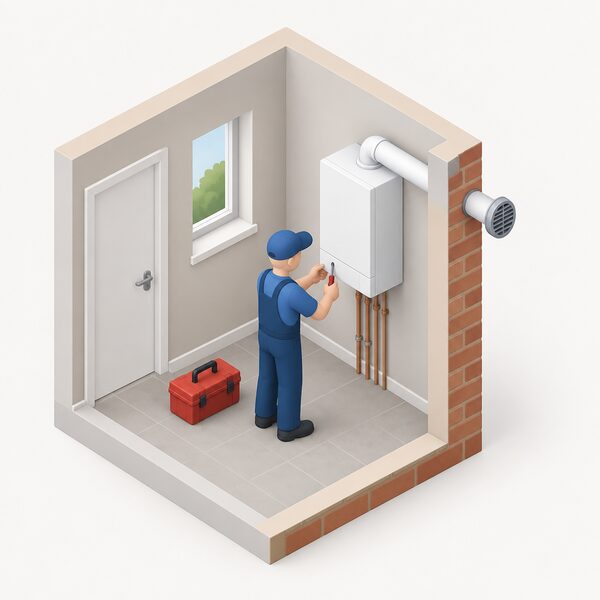
The Building Regulations apply to a defined list of projects. They bite if you want to "Put up a new building; Extend or alter an existing one; Provide services and/or fittings in a building such as washing and sanitary facilities, hot water cylinders, foul water and rainwater drainage, replacement windows, and fuel burning appliances of any type"12. The definition of building work sits in regulation 3 of the building regulations, and the categories include the erection or extension of a building, the installation or extension of a controlled service or fitting, alterations affecting ongoing compliance on structure, fire or access, cavity wall insulation, underpinning, and work affecting thermal elements or energy performance12.
In Northern Ireland specifically, the parts that apply to the provision of any service and fitting are set out in legislation: "Part F (Conservation of fuel and power)" sits alongside Part B on materials and workmanship, Part E on fire safety, Part K on ventilation, Part L on combustion appliances and fuel storage, Part N on drainage, and Part P on sanitary appliances, unvented hot water storage systems and reducing the risk of scalding13. That list matters because it tells a householder which technical areas an installer is working within, and which parts a council inspector will be checking against.
Extensions bring electrics into scope. Guidance on building regulations for extensions lists "Electrics" among the work sections covered3. Replacement glazing carries its own condition: "the provision of replacement double-glazing must not make compliance worse in relation to means of escape, air supply for combustion appliances and their flues and ventilation for health"12.
Some projects are exempt. "Some kinds of building projects are exempt from the regulations"12, and certain changes of use of an existing building may bring the regulations into play12. For a householder planning a heat pump, a battery, a stove or a full rewire, the question is not whether standards exist but which route proves compliance: council notification and inspection, or an installer's scheme membership where a scheme is recognised.
When approval or notification is needed, and when it is not
The default in Northern Ireland is notification. Building regulations set standards for the design and construction of buildings to ensure the safety and health for people in or around those buildings, and they also include requirements to ensure that fuel and power is conserved1. Where work does not follow them, "You may have to correct the work or pay a fine if building regulations are not followed"2. That is the baseline against which exemptions sit.
The Building Regulations (Northern Ireland) 2012 carve out a set of works where notices and deposit of plans are not required. These include "the replacement of windows or external doors of a dwelling"14, replacement of a combustion appliance under Part L with no structural alteration, replacement of a fitting under Part N or P except regulation 88, provision of carbon monoxide detection devices in a dwelling, replacement of parts of an existing fixed building service except a flue, provision of an output device such as an energy meter or a control device, certain self-contained fixed building services, and fixed internal lighting serving not more than 100 m2 of floor area in an existing building14.
The exemption is procedural, not substantive. The regulations state that "the work of replacement or provision shall in all respects meet any relevant requirements of these regulations"13. So a householder replacing a boiler or a window without a notice still has to end up with compliant work, and the absence of a council visit is not evidence that the work was right.
Where an installer is not in an approved competent person scheme, the notification route opens up explicitly: "In this case the installer will not be able to self-certify that their work is compliant"15, and "the firm or the householder will need to give notice to your Local Authority of the intention to carry out the boile"r work in advance, and "pay a notification fee"16. Fees are not published as a single national figure; guidance on stove installation in Northern Ireland states that "The fee is dependent on the extent and value of the task being undertaken"17.
Who is responsible if the work does not comply

Responsibility sits in two places at once, and householders tend to discover this late. The owner of the building is ultimately the person who may be served with an enforcement notice if the work does not comply with the regulations12. That confirmation is worth having in writing, because the enforcement route does not depend on who swung the hammer.
Installers carry their own duties. Competent Person Scheme members "should both notify the local authority of the work and issue you a certificate of compliance with Building Regulations e"ither directly or through their scheme operator18. Where an installer is not registered with such a scheme, a building regulations certificate must be provided within 30 days of completion19. In England and Wales, the installation contractor has a responsibility to ensure the work complies with building regulations, and the energy device owner may also have a responsibility and could be served with an enforcement notice in cases of non-compliance19; the same principle of dual exposure runs through the Northern Ireland enforcement model.
There is a separate electrical safety layer. Under Article 27 of the Electricity Safety, Quality and Continuity Regulations (Northern Ireland) 2012, a distributor may issue a notice in writing requiring remedial works where it is not satisfied that a connected or proposed connection is constructed, installed, protected, used or arranged for use to prevent, so far as is reasonably practicable, danger or interference20. That power reaches a consumer's installation, another distributor's network or a street electrical fixture20.
For a household, the independence point is blunt: the certificate trail is the asset. A certificate of compliance, a building regulations certificate, and an MCS certificate are what a future buyer, insurer or grant administrator will ask for, and they are what a householder has to fall back on if the installer is gone.
MCS certification: the quality mark for renewables, UK-wide
MCS is "a mark of quality which demonstrates adherence to industry-recognised standards for renewable products, contractors and their installations"4. It is a certification scheme for microgeneration installation companies and products, aiming to ensure consistent standards and provide confidence to consumers1. It is the government-endorsed route for finding certified installers, and official guidance directs householders to use it and to get at least three quotes from reputable installers21.
The mark is a starting point, not a guarantee of outcome. MCS "requires installers to provide a design-stage prediction of system efficiency, not verify actual performance"22, and it "does not require remediation of systems that are underperforming relative to their design"22. That is a material limit for anyone buying a heat pump on a modelled efficiency figure: the certification covers the design process and the installation standard, not the delivered result.
Certification bodies matter for funded work. One published scheme specification requires installers to carry a current and valid MCS Certificate issued by Certsure LLP t/a NICEIC, Napit Certification Ltd, Simply Certification, The IAA, or Amtivo Group t/a British Assessment Bureau5. The same specification requires that the existing electrical installation within the dwelling be assessed by an NICEIC certified electrician5, and that the installation be registered on the MCS Installation Database no later than 10 working days after commissioning, with an MCS Certificate generated5.
MCS also runs post-installation checks. Property owners contacted for MCS checks "should aim to respond within seven days"6, and MCS may make contact for a short, routine verification on behalf of Ofgem either by email or by phone on 0333 103 81987. MCS itself can be reached at mcscertified.com or on 0333 103 81306.
"MCS is a certification scheme for microgeneration installation companies and products. It aims to ensure consistent stan"
TrustMark: the Government Endorsed Quality Scheme
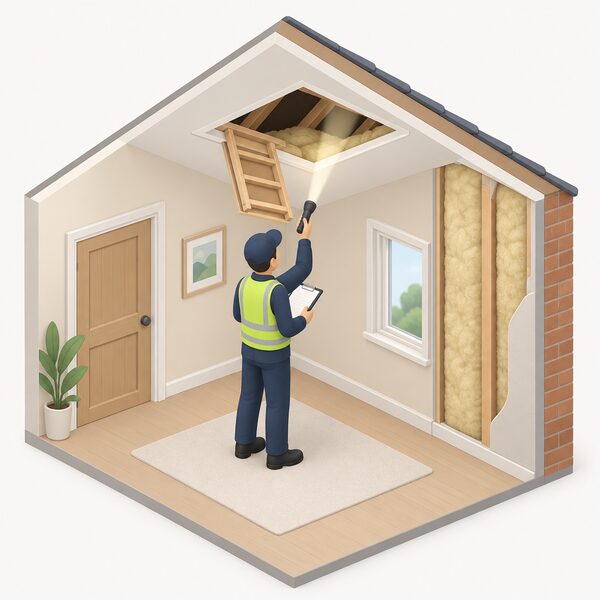
TrustMark is "a government endorsed quality scheme"2, and it functions as a competent person register for finding an installer that will assess your circumstances and property to identify suitable measures23. Its reach into funded work is written into scheme rules rather than left to choice.
On the Energy Company Obligation, "Trustmark accredited private installers will carry out the installation work"24. On the Green Homes Grant Voucher Scheme, "In order to be eligible as an installer for the scheme, tradespeople must be registered with TrustMark, which has a robu"st registration process25. Under the Warm Home Discount (England and Wales) Regulations 2026, a boiler or central heating system must be "installed by, or under the responsibility of, a person who is registered with Tr"ustMark, with a certificate of lodgement issued by the TrustMark operator11. In Ofgem's ECO4 delivery guidance, measures "should be installed by or under the responsibility of a TrustMark registered installer and have a relevant certificate o"f lodgement18.
The pattern is consistent: TrustMark registration is a condition of eligibility on publicly funded work, and the certificate of lodgement is the evidence that the condition was met. For a Northern Ireland householder, the caveat is that several of these instruments are named for England and Wales, so the applicable scheme rules for a locally funded project should be checked against that project's own terms.
TrustMark's complaints process is a three stage route, and its guidance page on that process, including dispute resolution eligibility criteria and time limits, was updated on 7 April 202623. That structure is what makes registration worth something after the work is done: a registered business has a route above it.
Finding and checking an installer: MCS Find an Installer and TrustMark directories
The checking process is short and worth doing before any deposit moves. Official guidance points to the Microgeneration Certification Scheme's find an installer tool to look for certified installers near you21, and to a competent person register such as TrustMark, the government-endorsed scheme for work done around you, for finding an installer that will assess your circumstances and property to identify suitable measures22.
For electrical work, the recommendation is to "hire an installer who is registered with a competent person scheme (a registered competent person') who can self-certify that the work meets the required standards"26. Where a scheme member is used, the installer notifies the local authority and issues a certificate of compliance either directly or through the scheme operator18.
| What to check | Where it sits | Why it matters |
|---|---|---|
| MCS certification | MCS directory and the MCS Certified Mark1 | Required for many renewable installations and grant routes |
| TrustMark registration | TrustMark register23 | Condition of eligibility on funded work11 |
| Competent person scheme membership | Scheme register26 | Determines whether the installer can self-certify |
| Certification body | NICEIC, NAPIT, Simply Certification, The IAA, Amtivo5 | Named bodies issue the MCS certificates some schemes require |
| Company status | Companies House and the register itself | A lapsed registration mid-project breaches scheme conditions27 |
The registration has to hold for the duration. On one funded scheme, the householder must "ensure the installer who you contract with to supply and install the Eligible Measures at your Property is registered wi"th TrustMark and must remain registered until the installation work has been completed27. The same rules bar the installer from being the borrower, a member of the borrower's household or immediate family27.
Consumer protection if something goes wrong
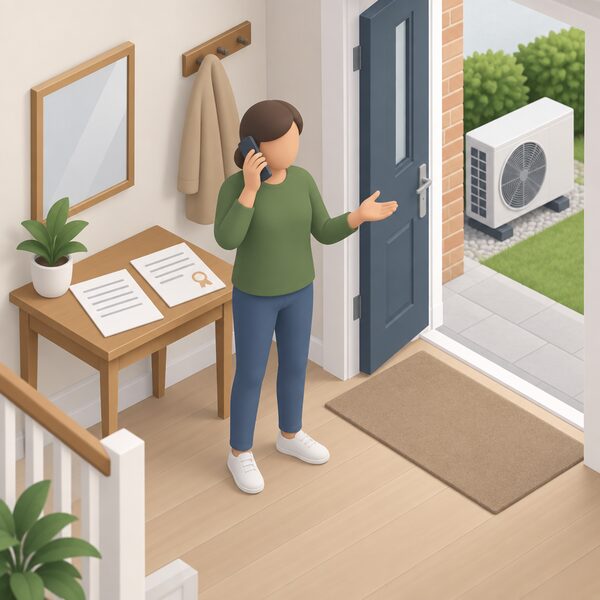
The complaint routes are tiered, and the deadlines are the part householders miss. For MCS certified installations, a complaint must be made "no more than two years after the date that the system was commissioned"3. Contact MCS if you have issues with the installation process, the installer, or the MCS certificate or product3. MCS can be reached at mcscertified.com or on 0333 103 81306.
TrustMark operates a three stage complaints process, with guidance updated on 7 April 2026 covering dispute resolution eligibility criteria and time limits23. Where a scheme requires the installer to remain registered until the work is complete, a lapse during the project is a breach of that condition27.
There is also a statutory route on the electrical side. Under Article 27, any dispute between the distributor and the consumer, another distributor or the owner of a street electrical fixture may be referred by any party to the Department20. Following the determination by the person appointed by the Department, the distributor shall maintain, connect, restore or may disconnect the supply as appropriate, subject to conditions stipulated in the determination20. Where a distributor disconnects, it must serve notice "as soon as reasonably practicable, after the disconnection, give the reasons for such disconnection and if appli"cable details of required remedial measures20. If no remedial measures are required, the distributor must connect or restore the supply as soon as reasonably practicable after the grounds for disconnection have ceased to apply20.
For a household, the independence question here is who holds the risk after the installer leaves. The certification body holds part of it, the scheme operator holds part of it, and the council holds the enforcement route. None of them replaces a written contract, a certificate trail and a record of the commissioning date.
Getting quotes and what to confirm before you sign
Official guidance on heat pumps is direct: "We'd recommend getting at least 3 installers to quote, so that you can compare costs and design"4. Independent guidance on renewable installations gives the same number, advising at least three quotes so that you can be more confident in the cost and design1. Three is a floor for comparison, and the design assumptions behind each quote carry more weight than the headline total.
On funded work, the conditions are set out in advance and are worth reading before signing. One published scheme requires that you "must instruct the Retrofit Coordinator named in your IG Letter, who will provide end-to-end support throughout the S"cheme, that the borrower owns and occupies the property at the time the grant offer letter is issued, that a project information form aligned with the recommendations reports is provided, that an unsecured fixed sum loan from the scheme has been obtained, that Annex C requirements are met, that installers are registered, that work must not start before the grant offer letter is issued, that the measure must be completely new, and that no other public financial support may be received27. Those conditions are drawn from a Welsh scheme, so a Northern Ireland householder should treat them as an illustration of how funded work is conditioned rather than as local rules.
Two further points belong in the pre-signature checklist. First, the installer is responsible for ensuring that an installation meets permitted development noise standards at the time of installation28. Second, where construction or building work is being carried out, you may need to notify the Health and Safety Executive and may have other duties as well12.
Sources29 cited
- Renewable energy solution, MCS, 2026-08-03
- Building work: competent person schemes, Welsh Government, 2026
- Who to contact, Ofgem, 2026-09-17
- Heat pumps explained: experts answer your questions, GOV.UK, 2024-03-28
- Barcud Solar Panel Installation Scheme Specification, Sell2Wales, 2026-06-15
- Boiler Upgrade Scheme guidance for installers, Ofgem, 2026-03-25
- Boiler Upgrade Scheme guidance for property owners, Ofgem, 2026-03-25
- Building regulations: electrics, Welsh Government, 2026-09-17
- Plug-in solar consultation document, GOV.UK, 2026-06-16
- Plug-in solar interim product specification, GOV.UK, 2026-07
- Warm Home Discount (England and Wales) Regulations 2026, legislation.gov.uk, 2026-03-27
- When you need approval, Planning Portal, 2026
- The Building Regulations (Northern Ireland) 2012, legislation.gov.uk, 2012-05-15
- Building Regulations (NI) 2012, Part L stove guidance for householders, Building Control NI, 2012-05-15
- Building regulations: boilers and heating, Planning Portal, 2026
- Building regulations: boilers and heating, Welsh Government, 2026-09-17
- Stove guidance for householders, Building Control NI, 2015-11
- ECO4 delivery guidance version 4.0, Ofgem, 2026-03-26
- Register energy devices in homes or small businesses, GOV.UK, 2021-03-31
- Electricity Safety, Quality and Continuity Regulations (Northern Ireland) 2012, Article 27, legislation.gov.uk, 2026-09-17
- Solar panels, London Borough of Hammersmith and Fulham, 2026-09-17
- Carbon footprint report: heat pump transition, GOV.UK, 2026-05
- Energy Company Obligation (ECO) scheme, Leeds City Council, 2026-09-20
- ECO4 Flex open, South Cambridgeshire District Council, 2026-09-17
- Green Homes Grant installer requirements, Bristol City Council, 2022-06-21
- Do I need building regulations approval for alterations to or installation of electrics?, Planning Portal, 2026
- Green Homes Wales loan standard terms and conditions, Development Bank of Wales, 2026-09-17
- The Microgeneration Certification Scheme, Planning Portal, 2026
- Planning permission: wind turbines, Welsh Government, 2026-09-17
 Using an Installer in EnglandHow do you check an installer is registered to sign off their own work, and what happens if they are not?
 Utility Regulator NIWho sets your energy prices in Northern Ireland and who can you complain to?
 The Full Installers GuideHow do you find an installer you can trust, and what should you check before signing anything?
 Finding an Insulation InstallerHow to find, verify and check an insulation, glazing or ventilation installer in the UK: the registration schemes, trade bodies and guarantee arrangements that cover the work, how to compare quotes, what a written specification should state, and how complaints and disputes are handled.
 Building Rules Northern IrelandDoing building work in Northern Ireland?
 Home Energy Planning Rules in NIDo you need planning permission for solar panels or a heat pump in Northern Ireland?