
In this guide
Buying solar panels, inverters, batteries or a heat pump online changes who is responsible for what. The equipment arrives, but the survey, the sizing, the electrical work, the network notification and the paperwork stay with the household unless a certified installer is engaged separately. The Consumer Rights Act 2015 establishes rights when entering a contract with a trader for the supply of goods, services and digital content, and the law protects consumer rights whether goods are bought remotely or in person1. What differs online is the cancellation window, the return logistics and the split between a manufacturer's warranty and a retailer's obligations.
The headline figures are consistent across official and independent guidance. A typical domestic solar panel system is around 3.5 kWp and costs around £6,100 to install, and a typical solar panel installation costs around £6,1003. That system saves between £530 and £650 a year on electricity bills for a typical home without electrical heating or an electric vehicle, and usually pays for itself in 10 to 12 years4. Plug-in solar panels are a separate, cheaper category: typical system cost is estimated at £400 to £500, with a typical warranty of 10 years5.
The trade-off is straightforward. Buying the kit yourself can reduce the headline price and gives control over specification, but it moves the risk of sizing errors, incompatible components, missing certification and unregistered equipment onto the buyer. Grant-funded schemes and government-backed work generally require TrustMark registered and/or MCS certified installers, so a supply-only purchase can remove access to those routes entirely6.
What buying solar equipment online means for householders
Supply-only purchasing splits a single job into several contracts. The retailer sells goods; the manufacturer warrants the product; an electrician or certified installer carries out the work and, where required, notifies the network operator and the building control body. Each contract carries its own remedies, and a fault in one does not automatically give a claim against another.
The consumer guide on buying green heating and insulation products covers solar panels, heat pumps and biomass boilers, and insulation, and notes that buying these products for a home can be complex1. That complexity is the reason the guidance exists: the products interact with the building, the electrical installation and, in grant-funded work, with scheme rules.
Group buying is one route that keeps certification intact while buying at scale. Solar Together is a group-buying scheme for solar panels and battery storage9. Because such schemes typically appoint certified installers, they sit between a pure supply-only purchase and a conventional single-installer contract.
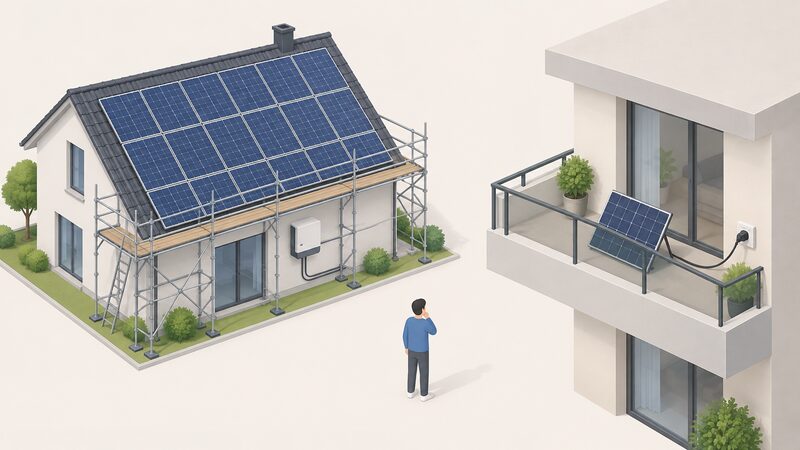
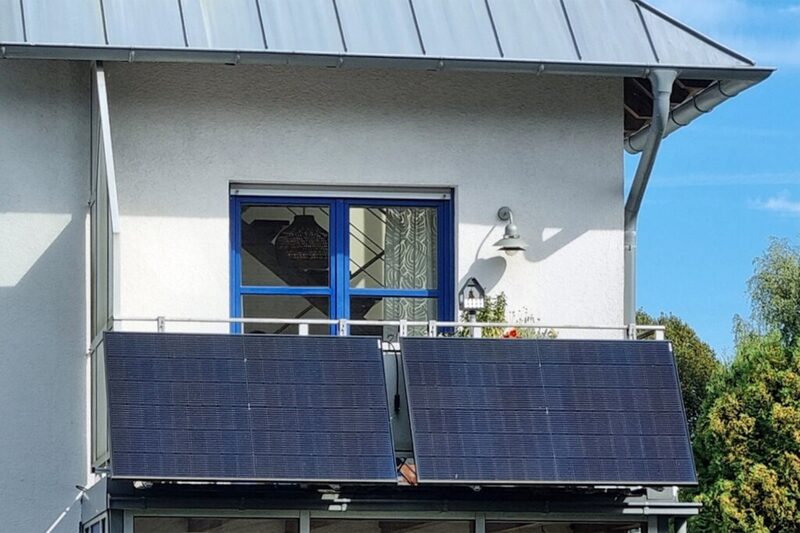
Plug-in solar has changed the entry point. The government stated it would make plug-in solar available for the first time in Britain so that families can buy a low-cost panel straight from a supermarket and set it up on a balcony or in a garden10. That is a genuinely direct-to-consumer purchase, with no installer in the chain at all, and it carries the corresponding absence of survey, sizing and notification support.
For a household's energy independence, the equipment itself is the gain: solar photovoltaic panels capture energy from the sun and turn it into electricity for the home to use, and could power a home, reduce bills and may earn money11. The dependence that remains is on the grid for import and export, on a supplier for billing and export payments, and on the manufacturer for warranty service. Buying online does not change any of those relationships; it only changes who the household deals with when something fails.
Is your home suitable for solar panels?

The good news, as the Energy Saving Trust puts it, is that solar panels are suitable across the UK3. Output varies with location, orientation and shading, but the technology is not restricted to the south or to particular building types.
Panels work during daylight, even when it is cloudy or overcast, because they use light rather than heat to generate energy4. The Energy Saving Trust confirms they even work on cloudy days, and Welsh Government guidance states that power can be generated even on a cloudy day3. A cloudy day reduces output rather than stopping it, which matters when comparing a performance estimate against a household's actual consumption pattern.
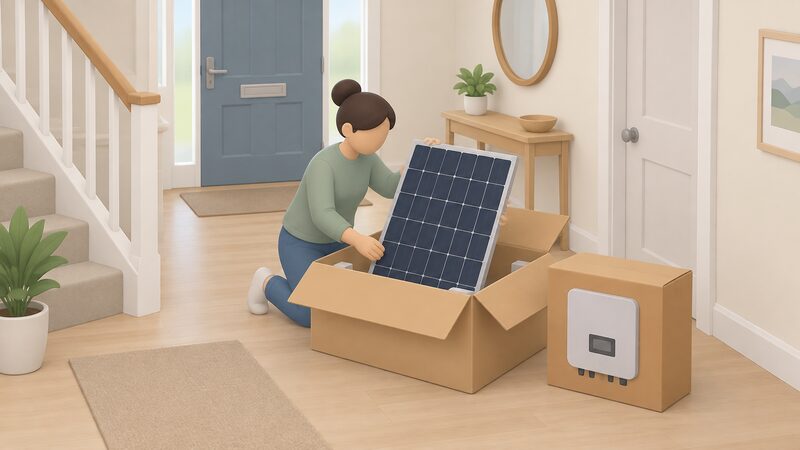
The practical suitability questions are roof condition, roof area, pitch, orientation, shading and the electrical supply. A direct current is produced, which needs to pass through a solar inverter to turn it into alternating current for the home11. Installing solar panels may also require approval under the Building Regulations, which is a separate consent from planning permission12.
For a supply-only buyer, suitability assessment is the first thing lost. A retailer selling a panel or a kit cannot see the roof, cannot measure the incoming supply and cannot confirm whether the consumer unit has capacity. Those checks fall to the household or to an electrician engaged before the order is placed.
Panel types and technology: what the listings actually offer
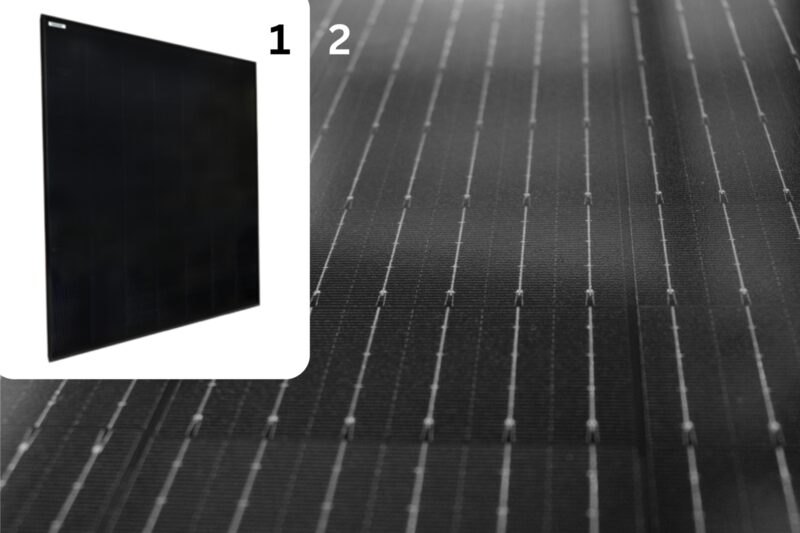
Listings generally describe the cell technology, the module efficiency and the physical dimensions. Welsh Government guidance groups solar photovoltaic technology into crystalline cells, thin-film and hybrid types13. Most domestic listings fall into the crystalline group.
Monocrystalline panels reach module efficiencies of up to 25%, and are described as very pricey8. Polycrystalline panels are being phased out in the UK, and few installers still offer them8. That shift matters for anyone comparing an older listing against a current one: a polycrystalline module may be cheaper per unit but is a technology the market is leaving.
Solar thermal is a different product entirely and should not be confused with solar PV in a listing. Solar thermal panels are the most popular form of solar energy used in the UK, according to Northern Ireland guidance14. Solar thermal heats water rather than generating electricity, and the two technologies are not interchangeable.
| Technology | What it does | Market position |
|---|---|---|
| Monocrystalline PV | Generates electricity; module efficiency up to 25% | Current mainstream; described as very pricey8 |
| Polycrystalline PV | Generates electricity | Being phased out in the UK; few installers still offer them8 |
| Thin-film and hybrid PV | Generates electricity | Listed among PV technology types13 |
| Solar thermal | Heats water | Most popular form of solar energy used in the UK14 |
The specification a buyer should read first is not the cell type but the inverter compatibility and the warranty terms attached to each component. A panel with a long product warranty paired with an inverter whose guarantee depends on registration within a set window is a different proposition from one sold as a matched kit.
Cost: what a typical system and individual panels sell for
The most quoted figure for a full installation is around £6,100. The Energy Saving Trust gives a typical domestic solar panel system as around 3.5 kWp costing around £6,100 to install, and a council guidance page gives a typical solar panel installation cost of around £6,1003. Both figures describe an installed system, not a supply-only kit, so they are a benchmark rather than a price list for online goods.
Plug-in solar sits at a different scale. Typical system cost is estimated at £400 to £5005. That is the estimated cost of a plug-in system, and it reflects a much smaller generating capacity than a rooftop array.
| Purchase route | Typical cost | What it covers |
|---|---|---|
| Rooftop system, installed | Around £6,100 for around 3.5 kWp3 | Panels, inverter, installation |
| Plug-in solar | £400 to £500 estimated5 | Panel and plug-in connection kit |
Prices for individual panels, inverters and batteries bought on their own are installer-quoted or retailer-quoted, and no published range applies across the market. A household comparing a supply-only kit against an installed system is comparing two different products: one is goods, the other is goods plus labour, certification, notification and warranty cover on the work.
The cost comparison also has to account for what is not included. A supply-only purchase typically excludes scaffolding, roof work, electrical installation, the inverter registration that activates guarantees, and the network notification. Each of those is a separate cost and a separate contract.
Savings, payback and what the equipment earns you
A typical solar panel installation saves between £530 and £650 a year on electricity bills for a typical home without electrical heating or an electric vehicle, and usually pays for itself in 10 to 12 years4. Those two figures are the core of any payback calculation, and both assume the system is installed, commissioned and registered correctly.
The saving depends on self-consumption: electricity used in the home rather than exported. A household with an electric vehicle or electrical heating has a different consumption profile and a different saving, which is why the published figure is qualified to homes without them4.
Solar thermal has its own record. Under the domestic renewable heat scheme, solar thermal generated 98.3 GWh of heat since the start of the scheme, with £19,156,389 paid15. That is a scheme total rather than a household figure, but it shows the scale at which solar thermal has been supported.
For energy independence, the saving is real but partial. The household still imports from the grid at night and in winter, still depends on a supplier for billing, and still depends on the manufacturer for warranty service on the equipment. What changes is the proportion of electricity generated on site rather than bought.
Returns and cancellation: your rights under the Consumer Contracts Regulations

Distance selling gives a cancellation right that in-person purchases do not. The Consumer Contracts (Information, Cancellation and Additional Charges) Regulations 2013 contain the relevant provisions: Regulation 28 is headed Right to cancel, and Regulation 34 provides that where those provisions apply to cancellation of a contract, the contract is to be treated as including those provisions as terms16.
The law protects consumer rights when goods, services or digital content are bought remotely or in person2. The Consumer Rights Act 2015 establishes rights when entering a contract with a trader for the supply of goods, services and digital content, and the Energy Ombudsman summarises the protection as covering faulty goods, poor service and problems with contracts2.
Where a supplier misled a consumer or used an aggressive commercial practice, the Consumer Protection from Unfair Trading Regulations 2008 give the right to unwind the contract, the right to a discount and the right to damages19. That is a stronger remedy than a straightforward cancellation and applies to the conduct of the sale, not just the goods.
Evidence matters. Trading Standards guidance in Wales sets out how to get evidence to prove a claim, which is the practical step that supports a cancellation dispute or a refund request20. For goods bought online, that means keeping the order confirmation, the listing description, the delivery note and any correspondence about the condition of the goods on arrival.
Warranty and registration: what to check before you buy
Warranty cover on energy equipment is layered, and the layers are activated in different ways. On a scheme installation, inverter product registrations to activate guarantees and warranties are to be completed within 48 hours of commissioning9. That is a tight window, and it is the installer's responsibility on a contracted job. On a supply-only purchase, the buyer has to establish who registers the product and by when.
Handover documentation is the other half of the picture. A scheme specification requires record drawings, test and completion certificates, maintenance instructions, manufacturers' directory and colour product literature, a full description of works and commissioning certificates to be handed over at practical completion9. A household buying goods online receives none of that unless it is arranged separately.
Registration of the device itself is a distinct step. Official guidance covers how device owners and installers register energy devices, including heat pumps and electric vehicle chargepoints21. That guidance is addressed to both audiences, which reflects the fact that the responsibility can sit with either depending on how the purchase was structured.
For plug-in solar, the warranty picture is simpler and shorter: a typical warranty of 10 years5. For rooftop systems, product, performance and workmanship warranties are separate, and the inverter registration deadline is the term most likely to be missed.
Choosing an installer: MCS and TrustMark certification

Certification is the dividing line between a supply-only purchase and a grant-eligible installation. Installers under UK Government schemes must be TrustMark registered and/or Microgeneration Certification Scheme certified6. A Welsh scheme specification states that the company providing the installation must carry a valid TrustMark and be MCS certified9.
Green Homes Wales sets the requirement in more detail: installers must either be registered with TrustMark as an approved PAS 2030 installer, or registered with TrustMark and certified with the Microgeneration Certification Scheme where the installation involves a low carbon technology such as a heat pump or solar panels23. The TrustMark Quality Assurance Framework adds that measures should be installed by or under the responsibility of a TrustMark registered installer and have a relevant certificate of lodgement for measures covered by PAS, including MCS24.
The practical consequence is that a household buying equipment online and then engaging an installer has to check the installer's registration separately, and the registration has to cover the specific technology. A TrustMark registration alone does not cover a low carbon technology installation; the MCS certification is the part that does23.
For a household's independence, certification is what makes the installation legible to the network operator, the grant body and any future buyer of the property. It is also what makes the warranty on the work enforceable through a code. Buying the kit directly does not remove the need for it; it only removes the installer from the purchase contract.
Links worth reading alongside this section: MCS certified installers, TrustMark registered businesses, and installer requirements for grants.
Plug-in solar panels and the new rules
Plug-in solar became legal to buy and use across Great Britain from 27 August 202625. The government press release states that from that date the easy-to-install panels can be plugged into homes across the country, and a second release confirms plug-in solar panels became legal across Great Britain25.
Availability followed the legal change. A government release stated the panels were to be available in shops within months and to save people money on their bills5. The same release described a parallel policy of ensuring solar panels are fitted on new homes in England as standard5.
The parliamentary record shows the political framing: plug-in solar would be made available for the first time in Britain so that families can buy a low-cost panel straight from a supermarket and set it up on a balcony or in a garden10. That is a direct-to-consumer purchase with no installer involved, and it is the clearest example of what buying home energy equipment online now means.
The limits are equally clear. A plug-in panel is not a substitute for a rooftop array in capacity, and it does not come with a survey, a performance estimate or a network notification carried out on the household's behalf. Typical system cost is estimated at £400 to £500, with a typical warranty of 10 years5.
Planning permission and building regulations
In England, the permitted development rights relating to solar panels are contained within Part 14 (Renewable Energy) of The Town and Country Planning (General Permitted Development) (England) Order 201527. The installation of solar panels and equipment on residential buildings may be permitted development with no need to apply to the local planning authority12.
That is not universal. In many cases, even in conservation areas, homes can have solar panels without requiring planning permission from the council under permitted development27. But if a property is a listed building, a conservation area or a World Heritage Site, or another designated area, planning permission may be needed4.
For listed buildings the position is firm. Solar panels on listed buildings need planning permission and listed building consent, and one council states that a listed property always needs both28. Listed Building Consent is always needed for solar panels on listed properties29.
Wales has its own guidance: details of the current planning regulations for the installation of solar PV equipment are set out in Leaflet 3, Generating Your Own Energy, which accompanies the Welsh Government pack13. Northern Ireland guidance covers solar thermal panels separately14. Wiltshire Council publishes common queries about planning permission for households checking their position29.
| Nation | Position on solar PV planning |
|---|---|
| England | Permitted development under Part 14 of the 2015 Order in many cases; listed buildings need planning permission and listed building consent27 |
| Wales | Regulations set out in Leaflet 3, Generating Your Own Energy13 |
| Northern Ireland | Separate guidance covering solar thermal panels14 |
| Scotland | Not covered by the sources cited here |
Building Regulations approval is a separate matter from planning. Installing solar panels may require approval under the Building Regulations, and permitted development status on planning does not remove that requirement12.
Sources29 cited
- Buying green heating and insulation products: consumer guide, GOV.UK, 2023-05-31
- Consumer protection rights, GOV.UK, 2026-09-17
- Solar panel myths: five common concerns debunked, Which?, 2026-06-09
- Solar panels, London Borough of Hammersmith and Fulham, 2025-10
- Households can save as plug-in solar panels come to market, GOV.UK, 2026-08-27
- ECO4 delivery guidance version 4.0, Ofgem, 2026-03-26
- Plug-in solar panels vs rooftop systems, Which?, 2026-04-27
- How long do solar panels last?, Uswitch, 2026-07-13
- Barcud Solar Panel Installation Scheme Specification, Sell2Wales, 2026-06-15
- Solar panels and permitted development, London Borough of Richmond upon Thames, 2026-07-06
- Solar photovoltaic (PV) panels, London Borough of Bromley, 2026-09-17
- Generating your own energy: solar electricity, Welsh Government, 2026-09-17
- Solar thermal panels, nidirect, 2024-10-22
- Are solar panels worth it?, Which?, 2026-05-15
- Guidance on scam emails claiming to be from Energy Ombudsman, Energy Ombudsman, 2026-02-09
- The Consumer Contracts (Information, Cancellation and Additional Charges) Regulations 2013, Regulation 28, legislation.gov.uk, 2026-09-17
- The Consumer Contracts (Information, Cancellation and Additional Charges) Regulations 2013, Regulation 34, legislation.gov.uk, 2026-09-17
- Understanding your rights, Energy Ombudsman, 2026-09-20
- Problems with services, Isle of Anglesey County Council, 2025-10
- Getting evidence to prove your claim, Trading Standards Wales
- Register energy devices in homes or small businesses, GOV.UK, 2021-03-31
- Valiant radiator fan product recall, Electrical Safety First, 2025-11-07
- Green Homes Wales, Development Bank of Wales, 2026-09-17
- Consumer protection system, House of Commons Library, 2026-05-13
- First regional solar breakdown as installations hit record highs, GOV.UK, 2026-08-27
- Britain continues to break clean power records, GOV.UK, 2026-05-28
- Solar panels and planning permission, Cornwall Council, 2026-09-17
- Planning and solar, Frome Town Council, 2025-09-02
- Common queries about planning permission, Wiltshire Council
 The Full Brands GuideWhich boiler, heat pump or solar brand can you trust, and who actually owns it?
 Manufacturer WarrantiesHow long does a boiler, heat pump or solar panel warranty actually last, and what do you have to do to keep it valid?
 Workmanship WarrantiesIf something goes wrong with your solar panels, who actually fixes it and who pays?
 Buying Direct or Via InstallerCan you buy a heat pump yourself and still get the grant, or does it have to go through an installer?
 Financing an InstallationPaying monthly for a boiler, solar panels, battery or heat pump sounds simple, but who actually lends you the money and what happens if the work goes wrong?
 Support and Spare PartsYour solar inverter or heat pump has broken down.