

In this answer
Short answer
PAS 2035 is the overarching UK retrofit standards framework, and it is the document that decides how a grant-funded home energy upgrade is planned, designed, delivered and checked. It is used in conjunction with PAS 2030, which sets out the standards required for installing energy efficient measures1. PAS 2035 was introduced in 2019 as a clear framework for best practice in the energy retrofit of domestic properties, and it has to be managed by a qualified Retrofit Coordinator2.
The current editions are PAS 2035:2023 and PAS 2030:2023. The 2019 versions were withdrawn on 30 March 2025, and after that withdrawal only the 2023 standards are valid3. The transition period between the two editions ended on 30 March 20254.
For a household, the practical effect is that retrofit work funded through government schemes is not simply a matter of buying a measure and having it fitted. The standard requires an assessment of the property, a design stage, a named coordinator and a route to redress. It is also the reason a householder may be told that a particular measure is unsuitable for their home even when a grant would cover it.
What PAS 2035 and PAS 2030 actually cover
The two standards divide the work. PAS 2035 is a specification for the energy retrofit of domestic buildings, used in conjunction with PAS 2030:2019, which sets out the standards required for installing energy efficient measures1. In the 2023 editions the split is the same: PAS 2035 provides guidance on planning and managing projects, addressing design, risk and evaluation, while PAS 2030 focuses on the delivery phase of retrofits8.
PAS 2035 is described by the Welsh Government as the overarching UK retrofit standards framework, and it provides a specification that any publicly funded retrofit should comply with5. The standard is a national standard for carrying out retrofit projects to ensure that the right work is done using the appropriate logic and adequate consultation9. Its stated purpose is to provide a robust framework for managing risk, balancing competing priorities and delivering better retrofit outcomes10.
PAS 2035 is developed by the British Standards Institute to ensure that domestic retrofit work meets a consistent specification11. It is not confined to grant schemes in its drafting: PAS 2035 is already referenced in the current version of Approved Document as a means to assess background ventilation in an existing dwelling, and that note will be retained in the 2026 edition12.
The distinction matters for a household because the two documents answer different questions. PAS 2035 asks whether the right measure has been chosen for this building, in this condition, with these occupants. PAS 2030 asks whether the person fitting it is competent to do so to a defined standard. A project can fail on either count.

Who the standards apply to

PAS 2035 applies to domestic retrofit projects, and PAS 2038 covers non-domestic property types like offices, hospitals and multi-residential buildings8. Within the domestic field, the standard requires a retrofit coordinator role, and a qualified Retrofit Coordinator is required for all domestic retrofit projects in order to comply with PAS 203513. The role is central to the standard, managing projects in compliance with it and protecting homeowners and clients14.
On the installer side, installers must be certified to PAS 2030 for energy efficiency measures under relevant DESNZ schemes, and installations must comply with PAS 2035 with installers TrustMark registered or meeting equivalent requirements6. TrustMark registration is a prerequisite of all government-funded schemes and offers vetting of technical competence and customer service8.
The reach of the standard is narrower than its profile suggests. In 2020, CIBSE noted that PAS 2035 would not only be required for a small number of cases, such as high-rise buildings and buildings that are both protected and traditionally constructed15. The Scottish Government has since described PAS 2035 and PAS 2038 as voluntary and frequently revised, which it says prevents the industry from fully adopting them16. The binding force for most households therefore comes through funding conditions rather than through a statutory duty.
| Role or body | Function under the standards |
|---|---|
| Retrofit Coordinator | Manages the project in compliance with PAS 203514 |
| Retrofit Assessor | Holds a Level 3 qualification in Retrofit Assessment under the standard11 |
| PAS 2030 certified installer | Installs measures to the delivery-phase standard6 |
| TrustMark | Government endorsed quality scheme, prerequisite of funded schemes8 |
| BSI | Develops PAS 203511 |
Conditions, exceptions and the 2023 transition
The most important condition is version control. After the withdrawal of PAS 2035/2030:2019, only PAS 2035/2030:2023 is valid3, and only the new standards can be used for ECO4 and GBIS4. ECO4 delivery guidance was updated throughout to reference PAS 2035:2023 in place of the 2019 edition17. All scheme measures are required to be installed in accordance with PAS 20354.
The qualification criteria attached to the standards have also changed: they have been updated and are measure specific18. That means the competence required depends on what is being installed, rather than being a single blanket ticket.
Changes to the standard itself are tightly controlled. The only authorised bodies who can make changes to the normative requirements under PAS 2035 is BEIS, and changes go through a formal process of review by a Steering Group and are not introduced ad hoc without formal consultation19. A review of PAS 2035 was set to take place at the end of the 19-month transition period, with the BSI Retrofit Standards Group involved20. The original transition period was intended to give the UK Accreditation Service time to accredit certification bodies and for those bodies to certify registered businesses as fit to perform retrofitting20.
Cost is a recognised friction point. The Welsh Government has said it recognises that PAS compliance can be costly, especially for small businesses21. For a household, that cost sits inside the installer's price rather than appearing as a separate line.
Where the standard is weakest

Two criticisms of the framework are on the record, and both bear on what a household can expect.
The first is independence. Retrofit assessors and retrofit coordinators can be appointed and contracted by the installer they are assessing, and the Department agreed there is not enough independence between these roles under the standard22. In other words, the person checking whether a measure suits the property may be engaged by the business that stands to install it. That is a structural feature of the standard as written, not a failure of any individual project.
The second is pace and complexity. In 2022, CREDS described PAS 2035 as only just beginning to take off, and as very complex to navigate for both householder and installer23. The standards were at pilot stage in 202024, and the transition to the 2023 editions has since completed.
There is also a delivery record to weigh. TrustMark is the government endorsed quality scheme that underpins funded work25, and it was nominated by the Department for Energy Security and Net Zero to directly support customers of the closed Energy Company Obligation scheme26. A parliamentary committee found that neither TrustMark nor DESNZ have been able to provide minutes of meetings which took place between 2022 and 202422. As of November 2025, 22 installers had been fully reinstated after meeting requirements on TrustMark's robust six-point plan, including full remediation of the problems identified22.
"Neither TrustMark nor DESNZ have been able to provide minutes of meetings which took place between 2022 and 2024"
For households, the protection that survives all of this is the warranty position: TrustMark registration brings a minimum two-year warranty for work, and a minimum 25-year guarantee for certain measures installed under the ECO7. TrustMark can be contacted on 0333 555 1234, by email at disputes@trustmark.org.uk, or through its online support form26. More on how these schemes compare is set out in installer schemes and consumer codes and on the TrustMark page.
How a PAS 2035 project is carried out
The standard imposes an order of work. Following the procedures given in PAS 2030/2035:2019 is one way of demonstrating that suitability has been adequately considered by a Building Control Body27. The retrofit designer is responsible for ensuring that selected products are appropriate and comply with Building Regulations6.
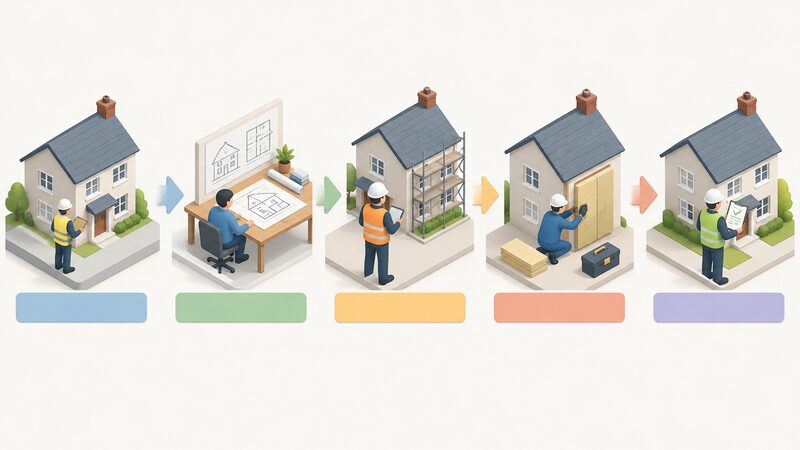
In sequence, a domestic project under the standard runs through assessment, design, installation and evaluation, with the coordinator managing the project throughout14. The assessor role carries a Level 3 qualification in Retrofit Assessment under the standard11. The design stage is where heritage and traditional construction need particular attention, because the framework exists to balance competing priorities rather than to apply a single measure everywhere10.
- Assessment of the property and its circumstances.
- Design of the measure package, with products checked against Building Regulations6.
- Coordination of the project by a qualified Retrofit Coordinator13.
- Installation by a PAS 2030 certified installer6.
- Evaluation and lodgement of the measure, with TrustMark warranty cover7.
What it means for a household's energy independence
PAS 2035 does not generate energy and does not reduce a household's reliance on a supplier. What it does is govern the quality of the physical work that reduces demand: insulation, ventilation, heating and controls. A retrofit delivered to the standard is intended to perform as designed, which is the precondition for any reduction in bills or in the amount of energy a home needs to buy in.
The dependence that remains is layered. The household still depends on the grid or on a fuel supplier for whatever energy the home continues to use. It depends on a certified installer and a coordinator to deliver the work, and on a certification body to keep that installer honest. It depends on TrustMark for warranty and dispute routes, and on the Department and BSI for the standard itself. Where a scheme has closed, as the Energy Company Obligation has, the support route changes even though the standard does not26.
The independence the standard offers is therefore procedural rather than energetic: a documented assessment, a design that considers the whole building, a named coordinator and a warranty. For the wider regulatory picture, see UK home energy regulation and policy and regulation and energy independence.
Sources27 cited
- Glasgow City Council committee report, Glasgow City Council, 2026
- Home energy efficiency key terms explained, Development Bank of Wales, 2024
- ECO4 delivery guidance v3.2, Ofgem, 2025
- Consultation on mid-scheme changes to ECO4 and GBIS, Ofgem, 2025
- Homes of today for tomorrow, Welsh Government, 2024
- The Warm Homes Plan, Elmhurst Energy, 2026
- Energy Company Obligation schemes, House of Commons Library, 2026
- PAS 2030 guide, The Retrofit Academy, 2026
- Retrofit, Act on Energy, 2026
- Why heritage retrofit design is essential, The Retrofit Academy, 2026
- What is a PAS 2035 retrofit assessor?, The Retrofit Academy, 2025
- Future Homes and Buildings Standards consultation response, MHCLG, 2026
- Energy Company Obligation schemes for homeowners, Elmhurst Energy, 2026
- Case study: Martin, The Retrofit Academy, 2022
- CIBSE response to the 10 point plan, CIBSE, 2020
- Review of retrofit assessment in Scotland, Scottish Government, 2025
- ECO4 delivery guidance v3.2 and measures table summary of updates, Ofgem, 2025
- A guide to PAS 2035/2030:2023 standards, Insulation Assurance Authority, 2025
- FAQ and myth buster, Insulation Assurance Authority, 2026
- PAS 2035 and the Each Home Counts review, The Retrofit Academy, 2019
- Heat strategy for Wales, National Insulation Association, 2023
- Public Accounts Committee report, House of Commons Public Accounts Committee, 2026
- Options for accelerating retrofit rates, CREDS, 2022
- New retrofit standards, new roles, CREDS, 2020
- Get a grant or loan to improve your home energy efficiency, Bristol City Council, 2026
- Written statement on support for householders impacted by the closure of the Energy Company Obligation scheme, Welsh Government, 2026
- Approved Document L Volume 1 consultation version, Welsh Government, 2025
 Building Regulations EnglandAdding a heat pump, solar panels or an extension usually needs building regulations approval, and it is separate from planning permission.
 Insulation StandardsHow do you know your insulation was fitted to a proper standard, and who backs the guarantee if the installer disappears?
 Installation StandardsWhich rules must an installer follow when fitting a home battery?
 Insulation a Heat Pump NeedsWill a heat pump still work if your home is not well insulated, and would you need to add loft, wall or floor insulation first?
 Building Regs Part L InsulationAdding insulation or replacing windows?
 High-Rise Flats and SafetyWho signs off new insulation, cladding or heating in a high-rise flat?